Presidio News
Commerce Insights
Presidio

Migrating to Shopify in 2026 is no longer just a technical project. For many brands, it’s a strategic move to simplify operations, improve site performance, and build a more scalable ecommerce foundation.
At Presidio, we help fast-growing and enterprise brands move off legacy or over-engineered platforms and onto Shopify with confidence. Our team has led hundreds of complex ecommerce migrations from platforms including Salesforce Commerce Cloud, Adobe Commerce (Magento), BigCommerce, commercetools, and custom headless stacks.
This guide outlines Presidio’s Shopify migration framework, designed to reduce risk, protect data integrity, and support long-term growth.
Why Shopify Migrations Fail and How Presidio Reduces Risk
Most ecommerce migrations run into problems for the same reasons: poor data hygiene before migration, incomplete mapping between platforms, limited testing before launch, high-risk cutovers without rollback planning, and weak post-launch validation.
Presidio’s migration framework is designed to reduce those risks through a phased, validated approach built around Shopify’s data model, APIs, and real-world operational requirements.
Stage 1: Audit and Clean Ecommerce Data
Every successful Shopify migration starts with a comprehensive data audit.
Before any data is moved, Presidio works with ecommerce, operations, and data teams to understand what data exists, how it is structured, and what should be migrated versus retired.
Legacy platforms often contain duplicate customer records, inactive or deprecated SKUs, corrupted order history, orphaned files, and inconsistent product or variant IDs. Cleaning that data at the source reduces migration complexity, shortens QA cycles, and helps prevent post-launch issues that affect reporting, operations, and customer experience.
Presidio also reviews data relationships, not just individual records, to make sure products, variants, images, inventory, subscriptions, and integrations remain intact once the business moves to Shopify.
Stage 2: Map Legacy Data to Shopify’s Schema
No two ecommerce platforms structure data in exactly the same way. Because Shopify’s schema differs from many enterprise and headless systems, data mapping is one of the most important stages in any migration to Shopify.
Presidio creates detailed mapping documentation that defines how each data object should be transformed inside Shopify, from product structures and customer records to order history and custom fields.
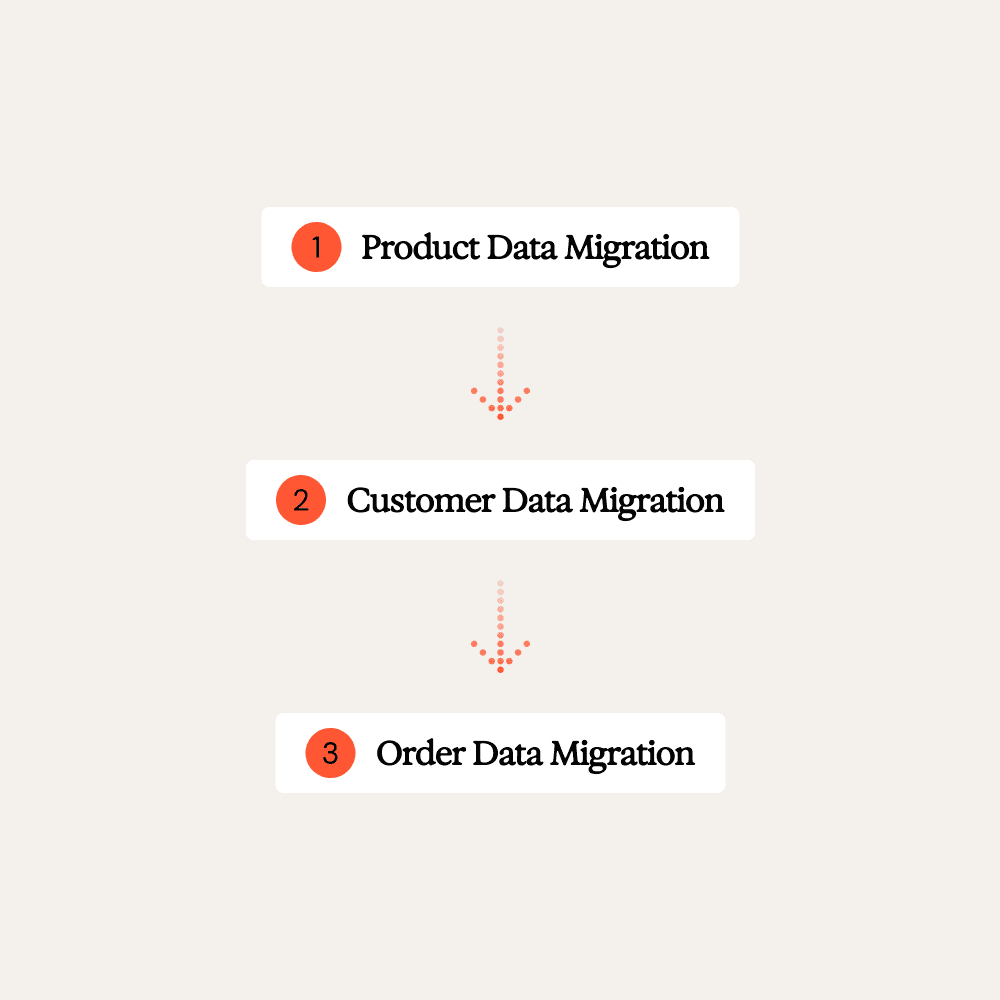
Product Data Migration
This includes restructuring product hierarchies into Shopify’s product and variant model, converting attributes into options and metafields, and preserving media, tags, and collections.
Customer Data Migration
It also includes migrating customer accounts, addresses, and order history, mapping custom fields into Shopify metafields, and maintaining compatibility with loyalty platforms, subscription tools, and CRM systems.
Order Data Migration
For orders, Presidio aligns statuses, payments, and fulfilment data while preserving timestamps, financial accuracy, and the historical detail needed for reporting and customer service.
This level of precision helps prevent the downstream issues that often appear weeks or months after launch.
Stage 3: Validate and Test in a Shopify Staging Environment
Presidio never migrates all data at once.
Instead, we begin with controlled test migrations, usually covering 1 to 5% of total data, inside a Shopify staging environment. This gives teams the chance to validate accuracy before the full migration is scaled.
Testing focuses on product, variant, and image relationships, customer order history, data truncation or type mismatches, and how the data performs across both the Shopify admin and the storefront experience.
Automated QA helps surface technical issues early, but manual validation by merchandisers and operators is just as important. It ensures the migrated data works properly in real-world workflows, not just in a test script.
Stage 4: Execute a Phased Shopify Migration
In 2026, the safest ecommerce migrations are phased rather than rushed through a single cutover.
Presidio executes Shopify migrations in structured stages, beginning with static data such as products, collections, pages, and content, followed by transactional data like customers and historical orders, and finally delta syncs that capture changes made between export and go-live.
This phased approach helps prevent data loss during cutover and gives teams more confidence in Shopify as the new system of record. Where needed, API-based syncs or middleware keep platforms aligned until the migration is fully complete.
Running parallel systems for a short period also reduces operational risk and gives teams time to validate Shopify under live conditions before fully switching over.
Stage 5: Reconcile, QA, and Stabilize After Launch
Launch is not the end of the migration process.
After go-live, Presidio carries out post-migration QA and reconciliation to confirm that Shopify matches the source system across core data and operational logic. That includes product, customer, and order counts, as well as inventory, pricing, tax, discount rules, analytics outputs, and integration behavior across systems such as ERPs, CRMs, 3PLs, and subscription platforms.
We also validate day-to-day workflows such as fulfilment, refunds, and inventory updates to make sure teams can operate normally from day one.
Only once data accuracy and operational stability are confirmed is the migration considered complete.
Why Brands Choose Presidio for Shopify Migrations
Presidio has delivered more than 150 global ecommerce migrations, helping brands move from legacy, enterprise, and headless platforms to Shopify with greater clarity and control.
Our team brings deep experience across Shopify Plus, enterprise replatforming, cross-platform migration strategy, QA, validation, and post-launch support, giving brands confidence before, during, and after go-live.
Presidio doesn’t just move data. We help brands build a stronger ecommerce foundation and unlock more value from Shopify over the long term.
Frequently Asked Questions About Shopify Data Migration
Can historical order data be migrated into Shopify?
Yes. Historical order data can usually be migrated into Shopify, although the exact approach depends on the source platform, data structure, and reporting requirements. In some cases, full order histories are migrated directly, while in others, summarized records are brought into Shopify and full archives are stored externally for compliance, reporting, or operational reference.
How is data security handled during ecommerce migrations?
Data security is a core part of any ecommerce migration. Presidio uses encrypted transfer methods such as secure APIs and SFTP, along with controlled access permissions and GDPR-compliant processes where relevant. Sensitive data is reviewed carefully and anonymized where appropriate to reduce risk during migration.
What is the biggest risk in ecommerce replatforming?
One of the biggest risks in ecommerce replatforming is incomplete data mapping or weak validation before launch. Small mismatches in schema, field logic, or record relationships can lead to reporting issues, fulfilment problems, and customer-facing errors once the new Shopify store is live.
Should brands handle Shopify migration internally or use a partner?
Smaller and less complex Shopify migrations can sometimes be handled internally. However, multi-system or enterprise migrations usually benefit from an experienced Shopify migration partner who understands data mapping, platform limitations, API behavior, and the operational risks involved in replatforming.
Considering a Shopify migration in 2026?
Presidio helps brands move from legacy ecommerce platforms to Shopify with a structured migration framework designed to reduce risk, protect data integrity, and support long-term growth.
Contact our team to discuss your Shopify migration strategy.
Presidio News
Commerce Insights