Presidio

Independent CRO guidance says AI works best when it analyzes both quantitative behavior and qualitative feedback, and Shopify's own 2025 guidance starts with a simple rule, measure current performance first, then layer in AI personalization, chatbots, and testing. That matters because AI can only improve what you can already see, and on Shopify stores the cleanest gains usually come from fixing friction on product pages, carts, and checkout before you chase broad redesigns. The strongest conversion rate optimization tips with AI don't begin with more automation, they begin with a benchmark, one conversion target, and a data set you trust.
For Shopify merchants, that means using the store's existing analytics stack, session replays, heatmaps, surveys, and funnel drop-off data to surface the bottlenecks worth testing. It also means keeping your technical stack lean enough that the signals stay clean, because AI-driven experimentation gets much less reliable when data is scattered across too many apps. Mobile behavior matters just as much, since mobile traffic now makes up over half of total users in most industries according to Linear Design's 2025 CRO guide, which makes mobile-first layouts, shorter forms, and simpler checkout flows a structural priority rather than a design preference.
The list below focuses on implementation. Each tactic is written for merchants who want practical advantage, native Shopify fit, and a path from insight to test to measurable improvement.
Table of Contents
3. AI-Powered Personalized Landing Page and Content Generation
5. AI-Powered Customer Segmentation and Behavioral Targeting
7. AI-Powered A/B Testing and Multivariate Testing Optimization
8. AI-Powered Performance Monitoring and Predictive Optimization
1. AI-Powered Product Recommendation Engines
AI recommendations work best when they're treated as a merchandising system, not a widget. On Shopify, that usually means placing personalized suggestions where buyers already show intent, on the PDP, in the cart, after checkout, and in post-purchase flows, then letting the algorithm learn from browsing history, purchase patterns, and product attributes.
Quiz-driven recommendation capture is a strong place to start because it gives you first-party preference data before the visitor has even bought. Presidio's Quiz Kit is a practical example of that approach, since the quiz answers can feed both on-site suggestions and audience segmentation. Brands like OUAI, Bobbie, OLIPOP, and Vintner's Daughter have all leaned on guided discovery in different ways, and that's an important lesson: the recommendation layer only works when it matches the way the category is shopped.
Start with preference capture, not just product surfacing
If you launch recommendation blocks before you understand customer intent, you end up reinforcing noisy behavior. A quiz like Quiz Kit helps you separate “what they clicked” from “what they want,” which is especially useful for categories with lots of variants, routines, or bundles. That data is then useful beyond the widget itself, because it can inform email flows, landing pages, and bundle logic.
A practical rollout looks like this:
Place the quiz early: Capture preferences on high-intent entry points, not only on a quiz landing page.
Use high-traffic surfaces first: Start on the PDP, cart, and post-purchase screen before expanding to collection pages.
Test recommendation logic: Compare collaborative, content-based, and hybrid approaches.
Watch for fatigue: If shoppers see too many modules, engagement falls off fast.
Tie logic to inventory: Don't recommend what you can't fulfill or what conflicts with your promotional plan.
The best results usually come when recommendation rules are connected to merchandising, inventory, and promotion calendars rather than left to a generic AI layer.
Practical rule: Let AI rank the options, but let your merchandising team define the guardrails.
2. AI-Driven Dynamic Pricing and Discount Optimization
Pricing is where AI can help, and where it can hurt you if you're careless. The right use case isn't “change prices constantly,” it's applying segmented discount logic with Shopify Functions so you can protect margin, keep the stack cleaner, and avoid the app sprawl that slows down maintenance.
Presidio's discussion of Shopify Function discounts versus Shopify's native discounting feature is useful here because it highlights a real operational trade-off. Native Shopify tools are simpler, but Function-based logic gives you more control over bundle pricing, eligibility, and customer-specific discounts without relying on a pile of third-party discount apps. That matters when the store needs first-time buyer incentives, returning customer offers, or inventory-based markdowns that have to stay understandable at checkout.
Use segmentation before you use flexibility
A common mistake is turning on discounts broadly and calling it optimization. That usually trains shoppers to wait for promotions and makes your margin problem worse. A better approach is to segment customers by lifetime value, frequency, and price sensitivity, then decide where incentives are justified.
For example, a brand selling recurring products can use different logic for first-time buyers than for repeat customers, while a high-volume store can use inventory pressure to guide clearance behavior. Clarity in the offer matters too, because shoppers need to understand why a price is different. Phrases like “exclusive price for returning customers” work better than opaque discounts that feel arbitrary.
You can structure the rollout like this:
Map customer segments first: Use purchase history, frequency, and sensitivity signals.
Protect margins: Track profitability alongside conversion, not after the fact.
Use inventory as a trigger: Let stock pressure inform escalation.
Test incrementally: Compare a narrow discount rule against a broader one.
Keep the message transparent: Explain the logic in plain language.
The biggest win is usually not a dramatic price change. It's a cleaner system that lets your team test offers without creating discount chaos.
3. AI-Powered Personalized Landing Page and Content Generation
Personalized landing pages work because they cut the gap between the click and the message. A shopper arriving from paid social, organic search, or email should not meet the same hero copy, imagery, and proof points. AI helps sort visitors into useful contexts quickly enough that the page can adapt before the first scroll.

The strongest Shopify setups usually begin with traffic-source personalization, then add device type, location, and prior behavior. That matters most for headless or composable builds, because the presentation layer can change without forcing a full theme rebuild every time the message shifts. Presidio's UI and UX design services fit that model well, since the goal is not just a better-looking page, it is a page that responds to intent with more precision.
A practical rollout starts small. Choose one high-intent entry point, define the variation rules, and verify that the page still loads quickly on mobile.
Build around high-value entry points first
You do not need personalized content everywhere on day one. The homepage, the main PDP, and campaign landing pages usually carry the most upside because they attract traffic and already sit close to purchase intent. A personalization layer that changes the headline, the proof, or the product angle based on referral source is often enough to validate the approach.
Quiz data becomes more useful after the first visit. Presidio's Quiz Kit can turn intent answers into follow-up content blocks, which makes the page feel like a continuation of the shopper's search instead of a reset. That pattern works well for skincare, supplements, fashion, and other categories where buyers need help narrowing choices before they commit.
Execution needs guardrails, not just a model.
Segment by source first: Paid, organic, email, and social usually need different framing.
Protect page speed: Personalization should not slow down Core Web Vitals.
Test copy systematically: AI-generated variants still need human judgment.
Use CRO audits to pick targets: Personalize the pages with the most friction.
Measure by segment: A winning email experience may not help paid traffic.
The best personalization systems feel obvious after the fact. They reduce doubt, and that is what raises conversion.
4. AI-Powered Checkout and Cart Abandonment Recovery
Checkout is where AI should become conservative, not creative. The goal is to remove friction, predict abandonment, and recover the carts that are worth saving without making the process feel manipulated. Shopify Plus brands can do a lot here with native checkout customization and disciplined data review, especially when they use AI to isolate drop-off points instead of guessing at them.
The strongest starting point is a CRO audit. Presidio's checkout work with brands like MOMOFUKU shows the value of diagnosing the exact step where hesitation appears, whether that's a shipping field, a payment step, or a trust issue. Once you know where the leak is, AI can help prioritize the fix, simplify the form, or recommend which carts deserve an incentive.
Reduce friction before you add recovery logic
The checkout path should collect only the information that matters. AI can help identify which fields are rarely needed, which steps correlate with abandonment, and which recovery message matches the reason the cart was left behind. That last part matters, because a shipping-cost objection needs a different response than a form-complexity objection.
A more effective flow usually includes:
Simplified fields: Keep only the essentials at checkout.
Progressive profiling: Ask for non-critical details after purchase.
Predictive incentives: Reserve offers for carts that are likely to be lost.
Trust signals: Keep guarantees, security cues, and testimonials visible.
Speed control: Avoid script bloat that slows the final step.
If the brand uses Shopify's native checkout controls well, the result feels like fewer obstacles rather than more persuasion. That's the difference between a system that recovers carts and one that nags people into leaving.
5. AI-Powered Customer Segmentation and Behavioral Targeting
Segmentation is where AI earns its keep across the whole funnel. It's not enough to know who visited. You want to know who's likely to buy soon, who needs education, who should see an upsell, and who belongs in a retention path instead of an acquisition one. AI is useful because it can combine purchase history, browsing patterns, email engagement, and RFM signals into segments that change as behavior changes.
OUAI, Bobbie, and OLIPOP all point to the same operational truth, different customer groups need different messages. New parents don't want the same framing as experienced parents. A repeat buyer doesn't need the same offer as a first-time shopper. When those distinctions are clear, the store's messaging becomes more relevant without feeling over-engineered.
Use RFM as the base, then add predictive layers
RFM segmentation is still the easiest place to start because it's simple to validate and easy to explain internally. Once that foundation is in place, AI can extend it with churn risk, next-purchase timing, or high-value potential. That's where segmentation starts to move from reporting to action.
A useful workflow looks like this:
Start with RFM: Build the first segments from recency, frequency, and monetary value.
Add predictive scores: Layer in churn risk and timing once the basics are stable.
Sync to ad platforms: Push audience logic into Google Ads, Meta, and TikTok.
Personalize on-site: Change offers and content for each meaningful tier.
Check stability: If a segment changes too often, it's not actionable yet.
The biggest mistake is building segments that are analytically interesting but operationally useless. If a segment can't guide a campaign, a landing page, or an offer, it doesn't help conversion.
6. AI-Powered Visual Search and Image Recognition
Visual search helps shoppers buy the way they already think, by sight first and keywords second. That's especially valuable in fashion, beauty, and home goods, where the buyer often knows the look they want long before they know the right product name. AI image recognition narrows that gap by matching objects, colors, styles, and aesthetics from an uploaded image to the catalog.
For categories like skincare or haircare, the search can be even more intent-rich than text. OUAI-style hair inspiration, KHY-style outfit discovery, and foundation matching for beauty shoppers all fit the same pattern, customers want the system to translate a reference image into a usable shopping path. That reduces search frustration and keeps people moving toward the product instead of bouncing out of discovery.
Make the catalog easy for vision systems to understand
Visual search depends on clean product data more than commonly realized. High-quality photography matters, but so do metadata tags, angle variety, and structured attributes like color, material, size, and style. If the catalog is poorly labeled, the image matching layer has nothing reliable to work with.
One useful way to think about it is this, image recognition is only as smart as the catalog underneath it. If two products look similar to a human but live in different parts of the taxonomy, the system needs structured clues to distinguish them. That means the work starts in merchandising, not in the search bar.
You can tighten the implementation with a few priorities:
Tag richly: Add color, material, style, and use-case metadata.
Photograph consistently: Use multiple angles and strong lighting.
Start with top categories: Focus where search demand is already high.
Review match quality: Refine the training data from real queries.
Promote the feature: Tell shoppers they can search by image.
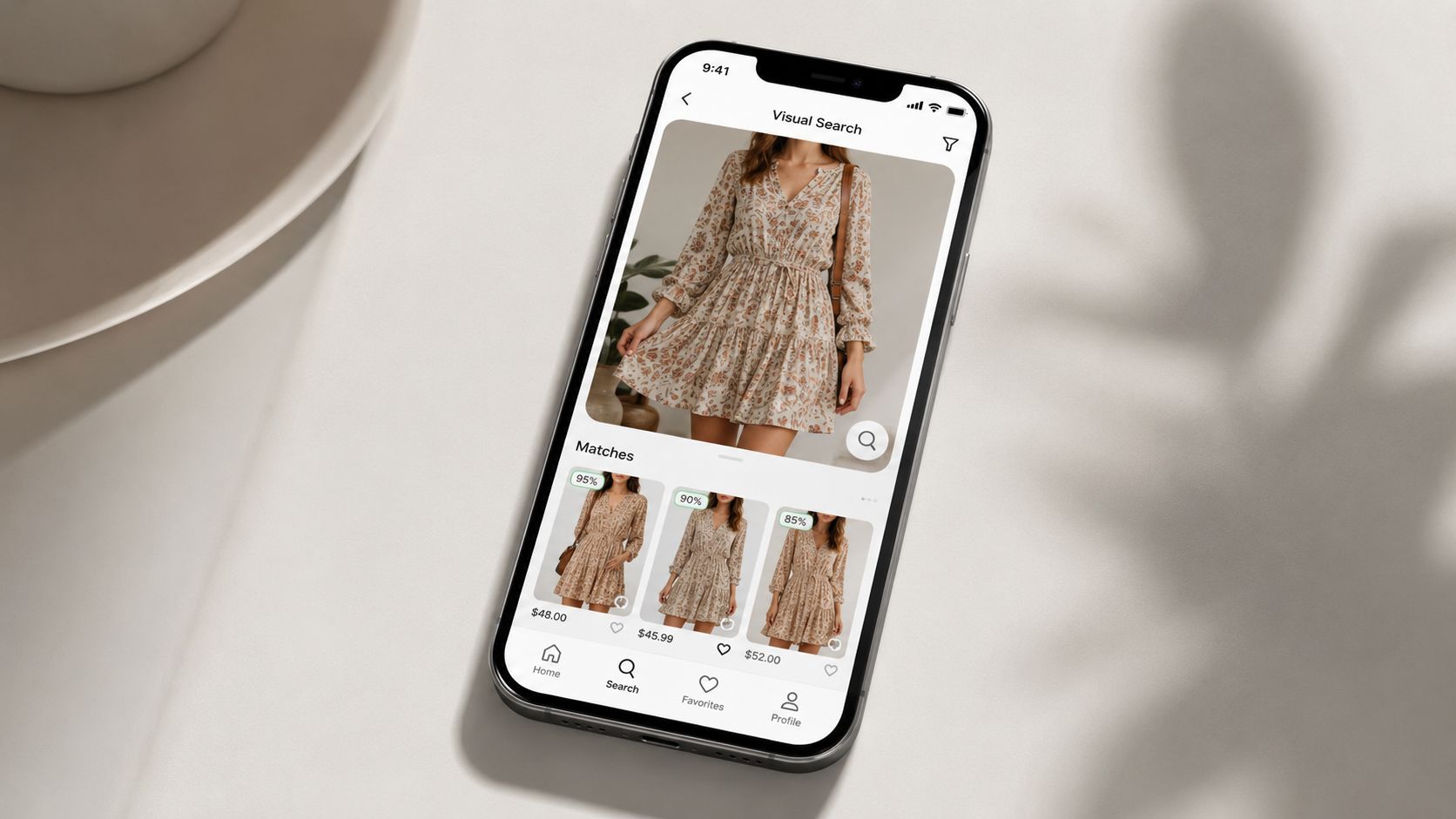
Good visual search doesn't replace merchandising judgment, it makes good merchandising discoverable faster.
7. AI-Powered A/B Testing and Multivariate Testing Optimization
AI makes experimentation more useful by increasing test velocity and helping you learn faster from each decision. Industry guidance in 2026 reports that teams using AI experimentation platforms can run about 2.7× more tests per quarter according to Digital Applied. The same guidance says systematic AI-enabled optimization programs can produce 40% to 60% annual conversion improvement when faster test velocity is paired with better traffic allocation and continuous learning, so the operating model matters as much as the software.
That doesn't mean every store should rush into multivariate testing on day one. The better use of AI is often to prioritize the next test, allocate traffic more intelligently, and avoid spending weeks on weak hypotheses. On high-traffic Shopify Plus stores, that can keep the roadmap moving without drowning the team in dead-end experiments.
Let the data shape the next hypothesis
AI can help you choose what to test, but it shouldn't replace a good testing framework. Start by ranking ideas by impact and likelihood of improvement, then use clean success metrics tied to business goals. Homepage messaging, PDP structure, and checkout friction are usually better starting points than cosmetic changes.
Presidio's CRO audits are useful because they turn scattered observations into a testing roadmap. That helps keep experimentation sequential instead of chaotic, which matters when personalization, quizzes, and other dynamic elements could otherwise conflict with one another. Testing works best when the team documents every learning, even the tests that lose.
A practical testing cadence often includes:
Prioritize by impact: Focus on the highest-value pages first.
Use one success metric: Don't let vanity metrics muddy the result.
Avoid test collisions: Run sequential experiments, not competing ones.
Feed in quiz data: Use preference signals to create stronger variants.
Track cumulative learning: The value compounds when findings are reused.
The advantage is not just faster winners. It's a clearer loop between hypothesis, test, and implementation.
8. AI-Powered Performance Monitoring and Predictive Optimization
Performance monitoring is an CRO lever, not just a technical task. Shopify brands lose a lot when slow pages, layout shifts, or failing scripts interfere with the buying flow, especially on mobile where the user is already dealing with smaller screens and less patience. AI is useful here because it can watch page speed, error rates, and Core Web Vitals continuously, then flag degradation before the team sees a conversion drop.
Presidio's migration guidance is a good reminder that performance discipline starts early. A move to Shopify, or any meaningful storefront change, only works long term if the build stays maintainable and the monitoring stays active. That is especially true for brands using headless or composable architecture, where flexibility is high but regression risk is real.
Treat speed as an ongoing conversion safeguard
Performance audits should happen on a schedule, not only after a crisis. Baseline your Core Web Vitals, check them quarterly, and track how major technical changes correlate with conversion trends. AI-powered monitoring platforms can help surface patterns, but the merchant still has to decide which fixes are worth prioritizing.
A good performance loop usually looks like this:
Set a baseline: Know your current page speed and stability.
Audit regularly: Use quarterly technical reviews, not one-off checks.
Prioritize ROI: Fix what affects conversion most, not just what looks messy.
Automate regression checks: Catch slowdowns before they reach customers.
Keep the stack lean: Limit unnecessary scripts and app overhead.
If a store is migrating, scaling, or adding personalization, performance monitoring should be part of the same plan. Otherwise every new feature risks undoing the gains from the previous one. For teams looking to optimize AI support agents alongside storefront performance, continuous optimization practices are a useful adjacent discipline.
AI-Powered Conversion Optimization: 8-Point Comparison
Solution | 🔄 Implementation complexity | ⚡ Resource requirements | 📊 Expected outcomes | 💡 Ideal use cases | ⭐ Key advantages |
|---|---|---|---|---|---|
AI-Powered Product Recommendation Engines | Medium, data & integration effort | Customer & catalog data, moderate engineering, A/B testing | 15–25% conv lift; 20–30% AOV increase | Upsell/bundling on PDP, cart, checkout; capture first‑party prefs via quizzes | Real-time personalization across touchpoints; native Shopify integration; first‑party data capture |
AI-Driven Dynamic Pricing & Discount Optimization | High, complex logic & tuning | Demand/inventory data, pricing engine, legal/comms, model tuning | 10–20% lift for price‑sensitive segments; 5–15% AOV gain | Margin optimization, clearance, segmented offers for high‑volume stores | Real‑time pricing, margin preservation, reduces app overhead via Shopify Functions |
AI-Powered Personalized Landing Page & Content Generation | Medium, data + creative workflow | Visitor data, copy/images, content-serving infra, model refinement | 15–35% conversion increase; 20–40% lift on paid traffic | Paid landing pages, home/PDP personalization, traffic‑source messaging | Scales tailored messaging; reduces bounce for paid traffic; faster copy/image variations |
AI-Powered Checkout & Cart Abandonment Recovery | Medium, combines UX, analytics & comms | Checkout analytics, email/SMS sequencing, checkout customization | 20–50% overall conv lift; 10–30% cart recovery | Checkout flow fixes, targeted recovery campaigns, form optimization | Predictive recovery triggers; personalized incentives; reduces checkout friction |
AI-Powered Customer Segmentation & Behavioral Targeting | Medium, modeling & integrations | Clean customer data, CDP/analytics, channel sync (email/ads) | 20–40% better targeted campaign conv; 30–50% email ROI lift | Retention, lifecycle campaigns, paid audience targeting | Precise targeting; reduces wasted spend; identifies high‑value cohorts |
AI-Powered Visual Search & Image Recognition | High, CV models & quality imagery | High‑quality product images, metadata, custom vision models | 15–30% discovery conv lift; 25–40% longer sessions | Fashion, beauty, home goods, visual discovery use cases | Improves visual discovery; strong mobile UX; differentiates product search |
AI-Powered A/B & Multivariate Testing Optimization | Medium, needs traffic & discipline | Testing platform, sufficient traffic, analytics, experiment roadmap | 20–40% faster test conclusions; 5–15% cumulative conversion gains | High‑traffic pages (homepage, PDP, checkout); continuous CRO | Intelligent traffic allocation; faster wins; automated hypothesis suggestions |
AI-Powered Performance Monitoring & Predictive Optimization | Medium, monitoring + engineering fixes | Monitoring infra, telemetry, performance engineers, CI/CD tests | ~1% conv per 100ms speed; 3–5% cumulative lift from optimizations | Stores prioritizing speed, Core Web Vitals, and uptime | Proactive issue detection; ROI‑prioritized fixes; prevents speed‑related revenue loss |
Implement Your AI-Powered CRO Roadmap
These eight tactics work best when they're sequenced, not scattered. Start with the parts of the funnel where the friction is most visible, then move outward into personalization, segmentation, experimentation, and predictive monitoring once the measurement system is stable. That's the cleanest way to use AI in CRO, not as a replacement for judgment, but as a force multiplier for a store that already knows what it's trying to improve.
If your Shopify brand is still early in the journey, begin with baseline measurement and one conversion target. If your data is mature, shift toward recommendation logic, dynamic testing, and performance monitoring that can keep pace with scale. And if your team is already dealing with app sprawl, checkout friction, or a messy migration, the best AI move may be simplifying the system first so the optimization layer can do real work.
The stores that win in 2026 won't be the ones that use the most AI. They'll be the ones that connect AI to a clean Shopify foundation, a clear benchmark, and a testing cadence that keeps learning. The practical pattern is simple, define the problem, let AI find the signal, test the fix, then keep the winning behavior in the stack.
Backlink: insights from WearView on AI fashion
A CTA for Presidio.