Outrank AI

A shopper lands on your product page, reads your headline claim, checks the price, hovers over add to cart, and leaves. Your copy didn't fail because it was badly written. It failed because the shopper had no reason to believe you over the doubt in her head.
That's the gap social proof fills. Shoppers look to other buyers when a product is unfamiliar or hard to judge from photos alone, and that behavior is routine before a first purchase. A Pew Research Center survey published in December 2016 found that 82% of U.S. adults read online customer ratings or reviews at least sometimes before purchasing an item for the first time. The same survey also exposed the credibility problem, since only 51% of review readers generally believed reviews gave an accurate picture of true product quality.
The fix isn't to add more proof everywhere. It's to place the right type of proof at the exact point of doubt. A star rating by the price answers a different question than a badge at checkout or a case study on a services page. Each example of social proof below is a placement decision, with copy to test and a failure mode to watch for.
Table of Contents
1. Customer Reviews and Star Ratings
Stars earn their keep where price and risk collide: beside the title, price, and add-to-cart area, the point where a shopper asks whether paying now beats waiting. Amazon keeps rating and count in that decision zone; on Shopify, Judge.me, Yotpo, and Loox can place the same signals there, and this guide to choosing a Shopify reviews app compares the trade-offs.
Position is the lever. In one A/B test, a review-led product page treatment for a premium marine and pool-paint retailer lifted conversion from 1.32% to 2.52%, about a 91% relative lift (90.9%), while traffic stayed approximately stable. Use it as a reason to test placement on your own store, not as a benchmark to expect.
A skincare page shows the working layout:

Make Reviews Answer a Specific Objection
Aggregate stars cannot tell a shopper whether a serum suits oily skin or whether a sofa works as an affordable refresh for your living room. Sephora pairs ratings with filters for skin type and other attributes, so shoppers can sort for reviewers who match their situation. Test copy near the stars that names the doubt: "Rated by customers with oily skin," "Fit checked by buyers like you," or "Reviewed after real use."
Time the request to use: Send review requests 2 to 4 weeks after purchase for skincare or apparel, once the customer has lived with the product.
Filter by attribute: Add size, skin type, or use-case filters so a browser can find reviewers like them.
Answer negative reviews in public: Name the issue, state the fix, and offer the next step. A specific reply shows responsiveness better than a perfect score.
Lazy-load the widget: Review scripts can drag page speed, so load them late to protect Core Web Vitals.
2. Customer Testimonials and Video Testimonials
Reviews are unprompted and scattered. Testimonials are curated, and that control is both their strength and their risk. Use them for high-consideration purchases where a shopper needs to see someone similar succeed, and place them beside the objection they counter, usually price, implementation time, or migration risk.
Video carries tone and hesitation that written quotes can't fake easily. Glossier weaves customer voices into product storytelling, while Shopify merchant stories let founders describe growth in their own words.
Ask Questions That Produce Usable Copy
Don't ask, "Do you like it?" Ask three things. What was the problem before? What changed? What number moved? A testimonial with one quantified result, published with the customer's agreement, beats five lines of praise because it gives the next buyer something concrete to compare against.
Placement still decides whether it helps. In The Motley Fool's experimentation program, adding testimonials slightly reduced conversion in upper-funnel experiments, while removing testimonials from the order page materially harmed transactions, average order value, and revenue per session. Testimonials earn their keep at the point of purchase, where anxiety peaks, not as homepage decoration.
Practical rule: Cut one long interview into short clips for paid social and landing pages, and get written usage rights before you publish any of it.
If you need to produce those clips at volume, tools that let you create videos with AI can speed up editing. Keep the customer's actual words. Polished scripts read as ads, and shoppers discount them accordingly.
3. Case Studies and Client Logo Walls
For agency and B2B buyers, the objection isn't "does it work?" It's "can this team handle a project like mine without breaking revenue?" A logo wall answers at a glance. A case study answers in detail. You need both, sequenced correctly.
Presidio's portfolio, including OUAI, Bobbie, OLIPOP, Momofuku, NOBULL, KHY, Acure, Vintner's Daughter, FlavCity, and Good Good Golf, works as a logo wall because the names are recognizable to DTC operators. Segment that wall by audience, such as Shopify Plus migrations or subscription commerce, so a prospect spots a peer in seconds.
A workspace view of results and trusted names is the visual shorthand buyers scan first:

Lead With the Outcome, Then the Approach
Open each case study with the measurable result, then explain what you built. A replatform story like this ecommerce migration case study breakdown format gives a technical evaluator the migration risk, the approach, and the timeframe in one place.
Name the client's quote and title: "Head of Ecommerce" carries more weight than an anonymous brand name.
Get metric approval in writing: State the timeframe for every result you publish.
Refresh annually: A case study citing old platform versions signals a team that stopped shipping.
The failure mode is a wall of logos with no story behind any of them. If a prospect clicks and finds nothing, the logos start to look borrowed.
4. User-Generated Content (UGC)
Studio photography shows your product at its best. UGC shows it on a real counter, in bad lighting, on a real body. That roughness is the point, because it answers the question shoppers really ask: what does this look like in a normal life?
Glossier built its community approach around customer photos and shared routines. Gymshark spotlights athletes and customers training in its apparel. On Shopify, apps like Yotpo and Stamped collect customer photos and place them on product pages near the buying decision.
A typical UGC display mixes creator clips with everyday lifestyle shots:
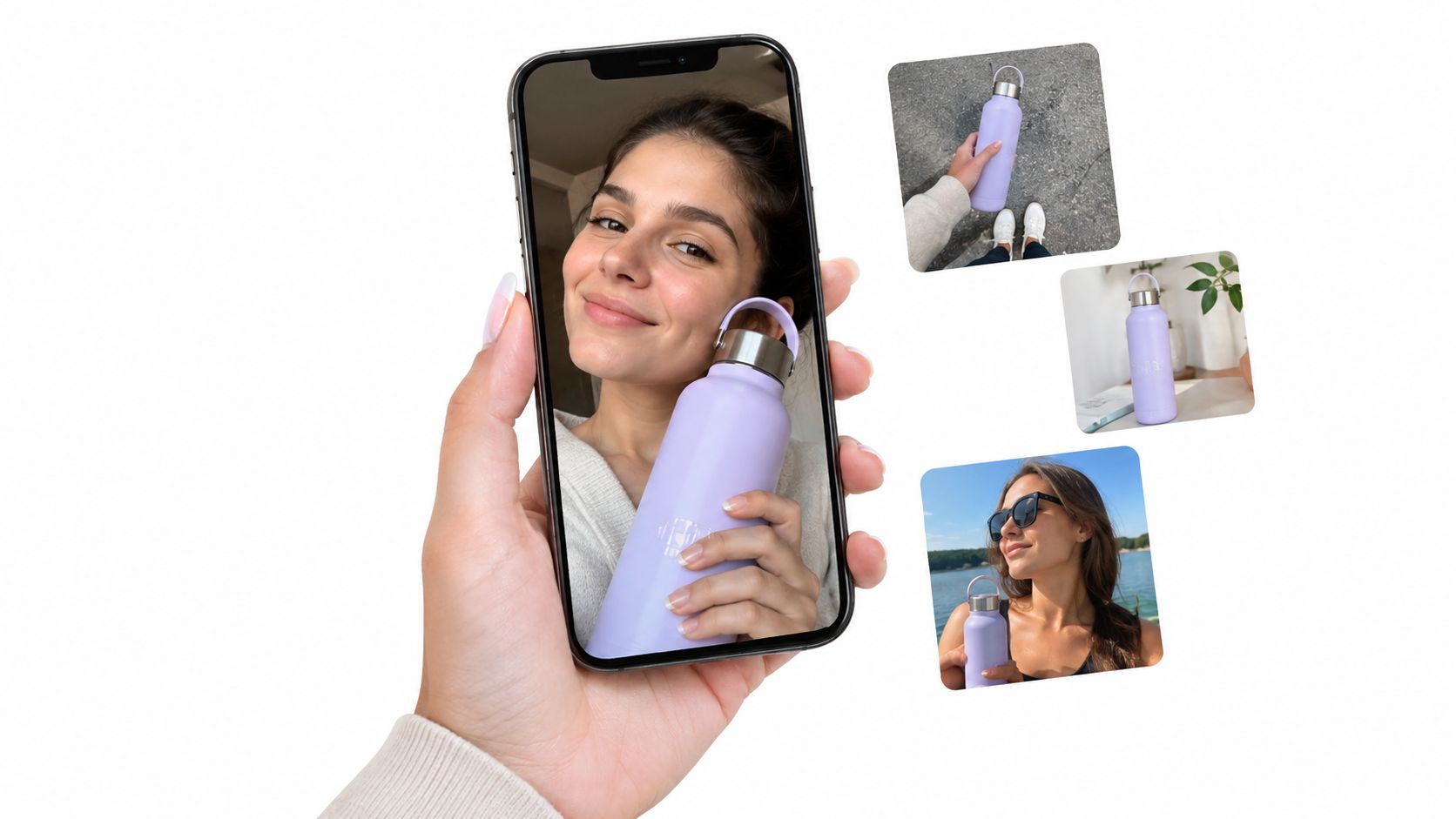
UGC and creators do different jobs in the journey. Bazaarvoice's 2025 social-commerce research reported that nearly 56% of Gen Z and Millennial respondents had purchased based on a creator recommendation. Creators start discovery. Peer photos and verified reviews on your page close it, so build the handoff instead of treating the two as interchangeable.
Run UGC Like a Content Pipeline
Create a branded hashtag with clear instructions for how customers get featured. Ask for permission in a follow-up email and offer recognition or a small discount. Place the gallery near add to cart, pair photos with written reviews, and track which assets drive conversion in ads. Retire the ones that don't, however much you like them.
5. Expert and Professional Endorsements
Expert proof works through authority. A dermatologist vouching for a cleanser carries weight because shoppers assume she evaluated it more carefully than they can. The endorsement only holds if the expertise matches the product's core benefit and the relationship is disclosed.
CeraVe was developed with dermatologists and puts that recommendation at the center of its messaging. Peloton leans on its instructors and athletes to validate training programs. In both cases, the expert explains the product, not just smiles beside it.
The format most shoppers recognize looks like this:

Put Experts in Education, Not Just Ads
Expert content performs best in FAQs, guides, and explainers, where a shopper is actively trying to understand ingredients, fit, or technique. A 90-second clip of a certified coach explaining who a program is not for builds more trust than a banner quote, because it shows judgment.
Match credentials to the benefit: A chef endorsing knives makes sense. A chef endorsing skincare doesn't.
Disclose payment clearly: Follow FTC endorsement guidance and keep claim substantiation ready before you publish.
Use your own experts: For agencies, technical leads and certified Shopify partners speaking on camera show depth that a borrowed name can't.
The failure mode is a famous face with no relevant expertise. Shoppers read it as a rental, and they're usually right.
6. Trust Badges, Awards, and Press Mentions
Badges are the weakest form of proof on a product page and one of the strongest at checkout. That distinction matters. Mid-page, shoppers care about the product. At payment, they care about whether your business is legitimate and their card details are safe.
Agencies display Shopify Plus Partner and Shopify Partner badges for the same reason, and pairing that context with guidance on choosing a Shopify Plus agency helps buyers verify what the badge really means. Checkout pages lean on payment provider badges and secure checkout seals to close the last gap.
A clean checkout with a small, current badge set is the target:

Fewer Badges, Each One Verifiable
Limit yourself to the three to five most relevant signals, placed near checkout or contact forms. Include the award year and awarding body. Link to the source where you can. Feature press logos only when the coverage was substantive, not a passing mention in a roundup.
A badge you can't verify in one click is worse than no badge, because it teaches shoppers to doubt everything else on the page.
Refresh the set quarterly and remove expired credentials. An outdated certification tells a careful buyer that nobody is maintaining the storefront, which is the opposite of the signal you wanted.
7. Real-Time Activity and Bestseller Indicators
Booking.com tells you how many people are looking at a property. Amazon marks category leaders with a Best Seller badge. Both rely on the bandwagon effect, the idea that a choice feels safer when others are making it right now.
This is the easiest proof type to abuse and the fastest to backfire. Fabricated scarcity and invented viewer counts might lift a click today, but shoppers who catch the pattern stop trusting your prices, your stock messages, and your reviews. The damage spreads beyond the one widget.
Use Activity Proof Only When the Data Is Real
Say you're running a Shopify store during a product drop. A "recently purchased" notice tied to real orders, limited to products with strong sales and review volume, gives hesitant shoppers a nudge that's grounded in fact. Pair it with a quiz or recommendation result and the message becomes personal instead of generic pressure.
Show only current, accurate data: If the feed breaks, hide the module rather than display stale numbers.
Restrict bestseller badges: Reserve them for genuine category leaders, or the label means nothing.
Test placement on collection pages: Activity signals compete with product imagery, so watch bounce rate alongside conversion.
Measure both metrics before and after. If conversion rises but returns rise with it, the urgency pushed people into the wrong product, and that's a net loss.
8. Adoption Milestones and Usage Statistics
"Trusted by 100,000 brands" is crowd proof. It tells a shopper the choice is already common, which lowers perceived risk when they are close to committing. Shopify uses the same signal when it says it powers millions of businesses, and Presidio states that its apps and themes have been adopted by over 100,000 brands.
Placement decides whether that number helps. On a homepage hero or pricing page, it answers "is this established?" before the visitor asks for detail. On a product page, put it after the value proposition and rating, where it supports a decision already forming. A large aggregate figure shown before relevance is clear can pull attention toward the crowd and away from the product, so treat scale as reinforcement rather than the opening argument.
Define the Number or Don't Use It
State exactly what is being counted: installs, active stores, paying customers, or brands served. Add an "as of" date and keep the record behind it. Shopify App Store listings work because install counts sit beside ratings: the unit is obvious and the rating qualifies the volume.
Put milestones in headers, app listings, and partner pages; support them below with reviews and case studies.
Segment the claim when the audience is narrow: "used by subscription brands on Shopify Plus" is stronger than a raw total for that buyer.
Test copy that names the unit directly near the CTA, such as "installed by active Shopify stores," and keep it within what can be substantiated.
Used well, a milestone frames the page. The reviews, photos, and outcomes inside that frame do the convincing.
How the 8 social proof types compare on placement, trust signal, effort, and risk
Item | Best Placement | Core Trust Signal | Effort to Launch | Main Risk |
|---|---|---|---|---|
Customer Reviews and Star Ratings | Product pages near title and price | Verified feedback from buyers | Moderate: collect reviews and add a widget | Fake reviews or unaddressed negative feedback |
Customer Testimonials and Video Testimonials | Near calls to action and key objections | First-person experiences and specific outcomes | High: secure customer approval and produce content | Scripted or generic testimonials reduce trust |
Case Studies and Client Logo Walls | Agency or service pages; sales materials | Recognizable clients and measurable results | High: gather approvals and validate results | Unapproved or outdated claims undermine credibility |
User-Generated Content (UGC) | Product pages near the add-to-cart area | Authentic customer photos and videos | Moderate: collect content and secure reuse rights | Reuse without permission |
Expert and Professional Endorsements | Near product claims and educational content | Relevant credentials and expertise | Moderate to high: secure experts and substantiate claims | Undisclosed relationships or unsupported claims |
Trust Badges, Awards, and Press Mentions | Checkout, contact forms, and service pages | Independent third-party validation | Low to moderate: verify credentials and display badges | Expired, unverifiable, or misleading badges |
Real-Time Activity and Bestseller Indicators | Product and collection pages | Accurate evidence of current popularity | Moderate to high: connect reliable data and maintain it | Fabricated urgency or inaccurate activity |
Adoption Milestones and Usage Statistics | Homepage headers, app listings, and about pages | Verifiable customer or usage scale | Low to moderate: define, verify, and update figures | Outdated or unclear statistics |
Build a Proof Stack That Answers Each Objection
Most stores collect proof the way they collect apps, adding whatever is available and scattering it wherever there's space. A proof stack works differently. You map each element to the objection that appears at that point in the journey, and you remove anything that isn't answering a live question.
High on the page, shoppers ask whether your brand is legitimate and relevant. That's where adoption milestones, segmented logo walls, and a small set of badges belong. Keep them light. Their job is to earn the next scroll, not to close the sale, and heavy proof too early can pull attention away from the product itself.
At the product decision point, the questions get specific. Does it work for someone like me? What does it look like in real life? That's where star ratings by the price, filtered reviews, UGC galleries, and one strong testimonial beside add to cart do their work. Reviews carry unusual weight here, since a 2021 survey of 6,538 U.S. consumers reported in Total Retail ranked ratings and reviews above price, free shipping, brand, and recommendations from family and friends as factors affecting online purchase decisions.
For high-consideration buyers, research stretches over days. Case studies, expert explainers, and detailed review threads give them material to return to and share internally. This layer rarely converts on first visit, but it wins the second and third, which is where considered purchases actually happen.
Authenticity now decides whether any of this holds together. A 2025 European Consumer Score Board cited by BEUC found that 66% of surveyed consumers reported encountering fake reviews. Shoppers have learned to scan for manipulation, so verified purchase labels, dated reviews, customer photos, and visible responses to criticism matter more than a perfect average. Fewer, more informative, visibly mixed reviews can outperform an enormous flawless rating.
Your store converts better when each claim sits next to evidence a shopper can check.
Start with a practical audit this week. Write down the top three objections on your best-selling product page and at checkout, pulled from support tickets, returns, and abandonment surveys. Assign one verifiable proof type to each objection and place it within the same screen as the decision it supports. That's the work that helps turn more visitors into enquiries and paying customers, because you're answering real doubts instead of decorating the page. Presidio can support that audit as part of broader Shopify and Shopify Plus optimization work, from product template refinements that showcase proof properly to ongoing CRO testing of placement and copy.
If your product pages have proof scattered where it fits instead of placed where doubt appears, Presidio can rebuild that stack, from review and UGC placement in your theme to A/B tests that show which proof type lifts add to cart and checkout completion. Visit Presidio to talk through a proof audit for your Shopify or Shopify Plus storefront.

Jamie, Presidio’s Designer, leads the practice alongside Johnnie. With over 10 years of e-commerce experience, Jay is a Shopify expert, known for crafting innovative solutions that prevent tech debt.
Jaime
Senior Product Designer, 2020