Presidio

You've installed a reviews app, added a star bar to your product pages, and assumed the hard part was over. Then a high-volume campaign sends customers to a product with three reviews, an old photo appears beside a current variant, and your marketing team asks whether those reviews can be reused in Google Shopping, email, or paid social. The app technically works. Your review system doesn't.
The best reviews app for Shopify isn't the one with the cheapest plan or the prettiest widget. It's the platform that protects review data, collects credible content, supports moderation, preserves structured data, and distributes customer proof wherever shoppers encounter your brand. That distinction matters because 92.7% of consumers read online reviews, while 66.5% always check them before purchasing, according to a 2026 consumer review survey.
App | Best fit | Main strength | Main trade-off |
|---|---|---|---|
Judge.me | Lean and early-stage Shopify brands | Generous entry point and broad core functionality | Less polished moderation experience |
Loox | Visual-first apparel and beauty brands | Photo-led UGC presentation | Paid structure and weaker cross-channel depth |
Yotpo | Enterprise and omnichannel merchants | Review infrastructure, segmentation, and syndication | Higher total cost and complex plans |
Stamped.io | Brands already using its loyalty tools | Reviews and loyalty consolidation | Crowded product experience |
Okendo | Premium, design-led brands | Branded widgets and detailed attributes | More expensive as requirements expand |
Junip | Small DTC teams prioritizing design | Clean storefront presentation | Lighter automation |
Fera | Merchants wanting flexible merchandising | Customizable review displays | Requires careful implementation decisions |
Table of Contents
The Real Cost of Getting Reviews Wrong on Shopify
A DTC brand launches a promising product. Six months later, a product recall affects one batch. The team needs to flag the affected SKU, suppress outdated content, preserve valid feedback, and push corrected product information into shopping channels. The reviews app can display stars, but it can't separate affected variants cleanly or control where old content appears.
That's not a cosmetic inconvenience. It's an operational failure.
Review infrastructure sits across the product page, structured data, post-purchase messaging, customer support, and acquisition channels. A migration can remove review markup from templates, break product-to-review associations, or strip verified-buyer context from imported content. Your team then spends time reconstructing an asset that customers had already created for you.
Practical rule: Treat review data like product data. Export it, validate it, document ownership, and test how it renders before changing the system that publishes it.
The SEO risk is easy to underestimate. If a theme migration removes aggregateRating or invalidates product schema, your pages can lose eligibility for enhanced search presentation. That can reduce the visibility and click appeal built through months of consistent merchandising and content work. Your Shopify SEO best practices should therefore include review schema checks, not just titles, canonical tags, and internal linking.
The commercial loss can be larger than the subscription you were trying to avoid. Northwestern's Spiegel Research Center found that products with five reviews were 270% more likely to be purchased than products with no reviews, and higher-priced products saw an increase of up to 380% when reviews were displayed, compared with 190% for lower-priced items in the same analysis (Spiegel Research Center review findings). If a platform switch loses your first reviews, the brand loses the most valuable stage of its proof-building process.
The cheapest app often stays cheap only while your store is small. Once you add migration labor, moderation, photo storage, feed management, support workflows, and the opportunity cost of UGC you can't reuse in email, SMS, or advertising, the subscription becomes a minor line item.
Why Reviews Now Outweigh Ratings Alone
A four-star average tells shoppers almost nothing by itself. It doesn't explain whether the fit runs small, whether the packaging survived shipping, whether the product works for sensitive skin, or whether a buyer received the correct color. Written reviews, images, video, questions, and merchant responses answer those objections.
Third-party credibility matters here. The 2026 survey cited above found that 91.3% of consumers trust online reviews at least some of the time, but 64.9% rarely or never trust reviews on official company websites. That gap is why a review program needs visible verification, transparent moderation, and credible distribution instead of a brand-controlled testimonial block.
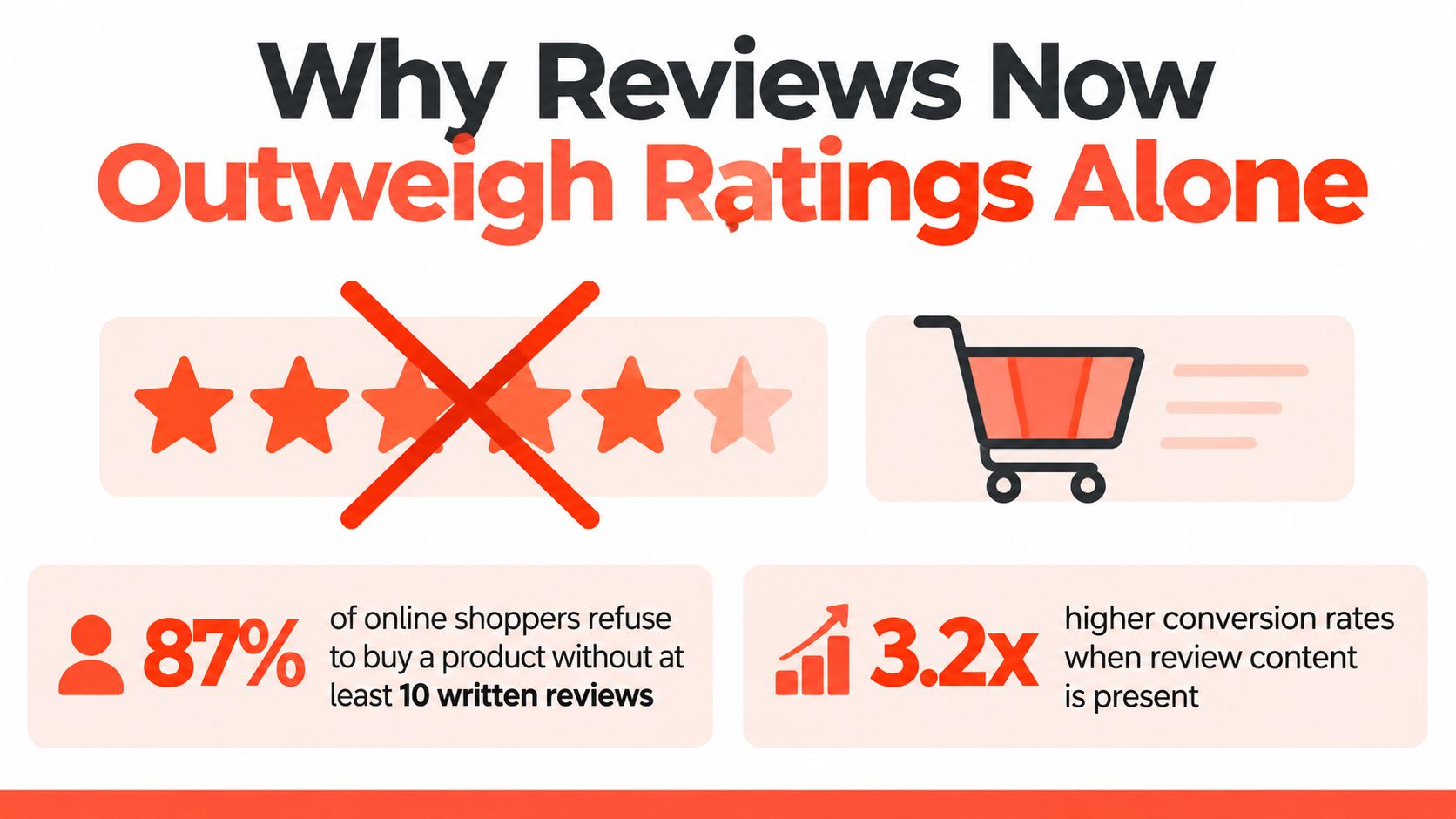
The strongest implementation starts with collection, not design. The first five reviews deserve special attention because that is where the Spiegel analysis identified the largest purchase effect. Automate post-purchase requests, identify verified buyers, and prioritize high-ticket products instead of spreading collection efforts evenly across every SKU.
PowerReviews found that shoppers exposed to one or more reviews were 52.2% more likely to convert than shoppers seeing none. Its analysis also reported conversion increases of over two times at 11 to 30 reviews, over 250% for products with 101 or more reviews, and a 120.3% lift from active interaction with review widgets (PowerReviews review volume analysis). The implication is clear: filtering, search, Q&A, photo galleries, and response tools can influence buying behavior because they help shoppers investigate rather than merely glance at a score.
The useful review widget is an objection-handling interface, not a decorative star strip.
Freshness also changes trust. In a 2026 survey of 4,200 respondents, reviews newer than 30 days were trusted by 73% of respondents, while trust varied across Google Reviews, Trustpilot, Amazon, and TripAdvisor (consumer trust and review freshness data). Your app should make recent feedback easy to collect and easy to find.
That makes reviews a compounding content asset. A strong system can turn customer language into product-page copy, merchandising filters, support insights, creative inputs, and structured content for external channels. For broader Shopify conversion rate optimization, review infrastructure belongs beside pricing, shipping, product education, and checkout testing.
The Shopify Reviews App Landscape at a Glance
The Shopify reviews market divides into three practical groups. Judge.me and Fera suit merchants that want a focused storefront layer. Loox, Okendo, and Junip put more emphasis on presentation and brand fit. Yotpo and Stamped.io make more sense when reviews connect to loyalty, messaging, analytics, and broader customer marketing operations.
Pricing changes by plan and usage, so don't treat a public starting price as your total cost. Ask what happens when photo submissions increase, when SMS becomes important, when you need multiple markets, and when your team requires approval workflows.
App | Starting Price | Review Request Channels | UGC (Photo/Video) | SEO & Rich Snippets | Notable Integrations | Best Fit |
|---|---|---|---|---|---|---|
Judge.me | Free entry option available | Email and app-supported workflows | Photo support, video depth varies by plan | Core structured review display | Shopify Flow, marketing and support tools | Cost-conscious Shopify brands |
Loox | Paid subscription model | Email and supported post-purchase flows | Strong photo focus, video capabilities vary | Review widgets and SEO features vary by plan | Social and marketing connections | Fashion, beauty, and visual products |
Yotpo | Tiered subscription model | Email, SMS, and broader campaign workflows | Photo and video UGC | Advanced review and syndication options | Klaviyo, Salesforce, Meta, loyalty tools | Enterprise and omnichannel brands |
Stamped.io | Tiered subscription model | Email and supported messaging flows | Photo and video support | SEO features depend on configuration | Loyalty, email, and support ecosystem | Brands consolidating loyalty and reviews |
Okendo | Paid subscription model | Email and customer marketing workflows | Photo and video UGC | Structured data and storefront widgets | Klaviyo and customer experience tools | Premium, research-led brands |
Junip | Paid subscription model | Email and selected post-purchase flows | Photo and video support | Clean on-site review presentation | Shopify-focused marketing tools | Design-focused DTC teams |
Fera | Tiered subscription model | Email and storefront workflows | Photo support and visual displays | Configurable review presentation | Shopify marketing ecosystem | Merchants needing widget flexibility |
Use this table to create a shortlist, not a final decision. App Store ratings can indicate support and stability, but they won't tell you whether the export preserves replies, whether schema renders in your theme, or whether a review can move from a product page into a paid campaign.
Feature Deep Dive Across Leading Reviews Apps
Judge.me
Judge.me is the practical default for a lean Shopify operation. Its free entry option gives smaller brands a credible way to collect and display reviews without immediately committing to an enterprise platform. It also fits stores that want straightforward Shopify workflows and broad compatibility.
The trade-off is operational polish. Moderation can feel slower when the catalog and submission volume expand, and teams should test how photo and video requests behave under their chosen plan. Judge.me is a strong choice for request volume and basic SEO coverage, but it's less compelling when the brand needs advanced governance across markets.
Loox
Loox wins when the product sells through imagery. Apparel, beauty, accessories, and lifestyle brands can build a storefront experience around customer photos rather than asking shoppers to read a long text wall. Its visual presentation usually requires less creative translation because the customers supply the raw material.
The limitation is strategic. A photo-first app can become expensive or restrictive when the brand needs deeper video production, extensive syndication, or more complex moderation. Don't choose Loox for the gallery alone. Confirm how it handles media rights, variant mapping, social reuse, and the channels that matter to your acquisition team.
Yotpo
Yotpo is built for merchants that treat reviews as part of a larger retention and acquisition system. Its enterprise orientation supports segmentation, SMS collection, loyalty handoffs, and integrations such as Klaviyo and Salesforce. For an omnichannel brand, that broader infrastructure can justify a higher subscription and more involved implementation.
Yotpo's weakness is cost complexity. Mid-tier plans can include quote-heavy upgrades, and SMS request volume can create additional expense. A smaller store may pay for capabilities it won't use. Choose it when syndication, segmentation, and operational scale are requirements, not aspirations.
Stamped.io
Stamped.io appeals to brands that already use its loyalty capabilities or want to consolidate related customer engagement tools. It supports review collection and UGC while giving a merchant a path to connect reviews with retention activity.
Its interface and upsell structure can feel crowded. Audit the admin experience with the people who'll moderate submissions and build campaigns. Stamped makes the most sense when stack consolidation saves real operational effort, not when the brand is selecting a review widget in isolation.
Okendo
Okendo is a strong fit for premium brands that care about how review components feel inside a carefully designed storefront. Its branded widgets and detailed product attributes can help merchants collect more useful feedback about fit, quality, use cases, and product experience.
That detail comes with a higher starting commitment and possible seat-based add-ons. Okendo is not the app I'd install casually on a small test store. It's a better option when the merchandising team has a clear taxonomy for customer attributes and intends to use those insights across product development and marketing.
Junip
Junip is the design-led pick. Its presentation is clean, polished, and suited to DTC teams that don't want a generic third-party block dominating the product page. It's especially attractive when the existing theme has a strong visual system and the review experience needs to match it.
Junip's lighter review-request automation is the constraint. If collection orchestration is your main bottleneck, test its triggers and segmentation before committing. Its strengths are storefront quality and brand coherence, not the deepest lifecycle automation.
App | Starting price | Request channels | Photo/video | Key integrations | Notable trade-off |
|---|---|---|---|---|---|
Judge.me | Free entry option available | Email and Shopify workflows | Strong photo support | Shopify Flow and common ecommerce tools | Moderator experience can slow at scale |
Loox | Paid subscription model | Email and post-purchase flows | Visual-first | Social and marketing connections | Less suited to broad governance needs |
Yotpo | Tiered subscription model | Email and SMS | Mature photo and video support | Klaviyo, Salesforce, Meta, loyalty | Complex pricing and higher ownership cost |
Stamped.io | Tiered subscription model | Email and supported messaging | Photo and video | Loyalty, email, support tools | Upsells can clutter the experience |
Okendo | Paid subscription model | Email and lifecycle tools | Rich UGC and attributes | Klaviyo and customer experience tools | Higher commitment and add-ons |
Junip | Paid subscription model | Email and selected flows | Photo and video | Shopify-focused tools | Lighter request automation |
On request volume, Judge.me and Yotpo are the strongest practical choices, for different reasons. On SEO schema quality, the winner is the app that renders valid, stable markup in your actual theme, not the app with the loudest feature page. On widget performance, Junip and Okendo deserve close testing for design-led stores, while Loox is the obvious candidate when imagery carries the sale.
Best Reviews App by Merchant Scenario
There isn't one universal winner. The right choice depends on how much review content you collect, where shoppers see it, and how much operational control your team needs.
For bootstrapped brands
Choose Judge.me when budget discipline matters and the team needs a reliable foundation. Its free entry option can carry meaningful value for an early store, especially when the catalog is manageable and the brand primarily needs collection, verification, display, and basic structured data.
Don't choose it if a multinational legal or compliance review is already on the roadmap. You'll want stronger governance, localization, and moderation controls before the review program becomes difficult to unwind.
For visual products
Choose Loox for apparel, beauty, accessories, and other categories where customer imagery resolves uncertainty faster than written copy. Budget for the media workflow, though. Without a plan for requesting, reviewing, licensing, and reusing visual content, you'll own a gallery rather than a UGC program.
For omnichannel operations
Choose Yotpo when reviews must move across storefronts, search, paid social, loyalty, and messaging. Its broader infrastructure suits brands with mature marketing operations and enough channel complexity to benefit from centralized control.
Avoid defaulting to Yotpo for a sub-$500K store. A smaller team often gets better economics from a focused Shopify-native tool, then upgrades when syndication and segmentation become actual constraints.
For stack consolidation
Choose Stamped.io if your brand already uses its loyalty ecosystem and the combined workflow reduces maintenance. Don't select it merely because two products appear under one vendor. Compare moderation, exports, support responsiveness, and the admin experience against a dedicated reviews platform.
For premium design systems
Choose Okendo when review attributes support merchandising and the storefront requires a more branded presentation. Choose Junip when design polish matters most and the team can accept lighter automation.
Decision shortcut: Pick the app that matches your next operational problem, not the feature list you hope to need someday.
Presidio also builds and supports custom Shopify implementations, including storefront and app work that can connect review workflows with broader merchandising and conversion systems. That kind of development is relevant when an off-the-shelf review app creates theme, integration, or data-governance constraints.
Implementation and Migration Without Downtime
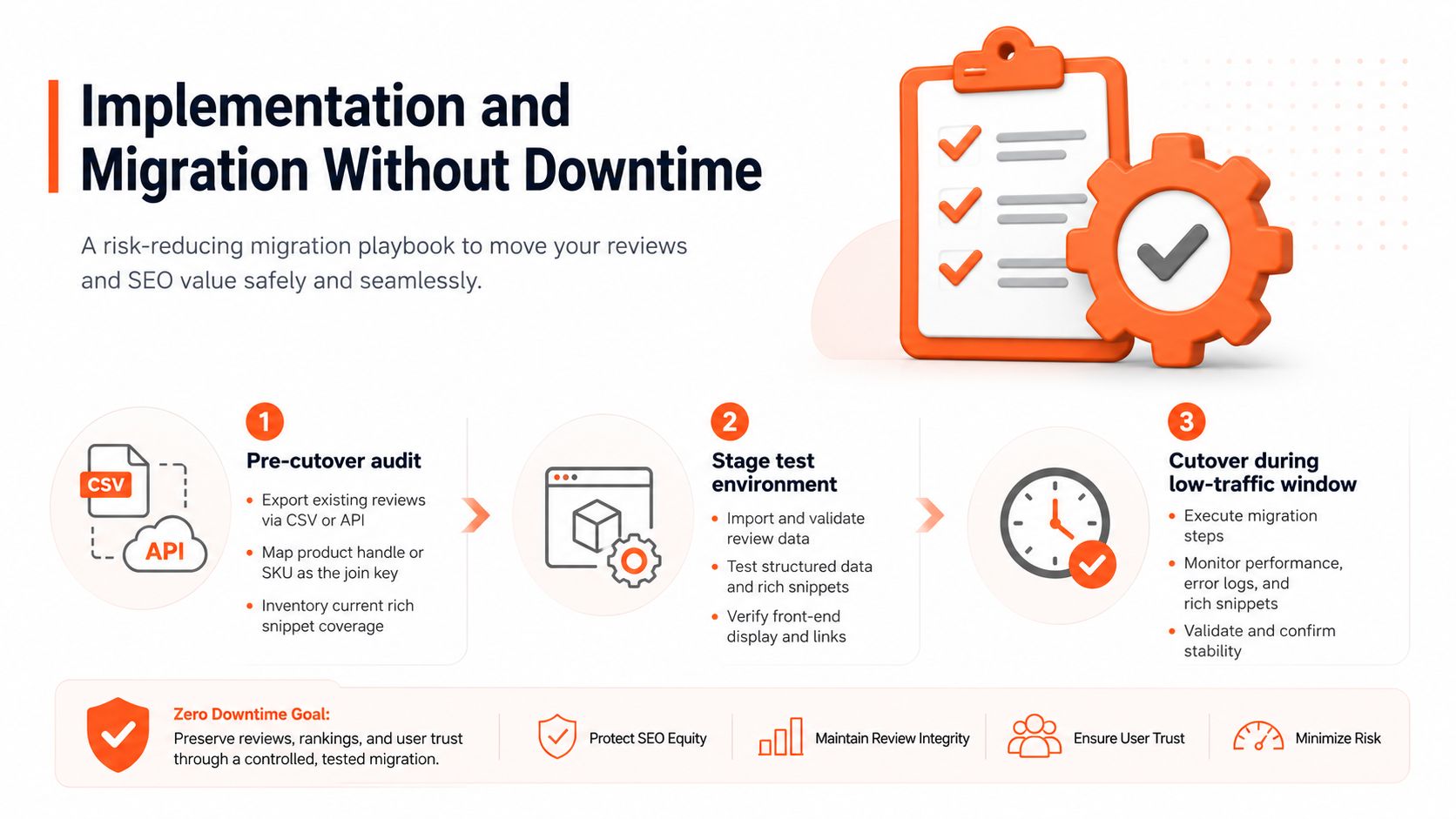
A reviews migration should look like a data migration, not a theme setting change. Export the existing content, preserve its relationships, validate its display, and only then change the production experience.
Audit before you touch the live theme
Start with a CSV or API export of reviews, media, product identifiers, ratings, responses, verification states, and timestamps. Use the product handle or SKU as the join key, not a fragile product title, because titles change and variants often share similar names.
Inventory the current rich snippet coverage as well. Record which product templates display review markup, how aggregate ratings are generated, and whether review URLs are indexable. This gives you a baseline for post-cutover validation.
Stage the new system
Install the replacement app on a development theme and import a representative product set. Check that product schema includes the correct product identity and aggregate rating output, then test variant behavior, pagination, filters, photo loading, mobile spacing, and accessibility.
Also verify the less visible data. Confirm that imported reviews retain verified-buyer labels, publication dates, merchant replies, image ownership, and moderation status. A visually accurate import can still be operationally incomplete.
Cut over in a controlled window
Send review requests to a small customer segment first. Check delivery, rendering, personalization, consent language, and unsubscribe handling before activating the full flow. Don't create duplicate requests by leaving old automations running during the test.
At launch, use this order:
Redirect legacy review URLs: Use 301 redirects where applicable so old review destinations don't become dead ends.
Publish the product-page widget: Validate the highest-value template first, then expand across the catalog.
Connect cart and post-purchase surfaces: Add review prompts where they support decision-making and collection without competing with checkout.
Set moderation ownership: Assign an internal SLA, escalation path, and recall procedure for affected SKUs.
Review attribution: Schedule a 30-day check in Shopify Analytics to compare request delivery, review creation, assisted sales, and channel reuse.
Your deployment process should be equally deliberate. The zero-downtime deployment guidance is a useful reference for staging changes, validating them, and reducing production surprises.
Common Buying Mistakes and How to Avoid Them
The cheapest plan is often the most expensive choice once the review program becomes important. Junior buyers compare the monthly price. Experienced operators compare ownership, data control, channel coverage, and failure recovery.
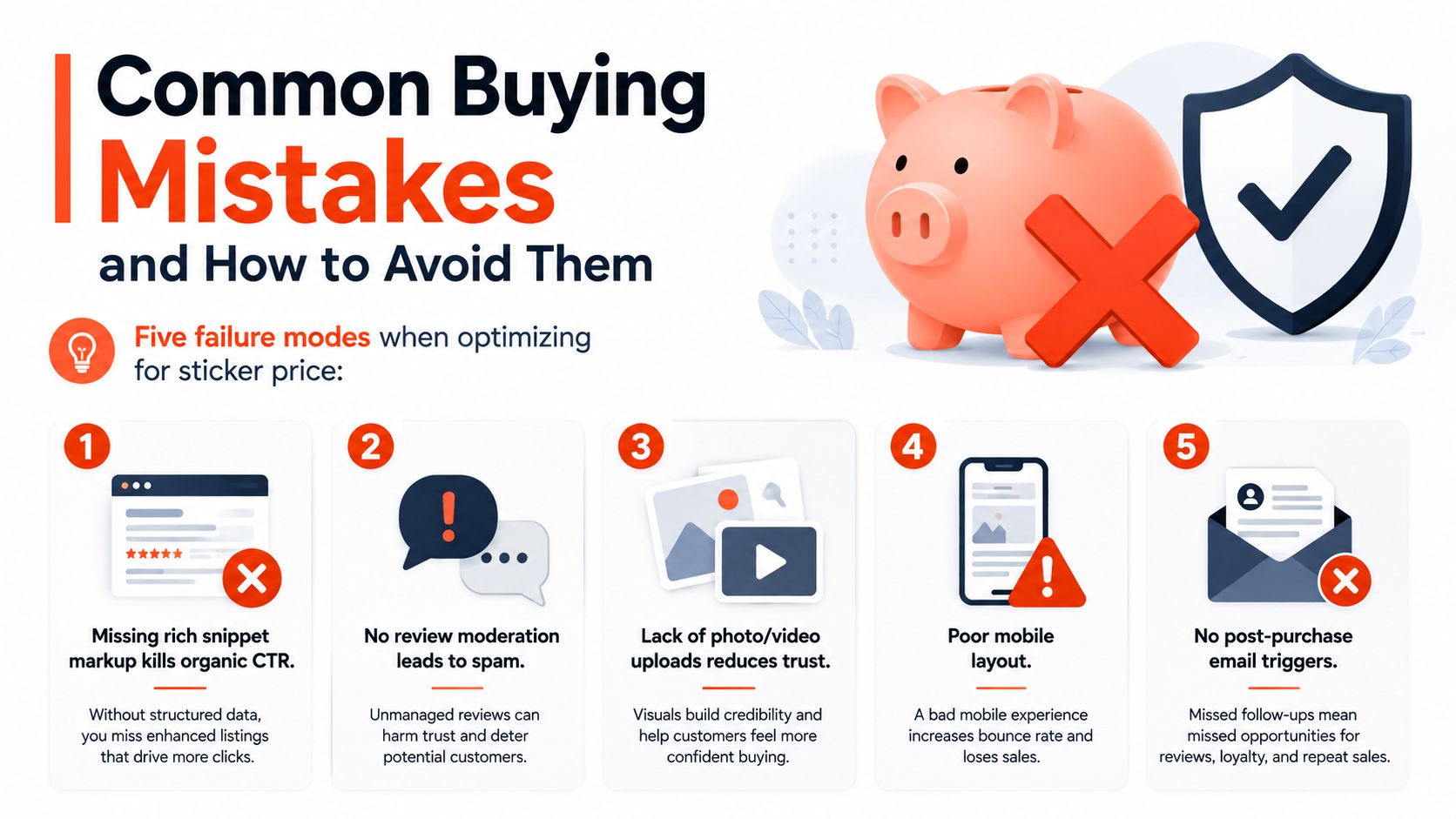
Five mistakes appear repeatedly:
Underestimating UGC volume: Photo and video storage, moderation, rights management, and review processing become meaningful work as submissions grow. Ask how usage-based costs change before signing.
Assuming schema is automatic: A widget can look perfect while structured data is missing, duplicated, or invalid. Test the rendered page source and validation output on your actual theme.
Ignoring shopping feeds: On-site stars aren't the same as ratings distributed into shopping environments. Confirm whether the app supports the feeds and verification requirements your acquisition team uses.
Treating request delivery as guaranteed: Customers can miss, ignore, or unsubscribe from post-purchase requests. Test timing, mobile rendering, sender identity, and the connection between fulfillment events and review prompts.
Skipping the migration rehearsal: Exports can lose product associations, photo rights, verification labels, or reply threads. Import one product line into a staging theme before moving the full catalog.
Run this filter before purchase:
Estimate your expected six-month review, photo, and video volume.
Confirm schema parity on your production theme.
Verify Google and other feed support in writing.
Audit request delivery and unsubscribe behavior.
Test import, moderation, replies, and media ownership on a single product line.
For most lean Shopify stores, Judge.me is the sensible starting point. Choose Loox when visual proof drives the category, Yotpo when syndication and enterprise workflows justify the cost, Stamped.io when loyalty consolidation matters, Okendo for detailed branded merchandising, and Junip for design-focused DTC teams. Whichever app you select, make trust architecture and migration safety part of the buying decision.
Presidio helps Shopify and Shopify Plus brands audit review integrations, improve storefront conversion paths, and build maintainable custom themes, apps, and data workflows around customer-generated content. Visit Presidio to discuss your reviews stack, migration plan, or broader ecommerce optimization roadmap.

Jamie, Presidio’s Designer, leads the practice alongside Johnnie. With over 10 years of e-commerce experience, Jay is a Shopify expert, known for crafting innovative solutions that prevent tech debt.
Jaime
Senior Product Designer, 2020