Outrank AI

A fragmented commerce stack can turn routine work into a revenue risk. In one documented migration, fulfillment time fell from 6.8 hours per order to 2.0 hours, oversell events fell from 35 per month to zero within 60 days, mobile conversion rose from 1.8% to 2.9%, and annual online revenue increased from $4.2 million to $6.0 million after the retailer adopted Shopify with an Odoo backend (case study of the Shopify and Odoo migration).
Those outcomes didn't come from choosing Shopify in isolation. They came from matching the migration pattern to the underlying problem, whether that problem was legacy technical debt, platform fragmentation, feature parity, data quality, or frontend flexibility. This comparison examines seven Shopify migration patterns through five practical questions: where the merchant started, what made the move difficult, how the implementation was controlled, which results were measured, and what another ecommerce team can replicate.
Table of Contents
1. Enterprise Migration from Magento to Shopify Plus
A Magento Enterprise retailer with multiple brands and storefronts faces a different migration problem from a single-store merchant. The central challenge is usually consolidation without losing commercial complexity. Regional merchandising, customer records, subscriptions, ERP connections, and legacy business rules all need to survive a platform change, while teams still need a clear operating model after launch.
A unified Shopify Plus architecture can make that redesign possible, but only if the team treats the work as a systems audit rather than a catalog export. Data mapping should cover products, variants, customers, historical orders, subscriptions, discounts, content, redirects, and integrations. Legacy logic also needs documentation before developers decide whether to reproduce it, replace it with an app, or remove it.

The phased rollout matters more than the platform label
A phased rollout limits the blast radius of defects. Teams can validate catalog behavior, customer data, subscription rules, checkout, fulfillment, and analytics before directing all traffic to the new environment. Presidio's ecommerce platform migration guidance is relevant here because staged execution and reconciliation are more useful than a one-time import when the store contains interconnected operational data.
The supplied enterprise scenario reports preserved catalog and customer complexity alongside faster storefront performance and lower operational overhead. Those outcomes should be read as consequences of simplification and controlled delivery, not as automatic Shopify results.
Practical rule: Document every legacy workflow before deciding whether it deserves a Shopify replacement. Feature parity isn't the same as business value.
For a mid-market apparel retailer, that might mean consolidating regional Magento stores. For a beauty brand, it could mean replacing duplicated integrations with one Shopify Plus operating layer. The transferable lesson is to audit the business architecture first, then design the storefront.
2. WooCommerce to Shopify Migration
A WooCommerce migration often begins with a familiar pattern: WordPress provides content flexibility, but the store accumulates plugins, custom checkout behavior, hosting dependencies, and maintenance work. The migration decision becomes attractive when the team wants a more controlled commerce environment without abandoning the brand's editorial content or customer acquisition channels.
The safest approach separates commerce data migration from content migration. Product data needs structured exports, clean variant relationships, usable collections, metadata, and redirect planning. Customer records and email permissions need their own validation process. The blog also deserves a separate workstream because moving articles, categories, media, internal links, and authors into Shopify's native blog or a headless content system can create different SEO and editorial tradeoffs.
Rebuild the buying journey, don't just copy it
A direct-to-consumer brand can use the migration to remove plugin conflicts and redesign checkout friction. The supplied WooCommerce scenario reports a faster checkout experience and improved conversion after the move, with Shopify's native tools supporting post-launch optimization. Those results are tied to the combined implementation, testing, and CRO work, so the lesson isn't that a platform switch alone raises conversion.
Before cutover, teams should:
Export cleanly: Use a structured WooCommerce export process, such as Presidio's Duplify tooling, and reconcile products, variants, customers, orders, and media against the source store.
Protect customer continuity: Preserve email addresses and segment records before import, while planning account communication for any password-reset constraints.
Test checkout paths: Test guest checkout, discount codes, shipping, tax, subscriptions, payment failure states, and mobile purchasing before traffic moves.
Restore measurement: Configure Google Analytics 4, advertising pixels, consent behavior, and event tracking before launch, not after the first campaign.
An artisanal food brand may need to preserve recipe content and subscription logic. An indie apparel label may need to clean years of plugin-generated product attributes. In both cases, the practical objective is the same: use migration to create a simpler operating baseline, then measure conversion and customer support behavior after launch.
3. BigCommerce to Shopify Plus
BigCommerce and Shopify Plus can both support complex commerce operations, but a migration between them can expose hidden dependencies. Dynamic pricing, tiered discounts, wholesale rules, customer groups, shipping conditions, and custom checkout behavior rarely map perfectly from one platform to another.
A fashion retailer moving from BigCommerce Enterprise therefore needs a business-logic inventory, not just a product inventory. Each rule should be described in plain language, connected to its trigger and outcome, and tested against representative orders. Developers can then use Shopify Functions, apps, or custom integrations where native configuration doesn't provide sufficient parity.
Test logic before moving the full catalog
The supplied case pattern used phased product uploads, parallel testing, and custom Shopify Functions for complex pricing and discount behavior. It also reported faster page loading and lower operating costs after launch. The commercial implication is important: the migration created value by improving both the customer-facing experience and the team's ability to release changes.
Useful controls include:
Specify discount behavior: Record stacking rules, exclusions, minimum quantities, customer eligibility, and wholesale conditions before implementation.
Build early: Implement and test Shopify Functions before the final data migration, so business rules don't become a late-stage blocker.
Run parallel environments: Keep the legacy and Shopify Plus experiences available for comparative order testing during the agreed test window.
Document exceptions: Capture unusual B2B contracts, manual approvals, payment terms, and fulfillment overrides that standard test orders won't reveal.
A retailer selling to both consumers and wholesale buyers shouldn't assume one checkout model will satisfy both audiences. It should test each journey separately, then monitor support tickets and failed orders after launch. The migration succeeds when the new platform preserves the rules customers and operators rely on while making future changes easier to manage.
4. Shopify to Shopify Plus Upgrade
An upgrade from Shopify to Shopify Plus can look easier than a cross-platform migration because the merchant is staying inside the Shopify ecosystem. That assumption can create its own risk. High-growth brands often carry theme debt, app limitations, brittle integrations, subscription complexity, and international requirements into the upgrade.
The right approach is an architecture rebuild with continuity safeguards. A supplement brand expanding across markets may need a cleaner theme structure, stronger automation, scalable integrations, and a more deliberate approach to subscriptions and localization. Shopify Flow can automate operational tasks, while a systems integration layer can reduce the number of isolated app dependencies.
Separate upgrade work from growth work
The supplied scenario describes a DTC supplement brand supporting complex subscriptions and international expansion. It reports faster deployment, fewer app limitations, and support for high transaction volume after the upgrade. Those outcomes show why Plus should be evaluated as an operating model, not as a higher plan.
A phased theme rebuild reduces the risk of changing templates, navigation, product merchandising, and tracking in one release. Teams should also establish monitoring before launch, including checkout health, subscription renewals, inventory events, payment behavior, page performance, and market-specific tax or shipping rules.
For a food or health brand, the post-launch opportunity often sits in experimentation. A cleaner theme and more flexible automation make it easier to test merchandising, bundles, landing pages, and subscription offers. The risk is spending the entire budget on migration mechanics and leaving no capacity to learn from the new architecture.
The practical lesson is to define the upgrade around constraints that are blocking growth. If the current store mainly needs a theme cleanup, Plus may not solve the underlying issue. If automation, international operations, subscriptions, and release speed are the limiting factors, the upgrade should be planned as a systems program with a CRO roadmap attached.
5. Custom Platform to Shopify
A custom ecommerce platform can encode years of valuable business knowledge, but it can also hide that knowledge inside undocumented code and database structures. A specialty retailer with a long-running custom system may not know which fields, integrations, pricing rules, or customer workflows are essential until engineers reverse-engineer the platform.
That makes data recovery and business-logic discovery the first migration phase. Product taxonomy may need rebuilding rather than copying. Historical orders need validation. Customer accounts may require a carefully planned transition, especially if authentication methods or password storage can't move directly to Shopify.
Use a hybrid transition when continuity is sensitive
The supplied custom-platform scenario used a hybrid approach, routing new customers to Shopify while legacy customers retained access during the transition. It reports lower IT maintenance costs, more frequent feature releases, and a better customer experience after modernization. The pattern is valuable because it avoids forcing every customer and operational team through the same cutover moment.
A data audit should identify:
Authoritative records: Decide which system owns products, customers, orders, inventory, subscriptions, and fulfillment during each migration phase.
Historical integrity: Compare order totals, line items, statuses, refunds, addresses, and timestamps between source and destination records.
Taxonomy behavior: Rebuild categories and attributes where the old structure creates poor navigation or unusable Shopify data.
Edge-case workflows: Record manual approvals, special shipping, returns, customer service actions, and integration failures.
The Shopify migration resource from Presidio should be used only as one part of a broader delivery plan, because tooling can't replace decisions about data ownership and business rules. For a family-owned specialty retailer, a slower hybrid transition can protect customer trust while the team cleans the historical system. Modernization is successful when it removes maintenance burden without erasing the operational knowledge embedded in the old platform.
6. Multi-Platform Consolidation
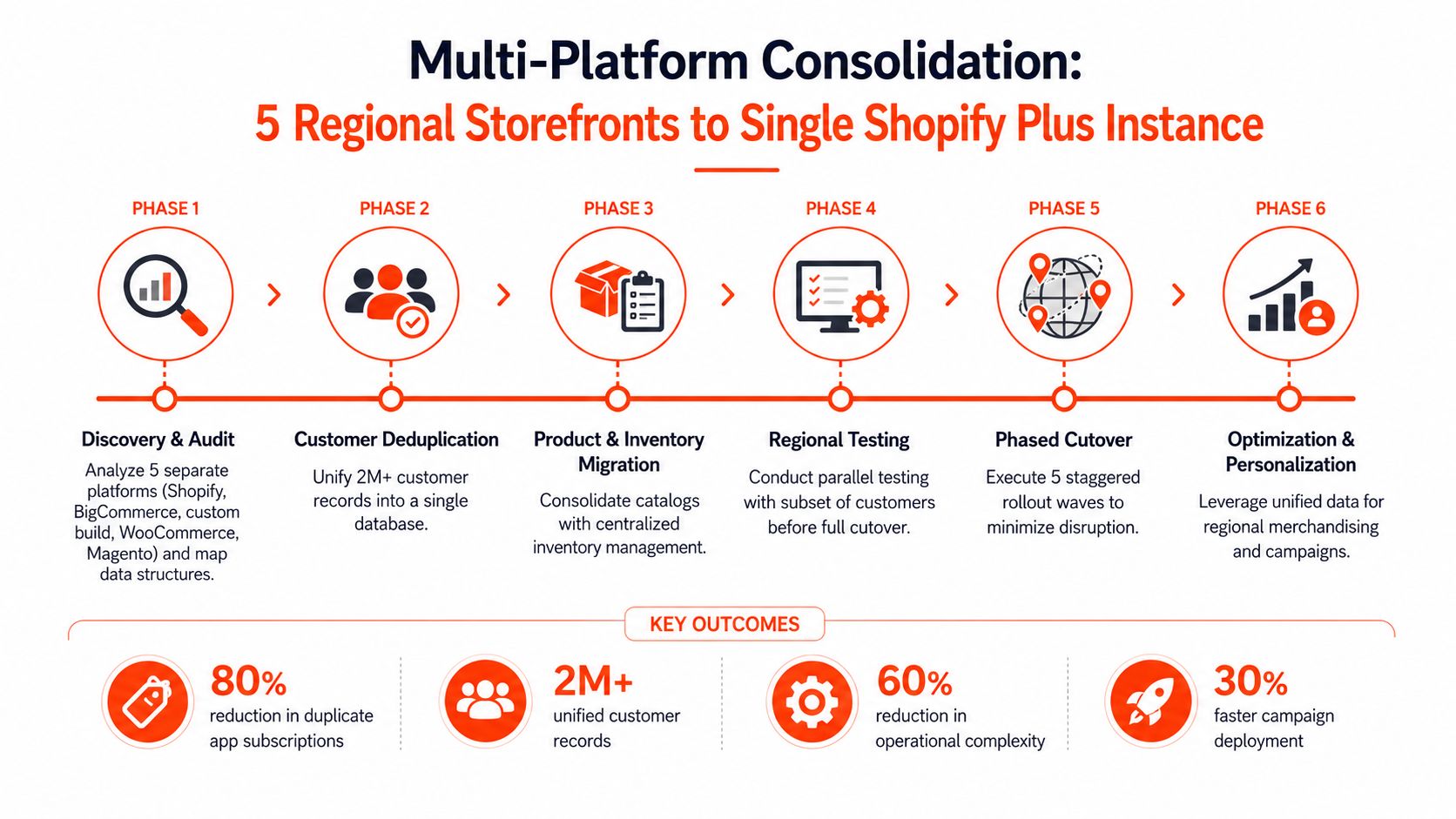
Consolidating five regional storefronts into one Shopify Plus instance is less about changing themes and more about creating a single source of operational truth. Acquisition history, regional exceptions, duplicated apps, inconsistent product structures, and disconnected customer data can make the existing model expensive to operate even when each individual store appears functional.
The beauty-retail scenario supplied for this pattern used competitive analysis across the source platforms, phased product migration, category remapping, unified customer records, and centralized inventory management. It reports substantial reductions in app redundancy and operational complexity, as well as a unified customer base. The key commercial benefit is not merely fewer systems. It is the ability to coordinate inventory, merchandising, reporting, and customer experience from a common foundation.
Reconcile before you consolidate
A single customer database can create duplicate-account problems if teams merge records without clear matching rules. Inventory consolidation creates a similar risk when regional stock identifiers, warehouses, availability rules, and fulfillment promises differ. Presidio's guidance on multiple storefronts in Shopify provides useful context for thinking through storefront architecture, but the merchant still needs a data model customized to its operating structure.
Regional testing should use representative customers, products, discounts, shipping destinations, tax conditions, and fulfillment paths. A parallel operating period can expose synchronization defects before the legacy stores are retired. Customer communications should explain account changes, saved addresses, order-history access, and any password-reset requirements in clear language.
Consolidation creates leverage only after the merchant standardizes the rules that the old storefronts handled differently.
For a national beauty retailer, the next opportunity is regional merchandising and personalization. A unified platform can make coordinated campaigns easier, but teams shouldn't remove every regional distinction. The transferable tactic is to centralize shared operations while preserving differences that affect customer demand or compliance.
7. Headless Migration to Shopify Plus
Headless migration is the most architectural pattern in this comparison. A high-fashion brand may want Shopify Plus for products, carts, checkout, orders, and app connectivity while retaining a custom frontend for distinctive design, editorial presentation, or omnichannel experiences.
The supplied scenario moved commerce logic from a legacy backend to Shopify Plus while preserving the custom frontend through the Storefront API and App Bridge. It reports lower infrastructure costs and faster development velocity, while retaining design flexibility and enabling personalization such as recommendations and quiz-led merchandising. That result depends on disciplined API design, observability, and a clear decision about which logic belongs in Shopify, the frontend, or an external service.
Migrate the backend in controlled layers
Preserving the frontend initially can reduce visual and brand risk, but it doesn't eliminate technical risk. API performance, caching, product availability, cart behavior, authentication, checkout handoff, error states, and third-party app compatibility all need dedicated tests.
A sensible sequence is:
Map custom services: Identify every legacy endpoint, data transformation, scheduled job, and commerce rule before replacing backend behavior.
Define API ownership: Decide which system owns catalog data, pricing, inventory, customer identity, cart state, and order status.
Monitor the boundary: Add API latency, error, timeout, and failed-cart monitoring before cutover.
Prefer proven extensions: Evaluate Shopify-native applications such as Quiz Kit for personalization before rebuilding equivalent functionality from scratch.
The composable commerce explanation from Presidio helps frame the tradeoff. Headless gives a brand more control over presentation, but it also creates more integration surfaces to operate. The pattern is replicable for luxury and high-fashion brands with genuine frontend requirements. It isn't automatically the best choice for a merchant whose main problem is maintenance complexity.
7-Case Ecommerce Migration Comparison
Project | 🔄 Implementation Complexity | 💡 Resource Requirements & Risks | 📊 Expected Outcomes | Ideal Use Cases | ⭐ Key Advantages / ⚡ Speed |
|---|---|---|---|---|---|
Enterprise Migration from Magento to Shopify Plus: Multi-Channel Consolidation | High, 6–8 month phased migration; extensive data mapping, parallel testing, custom apps/Functions | Dedicated engineering + consultants; ERP reintegration; significant data transformation & staff retraining | 📊 65% faster page loads, 40% lower ops overhead, preserved 500K+ SKUs & history, faster feature launches | Multi-brand retailers consolidating storefronts; mid-market apparel/beauty moving off Magento | ⭐ Unified merchandising & customer data, reduced TCO; ⚡ launches 3–4x faster |
WooCommerce to Shopify Migration: WordPress-Native Store Transition | Medium, product/catalog rebuild, SEO 301 redirects, theme redevelopment, content migration | Small-to-mid teams; SEO, CRO, and export tools (e.g., Duplify); moderate cost and learning curve | 📊 45% faster checkout, 25% conversion uplift, 18% lower abandonment, eliminated plugin conflicts | Small–mid DTC brands outgrowing WordPress; subscription and creator brands | ⭐ Access to Shopify ecosystem & stability; ⚡ improved checkout and mobile performance |
BigCommerce to Shopify Plus: Enterprise Feature Parity and Performance Gains | High, 8–10 month project; custom Functions to replicate dynamic pricing, tiered discounts, B2B workflows | Enterprise dev teams + consultants; ERP sync; substantial custom development and testing | 📊 52% faster load times, 35% cost reduction, 3x faster feature releases, improved CRO capabilities | Mid-to-large fashion and B2B/D2C retailers needing complex pricing & wholesale features | ⭐ Feature parity via custom Functions; ⚡ better scalability and faster release cycles |
Shopify to Shopify Plus Upgrade: Scalability and Advanced Features Unlock | Medium–High, theme architecture rebuild, Flow automation, multi-market setup, phased rollout | Plus subscription budget; specialized engineers; ongoing optimization and maintenance | 📊 40% faster deploys, 60% reduction in manual ops, supports 4M+ monthly transactions, international expansion | High-growth DTC brands, subscription-heavy CPGs, international expansion-focused retailers | ⭐ Native enterprise features & automation; ⚡ faster experimentation and scaling |
Custom Platform to Shopify: Legacy System Modernization and Data Recovery | Very high, reverse-engineer legacy DB, validate 20 years of data, phased hybrid migration (4–5 months) | Senior engineers and data specialists; heavy validation effort; high cost and hybrid operations risk | 📊 70% IT maintenance cost reduction, monthly feature releases, +60% mobile conversions, improved CX | Long-established specialty retailers with highly customized legacy platforms | ⭐ Eliminates technical debt and modernizes stack; ⚡ dramatically faster time-to-market |
Multi-Platform Consolidation: 5 Regional Storefronts to Single Shopify Plus Instance | Extremely high, 6–9 month consolidation, extract & reconcile data from 5 platforms, multi-wave cutovers | Large cross-functional team; significant consulting & change management; deduplication complexity | 📊 80% reduction in duplicate apps, unified DB 2M+ customers, 60% reduction in operational complexity, faster campaigns | National retailers with acquisition-driven fragmentation or regional storefronts | ⭐ Centralized operations and analytics; ⚡ 30% faster campaign deployment |
Headless Migration to Shopify Plus: Composable Commerce Implementation | High, preserve custom frontend while migrating backend to Storefront API; complex API integration & testing | Frontend and Shopify API expertise; API monitoring; moderate–high ongoing dev costs | 📊 55% backend infra cost reduction, 40% faster development cycles, improved personalization & performance | High-fashion/luxury DTCs or brands requiring bespoke frontend experiences and omnichannel | ⭐ Preserves design flexibility while gaining Shopify ecosystem; ⚡ faster feature development and lower infra costs |
Turn Migration Evidence Into a Safer Roadmap
Across these seven patterns, the strongest lesson is that migration outcomes follow preparation quality more closely than platform labels. Shopify's 2026 replatforming guide reports that brands migrating to Shopify implement, on average, 20% faster, are 66% more likely to implement on time, and are 3x more likely to implement on budget (Shopify migration analysis and replatforming insights). Those figures describe a measurable execution advantage, but they don't remove the need for data governance, integration testing, SEO control, and post-launch ownership.
Independent research cited in recent industry coverage reports that 77% of businesses planning a platform move aim to migrate within the next year, while 90% of recent migrators reported sales and revenue improvements after switching platforms (replatforming and Shopify analytics trends). The evidence supports migration as a growth lever, but it also suggests that teams should define the growth mechanism before they start. Faster releases, fewer operational failures, better checkout performance, centralized inventory, and improved discovery are different objectives and require different implementation choices.
A practical roadmap should follow this sequence:
Baseline the source store: Record organic traffic, indexed URLs, rankings, conversion, average order value, checkout completion, page performance, fulfillment timing, support volume, and integration health.
Audit and cleanse data early: Reconcile products, variants, customers, orders, redirects, content, subscriptions, inventory, and permissions before the build reaches final testing.
Document legacy logic: Write down discounts, tax rules, shipping conditions, account behavior, ERP flows, marketplace connections, and manual exceptions.
Test in parallel: Use a staging environment and representative orders to validate checkout, payments, discounts, fulfillment, customer accounts, subscriptions, analytics, and integrations.
Protect organic visibility: Map legacy URLs, preserve canonicalization and structured data, test redirects, check 404s, and monitor indexed URL retention after launch. This deserves special attention because one documented migration lost 40% of organic traffic within two weeks after extensive URL changes and technical SEO failures (post-launch ecommerce migration SEO case study).
Train operators: Give merchandising, customer service, fulfillment, finance, and marketing teams scenario-based training before cutover.
Reserve post-launch capacity: Review errors, search visibility, conversion paths, product discovery, and operational workflows, then turn findings into a CRO and development roadmap.
The most dangerous migration is the one that technically launches but leaves the team unable to explain what changed. Presidio can be a relevant option for migration planning, custom Shopify development, integrations, performance work, headless storefronts, and ongoing optimization. Broader SME digital transformation insights can also help leadership connect platform decisions with wider operational change.
A migration case study is useful only when it exposes decisions, not just outcomes. Ask what data moved, which logic changed, how the rollout was controlled, what broke after launch, and who owned the fixes. Those answers will tell you whether a proposed Shopify migration can be repeated in your environment.
Presidio provides staged migrations to Shopify and Shopify Plus, custom themes and apps, systems integrations, headless storefront development, performance tuning, and ongoing CRO support. If you're planning an ecommerce migration case study for your own brand, visit Presidio to discuss the architecture, data, testing, and post-launch work your roadmap requires.

Jamie, Presidio’s Designer, leads the practice alongside Johnnie. With over 10 years of e-commerce experience, Jay is a Shopify expert, known for crafting innovative solutions that prevent tech debt.
Jaime
Senior Product Designer, 2020