Outrank AI

The usual advice for choosing an e commerce growth agency is to compare case studies, check reviews, and book discovery calls. That's not enough. A persuasive agency can show attractive storefronts and revenue charts without proving that it can diagnose checkout friction, maintain your Shopify theme, or measure whether its work increased profit.
Start with the foundations instead: checkout usability, technical quality, accessibility, and consent-aware personalization. Give each a place in your scorecard and a question in your request for proposal. Then buy a bounded piece of work that lets the delivery team demonstrate its judgment before you commit to a retainer.
Table of Contents
Scope the Program Before You Talk to Agencies
Buying a growth label before defining the work makes proposals impossible to compare. One candidate may quote paid acquisition, another a theme rebuild, and another ongoing development. None is necessarily wrong, but they're pricing different problems.
International scope needs particular care. DHL eCommerce's 2025 survey covered 4,050 e-commerce businesses across 19 global markets, a useful reminder to specify the markets and operating systems your agency must support rather than treating ecommerce as a single-market storefront exercise.
Use a working session to connect visible problems to accountable owners.

Turn Symptoms Into Workstreams
Write a diagnostic sentence for each area, using your own reporting rather than assumptions:
Conversion work: Mobile visitors reach checkout but fail to complete, suggesting a checkout, cart, or payment investigation.
Technical quality: Product pages slow after merchandising adds scripts, so audit app weight, loading behavior, and accessibility.
Data and analytics: Shopify orders and purchase events disagree, making campaign and experiment reporting unreliable.
Personalization and merchandising: Quiz users view recommendations but rarely add products, so investigate recommendation relevance and consent handling.
Post-launch support: Warehouse sync failures leave inventory inaccurate, requiring integration monitoring rather than another landing-page redesign.
Treat these as hypotheses, not diagnoses. A falling completion rate might reflect payment failures, a shipping-policy change, or traffic quality.
Build the Scope Brief
Give every candidate the same concise document:
Trading baseline: Sessions and conversion rate by device, with seasonal context.
Suspected blockers: The most important problems, each paired with the metric it could affect.
System inventory: Shopify or Shopify Plus, ERP, 3PL, payments, subscriptions, analytics, and middleware.
Revenue exposure: Rank workstreams by affected transactions, customer impact, and operational risk.
For complicated system connections, use the considerations in our Shopify integration services guide to distinguish storefront work from back-office dependencies.
Ask who performs each workstream and whether subcontractors are involved. A candidate who requests this context before quoting is exercising judgment. Someone who prices an undefined growth program is selling a label.
Weighted Scorecard for Comparing Candidates
Build your scorecard before the first pitch. Otherwise, the team with the strongest presentation can win while the team with the stronger engineering and measurement practices loses.
The weights below are a recommended purchasing framework, not an industry benchmark. Score each criterion from absent evidence through convincing, relevant evidence, then apply its weight. Keep reviewers' original scores before discussing differences so enthusiasm doesn't erase legitimate concerns.
Scorecard Criteria, Weights and Red Flags
Criterion | Weight | Evidence to request | Red flag |
|---|---|---|---|
Platform depth | 20 points | Shopify Plus migrations and checkout extension work with named case studies | Generic CMS experience presented as Shopify expertise |
Experimentation method | 20 points | Test plans with hypothesis, sample size, duration and guardrail metrics | Promised uplift percentages with no test design |
Funnel and analytics | 15 points | Event map, device and market segmentation, analytics access arrangements before signing | Refuses dashboard access or reports only blended averages |
Technical quality | 15 points | Core Web Vitals before and after, accessibility audit results, app count and script weight | Treats speed and accessibility as optional extras |
Team and communication | 15 points | Named senior lead, weekly cadence, and who writes the code | Senior staff appear in the pitch while juniors deliver without meaningful oversight |
Commercial terms | 15 points | Itemized pricing, exit clause, code and data ownership | Long lock-in with unclear ownership of theme and customer data |
A before-and-after chart with a defined population and test duration deserves more credit than a logo wall. Ask what changed alongside the intervention, whether the comparison included a promotion, and whether the agency can distinguish measured results from plausible explanations.
Technical evidence matters. Goodface's UX statistics compilation cites Deloitte research associating a 0.1-second mobile speed improvement with an 8.4% retail conversion increase. That isn't a forecast for your store. It's a reason to request relevant performance evidence instead of accepting a desktop Lighthouse screenshot as proof of commercial impact.
Make the Foundations Explicit
Keep checkout friction inside platform depth and experimentation. Require the candidate to explain what Shopify permits, what requires an extension, and what belongs to payment or operational teams.
Within the recommended technical-quality allocation, I would reserve explicit scoring for accessibility, rather than letting speed consume the entire category. Request keyboard testing, screen-reader findings, defect severity, and evidence that fixes survive theme updates. Automated scans alone shouldn't earn full credit.
Score consent-aware personalization under experimentation and analytics. A candidate should describe eligible audiences, consent states, non-personalized fallbacks, and holdout measurement, rather than merely demonstrating a recommendation widget.
Selection rule: A high total shouldn't compensate for missing checkout competence or an inability to design a credible experiment.
Set minimum acceptable evidence for those capabilities before reviewing proposals. A polished account team can't substitute for either.
RFP Questions That Expose Real Experience
What did your last failed test change about your next decision? That question is harder to dodge than a request for a success story. A useful answer identifies the original hypothesis, the evidence against it, and what the agency stopped doing afterward.
Send the following questions in your RFP. Request redacted artifacts where client confidentiality prevents disclosure, and score the specificity of the answer rather than the confidence of the presenter.
Questions Worth Copying
Checkout competence: Show a Shopify Plus checkout you rebuilt. What were completion rates before and after, which shoppers were included, and what else changed?
Testing judgment: Which experiment did you stop early, and why? Distinguish a safety stop from stopping because a favorable result appeared.
Segmentation: How do you respond when the aggregate result improves but mobile performance declines in an important country?
Commercial trade-offs: What happens when conversion improves but average order value or contribution margin falls? Who decides whether the change stays?
Delivery team: Who will edit our theme, review pull requests, and approve releases? State the proposed allocation by role and identify subcontractors.
Exit readiness: If we terminate, how do we receive code, experiment logs, documentation, account access, and unresolved issues?
Consent handling: How do personalized experiences change by region and consent state? Show preference controls, withdrawal behavior, and the fallback experience.
App discipline: Which apps would you add, why are they necessary, and how would you remove their scripts, data dependencies, and theme changes?
Failure analysis: Describe a failed test and the decision it changed. Explain how you ruled out implementation or tracking errors.
Look Beyond the Recommendation Widget
Consent deserves a substantive answer. Adobe's 2025 retail report found that 87% of consumers expect retailers to handle personal data responsibly, while only 46% believe brands do; 74% want disclosure when AI-generated content, recommendations, or images are used.
A credible response connects privacy decisions to implementation. The agency should explain what a quiz stores, whether an answer becomes a marketing profile, and what happens when someone declines optional tracking. Have your privacy adviser confirm the applicable regional requirements.
Useful personalization helps shoppers choose. Aggressive profiling that makes the experience harder to understand can undermine that purpose. Ask candidates how they compare personalized and ordinary merchandising without treating immediate conversion as the only measure of success.
Engagement Models and What Each Costs You
An agency's fee structure determines which risks you retain. A fixed project transfers some delivery risk to the agency, but leaves you exposed to scope disputes. A retainer buys capacity, not automatically completed experiments or profitable growth.
There's no defensible universal price for an undefined Shopify growth program. Compare included work, delivery capacity, dependencies, and commercial exposure before comparing totals.
Engagement Models Compared
Model | How it is priced | Best fit | Main risk |
|---|---|---|---|
Project-based | Fixed fee for a defined audit, rebuild or migration | One-off replatform or checkout rebuild | Scope changes trigger costly change orders |
Monthly retainer | Fixed monthly fee for a set number of hours or a dedicated team | Ongoing CRO testing and post-launch development | Paying for hours you don't use when the roadmap stalls |
Performance-based | Percentage of agreed incremental revenue | Brands with clean attribution and stable traffic | Attribution and baseline disputes; fees move with seasonality |
Hybrid | Fixed onboarding sprint followed by a retainer | Teams that want to assess delivery before a longer commitment | Sprint ends before results emerge and retainer begins too early |
A project works when acceptance criteria are concrete: migrated records reconcile, specified checkout rules work, and agreed templates pass testing. It works poorly when the requirement is only to improve growth.
A retainer makes sense when the backlog is real and someone on your side can approve releases promptly. Clarify whether blocked hours roll over, disappear, or move to another approved task. A dedicated team and a bucket of shared hours aren't interchangeable.
Performance fees require the most negotiation. Promotions, stock availability, media spend, returns, and product launches can all affect the revenue calculation. Unless the contract explains how those changes are handled, you're negotiating a future dispute.
Demand Comparable Commercial Terms
Require the proposal to include:
Role-level capacity: Identify strategy, design, development, QA, and project-management allocations.
Revenue definitions: If compensation depends on results, define the baseline, attribution method, refunds, discounts, and exclusions.
A review and exit gate: I recommend a 90-day review with a written termination and handover mechanism.
A standalone opening price: Quote the first 90 days separately, including setup, software, and integration exclusions.
Separate creative production from storefront delivery. If your marketing team is considering the ShortGenius AI ad generator from ShortGenius for ad variations, specify who owns production, approvals, landing-page alignment, and tool charges. Don't assume a development retainer includes advertising assets.
Integrations also need explicit treatment. Our Grow service covers global expansion, ERP and 3PL hookups, and roadmap retainers; our Growth service includes international expansion and ongoing development support. Service names still aren't a substitute for a statement of work naming the systems and responsibilities.
Buy an accountable delivery agreement, not a list of capabilities that might become available after signing.
Choose the Agency and Start a Scoped Paid Audit
Choose the strongest evidenced candidate, not merely the highest total. Remove any agency that fails your minimum requirements for Shopify platform depth or experimentation, even if its commercial proposal is attractive.
Then test the relationship through a scoped paid audit. Diagnosis is a deliverable: you're buying a reliable explanation of what needs changing, why it matters, and what implementing it would require.
Make the Decision This Week
Check references: Speak with previous clients about a project that went badly. Ask how the agency communicated, corrected the work, and handled additional cost.
Commission a bounded audit: I would propose a two-to-four-week assignment, adjusted for access and system complexity, rather than an open-ended discovery phase.
Lock the deliverables: Name the team, allocated capacity, KPI definitions, exclusions, and acceptance criteria in the statement of work.
Confirm the exit: Make sure the commercial agreement provides the review point and handover obligations you negotiated.
Our Optimize service includes UX/CRO audits, conversion rate optimization, personalization, technical audits, integration strategy, and speed checks. The important buying decision is which of those disciplines your store needs first, not whether every discipline appears in the proposal.
Use our Shopify store audit guide to prepare the evidence and access needed for a useful diagnosis.
The audit should end with a ranked backlog, a measured baseline, and a reasoned retainer recommendation. Send your scope brief to the shortlist this week and request a separately priced audit against those outputs.
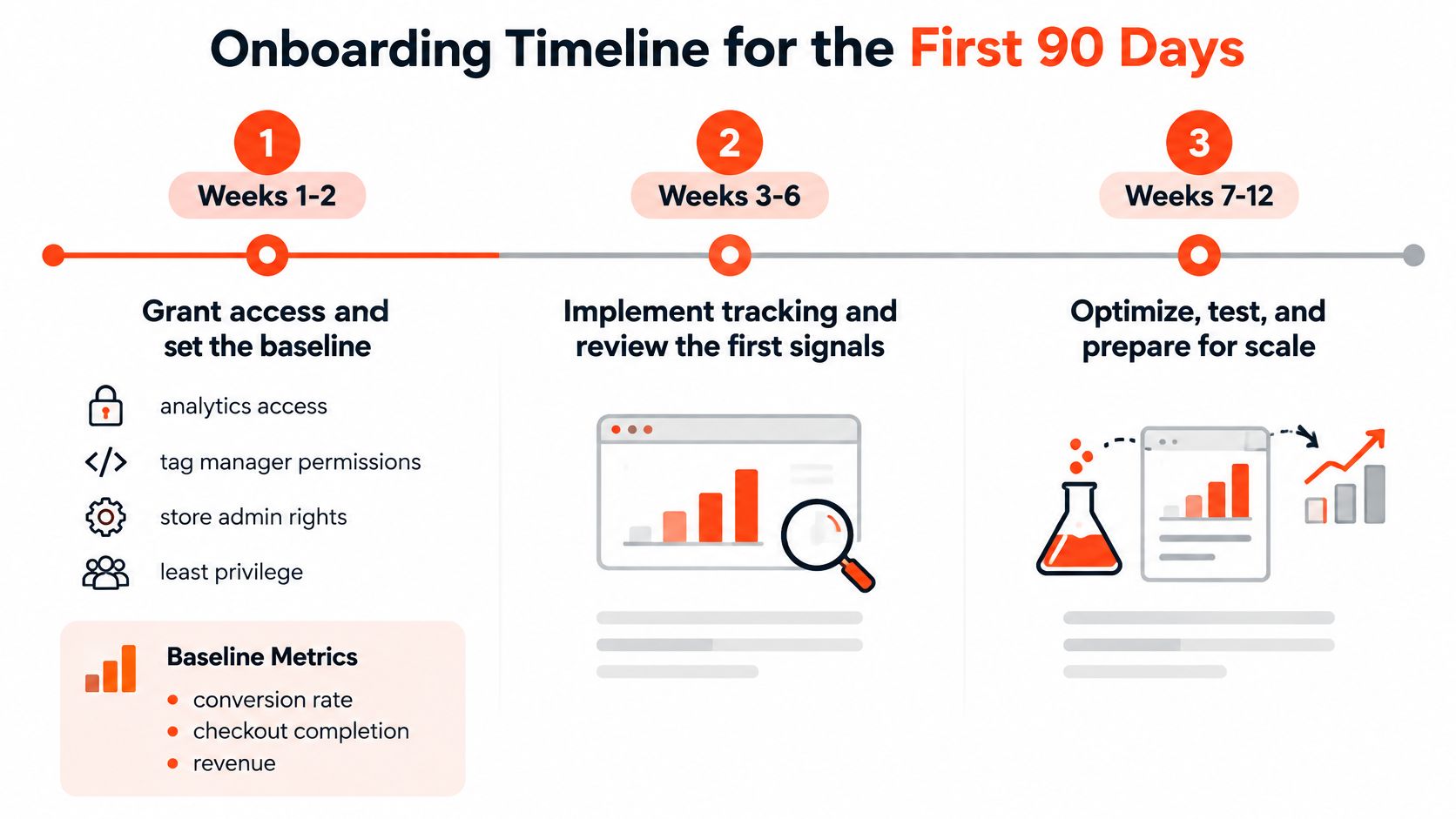
Onboarding Timeline for the First 90 Days
Treat the opening period as a sequence of decision gates, not a promise that growth will arrive on schedule. Access delays, unreliable events, and operational dependencies should change the plan rather than disappear from status reports.
Use this timeline to establish the broad sequence, then attach named owners and detailed acceptance criteria.
Establish Access and Diagnose Friction
Weeks 1–2, establish the baseline. Grant analytics access, tag manager permissions, and store admin rights using least privilege. Validate purchase events against orders, check duplicated transactions, and record conversion rate, checkout completion, revenue per session, and errors by device.
Gate: The merchant and agency agree that the reporting is reliable enough to guide priorities.Weeks 3–4, reproduce the purchase journey. Test mobile and desktop across important markets, payment methods, and customer states. Classify problems into cost transparency, delivery expectations, trust, account creation, form complexity, payment failure, and technical errors.
Gate: Approve an impact-ranked backlog with an owner for every dependency.
Baymard's checkout benchmark identifies an average U.S. checkout with 23.48 form elements displayed by default, while usability testing indicates an optimized flow can be reduced to approximately 12 elements. Use that finding to challenge unnecessary effort, not to impose a universal field count on every store.
Show estimated shipping and taxes earlier where feasible. Preserve entered information after validation errors and make guest checkout easy to find. When the underlying problem is shipping price or delivery speed, assign a commercial or operations owner instead of asking design to disguise it.
Implement and Decide What Continues
Weeks 5–8, run controlled changes. Start with the highest-impact testable hypotheses and avoid overlapping experiments that obscure interpretation. Repair broken payments and confirmed accessibility defects directly, with QA and monitoring, rather than withholding essential fixes for an experiment.
Gate: Confirm implementation quality, experiment eligibility, and the conditions for continuing or stopping.Weeks 9–12, evaluate delivery and commercial value. Review completed work, unresolved risks, results, and operational capacity. Document theme changes, app configuration, rollback instructions, and integration dependencies so another developer can maintain the store.
Gate: Renew, narrow, pause, or end the engagement based on evidence.
Accessibility QA should include keyboard navigation, visible focus, form labels, error recovery, and screen-reader checks. Payment monitoring should distinguish customer declines from integration failures so the team doesn't label every failed transaction a checkout-design problem.
Use the accompanying video as a discussion prompt alongside the written delivery plan.
The merchant's product owner should approve each gate. An agency can coordinate the work, but it can't independently change your shipping economics, inventory policy, or privacy decisions.
Measure Growth Without Fooling Yourself
A higher blended conversion rate can be misleading. It may reflect more returning customers, heavier discounting, or a change in traffic mix rather than a better shopping experience. Agree on metric definitions and denominators before implementation.
Abandonment also doesn't always indicate a defect. Baymard reports that 42% of U.S. online shoppers abandoned a cart because they were merely browsing or not ready to buy. Don't assume you can identify and exclude those individuals from analytics without an observable, justified eligibility rule.
KPIs to Agree Before Launch
KPI | What it tells you | Watch for |
|---|---|---|
Conversion rate | Share of sessions that buy | Blended averages hiding a weak device or market |
Checkout completion | Share of checkouts finished | Drops after shipping cost appears |
Revenue per session | Revenue earned per visit | Gains from a lower-margin product mix |
Average order value | Basket value per order | Conversion lifts that cut order value |
Refund rate | Refunds relative to the agreed order population | Conversion gains that raise refunds |
Contribution margin | Revenue remaining after defined variable costs | Discounts that lift volume but erode margin |
Support contacts | Customer questions per order | Changes that shift confusion into support |
Page performance | Speed and Core Web Vitals | Regressions from new apps or scripts |
Accessibility defects | Failures found in accessibility audits | Fixes deferred as optional extras |
Write down how taxes, shipping revenue, canceled orders, partial refunds, and subscription renewals enter each calculation. Otherwise, merchant and agency can report different results while both believe their dashboards are correct.
Use the visual checklist to keep measurement and decision-making connected.

Run a Defensible Decision Loop
Validate analytics and eligibility. Confirm events, assignment, consent-related measurement gaps, and the population the intervention can affect.
Combine evidence. Read funnel reporting alongside session-level errors and moderated usability sessions.
Write a falsifiable hypothesis. For example, exposing total landed cost before checkout increases mobile checkout completion.
Isolate the mechanism. Change the smallest useful component rather than bundling a redesign, promotion, and recommendation engine.
Evaluate. Use an appropriate controlled test. When traffic is insufficient, matched-cohort pre/post analysis can support decisions, but it doesn't provide the same causal confidence.
Report uplift with sample size, confidence interval, test duration, segmentation, and revenue or margin implications. Examine device, country, new versus returning customers, and traffic source without pretending every small subgroup supports a firm conclusion.
Our Shopify conversion rate optimization guide provides further context for connecting diagnosis to implementation. In our Acure work, results included conversion-optimized PDP architecture, improved Shopify mobile usability, and expanded retention and loyalty infrastructure. Those are concrete delivery outcomes, not permission to invent an uplift percentage.
A case study should distinguish what the team built, what customers did differently, and what the measurement can actually prove.
Reject universal conversion success rates. Ask which metric moved, for which shoppers, under which conditions, and whether the business retained the benefit after accounting for cost.
Presidio offers Shopify and Shopify Plus development, UX/CRO audits, technical optimization, personalization, and ongoing support to address the foundations behind sustainable growth. Visit Presidio with your scope brief to discuss a focused audit and a roadmap tied to your store's commercial priorities.