Outrank AI

Six months after moving to Shopify Plus, a mid-market apparel brand appeared to have completed a clean migration. Orders were flowing, revenue looked healthy, and the marketing team had already called the project a success.
Then fulfillment began missing service-level commitments. Inventory in Shopify drifted from NetSuite. A restock campaign promoted products that had sold out days earlier. Finance found that Shopify revenue didn't reconcile cleanly with the ledger. No platform had crashed. Each system was running, but the business was no longer operating from the same facts.
That's the post-go-live problem most Shopify integration guides skip. Failures often occur between the ERP, OMS, PIM, ESP, warehouse, and payment systems, where no single dashboard shows the full impact. Effective Shopify integration services are designed to expose those breaks early, route exceptions to accountable people, and keep the commerce operation honest after launch.
Table of Contents
When Your Shopify Stack Quietly Stops Working
The apparel brand's first visible symptom was a fulfillment delay. The warehouse wasn't necessarily at fault. Shopify had accepted orders, NetSuite had received records, and the warehouse system had processed inventory updates. The problem was a mismatch in timing and ownership. One system treated a stock adjustment as authoritative while another continued publishing the older available quantity.
Marketing amplified the problem. The ESP received a product availability event that looked valid, so it sent a campaign. The event didn't carry enough context to show that a pending allocation had already consumed the remaining units. Customers clicked through to products they couldn't buy, while paid media continued supporting the campaign.
The damage appears outside the integration dashboard
These incidents rarely announce themselves as integration failures. They show up as:
Fulfillment exceptions: Orders sit in a queue because a SKU, address, tax value, or warehouse code doesn't match the receiving system.
Inventory disputes: Merchandising sees sellable stock while operations sees reserved, damaged, or unavailable units.
Financial reconciliation work: Finance exports records from several systems and manually explains why totals differ.
Customer experience costs: Support teams respond to shipment delays, cancellation notices, and inaccurate back-in-stock messages.
Marketing waste: Campaigns and audiences use stale product or order events even though the ESP reports successful ingestion.
Practical rule: A successful API response proves that a message was accepted. It doesn't prove that the business process completed correctly.
The remedy isn't adding another connector. The team needs explicit ownership for each data object, event-level monitoring, retry behavior, reconciliation reports, and alerts that distinguish a temporary delay from a business exception. A Shopify integration should fail loudly enough that an operations manager can act before customers, carriers, or the CFO discover the problem.
What Shopify Integration Services Actually Cover
Shopify integration services are the consulting and engineering work required to connect Shopify with the systems that run commerce outside the storefront. That work includes discovery, data modeling, field mapping, API and webhook implementation, testing, monitoring, documentation, and post-launch support.
Think of Shopify as the visible sink in a house. Customers interact with the sink, but the house depends on pipes, valves, drains, and pressure regulators. Installing a faucet doesn't mean the plumbing works. In the same way, installing a Shopify app creates a connection, but it doesn't define what happens when data is missing, delayed, duplicated, or rejected.
Four practical service categories
Systems integration connects Shopify with an ERP such as NetSuite, SAP, or Microsoft Dynamics, plus OMS, WMS, and PIM platforms. The work determines which system owns inventory, pricing, product content, order status, purchase orders, returns, and financial records.
Channel integration extends commerce into Amazon, TikTok Shop, retail POS, and other marketplaces. These flows must coordinate listings, availability, pricing, orders, fulfillment updates, and cancellations without allowing one channel to publish stale information.
Marketing and customer data integration sends order, customer, consent, product, and behavioral events to tools such as Klaviyo, GA4, CRM platforms, CDPs, Meta Conversions API, and Postscript. The important question isn't whether an event was sent. It's whether the receiving system can interpret it consistently.
Custom development supports headless and composable storefronts, Shopify Functions, custom checkout behavior, proprietary pricing, and business rules that standard apps can't express. Teams evaluating this path should also understand the staffing implications through a practical guide to hiring API developers.
An app is therefore a component, not an integration strategy. The service layer decides how components fit together, how exceptions are handled, and who owns the system after release.
The Integration Types That Matter Most for Growing Brands
Growing brands don't need every possible integration. They need dependable control over the flows that affect cash, inventory, customer promises, and decision-making.
ERP integration
An ERP such as NetSuite, SAP, or Microsoft Dynamics typically connects orders, customers, products, inventory, purchase orders, tax values, returns, and financial postings. The operational risk is reconciliation drift. If Shopify records an order differently from the ERP, finance may spend days resolving discrepancies while operations works from incomplete information.
A healthy ERP flow has documented field ownership, predictable order-state translation, rejected-record handling, and a reconciliation process. Shopify's ERP integration guidance emphasizes certified apps, field mapping, and synchronization frequency, while complex histories may still require staged loads, custom scripts, and sandbox validation.
OMS and fulfillment orchestration
An OMS, Shopify Flow, Fluent Commerce, or a custom orchestration layer connects storefront orders to warehouses, stores, 3PLs, and customer service workflows. It should account for split shipments, backorders, reservations, holds, cancellations, and returns.
The failure signal is often a customer-facing status that doesn't match warehouse reality. Healthy orchestration exposes each order state, records why an order is held, and returns tracking or exception data to Shopify.
PIM and catalog governance
A PIM such as Akeneo, Salsify, or an in-house catalog service connects product attributes, media, taxonomy, translations, regional rules, and channel content. Misconfiguration creates inconsistent titles, missing compliance information, incorrect variants, or localized pages with conflicting values.
A healthy PIM integration validates required fields before publication and records which source supplied each value. Brands expanding across markets should treat catalog governance as an operating discipline, not a bulk import task.
Marketing, payments, tax, and composable builds
Klaviyo, Meta Conversions API, GA4 server-side tracking, and Postscript depend on reliable customer and order events. Client-side pixels alone are less dependable as browsers restrict cookies and tracking behavior, so server-side event design and identity handling matter.
Payments and tax systems, including Shopify Payments, Avalara, and TaxJar, connect transactions, authorizations, refunds, tax decisions, and settlement data. The failure signal is a mismatch between checkout behavior, tax records, and financial reporting.
In a headless build, the storefront, checkout experience, and backend services are decoupled. That creates flexibility, but it also increases the number of contracts that must be tested. A useful reference for the architectural trade-offs is this discussion of ERP and ecommerce integration.
Integration Type | Systems Connected | Main Operational Role | Common Failure Signal |
|---|---|---|---|
ERP | Shopify, NetSuite, SAP, or Microsoft Dynamics | Finance, inventory valuation, purchasing, reconciliation | Orders or totals fail to reconcile |
OMS | Shopify, warehouses, stores, 3PLs | Routing, reservations, split shipments, returns | Orders remain held or show incorrect status |
PIM | Shopify, Akeneo, Salsify, channels | Product data and localization governance | Listings contain stale or incomplete attributes |
Marketing | Shopify, Klaviyo, GA4, CRM, CDP, Meta | Audiences, lifecycle events, attribution | Campaigns use stale or duplicated events |
Payments and tax | Shopify Payments, Avalara, TaxJar | Authorization, refunds, tax calculation, settlement | Tax or payment records disagree |
Headless | Storefront, Shopify, checkout, backend services | Composable customer experiences | Frontend and commerce state diverge |
Native Apps vs Custom Middleware
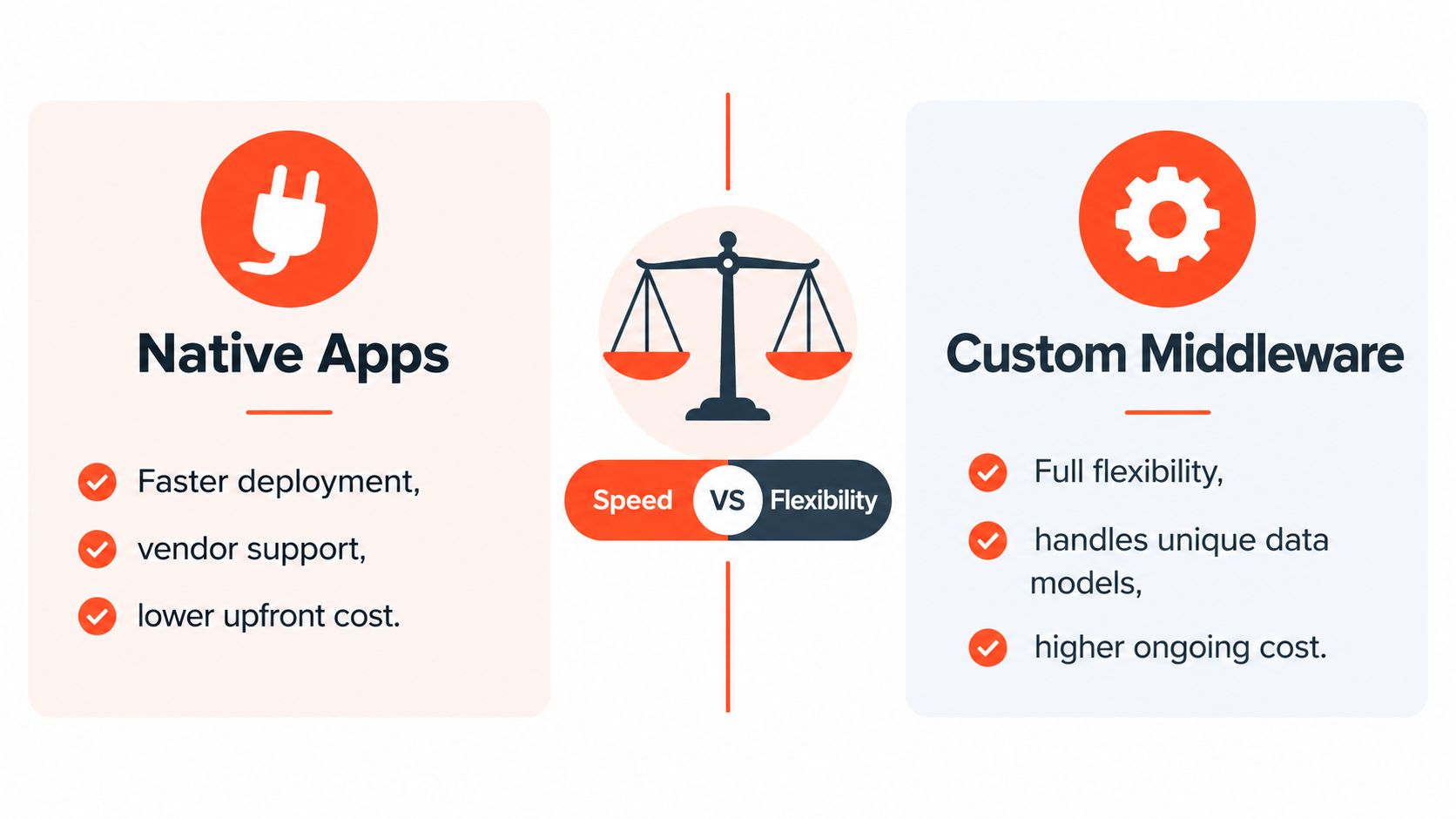
A native app is usually the right answer when the target systems and operating process already fit the connector's data model. It can deploy quickly, come with vendor support, and reduce upfront engineering. The trade-off is limited visibility into transformations, dependence on a vendor's roadmap, and possible gaps around unusual workflows.
Custom middleware earns its place when the business needs a shared rule layer across several systems. It can transform data, route events, apply validation, manage retries, and keep one business process from being duplicated across multiple point-to-point connectors.
Use a decision test, not a preference
Choose a native app when requirements are standard, the connector exposes useful logs, support is responsive, and the internal team doesn't need bespoke routing. A catalog sync or straightforward marketing connection often belongs here.
Choose middleware when the brand has multiple channels, complex inventory reservations, nonstandard pricing, B2B account rules, historical data requirements, or a need to coordinate ERP, OMS, PIM, and ESP behavior through one observable layer. The cost is ongoing engineering ownership, monitoring, security review, and maintenance.
The same principle applies to headless ecommerce development services. Decoupling the storefront can solve real experience and composability requirements, but it won't compensate for weak data contracts or unclear system ownership.
Shopify's API behavior should influence either design. The GraphQL Admin API limits use calculated query costs, with Shopify Plus allowing 1,000 points per second and Commerce Components allowing 2,000 points per second. The REST Admin API limits are 2 requests per second on Standard, 4 on Advanced, and 20 on Shopify Plus. These constraints favor webhook-led updates, batching, selective reads, queues, and backoff over chatty polling.
How a Shopify Integration Project Is Actually Run
The strongest projects begin with operational discovery, not connector configuration. Before anyone chooses an app or writes middleware, the team maps every system touching product, order, customer, inventory, payment, and fulfillment data.
Discovery and planning
Discovery should produce a system map, field-level data dictionary, ownership matrix, order-state model, and failure catalog. The team should answer practical questions:
Source of truth: Which system owns inventory, price, product content, tax, customer status, and order state?
Direction of flow: Which values move from Shopify outward, and which values return to Shopify?
Latency expectation: Which updates must be event-driven, and which can run in controlled batches?
Exception ownership: Who acts when a SKU is missing, an address is invalid, or a downstream API rejects a record?
Security boundary: Which credentials, customer fields, and operational records require restricted access?
The architecture then follows the business model. The design may combine native apps, Shopify webhooks, GraphQL, queues, middleware, scheduled reconciliation, and structured logs. Teams should define retry limits and dead-letter handling before production, not after the first incident.
Build, test, and cut over
Development should start with sandbox flows and representative records. Testing must go beyond the happy path and include edited orders, cancellations, partial fulfillment, refunds, duplicate events, missing products, inventory conflicts, delayed responses, and invalid addresses.
A controlled Shopify migration services process is especially important when historical orders, customers, products, and regional catalog data enter the new stack. Migration guidance from Refact's data migration analysis warns that integrations can fail after launch and recommends hyper-care and incremental or delta synchronization. It also notes that a single integration can add about 60 hours of migration work, while six or more integrations can create non-linear conflict costs.
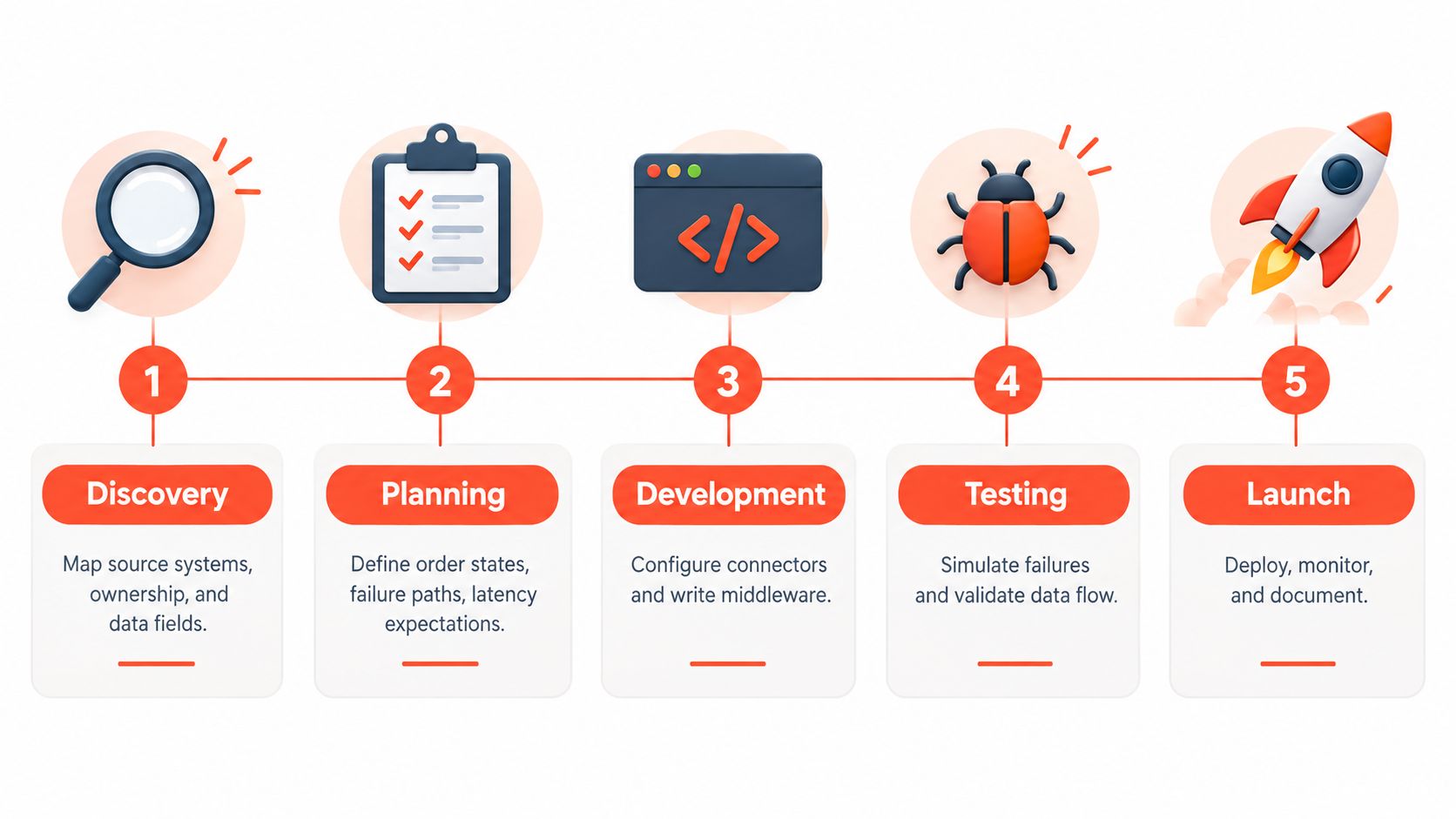
Cutover needs sequencing, backfill rules, rollback criteria, and named owners. After launch, monitor queue depth, synchronization latency, rejected records, duplicate events, and business exceptions. Hyper-care isn't a ceremonial support window. It establishes the daily operating rhythm that keeps silent failures from becoming financial surprises.
Cost, ROI, and the Maintenance Budget Most Brands Underestimate
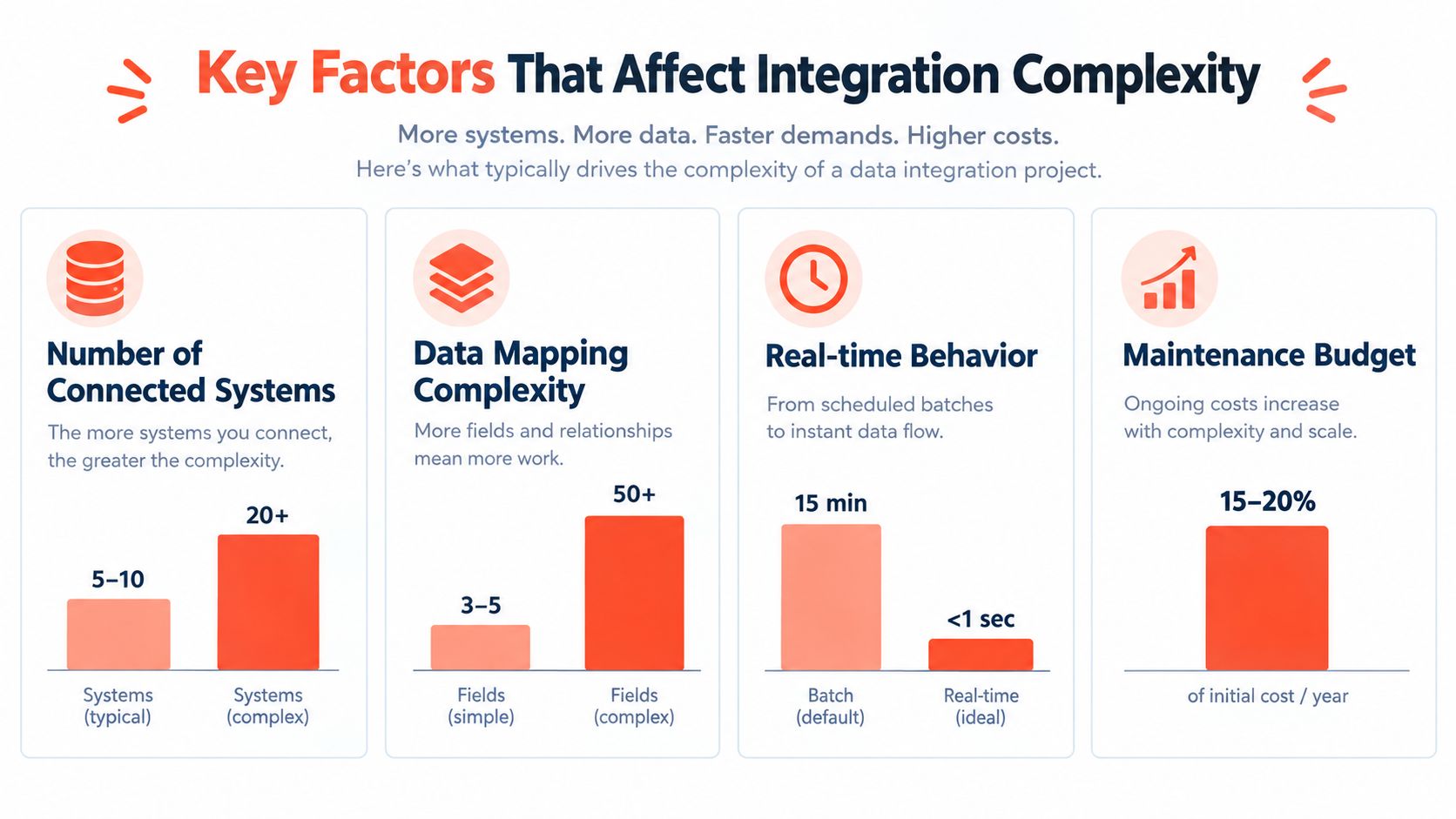
Integration cost follows complexity, not the number of logos in an architecture diagram. A simple marketing connection may need limited mapping, while an ERP and OMS program may require extensive rules for inventory, returns, reservations, payment states, tax, and reconciliation.
The main cost drivers are:
Connected systems: Each platform introduces contracts, credentials, version changes, and failure paths.
Data mapping: Standard fields are easy. Historical records, bundles, localized catalogs, and custom order states require interpretation.
Timing requirements: Real-time behavior demands event handling and operational monitoring. Batch flows require reconciliation and clear freshness expectations.
Exception design: Every business exception needs a decision, owner, alert, and recovery path.
Security and compliance: Customer and financial data may require additional access controls and review.
Measure operational value
ROI shouldn't stop at development spend. Establish a baseline for manual order entry, reconciliation effort, inventory disputes, fulfillment exceptions, chargebacks, customer-service contacts, and reporting delays. After launch, compare the same measures once teams have adopted the new process.
A credible business case can include:
Labor reduction: Fewer exports, spreadsheets, and manual corrections.
Revenue protection: Fewer oversells, missed allocations, and invalid promotions.
Faster operations: Quicker order release, refund handling, and financial close.
Better trust: Fewer shadow reports and fewer disputes over which system is correct.
Post-launch maintenance is the expense many budgets omit. Product fields change, promotions create new states, tax rules evolve, third-party APIs are revised, and teams introduce new exceptions. Reserve capacity for monitoring, connector upgrades, regression testing, incident response, and synchronization cleanup.
Why Fewer Connections Usually Beat More
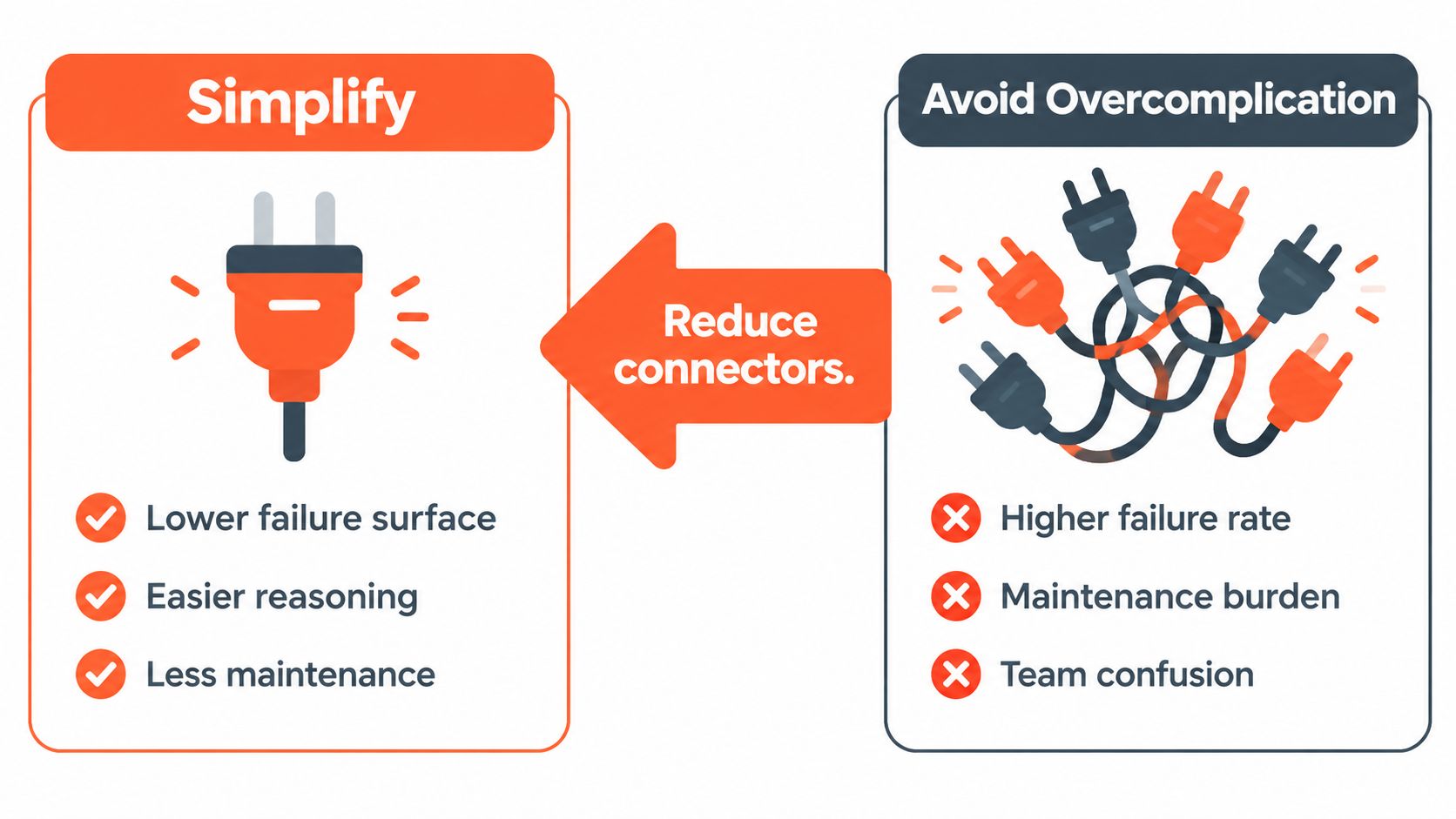
More apps don't automatically create a more capable commerce stack. Each connector adds another place where credentials expire, field meanings diverge, events duplicate, and ownership becomes unclear.
A brand may add separate tools for routing, inventory allocation, returns, marketplace orders, and fulfillment alerts. If those tools each try to update the same order or stock field, the team inherits competing interpretations of truth. One consolidated OMS or a carefully designed middleware layer can reduce that ambiguity.
Audit the stack as an operating system
Start with an inventory of every connector and the flow it supports. Retire orphaned automations, duplicate data paths, and apps that no longer sit on a critical business process. Require each remaining connection to have an owner, a documented purpose, an alert path, and a recovery procedure.
A lean stack isn't defined by having fewer tools at any cost. It's defined by having fewer unclear relationships between tools.
Prefer systems with open APIs, durable webhook support, usable logs, and exportable data. A closed marketplace may make installation easy while making future migration, debugging, or consolidation difficult. Lean architecture improves reasoning. When an incident occurs, the team can identify the path, isolate the failed handoff, and repair the process instead of searching through an app maze.
How Presidio Approaches Shopify Integration Services
Presidio treats integration as a systems problem, not an app installation exercise. Its approach starts by mapping the platforms that touch product, order, customer, and inventory data, then defining a target architecture with explicit owners for each connection.
Discovery creates the control layer
The engagement typically begins with a focused discovery phase. The team examines replatform timing, data ownership, current synchronization paths, operational service levels, historical data, and the consequences of third-party app changes or deprecation.
The deliverable isn't just a connector list. It should show:
The intended architecture: Which systems connect directly and where a shared integration layer is useful.
The data contract: Which fields move, in what direction, under which conditions.
The incident model: How failures surface, who receives them, and how records are replayed or reconciled.
The ownership model: Which internal and external teams maintain each workflow after launch.
Presidio combines Shopify Plus architecture with ERP and OMS capability so integration decisions stay connected to storefront, fulfillment, and finance realities. Delivery can be organized into an integration blueprint, build and configuration, user acceptance testing against failure scenarios, and a hyper-care period for sync incidents.
The right question is what remains after launch
Before signing with any integration partner, ask who will support the connection when a product model changes, a warehouse adds a new status, or an app vendor changes its API. Ask how the partner handles order edits, partial fulfillment, refunds, missing SKUs, retries, and reconciliation. Those answers reveal more than a polished demonstration.
Presidio's work can include Shopify and ERP connectivity, custom application and theme development, migrations, and ongoing technical support. The intended outcome is a maintainable commerce system with fewer unnecessary connections, clearer alerts, and documented ownership.
If ERP, OMS, PIM, and marketing data are drifting after your Shopify launch, Presidio can map the failure paths, design the integration architecture, and build the monitoring and recovery processes your team needs. Visit Presidio to discuss a phased Shopify integration plan that makes operational errors visible before they reach customers or finance.

Jamie, Presidio’s Designer, leads the practice alongside Johnnie. With over 10 years of e-commerce experience, Jay is a Shopify expert, known for crafting innovative solutions that prevent tech debt.
Jaime
Senior Product Designer, 2020