Outrank AI

The most popular pricing advice for DTC brands is also the most dangerous: lower the price whenever conversion slows. That approach treats price as a campaign lever instead of part of the product, brand, and customer experience. It can create a short-term response while teaching shoppers that the published price isn't real.
Strong retail pricing strategies do more than match competitors or add a margin to cost. They define where a brand sits in the market, how customers judge value, when promotions are justified, and how Shopify should enforce the rules. The best system protects contribution margin without making customers feel manipulated.
Table of Contents
The Hidden Cost of Perpetual Promotions
A sitewide sale can rescue a slow week, but it can't become the commercial operating system. When customers see the same product discounted repeatedly, they learn to postpone the purchase. The promotion stops feeling like an opportunity and starts feeling like the normal route to checkout.
That behavior weakens the product's internal reference price, the benchmark shoppers use to decide whether today's offer is attractive. Dynamic-pricing research also shows that shoppers react more strongly to price increases than to equivalent reductions, which makes careless price movement particularly risky for a brand that wants repeat purchases. Field and laboratory evidence on reference-price effects supports a more disciplined approach, stable public pricing with targeted value where it serves a clear purpose.
Simple value beats complicated urgency
Current shopper sentiment points to a tension many DTC teams miss. 55.9% of U.S. consumers prefer straightforward price discounts, while loyalty rewards received 19.8% preference, according to the RetailNext shopper sentiment report. Customers want understandable value, but that doesn't mean they want an endless stream of coupons, countdowns, and conditional rewards.
The same report says 37.7% of U.S. consumers believe buying mostly during major promotions will become normal. That's a warning for brands that rely on high-low pricing without a deliberate architecture. If shoppers expect a sale, full-price demand becomes harder to forecast and the undiscounted price loses credibility.
Practical rule: Give every promotion a reason that customers can understand, such as a seasonal exit, a bundle incentive, or a customer milestone. Don't discount merely because the weekly conversion report looks uncomfortable.
Replace sale reflexes with price architecture
A healthier structure separates the everyday price from specific forms of value:
Evergreen pricing: Keep the core price stable enough for customers to trust it.
Bundles: Add convenience or complementary utility rather than cutting every SKU.
Subscriptions: Trade commitment for a clear benefit, while protecting the one-time price.
Loyalty benefits: Reward an identifiable behavior instead of broadcasting a permanent sale.
Clearance: Use inventory age and remaining demand to justify a controlled exit.
Targeted offers: Reach a defined cohort without resetting the public reference price.
Shopify merchants also need discount logic that reflects these distinctions. Native rules can work for straightforward offers, but complex combinations need careful planning around eligibility, stacking, cart presentation, and customer communication. For a practical comparison of the platform's options, see Shopify Function discounts and native discounting.
The commercial objective isn't to eliminate promotions. It's to stop promotions from carrying the entire burden of acquisition and conversion. A customer should understand why the product costs what it costs, even when a temporary offer is present.
Core Pricing Frameworks for Modern Commerce
Every pricing decision needs a baseline. Without one, teams drift between cost-plus calculations, competitor reactions, and arbitrary promotional targets. The framework should fit the brand's position, category economics, and customer expectation.
Cost-plus pricing starts with product cost and adds a markup. It's easy to operate and useful when costs are volatile or differentiation is limited, but it can underprice products whose perceived utility is high. A premium DTC product may command more because it saves time, reduces uncertainty, performs better, or carries strong identity value. Cost alone can't capture those outcomes.
Competitor-based pricing looks outward. It helps a merchant understand the market's visible price range and avoid an accidental outlier, but it can trigger a race to the bottom when every brand responds to the same reference set. The empirical study of retailer pricing found that competitor prices and deal frequency explained substantial variation in retailer pricing strategy, while category characteristics, chain positioning, assortment, advertising, and customer price sensitivity also mattered. That combination is a useful reminder that competitor matching is an input, not a complete strategy.
Value-based pricing starts with the customer's perceived benefit. It asks what the product changes for the buyer, how credible that promise is, and which alternatives the customer would otherwise consider. This model suits differentiated DTC brands, but it demands strong product pages, proof, packaging, service, and merchandising. A high price without visible value creates friction rather than prestige.
Use a blended operating model
Most Shopify brands shouldn't choose one framework for every SKU. A practical model might use value-based pricing for hero products, competitor monitoring for common comparison items, cost-plus floors for operational protection, and bundles for increasing order value.
The category matters, too. A replenishable product may support subscription incentives, while a seasonal item needs an inventory-aware markdown plan. An exclusive product may need stable pricing because frequent public changes would conflict with its positioning.
Include logistics in the price decision
A product's apparent margin can disappear through freight, returns, handling, and fulfillment complexity. Pricing teams should understand shipping-rate structures and service trade-offs, especially when bulky or multi-item orders affect contribution. Resources that help operators rate strategies with Peak Transport can provide useful context for connecting freight decisions with commercial pricing.
B2B and wholesale stores add another layer, including customer-specific catalogs, volume tiers, contract terms, and approval controls. Shopify teams serving those buyers can also review B2B ecommerce best practices before translating a consumer-style promotion into account-level pricing.
The strongest baseline is therefore not a single formula. It's a hierarchy: protect the margin floor, understand the competitive context, quantify customer value, and assign each product a deliberate role.
Navigating the Risks of Dynamic Pricing
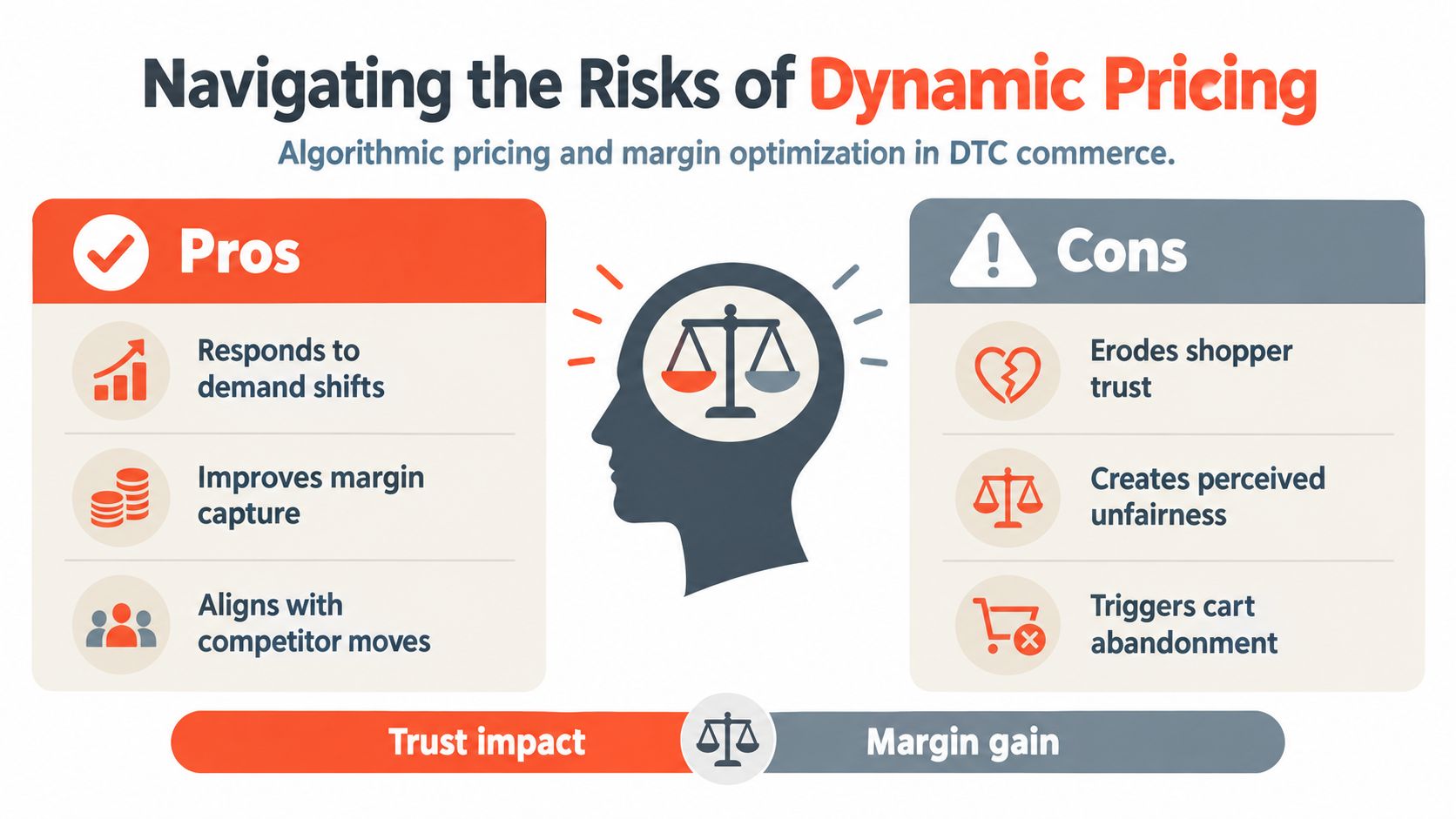
Dynamic pricing makes operational sense when demand, inventory, or costs change. The risk begins when an algorithm optimizes the visible number without accounting for how shoppers interpret the change. A technically rational price can still feel unfair if two customers believe they're being charged differently for the same item without a clear reason.
Recent U.S. evidence makes the trust issue difficult to dismiss. 68% of consumers felt dynamic pricing made them feel taken advantage of, while 80% considered consistent pricing more trustworthy and 42% said they'd pay more when confident the price wouldn't change, according to consumer research summarized by Consumer Goods. A Fall 2025 survey of 2,011 U.S. shoppers found that 54% disliked dynamic pricing, including 32% who strongly opposed it. Shoppers who viewed it negatively were 37 percentage points more likely to switch retailers for a discount, based on the same source.
Those findings don't make all price variation unacceptable. They show that the trust cost belongs in the model.
Establish a governance layer before automation
A Shopify merchant should decide where price stability is essential. Hero products, replenishment items, subscription references, and products frequently compared across channels usually deserve a stable public price. Inventory-specific offers, bundles, and loyalty incentives can create flexibility without changing the visible base price for everyone.
A workable governance policy answers four questions:
Which signal permits a change? Use documented inputs such as inventory position, cost movement, seasonality, or demand evidence.
Who sees the offer? Segment by lifecycle, membership, geography, or purchase history only when the commercial reason is defensible.
How large can the movement be? Set separate limits for increases and decreases, because shoppers often experience increases more negatively.
How will the team monitor trust? Track repeat purchase, complaints, refunds, churn, and customer-service language alongside margin.
A useful principle: Keep the public price predictable, then vary the value proposition around it.
Reference prices need continuity
Research on dynamic pricing indicates that increasing the amplitude and frequency of price changes can weaken the persistence of an established reference price. That may sound beneficial if a brand wants customers to stop anchoring on an old price, but the same volatility can make the store feel unreliable.
Segmented offers are usually safer than individualized public repricing. A returning customer might receive a bundle incentive or subscription benefit, while a new customer sees the same base price and a clear explanation of the offer. Deal-seeking shoppers may accept more variation than non-deal-seekers, so a single sitewide policy can misread the audience.
The algorithm should optimize incremental contribution margin, not only conversion. If a small margin gain leads to lower repeat purchase or higher switching, the business has traded durable customer value for a narrow metric improvement.
Maximizing Impact Through Merchandising Execution
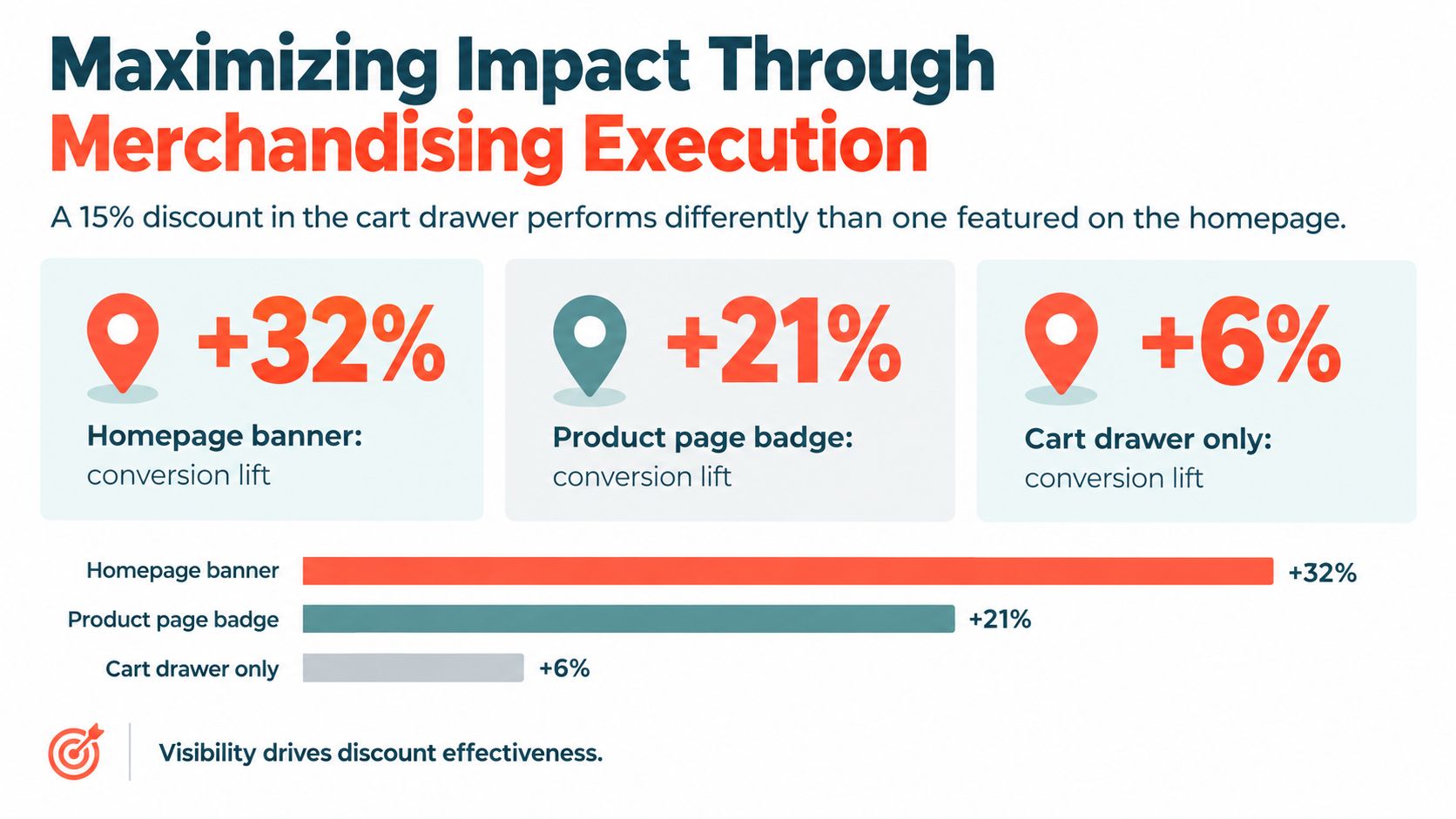
A discount only works when customers notice it, understand it, and believe it applies to the product they want. The historical evidence is clear on this point. An unsupported 15% price cut generated an average sales increase of 34%, while the same reduction supported by a feature rose to 161%, and support from both a feature and an in-store display reached 293%, according to the Information Resources, Inc. promotion evidence.
The lesson for ecommerce isn't to copy an in-store display. It's to treat placement as part of the offer. A homepage feature, collection position, search result badge, email message, product-page callout, and cart reminder each changes the chance that the shopper will process the value.
Build the promotion around discovery
Start with the customer journey rather than the coupon code. If the offer is central to a seasonal campaign, give it a visible collection, a clear landing page, and a consistent message across email and paid traffic. If it's a product-specific incentive, put the explanation close to the variant selector and buy button, not only in the cart.
Useful merchandising decisions include:
Collection ranking: Put qualifying products where the shopper can find them without filtering through unrelated inventory.
Search treatment: Add badges or copy that explain eligibility without overwhelming product titles.
Product-page clarity: Show the qualifying condition before the customer commits to a variant.
Cart reinforcement: Confirm the discount and explain any remaining threshold in plain language.
Lifecycle messaging: Tell existing customers about relevant offers rather than sending every promotion to every subscriber.
This approach can protect margin because better visibility may outperform deeper discounting. A merchant doesn't need to increase the percentage off just because a hidden offer underperformed.
Measure the whole commercial result
A promotion should have a measurement plan before launch. Track incremental revenue, contribution margin, traffic quality, conversion, average order value, and the proportion of purchases that would likely have happened without the offer. The last question matters because a discount can look successful while merely transferring full-price orders into a cheaper period.
A promotional calendar should also distinguish acquisition events from inventory events. A new-customer bundle may support paid media, while an aging seasonal product needs collection prominence and a controlled exit. Giving both offers the same sitewide treatment makes the business less precise and trains customers to wait.
Merchandising execution is therefore a pricing lever in its own right. The strongest offer isn't always the largest reduction. It's the one customers can understand at the moment they decide.
Strategic Markdown Optimization for Seasonal Inventory
Seasonal clearance isn't ordinary promotion. The merchant has a finite selling horizon, an aging unit, and a declining opportunity to recover full price. The correct question isn't “What discount will create the most orders?” It's “Which markdown path produces the best realized contribution while clearing inventory at an acceptable pace?”
Demand variability should determine the operating model. When demand is relatively predictable, a predefined price ladder can simplify planning. When demand is volatile, markdowns should respond to sell-through, remaining inventory, replenishment constraints, capacity, and updated forecasts. The empirical analysis of markdown pricing policies supports this distinction between primarily price-led decisions and coordinated inventory-and-supply decisions.
Create the markdown path before stock becomes urgent
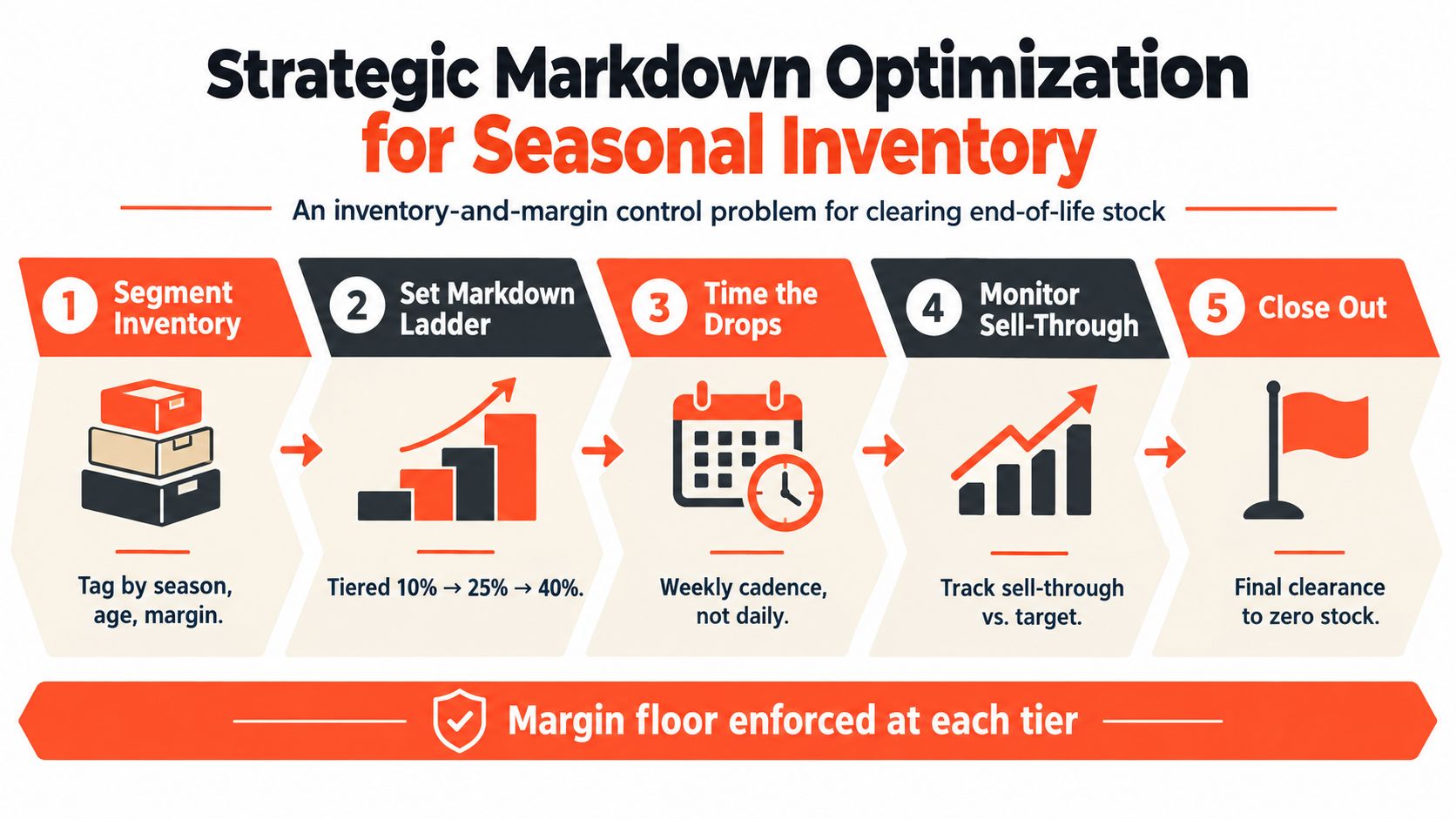
A useful process has five decisions:
Segment inventory. Tag products by season, age, margin, demand uncertainty, and strategic importance. Don't give a high-margin hero product the same treatment as an obsolete variant.
Set a margin floor. Calculate the lowest acceptable contribution after fulfillment, payment costs, returns, and expected liquidation loss.
Choose a cadence. Stable products can follow a planned ladder. Volatile products need checkpoints tied to actual sell-through rather than automatic calendar drops.
Coordinate supply. If replenishment or capacity can change, connect the markdown decision to those constraints instead of treating price as an isolated variable.
Define the closeout. Decide when the product moves to final clearance, bundle treatment, outlet handling, or another channel.
The model should compare expected sales at each candidate price with unit margin and the cost of holding, stocking out, or liquidating the remaining units. Revenue alone won't reveal whether the markdown created value.
Avoid predictable discount conditioning
Strategic customers may delay purchases when they learn that markdowns arrive on a reliable schedule. That makes a public, repeated ladder useful for operational discipline but potentially harmful when applied to products customers can easily wait for.
Use product segmentation and varied merchandising support rather than random price changes. A limited bundle, a gift, or a collection placement can move inventory without publishing a new lower reference price for every shopper. Keep the rules explainable internally, even when the customer-facing expression changes.
Clearance reporting should include sell-through, inventory aging, full-price share, realized margin, and remaining stock. Compare similar products across different markdown paths, and preserve a control group when the inventory position allows it. For teams evaluating affiliate-led seasonal campaigns or industry events, it can also help to compare affiliate industry gatherings before committing promotional budget.
Implementing Complex Pricing Logic in Shopify
Shopify's native discount tools are a sensible starting point for simple, transparent offers. A fixed amount, percentage discount, free-shipping rule, or basic purchase condition is easier to explain, test, and support than a custom system. The problem starts when the commercial rule depends on several interacting conditions.
Examples include mix-and-match bundles, tiered volume incentives, customer-specific pricing, subscription eligibility, market restrictions, shipping thresholds, and rules that must not stack. Each condition adds a question: where is eligibility calculated, what happens in the cart, how is the discount displayed, and what does customer service see when the result looks wrong?
Choose the simplest rule that survives operations
Use native Shopify discounting when:
The qualification is simple: A product or collection meets a clear condition.
The offer is broadly available: Most customers receive the same treatment.
Stacking is limited: You don't need several dependent rules to fire together.
The message is standard: The storefront can explain the offer without custom UI.
Consider Shopify Functions or a specialized app when:
The cart needs real-time logic: The discount depends on quantities, combinations, or line-item attributes.
The rule needs controlled exclusions: Certain products, markets, or subscription items must be protected.
The offer changes by customer context: Eligibility depends on a customer segment or account status.
The business needs a reusable engine: Multiple campaigns share the same pricing behavior.
Custom logic adds flexibility, but it also adds maintenance. A function must be documented, tested against cart edge cases, and reviewed when Shopify APIs, checkout behavior, subscriptions, or markets change. A third-party app may launch faster, but app sprawl can introduce duplicated scripts, conflicting discount logic, slower storefront behavior, and unclear ownership.
Design the implementation around the customer view
The discount should be visible before checkout and remain understandable through checkout. Build the customer-facing message at the same time as the rule. A “buy more, save more” offer needs threshold visibility, progress feedback, and a clear explanation of which items qualify. A bundle needs inventory behavior that doesn't leave the merchant overselling component products.
Keep price data and promotion rules separate where possible. The base catalog price should remain the source of truth, while campaigns define conditions, dates, audiences, and exclusions. For teams building custom discount, bundle, and order-rule functions, Presidio's Function Junction is one implementation option among native tools and other Shopify solutions.
International stores also need market-specific review. Currency presentation, rounding, tax treatment, local promotions, and inventory availability can change how a single rule behaves across regions. Test the full path from product page to order confirmation, then document who owns the rule after launch.
Testing and Analytics for Pricing Decisions
Pricing tests fail when the team measures only conversion. A lower price can increase orders while reducing contribution margin, attracting one-time deal seekers, or shifting purchases that would've happened at full price. The test needs a commercial hypothesis and a clear decision rule before traffic reaches the experiment.
Define the unit of analysis first. A product-price test may need a persistent customer assignment, while a bundle test may require a comparable product set. Keep a control group wherever possible so the team can estimate what would've happened without the pricing change.
Track the metrics that expose trade-offs
A useful scorecard combines immediate behavior with long-term value:
Conversion and revenue: Did more qualified shoppers purchase, and did the offer create incremental demand?
Contribution margin: What remains after product cost, fulfillment, payment costs, returns, and the discount?
Average order value: Did the rule expand the basket or only reduce the price of an existing order?
Repeat purchase: Did new buyers return without requiring another promotion?
Full-price share: Is the brand generating healthy demand outside the campaign?
Customer quality: How did results differ by acquisition source, cohort, geography, and purchase frequency?
Trust signals: Did complaints, refunds, cancellations, or support contacts change after the price update?
The dynamic-pricing research cited earlier supports monitoring conversion, contribution margin, repeat purchase rate, and the gap between the current price and a rolling reference-price proxy. Those measures help distinguish a useful offer from a price change that merely moves demand between periods.
Add guardrails before you read results
Set a margin floor, maximum permitted price movement, inventory constraint, and customer-experience threshold before launch. Cap upward changes more tightly when the customer reaction risk is asymmetric. If a test improves conversion but breaches the margin or complaint guardrail, it hasn't produced a rollout candidate.
Segment the result by acquisition source and customer cohort. A paid-social audience may respond to an introductory incentive while existing customers interpret the same offer as unfair. Don't average those groups together and call the result a universal win.
For a practical testing workflow, use Shopify A/B testing to structure hypotheses, controls, and rollout decisions. Record the winning rule, the conditions under which it worked, and the reason it was approved. Pricing knowledge compounds when teams document it instead of rebuilding the same experiment every season.
Presidio helps DTC brands build and maintain Shopify storefronts, themes, apps, and custom pricing logic, including discount and bundle implementations that need to remain manageable as the store grows. Visit Presidio to discuss a pricing architecture, Shopify Plus build, or testing roadmap that protects both margin and customer trust.

Jamie, Presidio’s Designer, leads the practice alongside Johnnie. With over 10 years of e-commerce experience, Jay is a Shopify expert, known for crafting innovative solutions that prevent tech debt.
Jaime
Senior Product Designer, 2020