Outrank AI

Only 36.3% of ecommerce A/B tests produce a statistically significant winner, according to an independent 2026 ecommerce experimentation benchmark. That result changes how Shopify merchants should think about testing. A few experiments can create meaningful gains, but most tests will be neutral, inconclusive, or too weakly designed to support a decision.
Shopify A/B testing works best when you treat it as an investment in decision quality, not a button-color lottery. Traffic volume, baseline conversion rate, test duration, implementation quality, and profit margin all determine whether an experiment can produce a useful answer. If your store doesn't have enough visitors, formal testing may create false confidence instead of revenue.
Table of Contents
The Reality of Ecommerce Experimentation
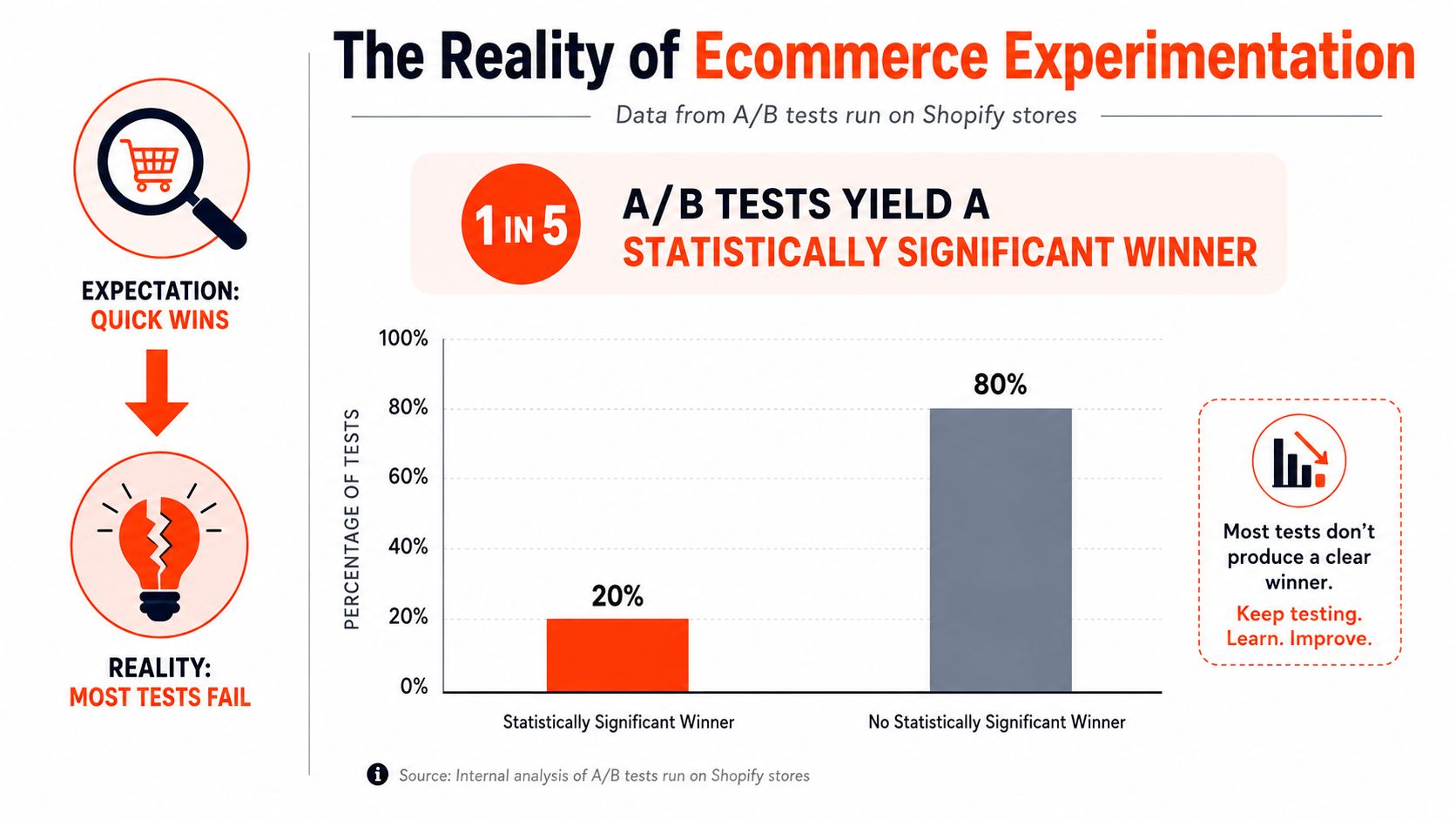
The first mistake in ecommerce experimentation is expecting every test to win. The 2026 benchmark found that only 36.3% of ecommerce A/B tests produced a statistically significant winner. After inconclusive tests were excluded, 62.1% of decisive outcomes were wins, which is a more useful way to understand the result. A test can fail to produce a winner without being a waste. It may reveal that the tested change isn't strong enough, that the audience was too small, or that the hypothesis addressed the wrong problem.
The same benchmark found that winning tests delivered a median uplift of 2.77% in revenue per visitor. That figure is a practical baseline for Shopify teams. A winning experiment doesn't need to create a dramatic transformation to matter, especially when the change can be rolled out across a high-volume page or customer journey. But the uplift should be evaluated against implementation effort, operational risk, and the margin attached to the additional revenue.
Why test volume isn't the strategy
A separate empirical meta-analysis of ecommerce A/B tests found that 20% of tests generated 81% of aggregate conversion uplift. Returns are concentrated. Most experiments won't produce a major commercial result, while a small group of well-chosen tests creates most of the value.
That pattern favors prioritization over speed for its own sake. A Shopify team should investigate where customers hesitate, abandon, or misunderstand the offer before building variants. Product page structure, delivery expectations, subscription terms, bundles, and checkout friction usually offer more commercial potential than isolated cosmetic changes, but the right opportunity depends on the store's customer behavior.
Practical rule: A mature testing program isn't measured by how many experiments launch. It's measured by whether the team learns which customer problems deserve investment.
A useful conversion rate optimization framework starts with a problem, turns that problem into a falsifiable hypothesis, and defines the business metric that will decide the outcome. That discipline prevents teams from declaring victory because a variant receives more clicks while completed purchases or profitable revenue remain unchanged.
What inconclusive results can teach you
An inconclusive result can still improve the roadmap. It may show that the proposed change was too subtle, that the page wasn't important enough, or that the test measured a weak proxy. It can also expose tracking problems, audience imbalance, or a mismatch between the page experience and the customer segment arriving there.
The practical response isn't to stop testing after several neutral outcomes. Review the hypothesis, confirm the sample and tracking quality, and decide whether the next experiment should target a larger customer obstacle. The few meaningful winners can justify broader implementation, while the inconclusive tests help narrow the range of changes worth building.
Determining If Your Store Has Enough Traffic to Test
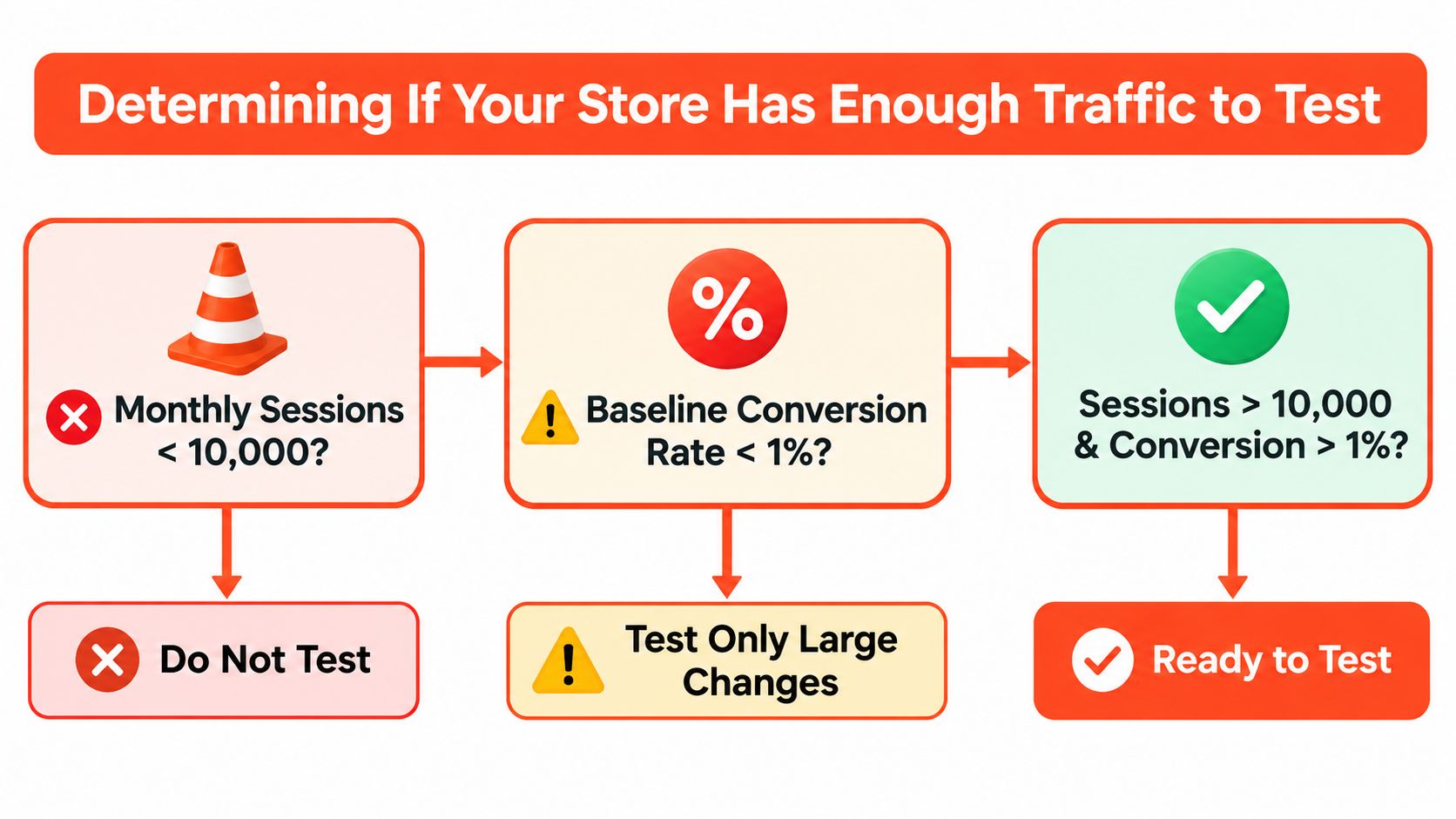
A test can need 50,000 to 80,000 visitors per variant before it can detect a modest improvement. The exact requirement depends on your baseline conversion rate, the smallest improvement worth shipping, and the statistical standards you set. A page with modest traffic may support a large-effect test, while the same page cannot reliably detect a small lift.
Shopify's A/B testing guidance describes a controlled process: create two versions, split traffic evenly, run the experiment for about two weeks, and evaluate a primary goal for statistical significance. The process is straightforward. The difficult decision is whether the page, audience, and expected effect can support a useful result.
A practical traffic decision tree
Begin with the exact page and audience in the experiment. Storewide sessions are not the usable sample if only a fraction of visitors reaches a product detail page. Device, geography, acquisition channel, and new versus returning visitor segments reduce the available volume further.
Choose the page and audience. Count sessions reaching the actual experience under test. Do not use total store traffic as a substitute.
Record the baseline conversion rate. Select one primary event, such as completed purchase, checkout completion, or another defined action. Keep the decision metric tied to the business outcome.
Set the minimum detectable effect. Decide the smallest relative improvement that would justify implementation. A subtle change requires far more traffic than an obvious change with a larger expected impact.
Calculate sample size before launch. The Shopify sample-size guidance from Metric Uno uses 95% confidence and 80% power as standard thresholds. For a typical store with a 2% to 3% conversion rate, its benchmark estimates roughly 50,000 to 80,000 visitors per variant to detect a 10% relative lift at those thresholds.
Check the calendar. Run the experiment through at least one complete business cycle. Weekday-only traffic can misrepresent intent when weekends behave differently.
Product detail page tests often expose the traffic problem first. Shopify-focused PDP guidance identifies about 50,000 or more monthly sessions on the tested page as a planning benchmark for reaching significance cleanly. It is not a guarantee. Baseline conversion, audience quality, and effect size still determine the calculation.
When formal testing is not the right tool
Limited traffic is a reason to change the research method, not force a weak A/B test. Use session recordings, on-site surveys, customer interviews, support-ticket analysis, usability reviews, and heatmaps to locate friction. These methods cannot prove that one variant outperforms another, but they can show why shoppers hesitate and help you select a larger, more testable change.
Small stores can focus experiments on their highest-traffic experiences or test changes with a plausible, substantial effect. Apply Shopify SEO best practices to build qualified discovery over time, while keeping acquisition and experimentation decisions separate. More organic sessions do not immediately create enough usable test volume. Measurement quality comes before launch frequency.
Choosing the Right Testing Tools for Shopify
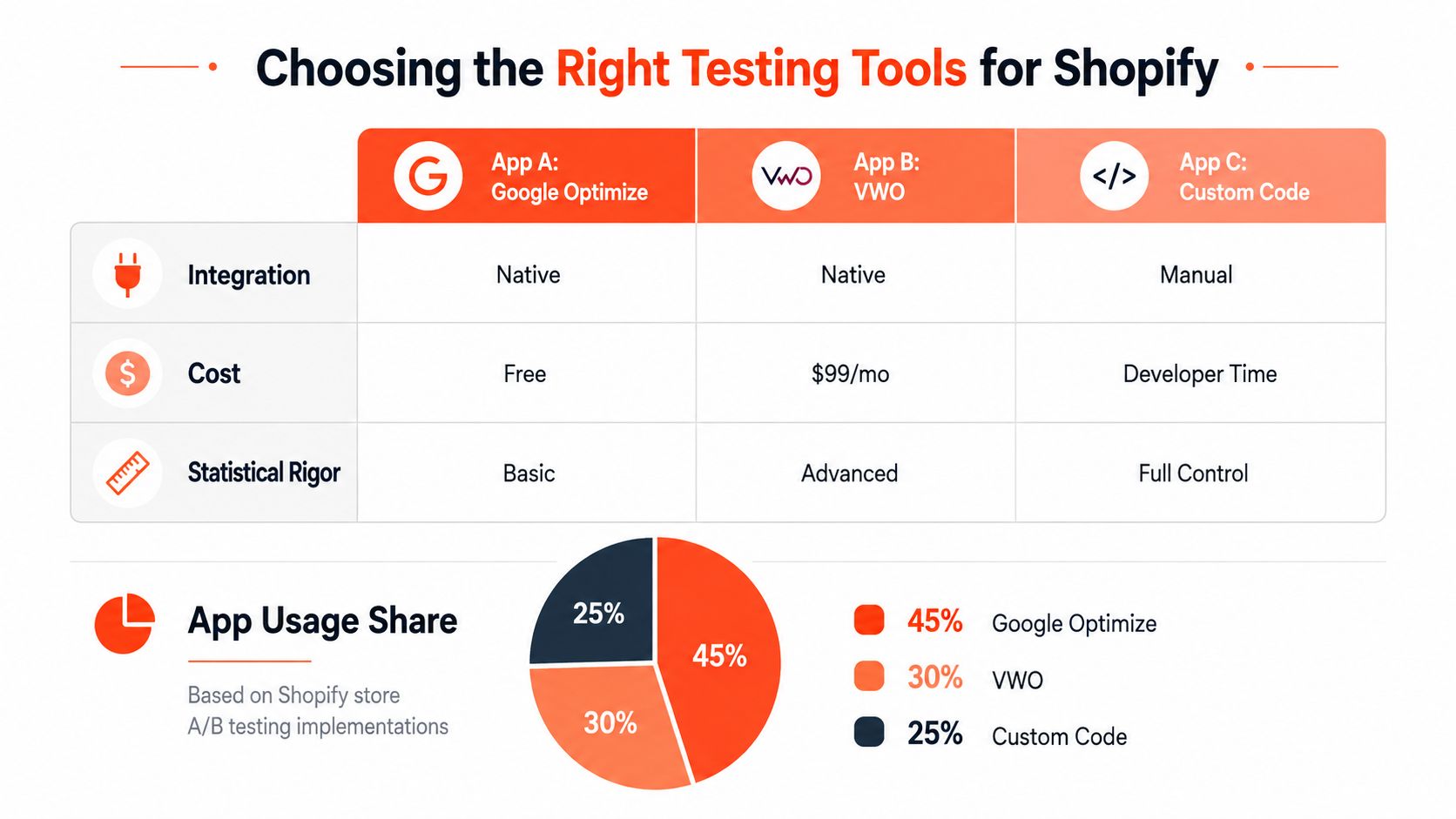
Shopify merchants usually choose a third-party testing app, an external experimentation platform, or a custom implementation. Shopify's guidance covers the method, but the store still needs reliable technology to assign visitors, serve variants, capture events, and connect results to commercial outcomes.
The fastest setup can create hidden measurement and margin problems. A plug-and-play app may let marketers launch a landing-page test without developer support, yet add script weight, conflict with the theme, cause flicker, duplicate analytics events, or limit testing around checkout and pricing. Custom code gives the team more control, but developers then own allocation, assignment persistence, tracking, quality assurance, and statistical interpretation.
Comparing the main approaches
Approach | Where it works well | Main trade-off |
|---|---|---|
Third-party Shopify app | Teams that need fast deployment and familiar admin workflows | Less control over performance, targeting, and advanced experiment logic |
External experimentation platform | Stores with dedicated CRO ownership and broader analytics needs | Requires careful integration with Shopify events, consent, and reporting |
Custom implementation | Shopify Plus, headless, or technically mature teams | Higher engineering responsibility and ongoing maintenance |
For a standard theme, an app can suit focused tests on content blocks, product-page layouts, merchandising modules, and promotional messaging. Before installation, inspect how it changes the storefront and how it records orders. Confirm support for persistent assignment, clean control groups, server-side or flicker-resistant delivery, reliable purchase tracking, and exportable results.
Traffic and margin should influence the choice. A low-traffic store cannot compensate for weak evidence by buying a more expensive platform. Standard sample-size calculators use 95% confidence and 80% power as thresholds, but the tool does not create the sessions required to reach them. If traffic is thin, prioritize qualitative research or reserve testing for changes with a plausible, meaningful commercial effect.
External platforms can provide advanced audience rules and reporting, but they still need a deliberate data layer. A system that records clicks while missing refunds, discounts, cancellations, or cross-session variant assignment can produce polished reports with little value for profit decisions. Validate revenue, contribution margin, and order-status data before trusting the dashboard.
When custom code earns its keep
Custom JavaScript or theme-level experimentation suits tightly scoped changes when the team can own the full measurement lifecycle. Headless storefronts may require testing at the frontend, edge, or application layer, depending on where the experience is rendered. Checkout changes need particular care because the implementation path depends on Shopify's supported extensibility model, the store's plan, and its architecture.
Avoid building a bespoke framework for one low-traffic test. Custom code becomes more defensible when the store needs consistent assignment across several surfaces, advanced audience logic, strict performance controls, or integration with internal analytics. Presidio provides custom Shopify theme and app development alongside CRO and A/B testing services for brands that want experimentation connected to a maintainable storefront.
Choose the least invasive tool that can produce trustworthy data. Move to custom infrastructure only when platform limits, performance requirements, or business-sensitive tests justify the engineering cost.
Setting Up a Statistically Rigorous Experiment
A Shopify A/B test needs a business decision before it needs a design file. Define the change, the reason it might work, and the evidence required to ship or reject it. A test that optimizes clicks while leaving revenue, margin, or order quality unclear can create activity without a useful commercial decision.
Shopify's testing workflow emphasizes controlled traffic allocation, one primary goal, sample-size planning, and statistical significance. Shopify's testing guidance has evolved to emphasize minimum detectable effect and sample size before launch. That planning matters even more for stores with limited traffic, because an undersized test can consume weeks without resolving the decision.
The design sequence
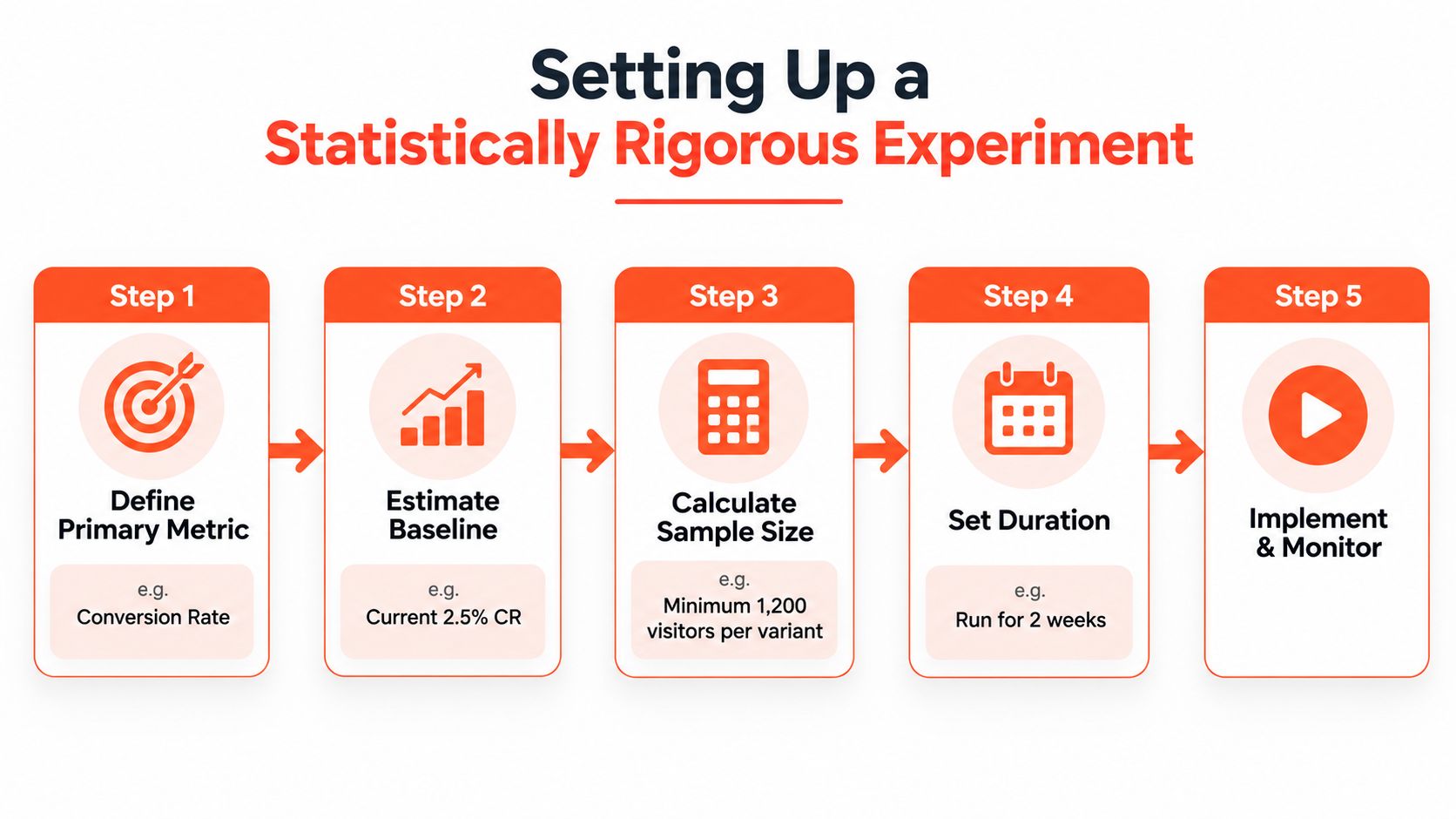
Define one primary metric. Choose the outcome that answers the commercial question. If the hypothesis concerns purchase friction, completed purchases or revenue per visitor may be more useful than add-to-cart rate. Secondary metrics can explain behavior, but they should not replace the decision metric after results appear.
Estimate the baseline. Use recent data from the same page and a comparable audience. A product page can perform very differently by device, campaign, or traffic source. Combining incompatible populations may make the sample look larger without improving the quality of the evidence.
Choose the minimum detectable effect. Set the smallest improvement worth implementing. The threshold should reflect design and development effort, discount cost, operational impact, and the margin available to fund the change. A simple, reversible change can justify a smaller practical threshold than an expensive release, but define that threshold before launch.
Calculate the sample size. Sample requirements depend on baseline conversion, the effect you want to detect, and the confidence and power thresholds you choose. Low-conversion stores may need substantial traffic per variant to identify a modest improvement. If the required traffic exceeds what the store can produce within a useful business window, use qualitative research or a focused usability review first.
Set the duration before launch. A test window should satisfy the planned sample requirement and cover a complete business cycle. Full weeks help represent weekday and weekend behavior. Do not shorten the window because one variant leads early.
Monitoring without corrupting the decision
Early results fluctuate. Repeatedly checking performance and stopping when a lead appears increases the chance of calling a false winner. The Shopify CRO statistics guidance highlights early peeking, underpowered tests, sample-ratio mismatch, and incomplete weeks as common sources of unreliable conclusions.
Keep implementation checks separate from outcome analysis:
Assignment balance: Confirm that visitors receive control and variant as planned.
Event integrity: Verify that product views, add-to-cart events, checkouts, purchases, discounts, and refunds map to the assigned experience.
Sample-ratio mismatch: Investigate unexpected allocation differences before reading performance results.
Business-cycle coverage: Preserve the predetermined window unless tracking failure or customer harm requires a stop.
Decision rule: Ship only when the primary metric meets the agreed threshold and guardrails show no unacceptable impact.
Statistical significance does not settle the commercial decision. Review contribution margin, fulfillment capacity, returns, customer support load, and site performance before making the change permanent. A result that clears the statistical bar but cannot repay its implementation cost is not a winning experiment.
Moving Beyond Surface-Level Tests to Margin-Aware Experiments
Button labels and hero images are easy to test because they don't usually alter the commercial structure of an order. They also tend to produce limited learning when the obstacle is price sensitivity, unclear value, weak bundling, or an offer that creates too little reason to buy now.
The more valuable Shopify experiments often involve price presentation, bundles, upsells, shipping thresholds, subscription framing, and promotional architecture. These tests are harder to implement and riskier to evaluate, but they connect directly to revenue quality. A conversion-rate increase can hide a profit decline when the variant relies on deeper discounting or shifts customers toward a lower-margin product.
Measure the economics of the variant
Shopify doesn't natively support A/B testing different price points, so merchants need third-party tooling for Shopify pricing experiments. The test must preserve a clear record of the offer shown, the customer assigned to it, the resulting order, and the commercial deductions attached to that order.
Use revenue per session as a central outcome rather than conversion rate alone. Then add margin-aware guardrails:
Contribution margin: Account for product cost, discounts, payment fees, shipping subsidies, and other variable costs.
Average order composition: Check whether the variant changes product mix, quantity, bundle adoption, or attachment of add-ons.
Refund and cancellation behavior: A short-term purchase lift may be unattractive if the offer creates more post-purchase problems.
Customer value: Separate new-customer acquisition effects from repeat-customer economics where the store has reliable customer-level measurement.
Operational load: A winning bundle may create inventory or fulfillment constraints that weren't visible in the initial conversion report.
Better experiments for commercial learning
A useful hypothesis might compare a bundle against a single-item offer, test an upsell's relevance, or clarify the value difference between product tiers. The control should represent the current customer experience, while the variant should change one coherent commercial idea. Don't combine a new price, new bundle contents, new page layout, and new shipping promise unless you're intentionally testing a complete offer architecture and can accept limited insight into the individual components.
Checkout and post-purchase experiences need architectural discipline. Shopify checkout extensibility guidance can help teams assess where supported customization belongs and how checkout-related changes should fit the platform's extension model.
A higher conversion rate is only a win if the resulting orders create acceptable economics. For margin-sensitive stores, the primary question isn't just whether more people bought. It's whether the variant created more valuable, sustainable demand.
Scaling Experiments Into a Sustainable Growth Program
A winning test still needs a controlled rollout. Move the approved experience into theme or app code, remove temporary experiment logic when appropriate, and monitor the original metric after release. Full-audience exposure, seasonal merchandising, and operational changes can alter a result produced under controlled allocation.
Document every experiment, including inconclusive results. Record the customer problem, hypothesis, audience, primary metric, guardrails, implementation details, sample requirement, decision, and follow-up questions. This record prevents repeated weak ideas and turns failed tests into usable product and UX knowledge.
Prioritize experiments by commercial impact
Rank opportunities by customer friction, traffic availability, expected effect, margin impact, implementation effort, and reversibility. High-traffic pages with clear purchase obstacles usually offer better candidates than low-volume pages with cosmetic opportunities. Pricing and bundle tests need extra review because they can change profitability, inventory, support demand, and customer expectations.
A sustainable program separates discovery from validation. Use qualitative research to identify problems, analytics to size them, then run A/B tests only when traffic can support a useful decision. If traffic is limited, prioritize interviews, session reviews, usability checks, or a focused analytics investigation instead of forcing an underpowered test. This sequence reduces design-preference testing and gives developers clearer requirements.
Share results in business language. State what changed, which customer behavior moved, how reliable the result was, and whether the economics supported rollout. A neutral result can prevent an expensive release. A statistically strong result may still require a margin and operational review.
Presidio helps Shopify and Shopify Plus brands connect storefront development, CRO audits, A/B testing, performance work, and custom theme or app implementation into a practical optimization roadmap. Visit Presidio to discuss traffic constraints, testing infrastructure, and a margin-aware experiment.

Jamie, Presidio’s Designer, leads the practice alongside Johnnie. With over 10 years of e-commerce experience, Jay is a Shopify expert, known for crafting innovative solutions that prevent tech debt.
Jaime
Senior Product Designer, 2020