Outrank AI

Shopify Plus expansion stores are extra storefronts under one organization and one Plus contract, with one main store plus up to nine expansion stores at no added contract cost. They must extend the same brand, not launch unrelated brands.
Your existing store sells well, but the next launch doesn't fit neatly. The United States team wants different merchandising. Wholesale needs a separate buying experience. Someone suggests cloning the store, and suddenly a market-entry decision becomes a long-term operating commitment.
The useful question isn't whether you can create another storefront. It's whether the business needs a boundary strong enough to justify maintaining it.
Table of Contents
Why Shopify Plus Expansion Stores Matter
A regional launch can look straightforward in a planning meeting. Reuse the design, adapt the content, and give the local team control. The difficult conversations start when that team needs a different promotion while headquarters is preparing a global theme release.
Keep everything together, and regional staff may struggle to deliver the experience they need. Separate too much, and your ecommerce team inherits parallel workflows for changes that used to happen in one place.
Shopify Plus expansion stores are an architecture decision, not just a launch shortcut. They make sense when the business benefits from a separate operating environment. An available store slot isn't enough reason to use one.
An expansion store is a controlled adaptation of one brand, not a cheap way to launch a second company.
Start with the business pressure
Consider the requests arriving on your roadmap. A country manager wants locally relevant campaigns. The wholesale team wants buyers to avoid consumer messaging. Operations wants regional changes to stop disrupting the main storefront.
Those requests deserve different answers:
Customer experience: What must the shopper or wholesale buyer experience differently?
Operational control: Which decisions must the regional or channel team make independently?
Team capacity: Who will maintain that independence after the launch team moves on?
This is the planning problem behind a global storefront rollout.

If you're still evaluating the platform itself, this explanation of what Shopify Plus includes provides useful context. For an existing Plus merchant, the harder task is separating a genuine operating requirement from a preference that a shared storefront could accommodate.
A useful decision ends with yes, no, or not yet. Yes means the separation is necessary and supportable. No means another architecture fits better. Not yet means the business case exists, but ownership or infrastructure isn't ready.
Before anyone estimates a build, establish whether the proposed storefront qualifies under the organization and contract rules.
How Shopify Plus Expansion Stores Work
Think of the organization as a headquarters with several labeled storefronts. Headquarters manages the organizational relationship, but each storefront still needs a clear purpose.
The distinction is between central administration and store-level operations. Being under the same commercial umbrella doesn't make every storefront interchangeable.
The organization structure looks like this.

Understand the allowance and eligibility
Shopify's expansion-store documentation describes a maximum of 10 stores at no additional cost, one main store and nine expansion stores, with staging stores excluded from that limit. It also establishes organization-level administration for users and billing, and requires expansion stores to retain the main brand's identity and sell the same types of goods or services.
Eligible formats include localized storefronts serving different languages, regions, or currencies. Separate .com, .ca, and .com.au experiences can fit that model. So can a B2B wholesale storefront or a direct-to-consumer storefront for a business whose primary operation is wholesale.
The important distinction is extension versus reinvention. A regional version of the existing business is an extension. A different brand selling a different category isn't just another localization project.
Separate brands require separate Plus contracts. Shared ownership of the companies doesn't, by itself, make those brands eligible expansion stores.
Test the proposed storefront
Use these questions before requesting approval:
Same identity: Would a customer recognize the storefront as the existing brand?
Same business category: Does it sell the same kinds of goods or services?
Distinct selling job: Does it serve a meaningful market or channel difference?
Passing those checks establishes a plausible fit. It doesn't establish that a separate store is the simplest solution.
Avoid treating “clone” as a promise of permanent sameness. It's a useful way to describe the starting relationship between storefronts, not an operating model for everything that happens afterward.
For additional viewing context, the following video accompanies the organization model.
Keep the commercial allowance separate from your implementation budget. Contract eligibility answers whether the storefront belongs in the organization. Your team still needs to establish whether the proposed separation earns its ongoing maintenance.
Business Cases for Expansion Stores
A qualified expansion store needs a specific job. “We want a local site” is a starting request, not a sufficient architecture brief.
The strongest business cases describe what buyers need and why staff can't reasonably deliver it through the existing operating setup.

Local experience and merchandising
Internationalization is about making the market experience coherent. Language, currency, campaign content, and merchandising should work together rather than look like unrelated edits to the home-market site.
For the shopper, that might mean locally appropriate product explanations and seasonal campaigns. For the merchant, the potential benefit is giving a regional team a defined space to operate. However, translation or currency alone shouldn't automatically trigger a new store.
A market-specific catalog is a different requirement. The question isn't whether a collection needs a different name. It's whether assortment, pricing decisions, or collection structure must diverge enough that a shared workflow becomes awkward for buyers or staff.
For example, a proposed regional store might need a tightly controlled assortment and its own launch calendar. Treat that as a requirement to evaluate, not proof that an expansion store is necessary.
Wholesale and regional control
A wholesale buyer may need an ordering journey organized around purchasing rather than consumer discovery. A separate portal can be appropriate when the business wants to isolate that experience and its administration.
Don't turn that into a blanket rule that wholesale must always live elsewhere. Document the ordering, pricing, and approval requirements first. Then assess whether separation is needed.
Regional legal or operational constraints require similar discipline:
Buyer impact: Specify which content, terms, or purchasing steps must differ.
Merchant control: Identify who approves changes and who can publish them.
Validation: Ask legal, tax, and operations teams to confirm the requirement rather than assuming another storefront resolves compliance.
Practical filter: Name the decision a local team needs to make independently. If you can't name it, don't prescribe a separate store yet.
Apply the eligibility boundary to the finished proposal, not just its working name. Changing the audience promise alongside the brand identity and goods may signal a different business, rather than a regional extension.
The useful roadmap entry is therefore precise: a named market or channel, a defined customer difference, and an explanation of why shared-store controls aren't sufficient.
What the LSKD Expansion Store Shows
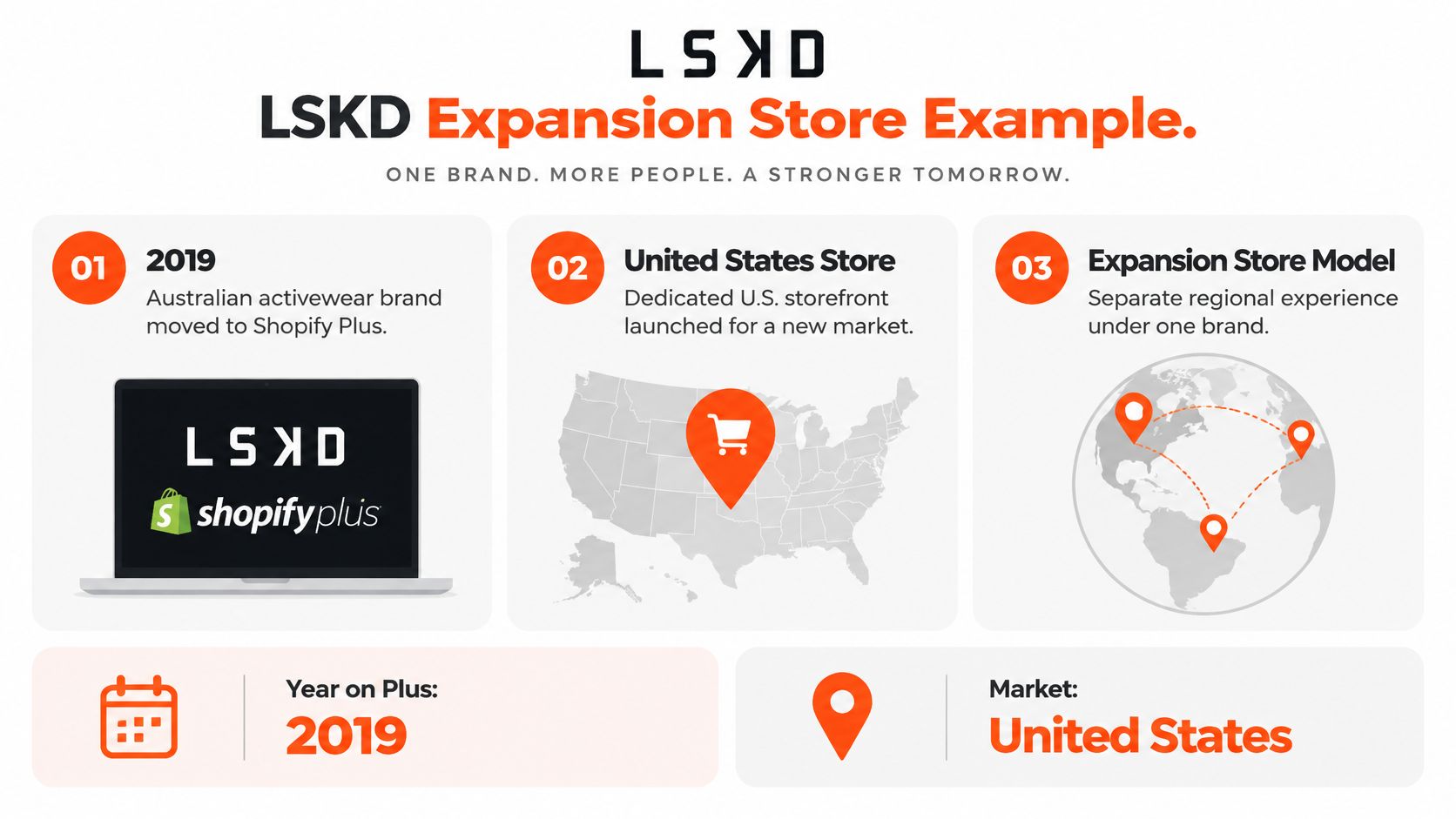
Australian activewear brand LSKD offers a documented example of a regional rollout with broader operating ambitions. It moved to Shopify Plus in 2019, then launched a dedicated United States storefront in 2020. In its published LSKD case study, Shopify reports 216% year-over-year growth in US store revenue, 37% year-over-year growth in overall online-store sales, and a 400% increase in POS revenue following the Plus upgrade and US expansion-store rollout; the account also describes a San Diego retail location and pop-up booths alongside eight Australian physical stores.
The launch sequence is useful to examine separately from those results. LSKD imported content from the existing store, adapted the US experience for local shoppers, and managed it through the same backend as the main store.
That gave the project a recognizable starting point. The business didn't need to invent a new brand experience before entering the market.
Read the outcome as an architecture example
The US storefront wasn't only a destination for international web traffic. It also supported physical retail and event selling through Shopify POS.
For an operator, that's the more useful lesson. A regional storefront can become the commerce base for a market, with local content and merchandising supporting a wider selling operation.
The transferable ideas are practical:
Reuse the foundation: Begin with existing brand assets and content where they're appropriate.
Adapt intentionally: Decide what local shoppers need rather than publishing an unchanged copy.
Plan beyond the website: Include retail and event requirements in the market brief when they're relevant.
If physical selling is part of your planning, Mystershirt's Antwerp football jersey store opening is a separate resource to bring into a pop-up discussion. It shouldn't be treated as evidence about LSKD's implementation or expansion-store performance.
Don't confuse results with guarantees
The published figures describe LSKD's experience, not an expected return for another merchant. They don't isolate the effect of the storefront architecture from every other change in the business.
Nor does the example establish automatic inventory synchronization or a repeatable release process for heavily customized regional themes. Copy the planning logic where it fits. Validate the operating details against your own systems.
Running Domains Inventory and Integrations
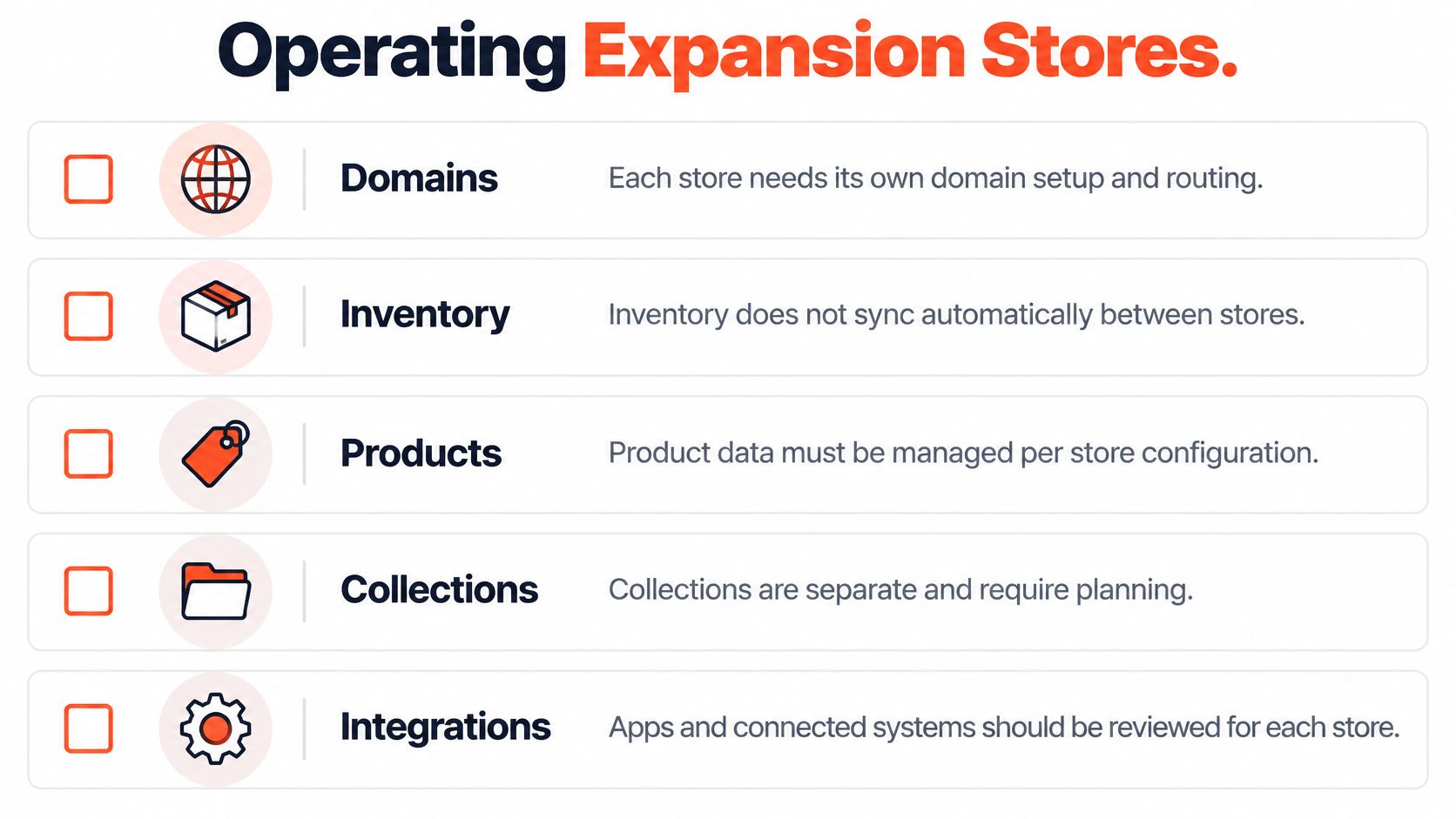
Centralized administration doesn't mean synchronized store data. Shopify's global-commerce guidance explains that stores have separate configurations and data, that products, collections, and inventory don't synchronize automatically, and that each live expansion store needs its own theme license.
Build the operating plan around those boundaries. A copied starting state isn't an ongoing connection, and a shared brand isn't a shared catalog database.
Design the data paths
Start with domains and locales as a customer journey problem. Document where shoppers should land, how they can choose another region, and what should happen when the destination store doesn't carry the product they were viewing.
For catalog and content, identify the authoritative source for each field. Product specifications might be centrally controlled while campaign copy stays local. Write down those boundaries before building automation, or a routine update could overwrite an intentional regional difference.
Inventory needs an explicit allocation policy. If storefronts draw from a shared warehouse, ask the operations team how available stock will be distributed and reconciled. Test purchases, cancellations, returns, and interrupted updates against that policy.
Use an integration inventory rather than a loose list of installed apps:
System responsibility: Name the system that owns each value and the permitted direction of updates.
Failure handling: Define who sees an error, who investigates it, and how staff recover.
Regional exceptions: Record differences that the integration must preserve.
A review of Shopify Plus integrations can help frame that scoping conversation, especially where ERP connections sit between the storefront and fulfillment operations.
Treat changes as releases
Review payment and checkout requirements for the target market rather than assuming the original setup can be copied unchanged. Test the actual purchasing journey with the staff who will support it.
Apply the same scrutiny to subscriptions, quizzes, discount logic, and connected systems. Include each regional configuration in testing. A successful test on the main storefront isn't approval for every other environment.
For themes, maintain a shared development baseline where practical, but document local exceptions. Licensing belongs in the budget; code ownership belongs in the release plan.
Release rule: Every global change needs a deployment scope, regional test evidence, an approver, and a rollback path.
Estimate ownership cost through the work your team expects to perform: release frequency, integration coverage, localization reviews, testing, and support. That produces a more useful budget than counting storefronts alone.
Choosing Expansion Stores or Markets
Use Shopify Markets where language, currency, and duties can remain within a broadly shared operating model. Reserve expansion stores for requirements that need genuinely distinct legal, operational, or merchandising control.
That's a decision principle, not a claim that Markets can never accommodate complexity. Validate the specific requirement against available capabilities before splitting the architecture. “Our team prefers a separate admin” isn't the same as “our operating model requires a separate store.”
Markets, Expansion Stores, or a New Contract
Decision factor | Shopify Markets | Expansion store | Separate Plus contract |
|---|---|---|---|
Brand fit | Shared storefront for the existing brand | Must satisfy the same-brand eligibility rules | Appropriate path for a separate brand |
Catalog control | Evaluate market needs within the shared store | Separate store-level catalog decisions | Define around the separate business |
Data sync | Avoids the cross-store sync problem for markets kept together | Requires an intentional cross-store data plan | Scope connections independently |
Theme licensing | Review the theme used by the shared storefront | Budget according to the live-store licensing requirement | Review licensing for the new implementation |
Maintenance load | Keeps more work in the shared environment | Adds regional configuration and release responsibilities | Establish a distinct operating and support plan |
The table is a planning aid, not a substitute for checking your configuration and agreement. Use it to expose the work attached to each choice.
Budget for divergence after launch
The hidden cost isn't clicking “create store.” It's deciding what happens when regional teams begin making different choices.
A promotion can be intentional in one market and obsolete in another. A theme fix can be ready centrally but untested against a local subscription setup. Accessibility and localized SEO work can stall if nobody owns them.
A hybrid architecture is often the sensible recommendation: retain broadly shared markets together and isolate only the regions or channels with a defensible need. Wholesale separation or a market-specific catalog and retail operation may justify that boundary. A new currency alone may not.
Build those decisions into a written global expansion strategy, including a maintenance model rather than just a launch roadmap.
Implementation can stay with an internal team, involve an integration specialist, or use a delivery partner. Presidio is a hybrid Shopify agency and software studio that plans international expansion, builds and supports Plus storefronts, connects ERP systems, and prioritizes lean themes over unnecessary app accumulation.
Its tooling includes Duplify for exporting and copying store data, and Function Junction for Shopify Functions covering discounts, bundles, and order rules. These sit alongside custom themes, migrations, and technical audits as implementation options, not reasons to choose a more complicated architecture.
Copying helps with setup. Governance determines whether the setup stays maintainable. Ask any partner to explain how they'll preserve local exceptions, reduce duplicated tooling, and assign post-launch release responsibility.
Plan Your Next Expansion Store Move
Bring a store boundary document to the approval meeting, not just a sitemap and launch date. It should explain what the proposed storefront is responsible for and what remains centrally controlled.
Keep it concrete enough that marketing, engineering, operations, and leadership can disagree with specific decisions. A vague commitment to “local flexibility” won't help when a regional campaign conflicts with a shared product update.
Check readiness before authorizing the build
Use a short working checklist:
Confirm eligibility: Record how the proposed storefront fits the existing brand and goods.
Name the selling job: Identify the market or wholesale requirement it serves.
Define necessary differences: List the experiences and workflows that must remain separate.
Assign accountable owners: Cover catalog changes, theme releases, apps, accessibility, localized SEO, and emergency fixes.
Approve the support path: State who handles incidents and who can authorize a rollback.
Missing ownership is a reason to delay, even when the market opportunity is attractive. Keep the shared setup where it meets current needs, or address the staffing and integration gaps before proceeding.
Schedule a decision session
Set a dated working session with the ecommerce lead, regional owner, technical lead, and operations representative. Ask participants to bring the current theme and app inventory, integration map, proposed regional exceptions, and support responsibilities.
Review what can be copied, what must be rebuilt, and what should remain shared. Include the release path in that discussion so the new storefront doesn't become an unmanaged codebase after handover.
The deliverable should be a written boundary the team can approve, plus a clear go, defer, or reject decision. Only then should store creation become a scheduled implementation task.
Presidio offers international expansion planning, Shopify Plus implementation, custom themes, ERP connectivity, and ongoing storefront support. Visit Presidio to scope your proposed expansion store, review the current theme and app stack, and define the integration and release plan before you build.

Jamie, Presidio’s Designer, leads the practice alongside Johnnie. With over 10 years of e-commerce experience, Jay is a Shopify expert, known for crafting innovative solutions that prevent tech debt.
Jaime
Senior Product Designer, 2020