Outrank AI

International expansion can increase demand and still make a DTC brand poorer. That isn't a theoretical risk. Global cross-border ecommerce is projected to grow from about $1.6 trillion in 2023 to more than $3.3 trillion by 2028, a 107% increase, with cross-border transactions expected to represent 33% of ecommerce spend by 2028, according to Juniper Research market data. The opportunity is substantial, but the brands that win won't just switch on international shipping. They'll control market selection, landed cost, checkout, fulfillment, and decision rights before demand exposes the gaps.
Table of Contents
The Moment DTC Brands Realize Expansion Is a Margin Problem
A DTC brand goes viral on TikTok and starts receiving orders from the UK, Germany, and Australia. The founder turns on international shipping, adds a few currencies, and assumes the new demand will improve growth. Within ninety days, blended margin falls from 7.5% to below 2%, refunds rise, customer service tickets double, and the team discovers that international expansion was an operations problem disguised as a marketing opportunity.
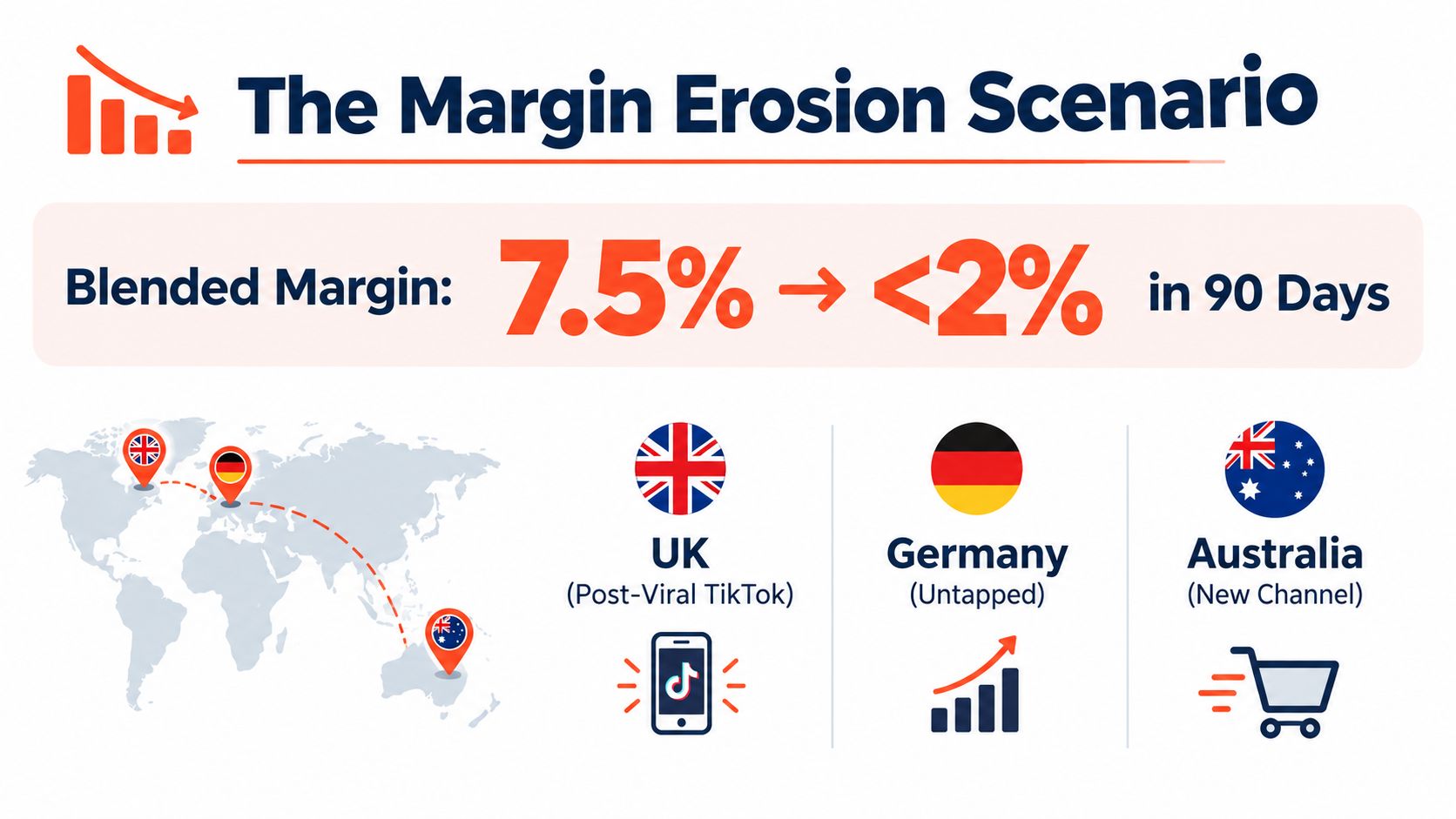
The dangerous assumption is that an order is profitable because the product margin looks healthy in the home market. International orders add variables that the domestic contribution model may not capture cleanly, including duties, VAT or GST, payment costs, foreign exchange movement, failed deliveries, customer support, and returns. A founder can acquire international customers successfully while subsidizing every transaction.
The de minimis era is also becoming less dependable as a planning assumption. Recent coverage highlights the removal or suspension of de minimis duty relief in major markets, while ASEAN cross-border ecommerce research identifies customs, duties, and returns as major barriers to participation. That changes the question from “How many countries can we ship to?” to “Which markets still produce acceptable contribution margin after the complete cost of serving them?”
Practical rule: Never open a market because your shipping software supports it. Open it because the order economics, compliance burden, and return path make sense.
Shipping blindly to thirty countries creates operational noise before it creates strategic learning. Your team needs a limited set of markets, a defined test budget, a landed-cost model, and clear stop conditions. International growth should earn the right to become local.
What a Global Expansion Strategy Actually Is for DTC Brands
A global expansion strategy is a written operating plan for deciding where to enter, when to enter, how to serve customers, and who owns each decision. It combines market selection, legal and tax preparation, fulfillment, checkout localization, merchandising, customer support, and governance. A country list in Notion isn't a strategy. It's an unprioritized backlog.
The strongest approach is phased. A peer-reviewed industry paper on international expansion describes a progression from research and strategy development to limited cross-border testing, progressive localization, and full local operations. It also states that successful international expansion typically takes 12 to 18 months from research to operational capability, so a founder should sequence investment around evidence rather than ambition.
Four operating stages
Validate demand cross-border. Start with a small group of demand-rich markets. Use Shopify Markets, localized currency display, transparent duties, and cross-border fulfillment. Your purpose is to learn whether customers convert and whether the contribution model survives real orders.
Localize proven markets. Add market-specific pricing, payment methods, language, promotions, returns messaging, and customer support where the data justifies the work. A market that converts only after checkout localization deserves a different investment decision from a market that remains weak.
Move fulfillment closer to customers. Consider a bonded warehouse or regional 3PL when delivery speed, return handling, or landed cost makes cross-border shipping less efficient. Don't move inventory only because local fulfillment feels more established.
Build local operations. Local entities, wholesale relationships, local hiring, and deeper partnerships belong after repeatable demand and operational requirements justify them.
Set gates before launch. Useful gates include the first 100 international orders per market, $500,000 in GMV, or sustained contribution margin above your internal target. These are planning thresholds, not universal rules. The point is to define evidence before excitement changes the standard.
Your Shopify architecture should support this sequence. A multi-market store may be enough for validation, while a more complex structure may become necessary as catalog rules, currencies, teams, and fulfillment paths diverge. Document those choices in a Shopify multiple storefronts guide before creating duplicate stores that your team can't govern consistently.
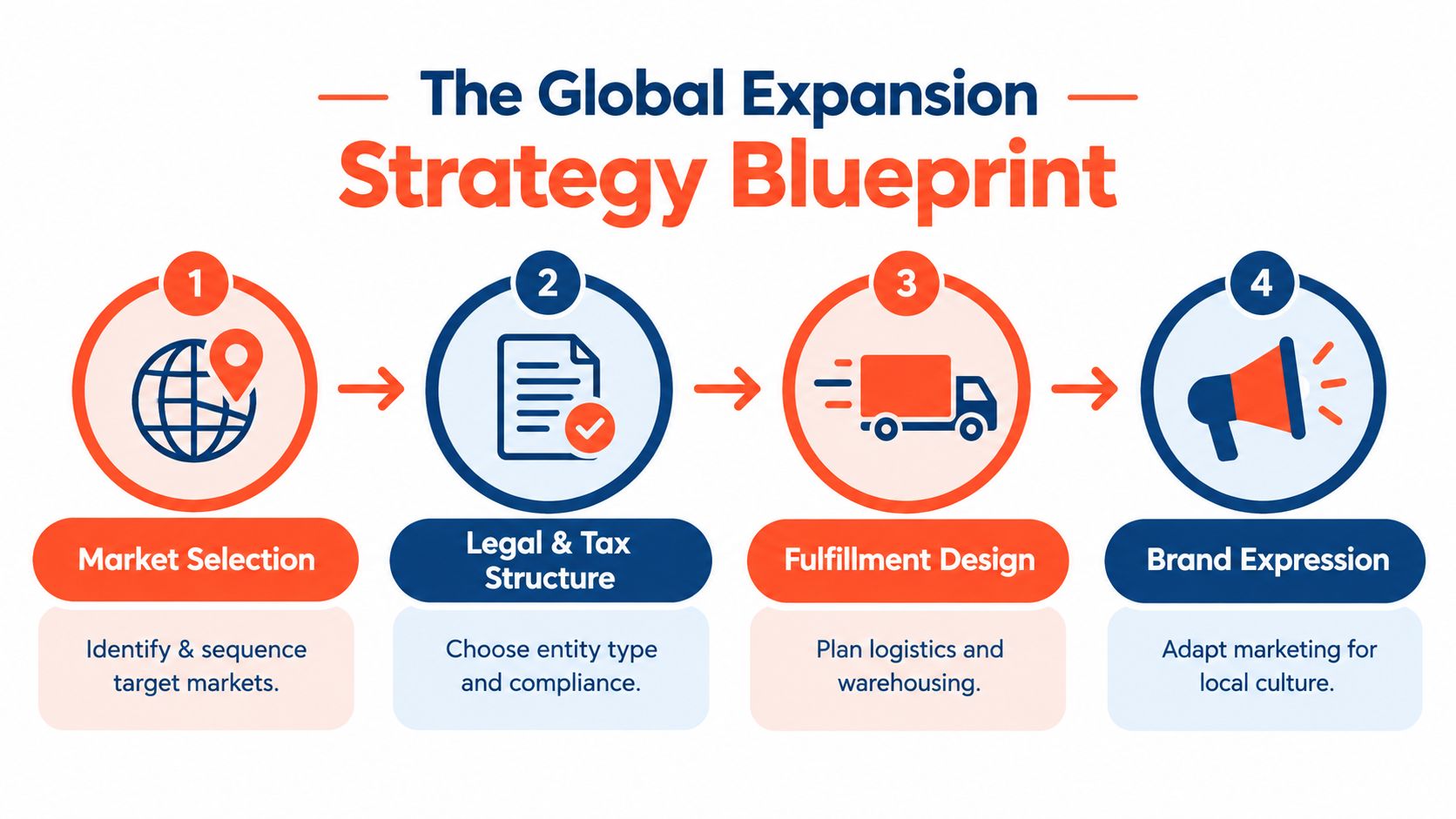
Choosing Where to Sell With a Scoring Model Instead of a Wishlist
Founders usually overvalue market familiarity. They select countries because competitors sell there, a distributor made contact, or social engagement looks promising. A better global expansion strategy uses a scoring model that makes trade-offs visible.
The Shopify enterprise market-selection guidance recommends weighing market size and growth potential against competition, regulation, infrastructure, and cultural distance. It also highlights GDP per capita, ecommerce penetration, mobile-wallet adoption, search demand, and regulatory burden as useful filters. Shopify Markets can support low-capital testing by showing regional conversion rate and average order value before you commit to local infrastructure.
Use a weighted model, but don't pretend the output is objective because it contains decimals. Assign each factor a weight based on your category. A beauty brand may prioritize payment behavior and repeat purchase potential. A bulky home-goods brand should give more weight to shipping distance, returns, and delivery economics.
DTC Market Scoring Matrix Example
The matrix below is an illustrative structure for a US beauty DTC brand. The scores are planning placeholders, not verified country statistics. Replace them with your own research before making an investment decision.
Filter | Weight | UK | Germany | Mexico |
|---|---|---|---|---|
Market size and growth potential | 25% | 5 | 5 | 4 |
Ecommerce and mobile-wallet readiness | 15% | 5 | 4 | 4 |
Competitive intensity | 15% | 3 | 3 | 4 |
Landed-cost and shipping feasibility | 15% | 4 | 4 | 3 |
Regulatory and tax complexity | 15% | 3 | 3 | 3 |
Cultural and language distance | 10% | 5 | 3 | 3 |
Search demand and category fit | 5% | 5 | 4 | 4 |
The weighted total matters less than the discussion it forces. If Mexico scores well on demand but loses on returns and fulfillment, the team can test it with a narrower assortment rather than treating the market as a full launch. If Germany has attractive demand but requires more language, compliance, and marketplace capability, those costs belong in the decision now.
Keep the first cohort focused. The Avalara global cross-border ecommerce report says 64% of manufacturers, retailers, and logistics providers either conduct cross-border ecommerce or plan to do so within the next year. It also reports that 77% expect cross-border ecommerce growth during 2023 and 2024. More supply entering the category means competition deserves a serious weight, not a footnote.
Legal, Tax, and Entity Setup Without Overbuilding
Legal and tax work should start before launch, but your first answer shouldn't be “incorporate everywhere.” Build the lightest compliant structure that lets you test demand, collect the required taxes, issue accurate invoices, and manage product obligations.
Begin with a country-by-country tax map. Shopify Tax can help calculate taxes in supported contexts, but it doesn't replace registration decisions, filings, product compliance, or local advice. Marketplaces may collect certain taxes under local rules, yet your own storefront still needs a defensible position on who collects, who remits, and what appears at checkout.
Separate the trigger from the entity
A registration threshold doesn't automatically mean you need a subsidiary. The right question is what activity creates the obligation, then whether your current operating model can satisfy it without a local entity. Review the registration basis for each market with qualified local advisers, especially when inventory, employees, or a local warehouse enters the picture.
Market | VAT/GST Threshold | De Minimis | Entity Required At |
|---|---|---|---|
European Union | Cross-border ecommerce rules require careful VAT analysis, including the EU-wide threshold cited in the expansion plan | Review IOSS and destination-duty treatment | When local operations, inventory, staffing, or banking require it |
United Kingdom | Review the applicable UK VAT registration rules and selling model | Confirm current treatment before launch | When local operations or regulatory obligations make an entity necessary |
Australia | Review Australian GST registration rules for the products and selling model | Confirm current import treatment and collection obligations | When local inventory, staff, or operating requirements justify it |
The specific registration thresholds listed in the operating plan are €10,000 for EU cross-border sales, £85,000 for the UK, and AUD 75,000 for Australia. Treat them as prompts for professional review, not as a substitute for determining which rules apply to your products, customer type, inventory location, and fulfillment structure.
Prepare these documents before marketing spend begins:
Tax registrations: Map obligations, filing ownership, and evidence retention.
Product compliance: Check requirements such as CE, UKCA, FDA, or FCC rules where relevant to the product.
Consumer terms: Localize returns, warranties, delivery promises, privacy notices, and dispute language.
Intellectual property: Search and protect trademarks in priority markets before public launch.
Import records: Define the importer of record, customs broker, tariff classification, and duty payer.
Entity triggers: Record the conditions that require a local bank account, warehouse lease, employee, or subsidiary.
If incorporation becomes necessary, founders can review practical guidance on company formation for entrepreneurs, then validate the decision with advisers in the target jurisdiction. Use the first thirty days for classification and document preparation, the next thirty for registrations and operational testing, and the final thirty for launch checks. Compliance shouldn't be the emergency project that appears after the campaign is live.
Fulfillment Models From Cross-Border to Local 3PLs
Fulfillment is a capital-allocation decision, not a badge of international maturity. Choose between shipping from your home country, using a bonded or regional warehouse, and placing stock with an in-country 3PL. The right model depends on order density, SKU complexity, return behavior, delivery promise, and the contribution margin you need to protect.
Cross-border shipping is usually the cleanest validation path. DHL, FedEx, and UPS can move orders without forcing you to pre-position inventory, negotiate warehouse contracts, or manage multiple stock pools. The weakness is predictable: longer delivery, more complex returns, and a landed-cost experience that can surprise the customer unless you use DDP and communicate clearly.
Bonded or regional warehousing sits between the two extremes. It can improve transit time and customs handling while avoiding a full local infrastructure commitment. A regional operator such as ShipBob, Ryder, or Maersk in Mexico may fit a brand that has repeatable demand but isn't ready to own a local node. Vendor suitability still depends on product category, service coverage, integration quality, and minimums.
Model | Best Volume Range | Transit Time | Return Handling | Cost/Order |
|---|---|---|---|---|
Ship from country of origin | Low or uncertain regional demand | Longest of the three | Centralized but slower | Variable, often efficient for testing |
Bonded or regional warehouse | Growing demand with shared inventory needs | Faster than origin shipping | Regional consolidation possible | Moderate, depends on storage and handling |
In-country 3PL | Dense, repeatable demand | Fastest local option | Local processing and resale decisions | Efficient at scale, expensive when underused |
The volume bands in your plan should be treated as operating hypotheses, not universal benchmarks. A low-SKU, lightweight product may remain cross-border longer than a high-SKU product with frequent returns. Likewise, a region with severe delivery friction may justify local stock earlier, while a nearby market may not.
Design the return path before the outbound path
Choose DDP when you want the brand to control the delivered price and customer experience. DAP can reduce upfront complexity, but it may leave customers responsible for import charges, which creates refusal, support, and refund problems. Decide who pays duties, where returns go, whether returned goods can be resold, and how refunds handle FX before launch.
Inventory pooling preserves flexibility. Distributed stock improves delivery speed but creates stranded inventory and reconciliation work. Connect inventory, orders, finance, and warehouse data through a deliberate architecture. A practical starting point is an ERP and ecommerce integration approach that gives finance and operations one view of market-level profitability.
Payments and Checkout Localization That Moves Conversion
Checkout is usually the fastest place to remove friction in a new market. A shopper may understand your product and trust your brand, then abandon the order because the price is in USD, the preferred payment method is missing, or duties appear only after the purchase decision.
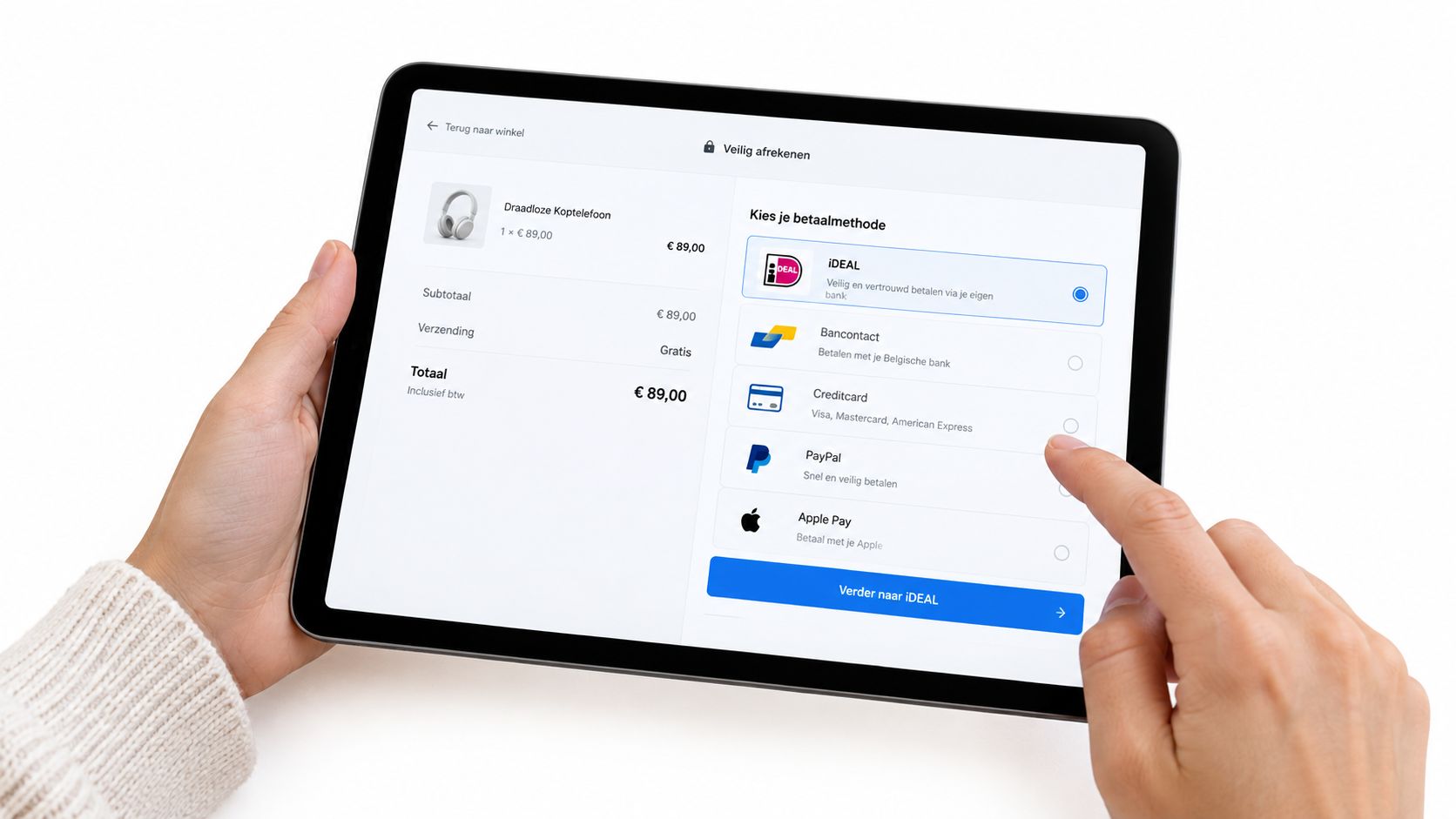
Start with payment behavior, not a global gateway checklist. The Netherlands and Belgium may require methods such as iDEAL and Bancontact. Klarna and Afterpay can matter across the Nordics, the UK, and ANZ. Brazil has PIX, Japan has Konbini, and Chinese-speaking shoppers may expect Alipay or WeChat Pay. The available methods should reflect the market and the customer's device, order value, and trust expectations.
Currency display is essential. Show local currency even if the business settles funds in USD, use sensible rounding, and make the relationship between product price, tax, shipping, and duties understandable. A price that converts cleanly into a market-friendly number can feel deliberate, while an awkward FX-derived price signals that the store wasn't built for the customer.
For Brazil, payment setup can involve local entity and gateway constraints. A practical example is the documented solved Stripe Brazil block from Chern & Co, which illustrates why payment architecture should be reviewed alongside legal structure rather than treated as a late integration task.
Configure the Shopify layer
Use Shopify Markets to define countries, currencies, domains or subfolders, catalog availability, and market-specific pricing. Configure checkout languages where supported, enable Shopify Payments where it fits your operating model, and connect appropriate local gateways. Use Shopify Functions or checkout extensions to apply market rules, validate conditions, and hide payment methods that don't apply.
Checkout rule: The customer should know what they're paying, how they're paying, when the order will arrive, and what happens if they return it before they submit payment.
Run a pre-launch test for every priority market:
Currency: Confirm product, shipping, tax, discount, and refund calculations.
Payment: Complete successful and failed transactions with each priority method.
Duties: Test DDP or DAP messaging and confirm the importer-of-record process.
Language: Review checkout, confirmation emails, returns, and support content.
Refunds: Test partial, full, and FX-sensitive refunds.
Analytics: Segment conversion, AOV, payment failure, and refund results by market.
For implementation patterns and review points, use this guide to optimize Shopify checkout.
Governance, Localization, and Growth Channels at Scale
Once a brand operates in more than a few markets, fragmentation becomes a margin problem. Every region wants its own promotions, apps, reporting definitions, product names, return rules, and campaign calendar. If nobody owns the global system, the business pays for duplicated work and receives conflicting answers.
Use a global core plus market configuration model. The central team owns the parts that protect the brand and the operating model. Local operators adapt the parts that depend on customer behavior, regulation, language, and channel access.
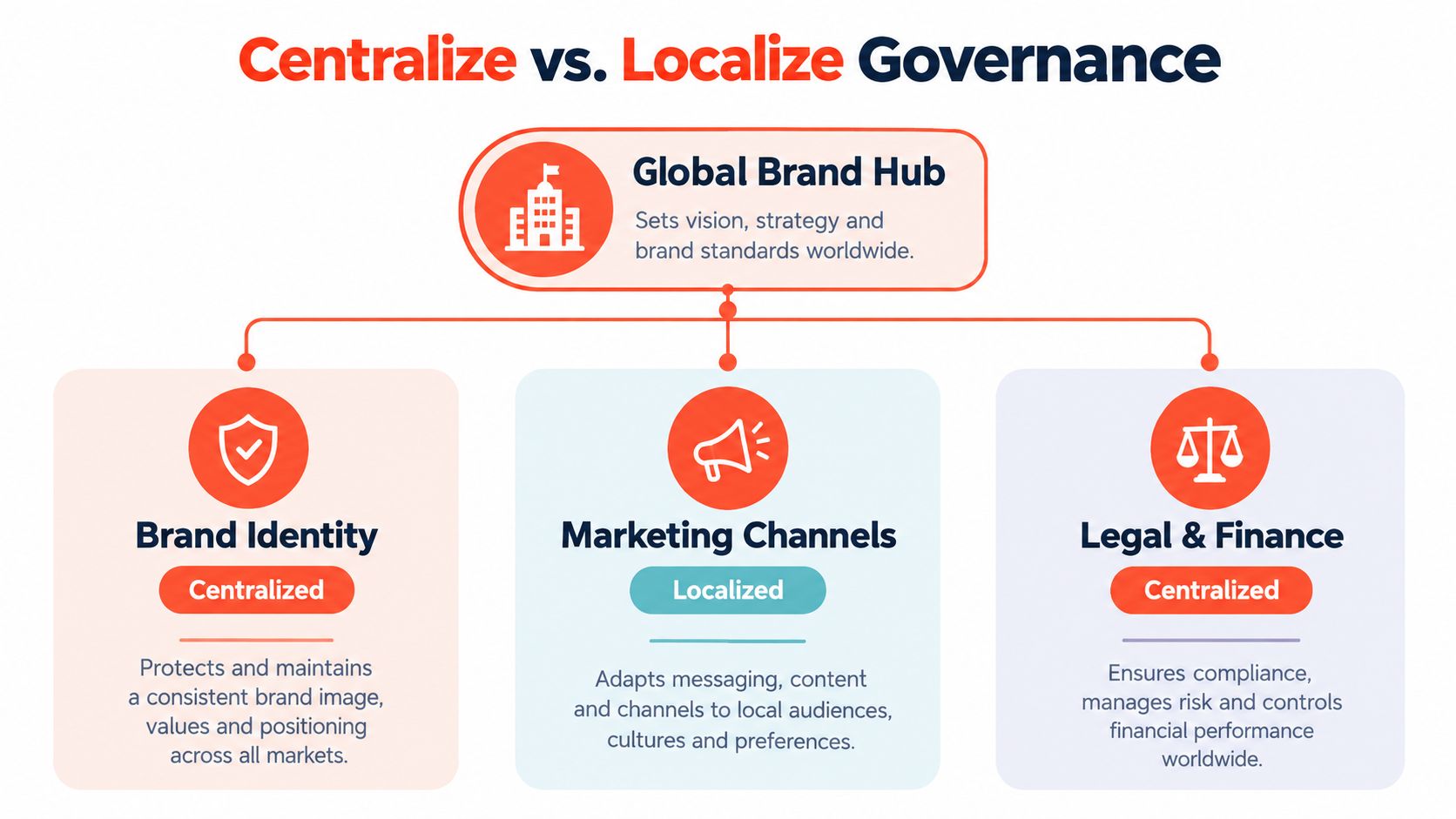
Keep these decisions centralized
Brand identity: Core positioning, visual standards, tone, claims, and approval rules.
Catalog structure: Product IDs, taxonomy, master data, and global assortment logic.
Pricing principles: Margin floors, discount authority, FX governance, and promotion guardrails.
Analytics: KPI definitions, attribution conventions, dashboards, and source-of-truth reporting.
Risk controls: Tax ownership, compliance registers, payment approval, and return-policy boundaries.
Platform architecture: Store structure, app standards, integrations, permissions, and release management.
Localize these decisions deliberately
Creative execution: Language, cultural references, creators, visual conventions, and seasonal moments.
Channel mix: Paid social may lead in the UK, marketplaces may matter more in Germany, and creator-led growth may be stronger in Brazil. Treat these as hypotheses to validate, not fixed rules.
Promotions: Local teams can propose offers that fit buying behavior, but central pricing rules should prevent margin leakage.
Customer operations: Support language, contact hours, delivery explanations, and return instructions should reflect the market.
Merchandising: Local demand can influence product emphasis without changing the global catalog's underlying structure.
Create a decision register with an owner, approver, review date, and escalation path for each market-sensitive rule. Add a controlled launch gate that checks tax, payments, inventory, returns, analytics, and creative before campaigns go live.
The dashboard should show each market separately while preserving shared definitions. Track conversion, AOV, contribution margin, payment failures, delivery exceptions, refund rate, return cost, support volume, and inventory exposure. Without that view, the central team sees blended performance and misses the market that is eroding profitability.
A Shopify and Shopify Plus Roadmap for the First 90 Days
A disciplined first ninety days should produce a controlled market test, not a collection of unfinished integrations. Shopify Markets removes much of the platform plumbing, but it doesn't decide whether your prices, duties, payment costs, returns, and fulfillment model produce acceptable contribution margin.
Days 1 through 30
Start with the commercial and technical foundation. Enable Shopify Markets for the selected countries, set international pricing and currency rounding, map tax registrations to each market, and configure both primary and backup payment gateways. Build the market scorecard and contribution model before approving creative spend.
Assign one owner from ecommerce, finance, operations, legal, and customer support. Each owner should sign off on their part of the launch checklist, rather than assuming another team has covered it.
Days 31 through 60
Move from configuration to controlled testing. Deploy Shopify Functions for relevant checkout validations, order rules, discounts, bundles, or market restrictions. Connect the selected regional 3PL or bonded warehouse only after the return path, inventory ownership, and data synchronization are documented.
Release localized storefront content for the markets that passed the first gate. Test product availability, shipping promises, duties, payment failure paths, refunds, transactional emails, and analytics with real orders.
Days 61 through 90
Launch the approved markets with controlled acquisition and daily monitoring. If you're on Shopify Plus and the operating model justifies it, evaluate a headless international storefront for deeper regional experiences. Don't use headless architecture to compensate for weak economics or unclear ownership.
Codify the governance model in Shopify permissions, release procedures, naming conventions, dashboard definitions, and market-level approval rules. A technically elegant store still fails if regional teams can change pricing, promotions, or product availability without a controlled process.
Phase | Days | Key Deliverables | Owner |
|---|---|---|---|
Foundation | 1 to 30 | Markets, currency, pricing, tax map, payment plan, scorecard | Ecommerce and finance |
Validation build | 31 to 60 | Functions, gateway testing, 3PL connection, localized theme content | Ecommerce and operations |
Controlled launch | 61 to 90 | Market launch, analytics, return monitoring, governance register | Ecommerce lead and regional operators |
Review the results at the end of the launch window. Keep markets that meet the contribution and service thresholds, fix markets with a clear operational issue, and pause markets where duties, returns, or compliance consume the commercial upside. International expansion should become a repeatable operating system, not a permanent experiment.
Presidio helps Shopify and Shopify Plus brands plan and implement international expansion through maintainable storefronts, checkout customization, integrations, performance work, and ongoing optimization. If you're deciding which markets to test or how to centralize your commerce stack without blocking local execution, visit Presidio to discuss the next stage of your roadmap.

Jamie, Presidio’s Designer, leads the practice alongside Johnnie. With over 10 years of e-commerce experience, Jay is a Shopify expert, known for crafting innovative solutions that prevent tech debt.
Jaime
Senior Product Designer, 2020