Outrank AI

A flash sale is live, the campaign email has gone out, and orders are arriving faster than your operations team expected. Then checkout errors appear. Your developers suspect an app, the fulfillment team sees delayed orders, and someone asks Shopify to investigate. The urgent question isn't whether Shopify Plus support is available. It's who owns each part of the failure, how quickly that person can respond, and whether the issue sits inside Shopify, your custom implementation, or the systems connected to it.
That distinction matters because enterprise commerce rarely breaks in one clean place. A platform incident, a checkout extension, an inventory workflow, and a customer notification can all interact. Shopify Plus gives larger merchants a priority path into Shopify, but that path doesn't automatically make Shopify responsible for every theme change, app, integration, or business rule your team operates.

Table of Contents
How Shopify Plus Support Differs From Standard Shopify Support
Choosing the Right Shopify Plus Support for Your Growth Stage
Introduction Why Shopify Plus Support Matters at Scale
At scale, support is an operational control, not just a customer-service channel. A launch issue can affect checkout completion, an outage can interrupt order capture, and a migration can expose dependencies that weren't visible in the old platform. The faster your team identifies the boundary between those problems, the faster it can assign the right person to resolve them.
Shopify Plus is designed for merchants operating with higher stakes and more complex commerce operations. Independent industry tracking in 2026 estimated roughly 71,118 to 76,528 Shopify Plus domains, with separate estimates placing distinct merchants at about 51,018 and live websites at more than 47,000. One dataset placed the United States at about 55% of merchants, with more than 25,000 Plus stores. These estimates are compiled in Shopify store statistics for 2026, and they illustrate the breadth of the Plus ecosystem rather than a niche enterprise audience.
Shopify also describes a fast product release cadence, with over 100 product updates every six months since 2020, as reported in the same Shopify store statistics source. That pace creates opportunity, but it also creates work. Themes, apps, APIs, checkout extensions, operational processes, and internal documentation must keep up with platform changes.
Operational rule: Before an incident occurs, decide which team owns Shopify platform behavior, which team owns custom implementation, and which team coordinates the business response.
This guide uses three layers to make that decision clear:
Shopify platform support, which diagnoses Shopify-managed behavior and provides priority access.
Engineering ownership, which covers your custom theme, apps, integrations, workflows, and business logic.
Agency retainer support, which provides ongoing technical capacity, planning, maintenance, and coordination.
Once those layers are separated, Shopify Plus support becomes easier to evaluate. You can contact Shopify for the platform edge, involve engineers for implementation issues, and use an agency when your team needs a continuing operating partner rather than a ticket-by-ticket reaction.
What Shopify Plus Support Actually Includes
Shopify Plus support is best understood as a priority route into the Shopify platform. Standard support helps merchants use Shopify, troubleshoot supported functionality, and find answers. Plus adds an enterprise-oriented support structure for merchants whose storefronts, integrations, and launches carry greater operational consequences.
The simplest analogy is an airport. Standard support is the main service desk, where customers receive assistance through established channels. Plus support provides a faster, more direct route to specialist help. That route can shorten the time needed to establish whether Shopify itself is malfunctioning, whether a configuration is supported, or whether an issue needs escalation.
The support channels available to Plus merchants
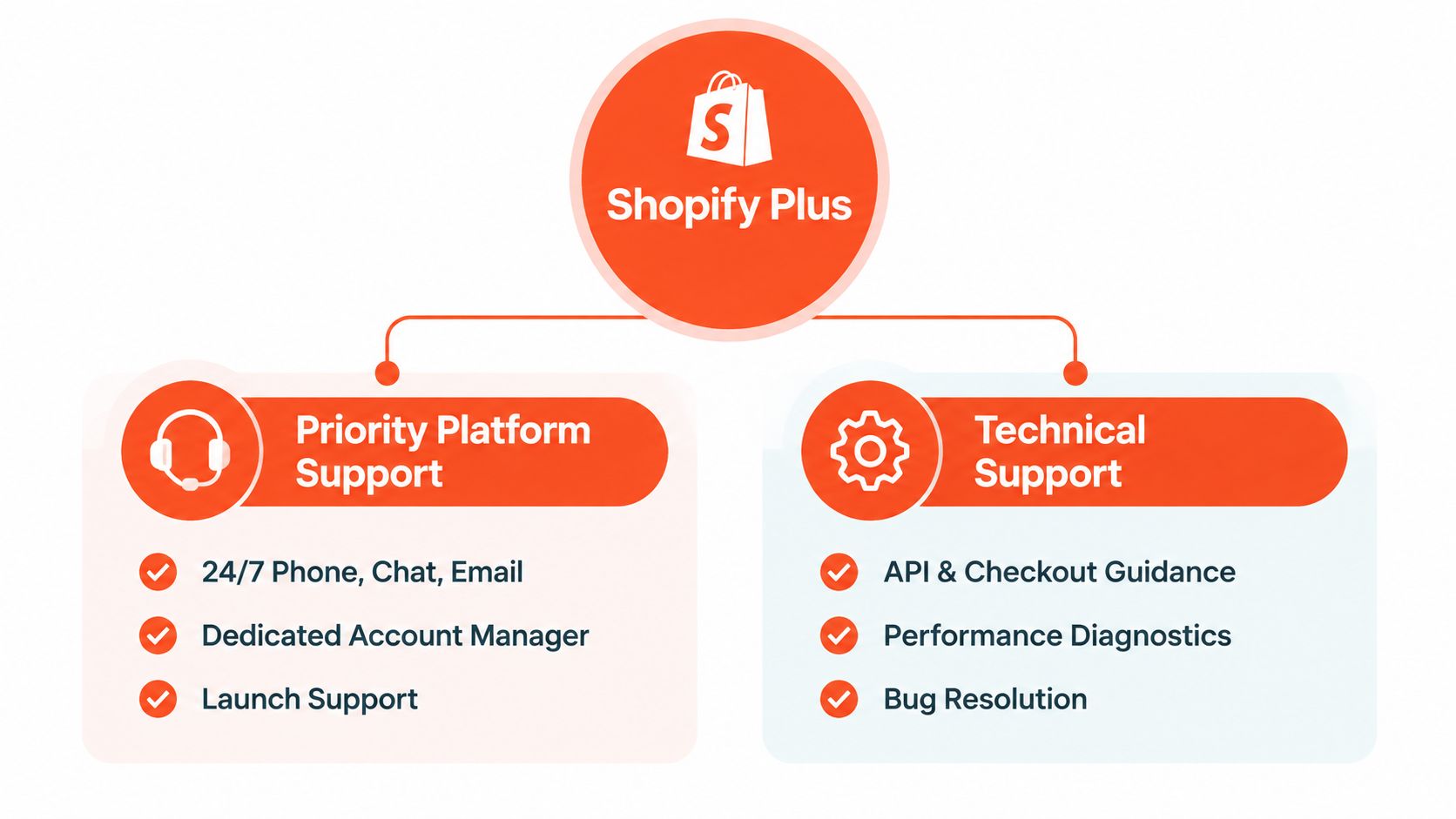
The official Shopify Plus plan documentation lists 24/7 priority phone and chat support as part of the plan. Shopify's support guidance for contacting Shopify also says Plus merchants can access chat with Plus Support Advisors, a direct phone line, and email tickets with typical 48-hour response times.
Those channels matter during different situations:
Phone support gives a team a direct route for urgent conversations when written troubleshooting would slow down diagnosis.
Chat support is useful for fast clarification during launches, configuration checks, and active incidents.
Email tickets create a written record for issues that need investigation or follow-up.
Plus Support Advisors provide a support path aligned with the Plus organization selected in the Help Center.
Shopify's guidance also says API, code, and developer support is available when a user selects a Plus store or Plus organization in the Help Center. That makes Plus support structurally better suited to storefront, API, and integration diagnostics at the platform edge.
What Shopify support can establish
Shopify support can help determine whether Shopify is behaving as designed, whether a platform feature is available, and whether a suspected bug belongs to Shopify's infrastructure. It can also guide teams toward supported approaches for APIs, checkout, and other platform capabilities.
That doesn't mean Shopify will modify your custom theme, repair a third-party application, or rewrite business logic. The Shopify Plus plan documentation makes the Plus support structure clear, while the engineering boundary remains equally important.
Support is included in the enterprise plan. Custom engineering isn't. Your team still needs ownership for code, apps, data flows, testing, deployment, and the operational decisions built around Shopify.
How Shopify Plus Support Differs From Standard Shopify Support
The difference isn't that standard Shopify support is absent. The difference is priority, access, and suitability for higher-stakes technical conversations. A growing brand may use standard support effectively for everyday questions, while a Plus merchant may need a direct escalation path during a launch or an API failure.
Support Feature | Standard Shopify Support | Shopify Plus Support |
|---|---|---|
General platform questions | Available through standard Shopify support channels | Available with Plus priority access |
Urgent operational incidents | May follow the standard support route | 24/7 priority phone and chat support |
Plus Support Advisors | Not part of the Plus-specific path | Available to Plus merchants through the Help Center |
Email support | Available according to standard support processes | Plus merchants can submit email tickets, with typical 48-hour response times noted by Shopify |
API and developer guidance | Available within supported support processes | Shopify says API, code, and developer support is available when a Plus store or organization is selected |
Custom theme ownership | Not included | Not included |
Third-party app ownership | Not included | Not included |
Custom business logic | Not included | Not included |
A useful comparison is available in this guide to Shopify Advanced versus Plus, but the practical decision is simpler than the plan names suggest. Contact Shopify when you need to know whether the platform, a supported feature, or a platform-facing API is working correctly. Contact your engineering team when the issue involves code your organization controls.
The boundary that causes the most confusion
Suppose an order discount fails. Shopify may confirm how discount functions are supposed to behave. It may investigate a platform error. But if your custom function contains the wrong condition, your development team owns the correction.
The same principle applies to a checkout extension, a theme component, a middleware service, or an ERP synchronization process. Shopify can help identify what the platform received or returned. It doesn't automatically own the code that prepared the request or interpreted the response.
Practical rule: Use Shopify Plus support to verify the platform boundary. Use engineering ownership to repair everything your organization added around that boundary.
What Agency Support Covers That Platform Support Does Not
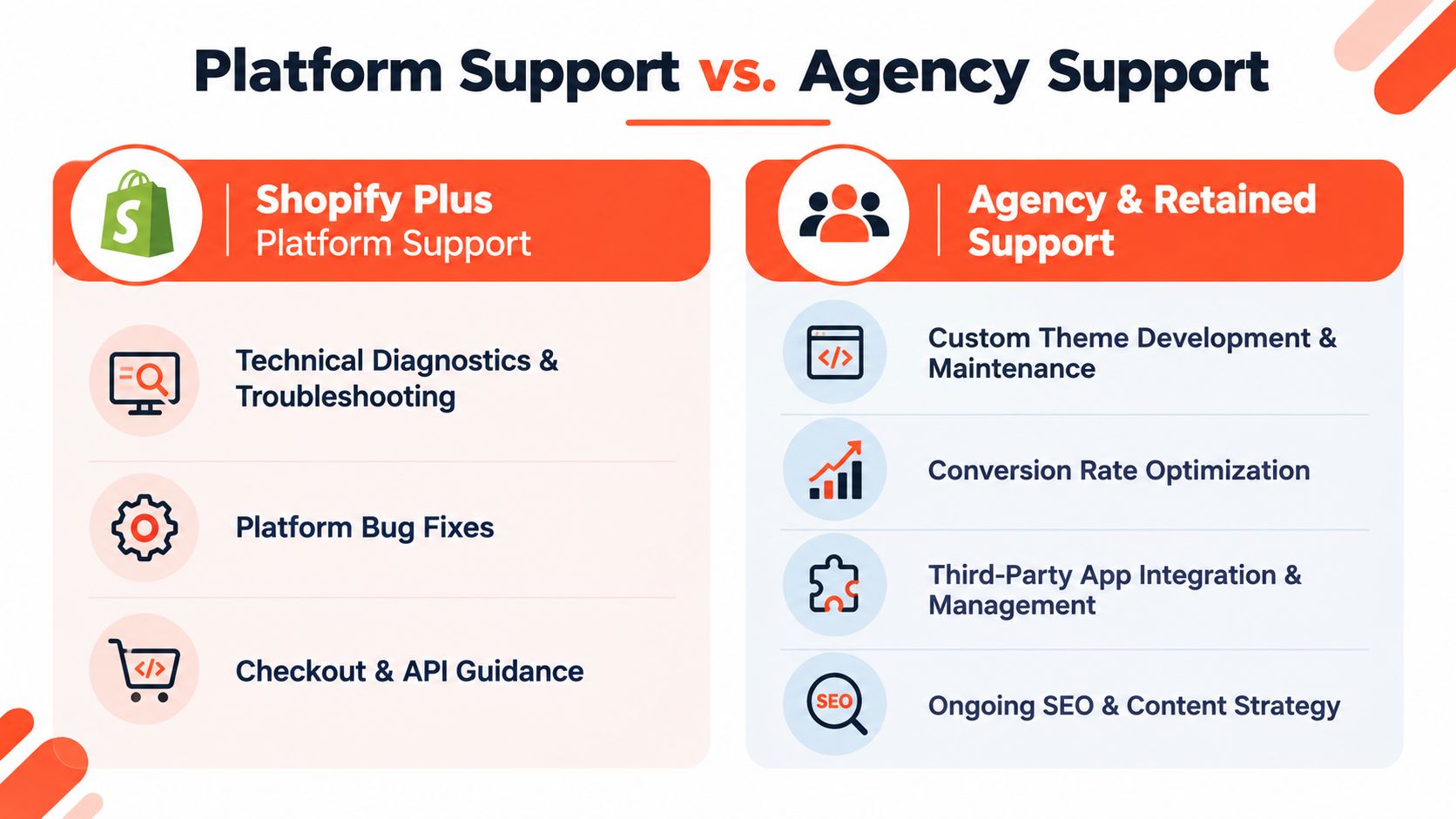
Platform support and agency support answer different questions. Shopify support asks, “Is Shopify behaving correctly, and what supported path should the merchant use?” An agency asks, “How does this storefront, app, integration, workflow, and release process work together, and what should we change?”
That difference becomes visible in gray-area failures. An order may leave Shopify successfully but fail to reach an ERP. An app may create a valid customer record but send the wrong message. A fulfillment workflow may run, yet customer communication may still show inaccurate status. Shopify can confirm its part of the transaction, while your team still needs someone to own the complete chain.
An independent guide to the limits of Shopify Plus support describes this pattern as a recurring weakness. Plus support can confirm platform behavior and escalate platform issues, but it rarely owns a workflow that crosses apps, custom logic, fulfillment, and customer communication.
Four practical agency support scopes
Custom implementation maintenance covers the theme, extensions, functions, scripts, and integrations your team controls. It prevents small changes from becoming undocumented production risks.
Operational troubleshooting follows a transaction across systems. The work may include logs, payloads, app settings, fulfillment rules, and customer-facing messages. This scope prevents teams from stopping their investigation at the Shopify admin.
Performance and experience work addresses page speed, accessibility, user experience, and conversion friction. Platform support can explain platform behavior, but it won't run your UX audit or prioritize your storefront roadmap.
Migration and modernization handles changes such as checkout architecture, theme refactoring, app replacement, and international expansion. The agency coordinates implementation, testing, rollout, and fallback planning.
Checkout Extensibility changes the ownership question
Checkout Extensibility is a clear example of where platform guidance stops and engineering work begins. Independent coverage of Shopify's changelog and checkout transition notes that Plus merchants had already passed the August 28, 2025 cutoff for thank-you and order-status migration, while non-Plus stores faced a separate August 26, 2026 deadline.
After legacy checkout customization paths stop working, Shopify support can explain the supported architecture and confirm platform behavior. It can't recreate a legacy customization that the platform no longer supports. Your engineering team or agency must map the old logic, identify the equivalent extension point, rebuild the experience, and test the customer and operational consequences.
For teams that need to staff this work internally or externally, a resource such as explore support roles in Latin America can help frame the people and coordination requirements. The key is to hire for ownership, not just for ticket volume.
For a broader view of how an agency can support this type of work, see Shopify Plus agency services. The right partner doesn't just forward Shopify replies. It traces the failure, changes the implementation, and stays accountable for the result.
Understanding SLAs Retainers and Support Scopes
A support retainer is a capacity agreement. An SLA, or service level agreement, is a response and service commitment. They often appear together, but they solve different problems.
A retainer answers, “How much ongoing access to a technical team are we buying?” An SLA answers, “How quickly will that team acknowledge and handle a particular priority?” A contract can include a large pool of development hours and still provide weak incident coverage if response expectations aren't defined.
Start with the work, not the package name
Before comparing providers, list the work your team expects to delegate:
Technical maintenance: Theme updates, code reviews, app configuration, bug fixes, and release support.
Performance tuning: Speed checks, asset review, storefront diagnostics, and remediation planning.
Feature iteration: New merchandising tools, subscriptions, personalization, discount logic, and checkout extensions.
Migration work: Data movement, architecture changes, platform transitions, testing, and launch coordination.
Growth support: CRO audits, experiment implementation, UX improvements, and international storefront planning.
Then separate urgent work from planned work. A checkout incident needs a different process from a new landing page. A planned migration needs different documentation from a minor theme adjustment.
Questions an SLA should answer
A useful SLA should define coverage hours, priority levels, acknowledgement expectations, escalation contacts, and what counts as resolution. It should also explain dependencies. If the agency needs access to an app vendor, a logistics provider, or Shopify support, the clock and responsibility should be clear.
Don't accept language that promises “fast support” without defining the conditions. Ask what happens when an issue crosses the platform boundary, whether emergency work consumes retainer hours, and who communicates status to marketing, operations, and leadership.
Match the model to your operating rhythm
A lean retainer may suit a stable storefront that needs maintenance, planned fixes, and occasional releases. A broader engagement fits a team managing frequent launches, multiple integrations, performance debt, and a visible experimentation roadmap.
The scope should be specific enough to prevent disputes. It might define a monthly development capacity, an incident process, a release review, and a recurring technical audit. It should also state what isn't included, such as third-party vendor fees, major replatforming, or entirely new application products.
Contract test: If your team can't tell whether a production issue is included, the support scope isn't finished.
How Presidio Structures Shopify Plus Support Engagements
Presidio approaches Shopify Plus support as a lifecycle rather than a queue of isolated tickets. That model starts with the storefront foundation, then connects maintenance, technical oversight, performance work, integrations, and growth initiatives to a shared roadmap.
The hybrid agency and software studio structure allows an engagement to include custom themes, apps, UX work, and operational planning. A brand may need a technical audit after launch, speed optimization before a campaign, accessibility improvements, or a new integration that affects fulfillment. Treating those needs as one connected system reduces the risk of solving a local problem while creating a new dependency elsewhere.

From lean implementation to maintainable operations
A lean build can reduce app sprawl and make future troubleshooting more understandable. Instead of stacking separate tools for every requirement, a team can evaluate whether a theme feature, Shopify Function, custom app, or integration provides a cleaner long-term boundary.
That approach matters after launch. When an incident occurs, engineers need to know which system owns pricing, customer data, inventory, subscriptions, and fulfillment. A maintainable foundation makes that investigation faster and gives the agency a clearer path for safe changes.
Presidio's Presidio Plus support offering connects ongoing development support with technical oversight for Shopify Plus merchants. The work can include backend integrations, subscription architecture, frontend optimization, feature delivery, and launch assistance.
Support that follows the roadmap
A useful partner doesn't wait for a failure before learning the store. Presidio's support model can be organized around recurring audits, backlog refinement, release planning, CRO, new features, integrations, accessibility, and international expansion.
That structure also helps an ecommerce director communicate with different teams. Developers can work from a prioritized technical backlog. Marketing can plan campaigns around release constraints. Operations can see how fulfillment and customer communication depend on the commerce stack. Leadership can evaluate support as planned operating capacity rather than an unpredictable emergency expense.
The result is a clearer separation of responsibilities. Shopify remains the platform escalation layer. The merchant retains ownership of business decisions. The agency provides the engineering and delivery capacity needed to keep the implementation healthy as the brand changes.
Choosing the Right Shopify Plus Support for Your Growth Stage
Shopify Plus support is sufficient when your main need is platform clarification, supported configuration guidance, or escalation of a Shopify-managed incident. It isn't sufficient when your team needs someone to maintain custom code, coordinate several vendors, own releases, or improve the storefront continuously.
Use these signals to assess your current position:
Your team needs implementation ownership: Choose engineering or agency support when custom themes, apps, functions, APIs, or integrations are central to revenue operations.
Your releases are becoming risky: A retainer becomes useful when marketing requests, platform changes, and technical debt compete for the same developers.
Your incidents cross system boundaries: Bring in an owner who can trace Shopify, apps, fulfillment, ERP, analytics, and customer communication as one workflow.
Your checkout architecture is changing: Plan engineering work for Checkout Extensibility rather than assuming platform support can restore legacy customization.
Your storefront needs proactive improvement: Performance, accessibility, UX, CRO, and internationalization require an ongoing roadmap, not just reactive troubleshooting.
Your business is preparing for a migration: Assign responsibility for discovery, data, integrations, testing, launch coordination, and post-launch stabilization before the cutover.
The right model may be a combination. Shopify Plus provides the priority platform relationship. Your internal developers own the code they maintain. An agency retainer fills capacity, planning, and cross-system accountability where the internal team needs reinforcement.
When evaluating a partner, ask for a sample escalation process, a clear list of included systems, release and testing practices, documentation standards, and examples of how gray-area incidents are handled. The strongest agreement makes ownership visible before an outage, not during one.
Presidio provides ongoing Shopify Plus development, performance optimization, integration support, accessibility work, and roadmap planning for brands that need more than platform-level troubleshooting. Visit Presidio to discuss a support model that connects incident response with maintainable engineering and long-term ecommerce growth.

Jamie, Presidio’s Designer, leads the practice alongside Johnnie. With over 10 years of e-commerce experience, Jay is a Shopify expert, known for crafting innovative solutions that prevent tech debt.
Jaime
Senior Product Designer, 2020