Outrank AI

Shopify Advanced caps at $399 per month when billed monthly, or $299 per month on an annual plan, while Shopify Plus starts at $2,300 per month on a three-year term. The key decision is whether the gap is justified by your checkout, API, B2B, and multi-store requirements at your current stage.
You're probably not comparing these plans because the feature pages are interesting. You're comparing them because the business has started to feel slower than it should. An ERP sync waits during a peak order period, a wholesale buyer needs terms your storefront doesn't support cleanly, or your growth team wants to change checkout behavior and discovers that Advanced won't give them enough control.
That's the practical Shopify Advanced vs Plus question. Advanced is a capable mid-market plan. Plus is an operational platform for merchants whose complexity has become expensive. The upgrade makes sense when Plus removes recurring friction, not when the business wants an enterprise label.
Decision area | Shopify Advanced | Shopify Plus |
|---|---|---|
Headline subscription price | $399 monthly, or $299 monthly on an annual plan | Starts at $2,300 monthly on a 3-year term, or $2,500 monthly on a 1-year term |
Checkout control | Standard checkout capabilities | Checkout Extensibility and Checkout Branding API |
REST Admin API limit | About 4 requests per second | About 20 requests per second |
GraphQL Admin API limit | Roughly 200 points per second | Roughly 1,000 points per second |
B2B complexity | Often requires workarounds or additional tooling | Native enterprise B2B capabilities |
Store operations | Better suited to a simpler operating model | Designed for multi-store and enterprise operations |
Support model | Standard Shopify support | Dedicated Plus support structure and merchant success resources |
The pricing figures come from Shopify's published pricing, while the checkout distinction is documented in this Shopify Advanced and Plus checkout comparison. The API figures come from Naturaily's plan comparison.
Table of Contents
Where Most Merchants Stall on Shopify Advanced
Consider a growing brand with a complex catalog, an ERP, a third-party logistics provider, and a wholesale roadmap. The store may be commercially healthy, but the operating team spends too much time managing exceptions. Orders need careful synchronization, promotions require manual checks, and checkout experiments stop at the edge of what Advanced allows.
That merchant hasn't necessarily outgrown Shopify. They've outgrown the way Advanced handles operational complexity.
The warning signs usually appear in the workflow rather than in the storefront. An integration queues work because the API responds more slowly under pressure. A developer adds another app to approximate checkout logic. The finance team relies on exports because the preferred system can't reliably receive every update in the required sequence. Each workaround looks manageable in isolation, but the stack becomes harder to test, monitor, and maintain.
Start with the friction, not the feature list
Audit the last few months of operational problems and classify each one:
Checkout friction: Which conversion, payment, shipping, or post-purchase changes are blocked by the current checkout architecture?
Integration friction: Which jobs fail, retry, or wait because the platform cannot process requests quickly enough?
Channel friction: Are DTC, wholesale, and regional operations forcing separate processes or storefront workarounds?
Support friction: Does the team lose meaningful time diagnosing platform issues without an account team familiar with the business?
This approach matters because the Plus subscription is not a small add-on. On headline subscription cost, the three-year Plus starting price is roughly 5.8 times the monthly-billed Advanced price, and the annual-billed Advanced comparison is roughly 7.7 times higher for Plus, based on Shopify's published pricing. Those multiples make an upgrade difficult to justify if Advanced already supports the business cleanly.
Practical rule: Upgrade when the cost of recurring workarounds, blocked revenue initiatives, and integration failures is more damaging than the cost of the platform change.
The rest of the decision should follow that rule. Don't ask whether Plus has more features. Ask whether your team has reached a specific operational trigger that Advanced can't address without fragile code, extra apps, or duplicated processes.
What Each Plan Is Actually Built For
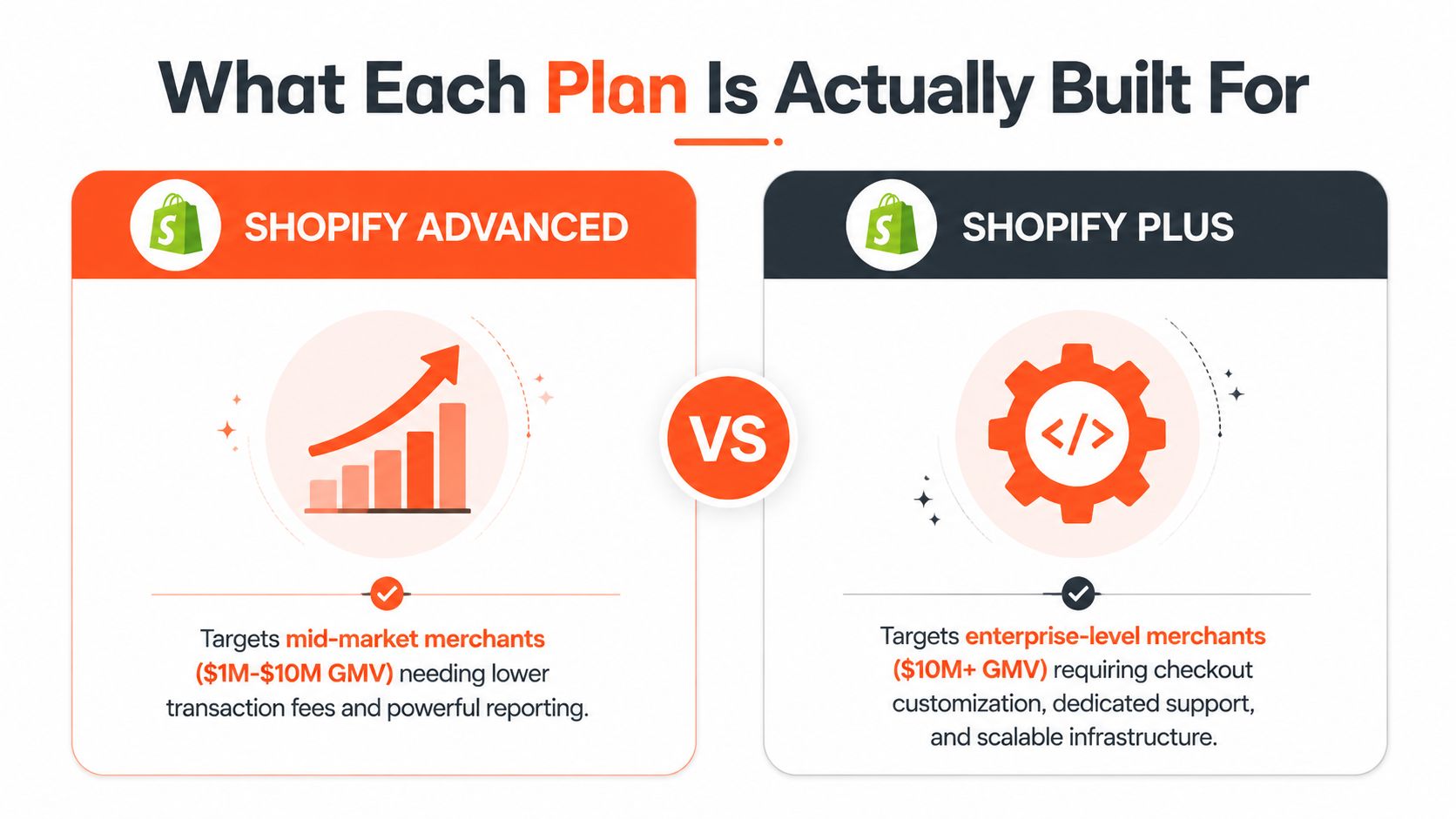
Shopify Advanced is built for a merchant that has moved beyond basic commerce requirements but still operates with a relatively focused structure. The plan suits a growing brand that needs better reporting, lower-cost platform access than enterprise Shopify, and room for more advanced integrations without introducing the commercial and technical overhead of Plus.
Shopify Plus serves a different operating model. It's intended for organizations managing higher-volume commerce, multiple storefronts, complex B2B relationships, or demanding backend integrations. The key distinction isn't that Plus replaces Shopify's core platform. It gives larger teams more control over the parts of the platform that become restrictive at scale.
Advanced fits a focused commerce operation
Advanced is the sensible choice when one main storefront serves the business, the checkout needs standard customization, and integrations can operate within standard platform limits. It gives the team a strong base for reporting, merchandising, shipping configuration, and workflow improvements.
The plan also supports automation and development work, but the available surface area matters. You can build a polished store on Advanced. You can also use Shopify Functions and automation tools where the plan supports them. The question is whether those capabilities cover the workflows you need, not whether your team can technically add more software.
Plus fits organizational complexity
Plus becomes more relevant when the business needs a coordinated structure around commerce:
Checkout control: Plus merchants get Checkout Extensibility and the Checkout Branding API, enabling custom checkout UI extensions and branded styling.
B2B operations: Wholesale teams can build around company accounts, buyer-specific catalogs, negotiated terms, and more structured purchasing workflows.
Multiple markets and stores: Regional, brand, or channel-specific storefronts can be managed as part of a broader Plus organization rather than treated as disconnected projects.
Enterprise integrations: Higher API throughput gives systems teams more room for order, catalog, inventory, and fulfillment synchronization.
Operational support: A dedicated Plus relationship can matter when platform decisions affect several teams or markets.
The right plan follows the shape of the business. A mid-market merchant with a disciplined single-store model may get little value from Plus. An enterprise operator can find Advanced expensive in a different way, because every workaround creates more ownership for developers, operations, finance, and customer service.
Side by Side on the Criteria That Matter
Price starts the comparison, but operational limits decide it. A focused store can run efficiently on Advanced. A merchant managing custom checkout behavior, high-volume integrations, B2B purchasing, or several stores needs to price the cost of working around those limits.
Criterion | Shopify Advanced | Shopify Plus |
|---|---|---|
Headline subscription | $399 monthly, or $299 monthly on an annual plan | $2,300 monthly on a 3-year term, or $2,500 monthly on a 1-year term |
Checkout | More limited control over checkout customization | Checkout Extensibility and Checkout Branding API |
REST Admin API | About 4 requests per second | About 20 requests per second |
GraphQL Admin API | Roughly 200 points per second | Roughly 1,000 points per second |
B2B | May require apps and process workarounds for complex needs | Better suited to native, structured B2B operations |
Multi-store complexity | Better for a focused store model | Better for multi-store enterprise structures |
Support | Standard support model | Dedicated Plus support and merchant success resources |
Integrations | Suitable for standard integration loads | Better suited to heavier automation and synchronization |
As noted in the pricing table above, Advanced carries a predictable monthly operating expense for a growing merchant. Plus demands a stronger commercial case. The upgrade makes sense when checkout control, API capacity, B2B volume, or multi-store coordination affects revenue and operating workload.
Checkout control is a conversion decision
Advanced works for teams that need branding, supported extensions, and conventional checkout improvements. Plus fits a merchant whose checkout is part of the product strategy, including custom UI extensions, specialized buyer journeys, or post-purchase experiences that require deeper control.
Review this guide to Shopify checkout extensibility before committing to Plus for checkout work. Confirm that the desired experience fits Shopify's supported extension points. If it does not, the team may keep rebuilding around the same restriction, which weakens the business case for Advanced.
API capacity affects reliability
The REST and GraphQL limits affect daily operations. They determine how quickly an ERP receives orders, how reliably inventory updates, and how much work a middleware layer can process during concentrated demand. Plus provides materially higher published limits, giving integration teams more room for heavier synchronization workloads.
Higher limits do not repair poor integration architecture. A badly designed sync can fail on either plan. Plus is the stronger foundation when order, catalog, inventory, or fulfillment traffic has outgrown standard throughput and failed synchronization creates customer or operational consequences.
Support should match the cost of failure
Standard support fits a focused team with strong internal technical ownership. A merchant running several channels, markets, or revenue-critical integrations may need faster escalation and a support relationship that understands the commercial context.
Support alone rarely justifies Plus as the first upgrade reason. Repeated delays that disrupt launches, integration fixes, or checkout work change the calculation. At that point, the cost sits in postponed revenue and internal coordination, not only in the subscription fee.
How the Plans Behave in Real Operations
Feature pages don't show the operational difference clearly. The same merchant can make Advanced work for a while, then reach a point where every new market, sales channel, or integration adds another exception.
Scenario | Shopify Advanced | Shopify Plus |
|---|---|---|
Regional expansion | Separate operating patterns can create duplicated setup and administration | Better suited to coordinated multi-store and international structures |
Wholesale channel | Workarounds may involve apps, separate processes, or manual order handling | Native B2B capabilities support more structured buyer relationships |
ERP and 3PL synchronization | Standard API limits can constrain heavy request loads | Higher API limits provide more throughput for demanding integrations |
Campaign operations | Teams may rely on manual launch coordination and app combinations | Plus tooling can support more centralized enterprise automation |
A second market exposes organizational weaknesses
A merchant adding another region needs more than translated content. Currency, catalog rules, fulfillment, tax handling, promotions, customer support, and reporting all need a clear operating model. Advanced can support international selling, but a business that requires separate regional storefronts and coordinated governance may start duplicating work.
Plus is designed for that more complex structure. It's the better fit when regional experiences need to operate as part of one enterprise system rather than as a collection of loosely connected stores.
Wholesale turns exceptions into a process
A DTC store can sometimes handle wholesale demand with draft orders, spreadsheets, negotiated discounts, or a third-party B2B application. That approach becomes harder to manage when buyers expect company-specific purchasing rules, repeat ordering, account permissions, and reliable terms.
Plus makes more sense when wholesale is a core channel rather than an occasional sales motion. Before reviewing the platform decision, founders should also understand the financial control required as channels multiply. This guide to ecommerce bookkeeping for founders is useful for connecting order flows, channel reporting, and operational accountability.
Integration pressure appears during peaks
An ERP and a 3PL rarely need the same data at the same moment. Inventory updates, order creation, fulfillment events, returns, and catalog changes can compete for API capacity. On Advanced, a burst of activity can force the integration layer to queue or retry requests. On Plus, the higher limits are better suited to a heavier synchronization workload, although the implementation still needs sensible batching, retries, and monitoring.
The practical test is simple. If your team regularly treats API throttling as a launch risk, you're no longer evaluating Plus as a luxury feature set. You're evaluating it as infrastructure.
Operational Triggers That Signal an Upgrade
Revenue alone shouldn't determine the move. A smaller merchant with a demanding checkout or complex B2B operation may need Plus before a larger single-store brand does. The strongest signal is repeated operational friction tied to a business-critical workflow.
The four triggers to document
Checkout customization limits: If your growth team has experiments ready but can't implement the required checkout experience through supported extensions, Advanced has become a product constraint.
API throttling errors: Repeated rate-limit errors during ERP, 3PL, catalog, or order synchronization indicate that standard throughput may no longer match the workload.
Multi-store management complexity: If regional or brand storefronts require duplicated administration, inconsistent releases, or separate reporting processes, Plus deserves a serious evaluation.
Exclusive B2B requirements: If wholesale buyers need structured company purchasing, buyer-specific catalogs, net terms, or more advanced pricing workflows, app-based workarounds may be creating unnecessary risk.
The API comparison provides a concrete diagnostic. Independent comparison data places Advanced at about 4 REST requests per second and roughly 200 GraphQL points per second, compared with about 20 REST requests per second and roughly 1,000 GraphQL points per second on Plus. Those limits should be assessed against your actual logs, not guessed from order volume alone.
Turn the triggers into a decision record
Create a short upgrade document with four columns:
Observed problem: Record the failed sync, blocked checkout requirement, duplicated store task, or wholesale request.
Business consequence: Note the team involved, the delay created, and the customer or revenue workflow affected.
Current workaround: List the app, manual step, custom script, or separate store being used.
Required Plus capability: Identify the specific platform capability that would remove the workaround.
Don't use an arbitrary order count as a substitute for diagnosis. The brief's suggested thresholds may help with internal planning, but they aren't universal platform rules, and the verified plan data doesn't establish a single order-volume cutoff. Measure the friction you can prove.
Choosing the Right Plan for Your Stage
Stay on Advanced when your business has one primary storefront, a manageable integration footprint, no urgent native B2B requirement, and a checkout roadmap that fits supported customization. It's also the right stop when your team doesn't have the technical ownership to use Plus capabilities responsibly.
The strongest Advanced profile is a focused DTC merchant. Marketing, merchandising, operations, and development can work from one storefront, the catalog is governed centrally, and integrations don't regularly compete for capacity. In that environment, Plus may add cost and implementation work without removing a meaningful constraint.
Choose Advanced when the operating model is still focused
Advanced is a good fit if:
One storefront serves the main market: You aren't coordinating regional, brand, and wholesale storefronts.
Checkout improvements are conventional: Your team can build the desired experience through the checkout tools available on the plan.
B2B is limited or experimental: Wholesale doesn't yet require complex company-level purchasing rules.
Integrations are stable: Your ERP, inventory, and fulfillment systems synchronize without persistent rate-limit problems.
The team values simplicity: You don't need enterprise governance or a dedicated Plus relationship.
Choose Plus when complexity is already expensive
Move to Plus when the business operates across markets, brands, or channels and the current setup forces duplicated work. The case is even stronger when checkout conversion is a material growth lever, B2B buyers expect more advanced purchasing, or integration failures create fulfillment and customer-service problems.
A Plus project should have an owner, a defined capability gap, and a financial model. It shouldn't be approved because competitors use Plus or because the business wants to appear more established.
For merchants weighing implementation support, a specialized Shopify Plus agency can help translate operational requirements into an architecture and rollout plan. Revisit the decision regularly, especially after a major market launch, wholesale expansion, ERP change, or checkout redesign.
What a Move to Plus Actually Involves
A Plus migration isn't a billing switch. Plan for a structured implementation that may take 6 to 12 weeks, depending on the store's data, integrations, checkout requirements, and organizational changes. The work typically begins with a Plus Solutions Architect consultation, commercial agreement, and provisioning of the Plus organization.

Phase one is commercial and architectural
Before developers move code, document the operating model. Decide which stores, markets, catalogs, customer types, and integrations belong in the Plus organization. Confirm the contract term and identify which current apps can be replaced by native Plus capabilities.
A Shopify migration services team can reduce avoidable rework. The goal isn't to copy every existing workaround into a more expensive plan. It's to remove obsolete dependencies and rebuild the workflows around supported capabilities.
Phase two is migration and reconstruction
Theme code can move through the Theme Kit or GitHub integration, but checkout customization often needs more than a transfer. Scripts, webhooks, apps, and custom integrations should be audited individually, because a feature that works in the current environment may need a different implementation through Checkout Extensibility, the Branding API, or Functions.
Catalog and customer data deserve their own migration plan. Validate products, variants, inventory, orders, customer records, discounts, redirects, and analytics before launch. Keep the old environment available as a fallback while the team tests the new organization.
Phase three is controlled launch
Use a soft launch rather than treating cutover as a single irreversible event. Test checkout paths, payment methods, shipping logic, promotions, B2B permissions, ERP synchronization, fulfillment events, and reporting.
The final approval should come from operations as well as marketing and development. A visually successful launch that sends incomplete orders to the warehouse is not a successful migration.
Common Questions Before Committing
Does Plus require a long contract? Shopify publishes Plus pricing by contract term. The starting price is $2,300 per month on a three-year term and $2,500 per month on a one-year term, so the commercial commitment should be evaluated alongside the operational roadmap, not separately. Verify the exact proposal, renewal terms, and any variable commercial provisions with Shopify before signing.
Does Plus pricing change by country? Yes. Shopify Plus publishes local-currency entry ranges across major markets, including CAD $3,400 to $3,650, EUR €2,100 to €2,250, GBP £1,800 to £1,950, JPY ¥368,000 to ¥398,000, AUD $3,700 to $4,000, and INR ₹175,000 to ₹190,000, depending on contract term. Review Shopify Plus pricing by market and confirm taxes, currency, and contract treatment for your business.
Can you downgrade later? Treat downgrade planning as part of the initial negotiation. A move away from Plus can affect checkout capabilities, B2B workflows, store architecture, support, and integration capacity, so document which Plus-dependent functions would need replacement before committing.
Do apps become free on Plus? No. Your app costs generally remain separate from the subscription. Plus may provide access to negotiated terms with selected technology partners, but confirm those terms individually.
What should you model financially? Compare the subscription with the cost of current workarounds, failed integrations, duplicated stores, developer time, and blocked checkout initiatives. If those costs aren't documented, you're not ready to defend the upgrade internally.
Presidio helps Shopify merchants plan and implement Plus migrations, checkout extensibility, integrations, custom Functions, and ongoing optimization without carrying old workarounds into the new architecture. Visit Presidio to discuss the operational trigger you're hitting and build a practical upgrade plan around it.

Jamie, Presidio’s Designer, leads the practice alongside Johnnie. With over 10 years of e-commerce experience, Jay is a Shopify expert, known for crafting innovative solutions that prevent tech debt.
Jaime
Senior Product Designer, 2020