Presidio

You click “subscribe” on a bag of coffee, a skincare refill, or a box of pet food. The checkout takes a moment, the first order arrives, and future deliveries feel automatic. From the shopper's side, a subscription looks like a simple promise: pay regularly, receive value regularly, and skip the effort of remembering to reorder.
For a brand, the same offer is much less simple. The store must schedule charges, handle renewals, send fulfillment instructions, recover failed payments, support skips and pauses, and keep the customer interested after the first delivery. A subscription can create repeat revenue, but only when the business earns the next payment and successfully collects it.
That distinction matters because the subscription economy has moved far beyond streaming media and software. Grand View Research estimates the global subscription economy at USD 492.34 billion in 2024, with a projection of USD 1,512.14 billion by 2033 at a 13.3% CAGR from 2025 to 2033 (Grand View Research data summarized by Justt Pricing). Consumer goods, services, memberships, and digital access now use the model, making subscriptions a central part of modern ecommerce retention strategy.
This guide answers what is a subscription model in practical terms. You'll learn how the model works, where the money moves, which format fits different products, and why profitable subscriptions depend less on acquisition volume than on retention, payment recovery, and customer-perceived value.
Table of Contents
Introduction Why Subscriptions Feel Simple Until You Run One
A customer buys a coffee subscription because it removes a small recurring chore. They choose a roast, select a delivery cadence, enter payment details, and move on. The next shipment should arrive before the cupboard is empty, without another product search, comparison, or checkout.
That convenience creates a strong customer experience, but it also creates an ongoing brand obligation. The merchant has to deliver the expected product at the expected time, charge the right amount, communicate clearly, and make changes easy when the customer travels, has too much inventory, or wants a different flavor. A rigid subscription often turns convenience into frustration.

The customer sees a promise
The buyer isn't thinking about billing states, payment tokens, fulfillment events, or retry schedules. They're thinking, “I want this product to keep showing up.” That expectation changes the standard for service. A one-time order can succeed even if the customer never returns. A subscription must make the next interaction feel useful enough to continue.
The model has also become a major operating choice for brands, not just a promotional add-on. The market's scale helps explain why merchants increasingly treat subscriptions as a long-term commercial system rather than a one-time discount tactic (subscription economy overview).
The merchant runs a system
A subscription offer connects several teams and tools:
Merchandising: Define what customers receive and why it remains valuable.
Checkout: Capture consent, cadence, price, and payment information accurately.
Billing: Create invoices and attempt charges on the agreed schedule.
Fulfillment: Translate successful renewals into pick, pack, and shipment activity.
Retention: Give customers reasons to stay, pause, change, or upgrade.
Support: Resolve skipped orders, duplicate concerns, failed payments, and delivery questions.
The central lesson is straightforward. A subscription isn't predictable revenue by default. It's a recurring opportunity to prove value and collect cash.
What a Subscription Model Really Means
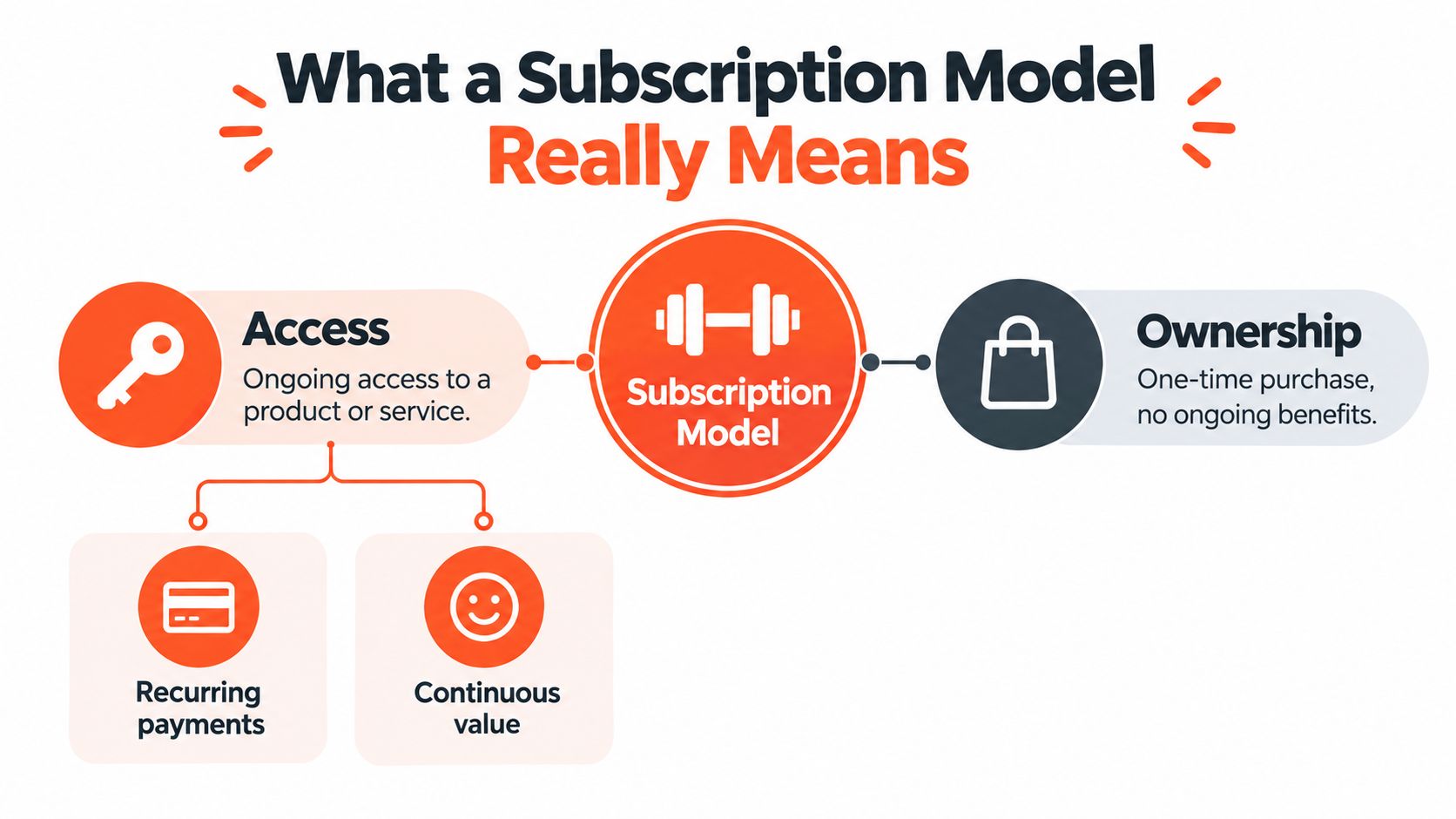
A subscription model is a business structure in which a customer receives ongoing access to a product, service, benefit, or curated experience in exchange for recurring payment. The customer doesn't complete a new purchase for every cycle. Instead, they authorize the business to continue the relationship under agreed terms.
A gym membership makes the idea easy to understand. A day pass is a single transaction for temporary access. A membership creates continuing access, with payment recurring according to a chosen term. The same logic applies when a customer receives coffee every month, uses software while their account remains active, or gets members-only benefits.
The three parts of the definition
You can explain the model to a teammate in three steps:
Ongoing value: The customer receives something repeatedly, such as replenishment, access, support, or discovery.
Recurring payment: The business charges according to a defined cadence, such as monthly, quarterly, or annually.
Continuing relationship: The customer can remain active, change the arrangement, or cancel under the service terms.
Remove the recurring payment and you have a repeat-purchase program. Remove the ongoing value and you have a charge without a meaningful subscription experience. Add points or occasional rewards without recurring access or delivery, and you're describing a loyalty program rather than a subscription.
Practical rule: A subscription should make the customer's future experience easier or better, not merely make the merchant's revenue report look smoother.
Access changes the brand's obligation
A one-time purchase usually ends with delivery, installation, or activation. A subscription keeps the merchant accountable after that moment. The brand must maintain product quality, manage inventory, honor the selected cadence, and provide a clear path for account changes.
That ongoing relationship can create stronger retention and more useful customer feedback, but it introduces operational work. Customers expect transparency around price, timing, renewal, cancellation, and what happens when a payment fails. The offer must be designed around those expectations from the start.
The simplest definition is therefore also the most useful: a subscription exchanges recurring payment for recurring value, while giving the customer an ongoing relationship with the brand.
How Subscription Billing and Revenue Mechanics Work
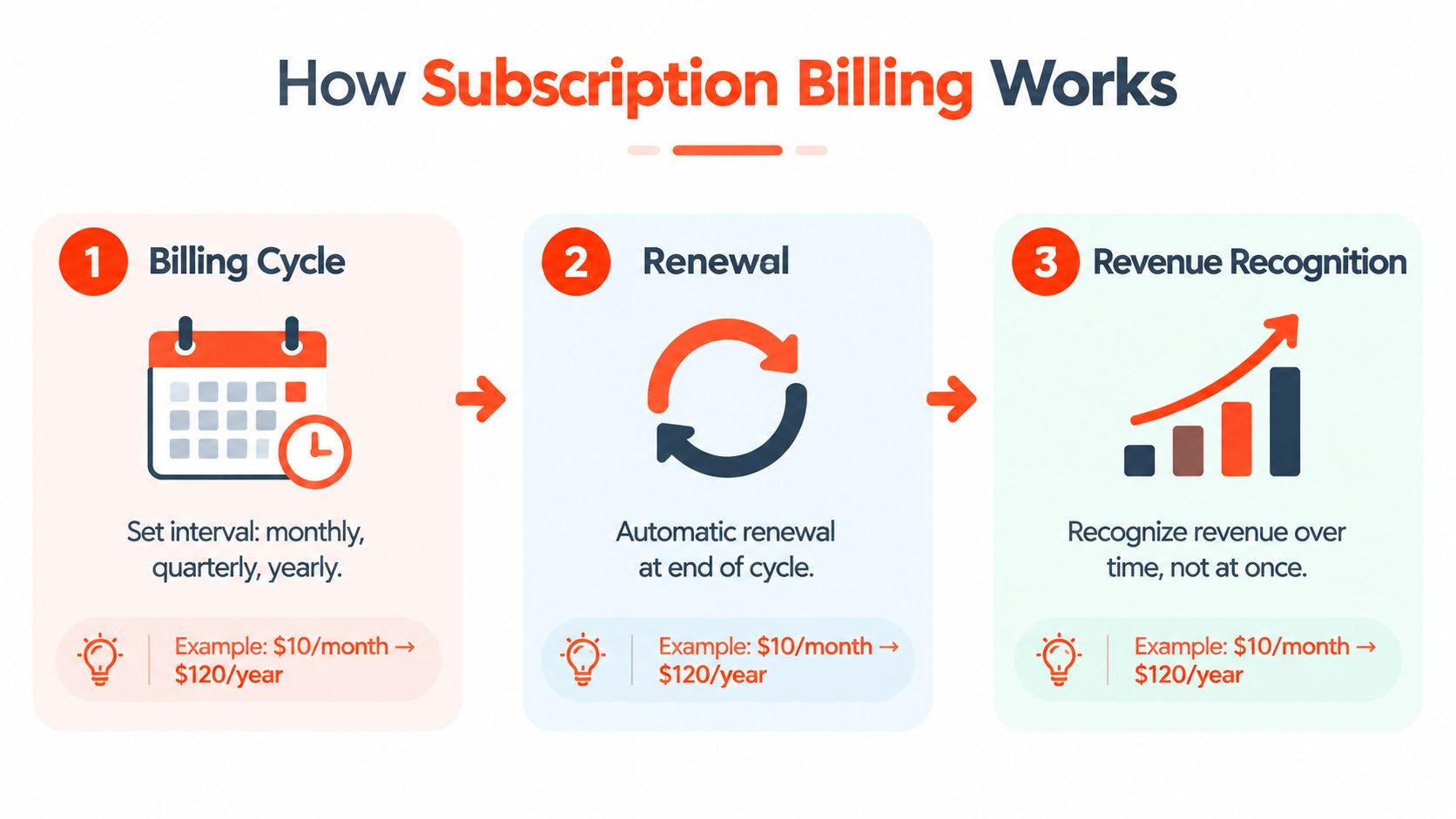
A subscription business operates through three connected mechanics: billing cycles, renewals, and expansion revenue. Treating them as separate features creates gaps. A billing cycle sets the timing, a renewal attempts to continue the relationship, and expansion increases the value of an active account through upgrades, add-ons, or higher usage tiers (Chargebee's explanation of the subscription business model).
Billing cycles set the rhythm
The cadence determines when the system creates an invoice and attempts payment. Monthly terms can create frequent customer touchpoints and shorter commitment periods. Quarterly terms may reduce transaction frequency while changing how customers evaluate inventory, value, and cash outlay. Annual terms can collect more upfront, but they also create a longer wait before the next renewal decision.
Those differences affect forecasting and retention analysis. A merchant shouldn't treat every active subscriber as equivalent if some customers pay monthly while others pay annually. The business needs to understand when cash is expected, when a customer can cancel, and when fulfillment should occur.
On Shopify, the storefront experience also matters. A subscription selector, delivery-date message, discount rule, or account change may require carefully coordinated checkout behavior. Teams planning custom interactions can review Shopify checkout extensibility considerations before adding subscription-specific logic.
Renewals turn intention into realized revenue
At renewal, the billing system creates an invoice and attempts to collect payment. If the payment succeeds, the customer remains active and the fulfillment process can continue. If it fails, the account enters a recovery path rather than instantly becoming a lost customer.
That path may include retries, customer notifications, updated payment credentials, and support intervention. The quality of this workflow affects realized monthly recurring revenue because an active record isn't the same as collected cash.
Expansion raises account value
Expansion revenue comes from a customer moving to a higher tier, adding products, increasing usage, or purchasing complementary items. A coffee subscriber might add filters. A membership customer might upgrade for extra benefits. A software account might add seats or move into a higher usage tier.
Expansion helps a business grow within its existing customer base, but it must remain understandable. Customers need to see what changed, what they'll pay, and what additional value they receive. Strong subscription operations connect billing data, account status, product availability, and customer communication so every change is reflected consistently.
Types of Subscription Models You Can Choose From
Not every product belongs in the same subscription format. A consumable with a predictable replacement cycle suits replenishment. A discovery-led assortment needs curation. A digital product or community may work better as access. Usage-based subscriptions can fit services where consumption varies meaningfully between customers.
The right choice starts with the customer's job. Are they trying to avoid running out, discover something new, access a benefit, or pay in proportion to usage? Forcing every catalog into automatic replenishment can create excess product, unnecessary support requests, and avoidable cancellations.
Subscription Model Types Compared
Model Type | Best For | Customer Promise | Ecommerce Example |
|---|---|---|---|
Replenishment | Consumable products with repeat demand | “You won't run out.” | Coffee, vitamins, pet food, skincare refills |
Curation | Discovery and variety | “You'll receive a thoughtful selection.” | Beauty box, snack box, themed product box |
Access or membership | Benefits, content, or privileges | “You'll receive ongoing member value.” | Members-only discounts, premium community, early access |
Usage-based | Variable consumption or service intensity | “Your payment reflects how much you use.” | Digital credits, metered services, replenishment based on usage |
Replenishment reduces routine work
Replenishment works best when customers already know they'll need the product again. The merchant should make cadence changes easy because actual consumption rarely follows a perfect calendar. A customer may need to skip a shipment, change quantity, or delay the next order.
Curation sells anticipation
Curation adds editorial and discovery value. The customer isn't receiving the same item again. They're paying for selection, variety, and the experience of opening the box. That makes inventory planning and expectation setting more complex because each cycle may contain different products.
Access depends on continued relevance
Access and membership models need benefits customers can understand and use. A discount alone may not sustain the relationship if customers don't shop often enough. Early access, exclusive products, helpful content, or community participation can give the membership a clearer role.
Usage-based models require careful measurement and communication. Customers should know what counts as usage and how that usage affects billing. A hybrid structure can combine a recurring access fee with usage or add-on charges, but that flexibility also increases billing and support complexity.
Subscription Model Examples in Ecommerce and Shopify
A coffee brand might offer recurring delivery, a beauty company might let customers refill a routine, and a membership brand might provide exclusive pricing without sending a physical box. These are different customer experiences, even though each uses recurring payment.
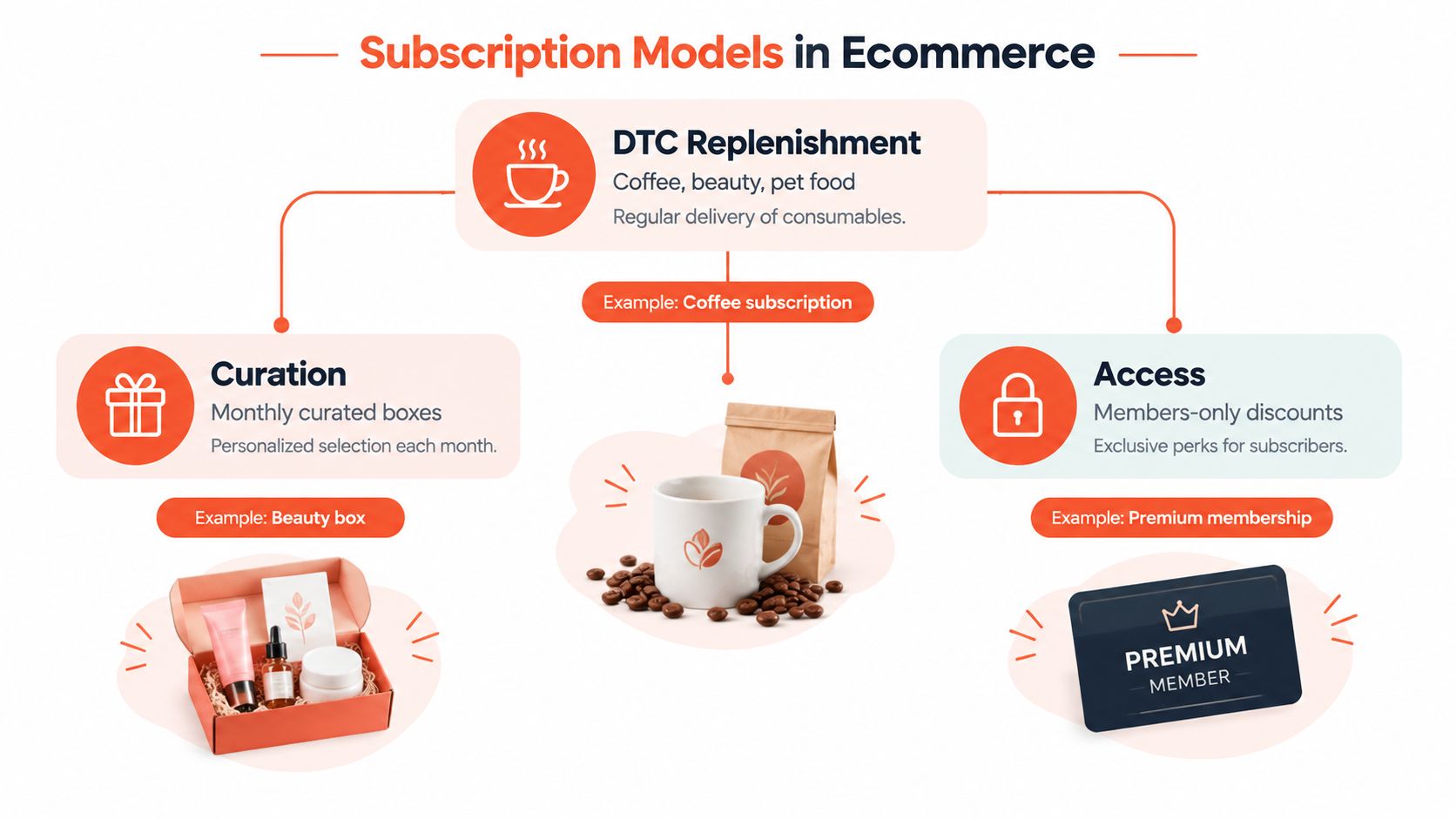
DTC replenishment needs flexible controls
For coffee, skincare, supplements, and pet food, the main implementation question isn't whether recurring orders can be created. It's whether the customer can manage the relationship without contacting support.
A useful account area should expose the next order date, selected products, delivery cadence, payment method, and available actions. Customers may want to skip, pause, swap, increase quantity, or cancel. Hiding those actions may protect a short-term renewal, but it can also make the brand feel difficult to deal with.
Fulfillment must respond to billing outcomes. A successful renewal should generate the appropriate order activity, while a failed charge should not send inventory into a shipment workflow prematurely. Inventory reservations, discounts, shipping rules, taxes, and notifications also need to agree with the subscription state.
Curation creates merchandising complexity
A curated box requires a stronger connection between subscription logic and merchandising operations. The team needs to decide how much control customers have, how substitutions work, and what happens when a selected item becomes unavailable.
A Shopify implementation may use an app for standard recurring orders, but complex bundles, customer choices, or custom account flows can justify a more deliberate build. Before adding another tool, document the subscription states and the events that move an account from one state to another. Teams exploring custom functionality can review how to build Shopify apps as part of that technical planning.
Access combines commerce and entitlement
An access membership may provide discounts, products, content, or early shopping windows. The store must recognize whether a customer is entitled at the moment they browse, add to cart, check out, or contact support.
That entitlement can touch customer tags, discount logic, theme components, checkout behavior, and fulfillment rules. A lean Shopify foundation reduces the risk of contradictory app logic. For customer questions about skips, renewals, and account changes, merchants may also evaluate AI support for subscriptions alongside human escalation paths.
The practical design principle is to build around the customer's account lifecycle. A recurring charge is only one event in that lifecycle.
Why Subscription Revenue Is Harder Than It Looks
A subscription can look healthy on the day an order is created, yet lose revenue before the next renewal. A customer may still want the product, but a card can fail. Another customer may have too much inventory at home, lose track of several recurring charges, or cancel after deciding the value no longer justifies the cost.
The popular shorthand says subscriptions create predictable recurring revenue. In practice, they create recurring revenue opportunities. Profitability depends on keeping customers active, collecting each renewal, recovering failed payments, and reducing the friction that turns temporary hesitation into cancellation.
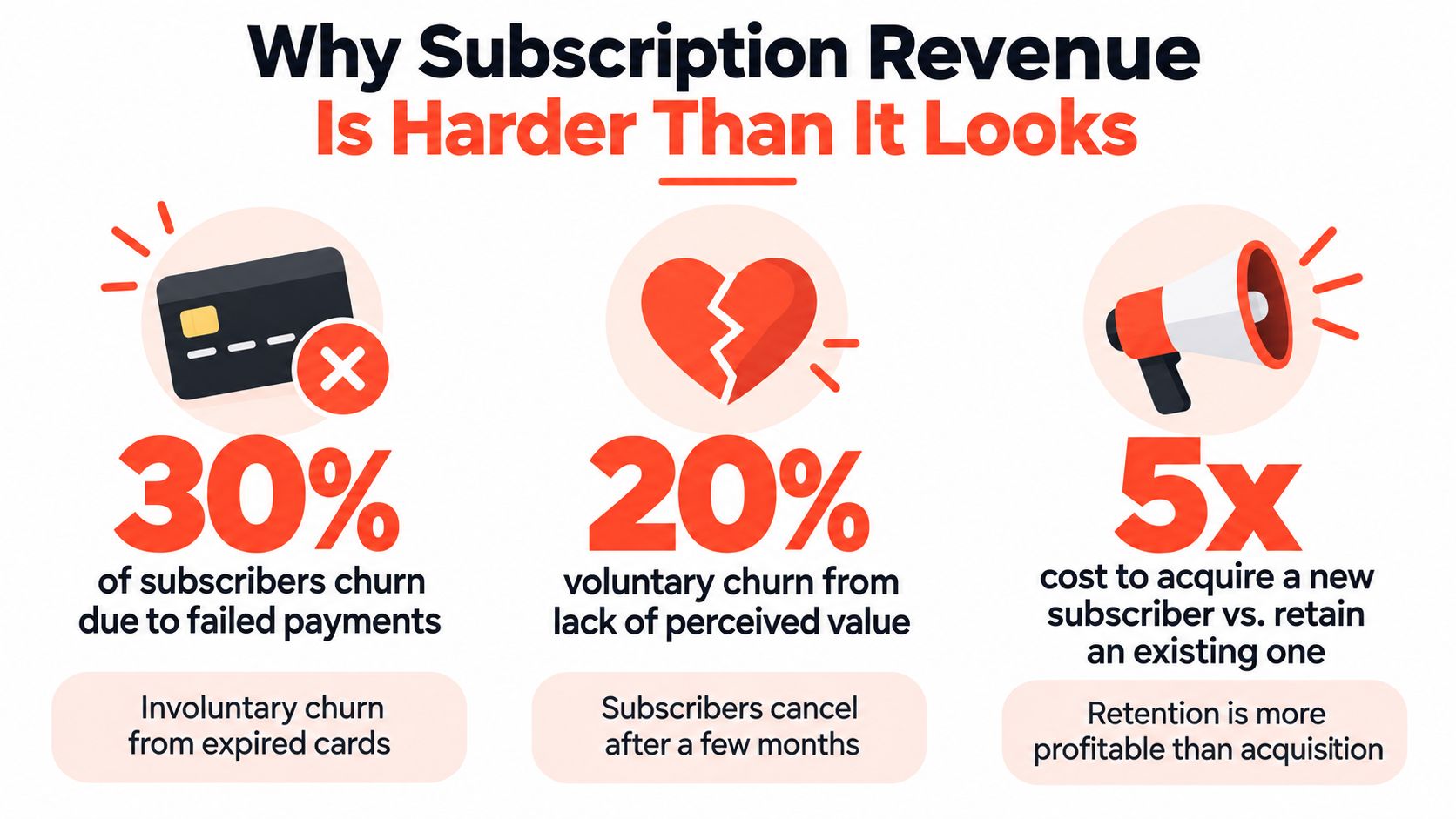
Failed payments are a particularly important technical variable. Independent industry guidance reports that failed card payments can account for roughly half of subscription churn, while first-attempt payment authorization has been cited at about 57% (payment recovery guidance from Waffo). The same guidance notes that 20% to 40% of churn may be preventable through better payment recovery, including retry logic, tokenized credentials, and dunning workflows.
Churn has more than one cause
Customer-choice churn occurs when the buyer no longer sees enough value, has more product than needed, finds a better alternative, or struggles to justify the cost. Involuntary churn occurs when payment collection fails even though the customer may still want the product. These causes need different responses, much like fixing a leaking pipe requires knowing whether the break is in the supply line or the drain.
Mastercard's 2025 research reports average monthly churn of 20%, says more than half of U.S. businesses report at least 10% of subscribers are inactive, and finds that 54% report more than 20% of churn is involuntary (Mastercard's 2025 subscription economy report). Those figures point to an operational problem alongside the marketing problem.
A recovery system can use payment retries, card updater coverage, clear notifications, and a grace period that gives customers time to fix an issue. The flow should explain what happened and avoid repeated charge attempts without useful context.
Fatigue changes the value equation
Subscription fatigue makes retention harder because customers judge the total collection of recurring commitments in their lives, not one offer in isolation. A 2026 consumer survey summary reports that 89% of consumers underestimated their subscription spending, with 66% missing by more than USD 200 and 13% by more than USD 400 (Mastercard subscription economy research summary).
The same source reports that 31% of consumers frequently cancel and resubscribe. Cancellation may therefore signal timing or budget pressure rather than permanent rejection. Pause controls, usage visibility, sensible bundles, and easy reactivation can serve customers better than aggressive retention screens.
Track the leaks that affect MRR
A subscription dashboard should separate active accounts from successfully collected accounts. Useful views include renewal success, failed-payment recovery, skips, pauses, cancellations, reactivations, inactive subscribers, expansion activity, and support contacts related to billing.
Personalized account messaging can help customers understand product value and choose appropriate changes. Ecommerce personalization software can connect recommendations and merchandising to customer behavior without treating every subscriber as identical.
Deciding If a Subscription Model Is Right for Your Brand
A subscription model fits when customers receive value repeatedly and can predict, or comfortably manage, their future need. Consumable products, replenishable routines, ongoing access, and services with clear recurring benefits are natural candidates. Products bought rarely, stored for long periods, or chosen mainly for novelty may need a lighter membership or replenishment reminder instead.
Use this decision filter before building:
Product fit: Customers already need or want the product again.
Value clarity: The recurring benefit is easy to explain without relying only on a discount.
Cadence flexibility: Customers can skip, pause, swap, or adjust quantity when their circumstances change.
Fulfillment readiness: Inventory, shipping, taxes, and order creation can support recurring events.
Payment recovery: The team has a plan for failed charges, customer notifications, and payment updates.
Retention ownership: Someone monitors churn reasons, inactivity, renewal success, and reactivation.
Support capacity: Customers can resolve common account questions without unnecessary friction.
A subscription isn't automatically the right answer to weak repeat purchase behavior. If customers don't return because the product disappoints them, automation won't solve the underlying issue. Start with a focused offer, validate the customer's preferred cadence, and design the account controls before investing in a large technical system.
Shopify brands should also decide whether an existing subscription app can handle the required lifecycle or whether custom development is justified. Specialized support becomes useful when subscription logic intersects with bundles, complex discounts, international storefronts, ERP workflows, custom checkout behavior, or a high-volume customer portal.
Presidio builds and supports Shopify and Shopify Plus storefronts, themes, apps, integrations, and custom subscription features, with a focus on maintainable implementations rather than unnecessary app sprawl. Visit Presidio to discuss a subscription experience that connects billing, fulfillment, customer controls, and retention operations.

Jamie, Presidio’s Designer, leads the practice alongside Johnnie. With over 10 years of e-commerce experience, Jay is a Shopify expert, known for crafting innovative solutions that prevent tech debt.
Jaime
Senior Product Designer, 2020