Outrank AI

A shopper lands on a Shopify product page, scrolls through the photos, checks the price, and still isn't sure what fits their needs. They open a second tab, search a broader marketplace, and leave without buying. Your catalog may contain the right product, but discovery has failed before checkout even becomes relevant.
That gap is where AI product recommendations can help. The useful version isn't a decorative “You may also like” carousel that earns clicks without proving sales. It's a revenue infrastructure layer that helps shoppers choose, increases the relevance of each merchandising moment, and gives your team a way to test whether recommendations create purchases that wouldn't have happened otherwise.
Product discovery also overlaps with how shoppers search, filter, and compare. A strong ecommerce site search strategy can help customers find a known item, while recommendations guide customers who aren't yet sure what they want.
By the end, you'll understand how recommendation models rank products, which Shopify implementation path fits your catalog, why click-through rate can mislead your team, and how holdouts reveal true lift. You'll also see where quizzes such as Quiz Kit can collect shopper preferences, how explainability affects trust, and which privacy and integration checks should come before launch.
Table of Contents
Introduction Why Product Discovery Still Decides Revenue
A DTC brand can have excellent products, polished creative, and a fast Shopify storefront, yet still lose sales when shoppers face too many plausible choices. A first-time visitor might know the problem they want to solve, but not the product name, category, size, finish, or bundle that solves it. Static collections and generic bestsellers leave that shopper doing the work.
A recommendation system acts more like a helpful store associate. It can use the shopper's current browsing context to narrow the field, show complementary products after a choice, or offer alternatives when the first item isn't quite right. The value isn't that the system displays more products. The value is that it displays more relevant products at the moment uncertainty is highest.
The commercial case is substantial. Industry summaries report that recommendation-driven traffic represents only about 7% of shopper interactions, yet can generate roughly 24% of orders and 26% of ecommerce revenue. That relationship is documented in Clerk's product recommendation statistics roundup, and it explains why recommendations have moved from optional widgets toward core merchandising infrastructure.
Practical rule: Treat every recommendation placement as a buying decision aid first, and a merchandising surface second.
That distinction changes how you build. Instead of asking which app has the most blocks, ask which shopper problem each recommendation solves. Instead of celebrating a high click-through rate, ask whether exposed shoppers buy more than comparable shoppers who weren't exposed. Instead of hiding the logic, give people enough context to decide whether the suggestion makes sense.
The rest of the work follows that path. First, learn the mechanics without getting buried in model terminology. Then match recommendation patterns to shopper intent, compare Shopify implementation routes, establish trust and data guardrails, and create a testing loop that can scale with your catalog.
How AI Product Recommendations Actually Work
The easiest way to understand a recommender is to compare it with a store associate.
A basic associate follows a script: “If a customer buys a camera, show a memory card.” That resembles a rule-based cross-sell. It can be useful, predictable, and quick to launch, but it treats similar shoppers alike.
A more capable associate notices context. One customer compares travel products, another repeatedly views sensitive-skin items, and a third adds a product before looking for a larger size. The associate combines those signals with product knowledge and ranks the most useful options. Machine-learning recommenders attempt to do that ranking systematically from browsing, purchase, and session behavior.
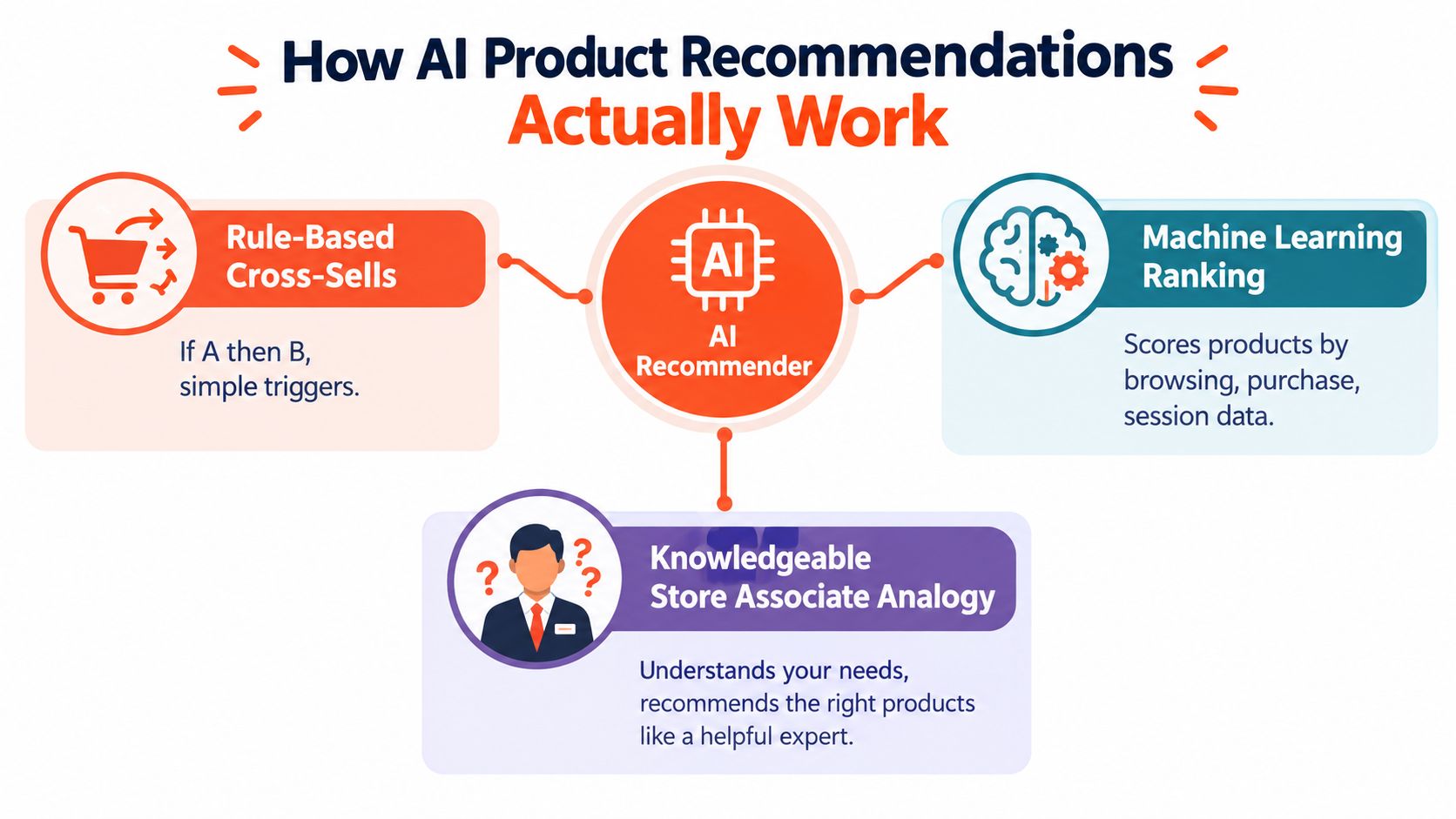
From fixed rules to ranked candidates
A recommendation request generally involves two logical jobs:
Find plausible candidates. The system narrows the catalog to products that could fit the shopper, based on relationships, attributes, or current intent.
Rank those candidates. It scores the options and chooses the order in which they appear.
Collaborative filtering looks for behavior patterns across shoppers. If people who interacted with one product often interacted with another, that relationship can inform a suggestion. This approach can uncover useful pairings that a merchandiser didn't explicitly create, although it needs enough interaction data to work well.
Content-based recommendation relies on product information and observed preferences. If a shopper consistently explores a particular material, use case, category, or style, the system can favor items with related attributes. This makes product data quality important, especially for new products with little behavioral history.
Hybrid systems combine these methods. They can use behavioral relationships where sufficient history exists and product attributes where it doesn't. For Shopify brands, that fallback matters because new visitors and newly launched products won't have the same interaction history as established products.
Why sequence matters
A shopper's latest actions can change the meaning of earlier ones. Viewing a product, returning to it, adding it to cart, and then searching for an accessory form a sequence, not four isolated events. Sequence-aware models can use that progression to distinguish casual browsing from stronger purchase intent.
A Taobao empirical study illustrates why model choice and objective function deserve attention. In that study, a DIN-style model reported 9.85% CTR and 3.18% conversion, with a reported lift over ItemCF of 59.3% for CTR and more than 80% for conversion. The findings appear in the published empirical study of recommendation models. The lesson for a Shopify team isn't to copy a model name. It's to evaluate whether the system improves the business outcome you care about, rather than assuming more clicks equal more revenue.
Measuring What Matters Beyond Clicks
A recommendation can win the click and lose the business case.
Click-through rate tells you whether a shopper selected a displayed product. It doesn't tell you whether that shopper would have found or purchased the same product without the recommendation. If your team reports “recommendation revenue” by counting every order after a click, attribution can make a familiar purchase path look like incremental growth.
Microsoft's large-scale Amazon study found that at least 75% of observed recommendation clicks would likely have happened without the recommender, implying that only about one quarter of recommendation traffic was incremental. The causal finding is detailed in Microsoft's study of recommendation impact.

Use a measurement ladder
Start with engagement diagnostics, then move toward commercial and causal measures.
CTR: Useful for checking whether a placement is visible, understandable, and relevant enough to attract interaction. It shouldn't be your final success metric.
Recommendation-assisted conversion: Helps connect a recommendation interaction with a purchase, but still carries attribution risk.
Average order value: Shows whether recommendations influence basket composition. Compare exposed and unexposed groups rather than relying on clicked orders alone.
Incremental revenue: Measures the additional revenue associated with recommendation exposure after accounting for what would likely have happened anyway.
Retention: Matters when recommendations help customers discover products that support repeat purchasing, not just a single larger order.
Holdouts reveal the counterfactual
A holdout test creates a comparison group. Some eligible shoppers see the recommendation experience, while a similar group doesn't. Randomized exposure makes the comparison more credible because the groups aren't selected based on who already appears likely to buy.
For a Shopify team, the test might suppress a PDP recommendation module for a defined audience while keeping the rest of the page consistent. Compare conversion, AOV, revenue per visitor, and downstream purchasing behavior between the exposed and holdout groups. The exact setup depends on traffic, catalog complexity, and analytics capability, but the principle is stable: measure the difference created by exposure, not just the activity that follows it.
Measurement rule: If your dashboard can't show what happened to shoppers who didn't see the recommendation, it can't prove incremental lift.
The objective also changes the answer. A system tuned for clicks may favor familiar, easy-to-click products, while a system tuned for margin, conversion, retention, or inventory balance may rank differently. Decide which business outcome has priority before evaluating model performance.
On Site Personalization Patterns That Guide Shoppers
Placement should follow intent. The same recommendation logic won't serve an exploratory visitor and a shopper who has already chosen a product.
On the homepage, recommendations can help a visitor begin. Use them to surface relevant collections, recently viewed products, or category paths that reduce the blank-page problem. The homepage is a discovery environment, so variety matters more than aggressive upselling.
On a product detail page, the shopper has supplied a clearer signal. Complementary items can complete a use case, while alternatives can address uncertainty around price, format, ingredients, fit, or performance. A skincare PDP might show a compatible cleanser, a different formulation, and a routine-based option. The goal is to answer the next question before the shopper leaves to ask it elsewhere.
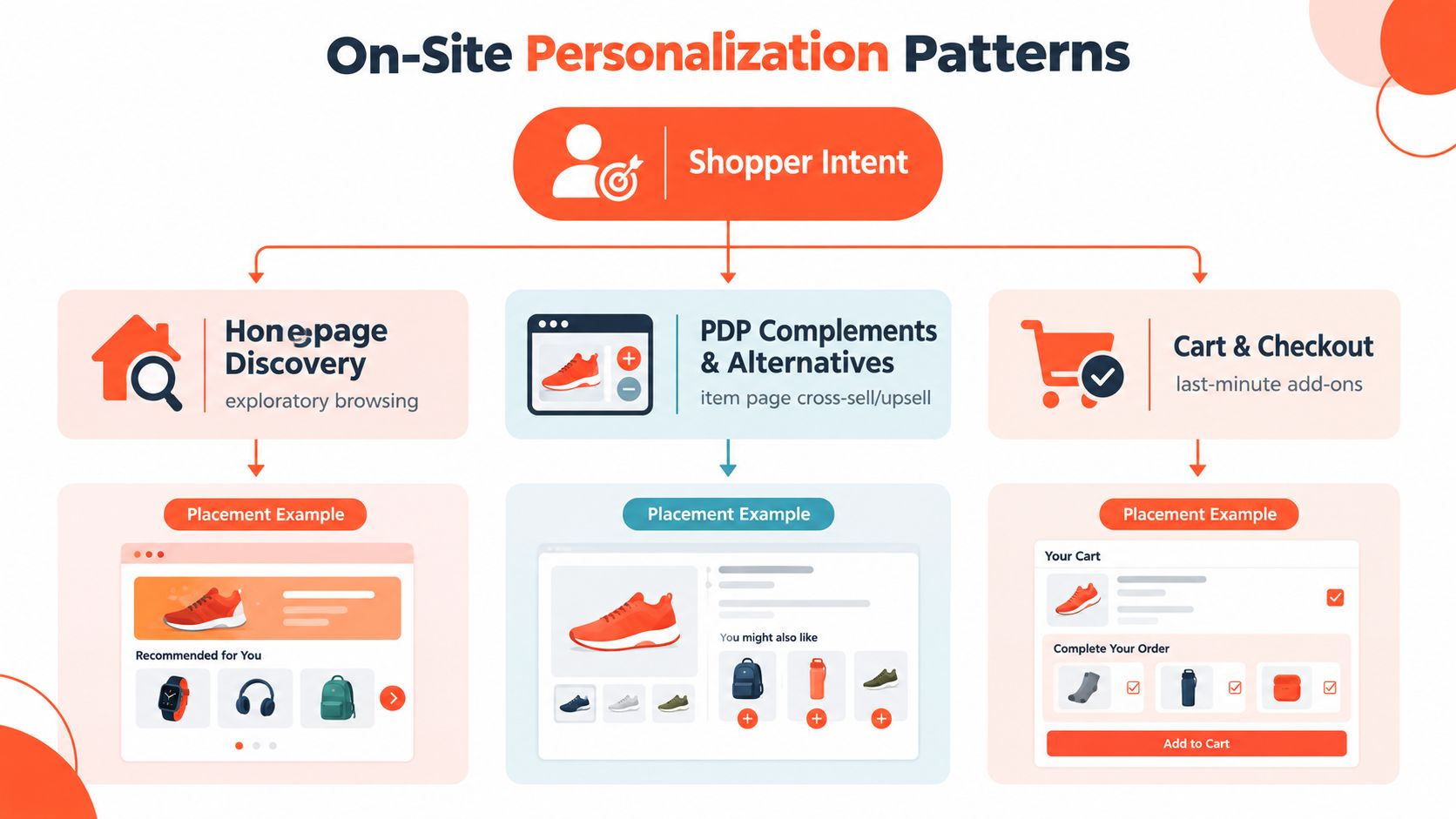
Match the module to the moment
Cart and post-add-to-cart recommendations should feel like completion, not interruption. Show an accessory, refill, or bundle component that makes the selected product more useful. Don't force a high-priced upgrade when the shopper is trying to finish a straightforward purchase.
Search and collection pages can personalize ordering when the shopper's behavior indicates a preference. Keep filters and sorting understandable, and avoid making the system feel like it has hidden the catalog. A recommendation should narrow choice without removing control.
Quizzes create a different kind of signal. Instead of inferring every preference from clicks, a guided flow asks shoppers directly about needs, preferences, or intended use. Those answers become zero-party data, information the shopper deliberately provides, which can support a more explainable result and lead capture when the value exchange is clear.
Merchandising also depends on the assets behind the recommendation. If a campaign needs coordinated product imagery across several SKUs, a resource on factory-ready multi-SKU asset creation can help the team prepare consistent creative for the collection. Product presentation and recommendation logic work together. A relevant suggestion still underperforms when its images, naming, or comparison information creates doubt.
For a broader view of tools that support these journeys, review ecommerce personalization software considerations. The key decision isn't how many placements you can add. It's whether each placement answers a specific shopper question and supports a measurable next action.
Choosing Your Shopify Implementation Path
Shopify merchants usually have three practical routes. The right choice depends less on whether AI sounds advanced and more on how much control, data, and maintenance your team can support.
Implementation Option | Best For | Effort and Control | Trade Offs |
|---|---|---|---|
Native Shopify app solution | Lean teams seeking a fast launch | Lower implementation effort, moderate configuration | Less control over model behavior and data flows |
Custom model, app, or headless integration | Complex catalogs and distinct merchandising logic | Higher effort, high control over ranking, UX, and integrations | Requires engineering ownership, testing, and ongoing maintenance |
Quiz-powered recommendations | Brands with preference-led products or limited behavioral history | Moderate setup, strong control over questions and result logic | Adds friction if the quiz is too long or poorly positioned |
Native apps prioritize speed
An app can provide recommendation blocks, event tracking, and configuration without requiring your team to build a ranking service. This route suits a brand that wants to validate demand, improve a few high-intent placements, and establish a measurement baseline.
The trade-off is dependence on the app's data model, storefront behavior, and reporting. Check how it handles inventory, variants, exclusions, consent, theme compatibility, and holdout testing before installation. A fast launch isn't valuable if the app creates performance problems or leaves you unable to distinguish attributed sales from incremental sales.
Custom and headless builds maximize control
Custom theme or app development makes sense when recommendations need to connect with complex pricing, subscriptions, ERP data, fulfillment rules, or proprietary product logic. A headless storefront can provide more freedom over the experience, but it also makes the integration and monitoring burden your responsibility.
This route is appropriate when recommendation logic is a strategic differentiator, not when a standard PDP module would solve the immediate problem. Define the smallest useful version first. A focused custom flow is easier to test than a large system that attempts to personalize every screen at launch.
Quizzes collect intent directly
Quiz-powered recommendations are particularly useful when shoppers can't easily express their needs through navigation. Quiz Kit, for example, supports AI-powered product recommendations and lead capture for Shopify quizzes, connecting answers with product results and catalog logic.
The broader recommendation market is expanding. One estimate places artificial intelligence recommendation software at USD 4.32 billion in 2025, rising to USD 5.04 billion in 2026 and USD 11.94 billion by 2031, with an estimated 18.83% CAGR from 2026 to 2031, as reported by Mordor Intelligence's market analysis. That growth doesn't mean every merchant needs a complex platform. It means implementation choices deserve a deliberate fit assessment.
Avoid app sprawl by mapping the required capability first, then deciding whether an existing tool, a focused custom feature, or a quiz provides it with the least operational burden.
Privacy Trust and Integration Essentials
Shoppers may welcome help with research while resisting the idea that an AI system should decide what they buy. Independent 2026 data found that nearly half of shoppers had used AI to research a purchase, but only 35.4% trusted AI recommendations completely or mostly, while 22.2% didn't trust them at all. The AI shopping trust gap data shows why usefulness and delegation aren't the same thing.
That gap should shape the interface. Explain why an item appears, show alternatives, preserve reviews, and let shoppers compare rather than presenting one answer as authoritative. If sponsored products influence ranking, label that relationship clearly. A recommendation that feels secretly monetized can damage confidence even when the product is relevant.
A 2026 shopping survey found that 65% of respondents would trust recommendations less if they saw ads in the tool, and 75% would trust AI less if suggestions were swayed by brand dollars. Those findings are available in the Wildfire Systems survey report on AI shopping trust.
Four checks before launch
Data handling: Collect only the behavioral information needed for the experience, protect it appropriately, and define retention rules.
Consent: Make tracking and personalization choices understandable. Don't bury meaningful controls in confusing settings.
Explainability: Pair recommendations with plain-language reasons such as “matches your selected use” or “often paired with this product.”
Systems integration: Keep product availability, price, variant status, and merchandising rules synchronized with Shopify and operational systems.
A stale recommendation can be worse than no recommendation. If the system suggests an unavailable variant or ignores an active bundle rule, the shopper experiences the brand's operational failure directly. Strong Shopify integration services can help connect storefront behavior with the systems that keep catalog and order information accurate.
Optimizing and Scaling AI Recommendations Over Time
A recommendation launch is a starting point, not a finished feature.
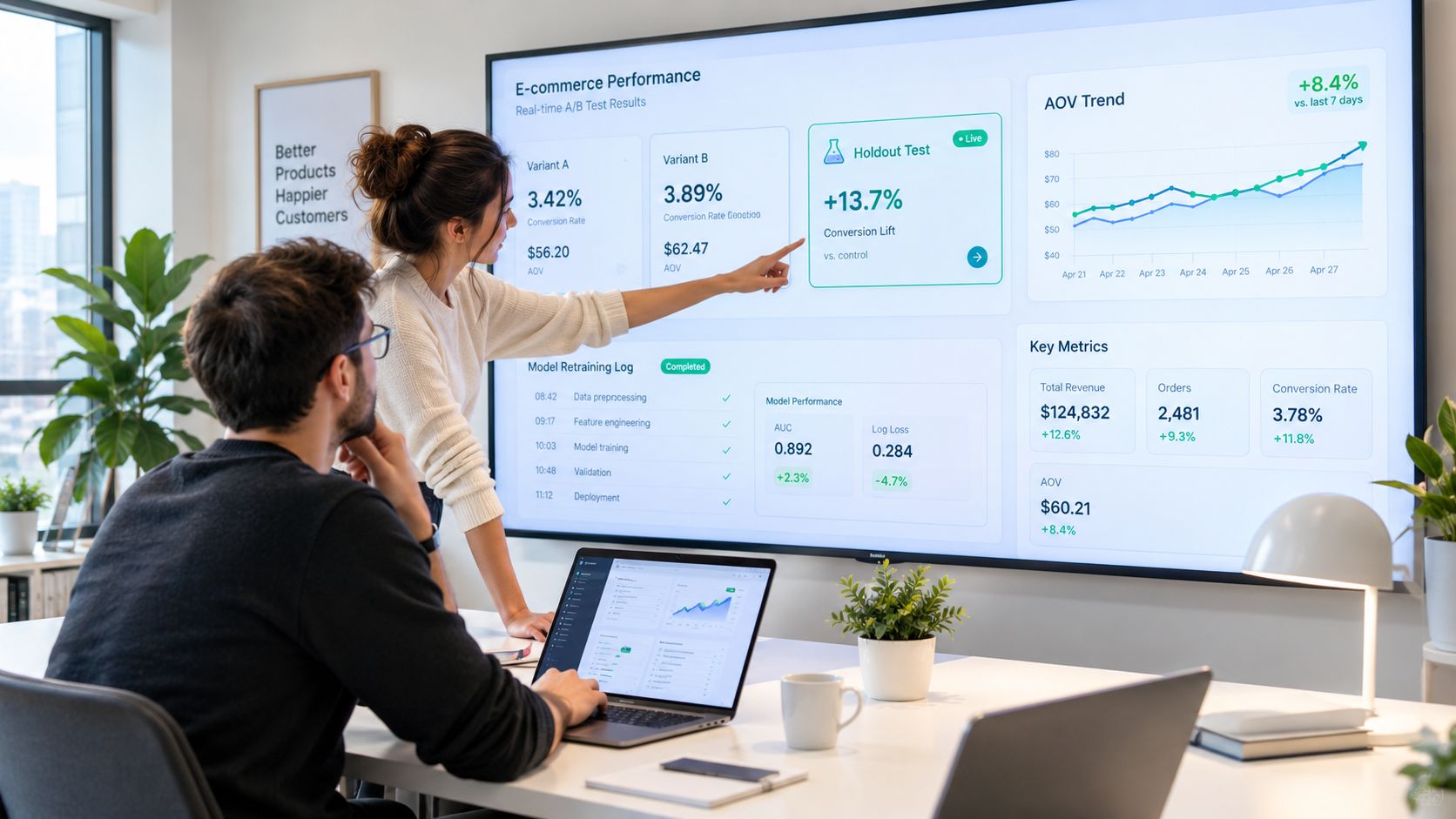
Begin with one or two high-intent placements and a clear baseline. Record which shoppers qualify for exposure, what they see, and what happens afterward. Then run a holdout or randomized exposure test, review conversion and AOV alongside incremental revenue, and document what changed between versions.
After the initial test, inspect failure modes rather than only looking at averages. Are the same bestsellers appearing for everyone? Do recommendations disappear for new products? Are out-of-stock variants being surfaced? Does the module help shoppers complete a purchase, or does it distract them from the selected product?
Build a repeatable optimization loop
Audit the data: Review event quality, product attributes, variant status, and exclusions.
Test one meaningful change: Adjust placement, ranking objective, quiz logic, or explanation copy, but keep the comparison interpretable.
Evaluate downstream outcomes: Use conversion, order value, and incremental revenue instead of treating clicks as the conclusion.
Refresh the model or rules: Feed useful new behavior back into the system while removing stale relationships.
Expand carefully: Add another placement only after the first experience has a stable measurement process.
The trust layer needs testing too. If recommendations appear influenced by paid placement, or if the explanation doesn't match the product, shoppers may disengage. Keep personalization distinct from sponsored merchandising and provide alternatives where a single suggestion could feel overly directive.
Use analytics reviews, UX and CRO audits, and performance monitoring to keep the experience maintainable. A fast recommendation that arrives late, shifts the layout, or conflicts with inventory won't create a better journey.
The most durable Shopify programs treat AI product recommendations as a continuous operating system for discovery. Start with a narrow commercial question, prove incremental value, improve the explanation and data quality, then expand the system as evidence earns the next investment.
Presidio can help Shopify and Shopify Plus teams plan recommendation flows, connect quizzes and catalog data, build custom themes or apps, and support ongoing CRO and performance work. Visit Presidio to discuss a maintainable path from product discovery to measured incremental revenue.

Jamie, Presidio’s Designer, leads the practice alongside Johnnie. With over 10 years of e-commerce experience, Jay is a Shopify expert, known for crafting innovative solutions that prevent tech debt.
Jaime
Senior Product Designer, 2020