Outrank AI

Most Shopify advice gets AI ecommerce personalization backward. It tells merchants to add more recommendation widgets, install a quiz app, connect an email engine, personalize search, and let every vendor claim a share of the customer journey. That approach can produce more relevant storefronts, but it can also create slower pages, fragmented customer data, opaque decision-making, and experiences that feel invasive.
Personalization is a commercial priority. In a March 2026 survey, 73% of ecommerce leaders ranked AI-powered personalization as the top shopper-facing use of AI, while 67% ranked AI-powered conversational shopping highly according to BigCommerce's ecommerce AI survey. Yet revenue isn't the only outcome that matters. The strongest Shopify implementations optimize for relevance, performance, maintainability, and trust at the same time.
Table of Contents
The Hidden Costs of AI Personalization
More personalization can raise sales and still weaken a store. Shoppers react to the inference behind an offer, not only its relevance. A consumer study summarized in a systematic review of personalization and trust associated invasive personalization with a 23% reduction in trust, even while conversion rose by about 31%. Both figures come from that review, so they should guide a trade-off discussion, not serve as independent proof.
The implementation question is therefore broader than “Can this recommendation increase sales?” Ask what the experience reveals about the customer and whether the customer can understand its purpose. A suggestion based on the current category usually feels useful. A message that appears to infer income, health, or personal circumstances can feel intrusive, even when the prediction is accurate.

Relevance needs boundaries
Trust tends to improve when a brand explains what it collects and gives shoppers a clear benefit in return. A preference quiz creates that exchange by asking for sizes, use cases, or style preferences to improve product selection. Silent tracking across unrelated touchpoints offers less control and can make the same recommendation feel invasive.
Audience tolerance also varies. A 2025 summary reported that 34% of U.S. online shoppers over 55 viewed brands negatively when AI used personal data to recommend products or customize experiences. The finding comes from the same consumer personalization review cited above. Older shoppers do not necessarily reject relevant experiences, but a DTC brand should not assume every audience accepts the same level of inference.
Practical rule: Personalize what helps a shopper decide, not everything the data lets you infer.
App sprawl creates a separate cost. Each personalization tool may inject scripts, define its own events, store a separate customer profile, and alter the theme differently. The result is duplicated consent logic, conflicting recommendation rules, slower diagnosis, and technical debt that no single vendor owns end to end.
A lean Shopify implementation starts with lower-risk signals, including current product context, explicit quiz answers, and purchase history. Keep sensitive inference limited, explain the value of personalization, and give shoppers meaningful controls. Native Shopify data structures and a small number of clearly owned decision rules are easier to test and maintain than a stack of overlapping apps. Helpful personalization supports a decision. Creepy personalization feels like surveillance wearing a sales badge.
Core Mechanics of AI Ecommerce Personalization
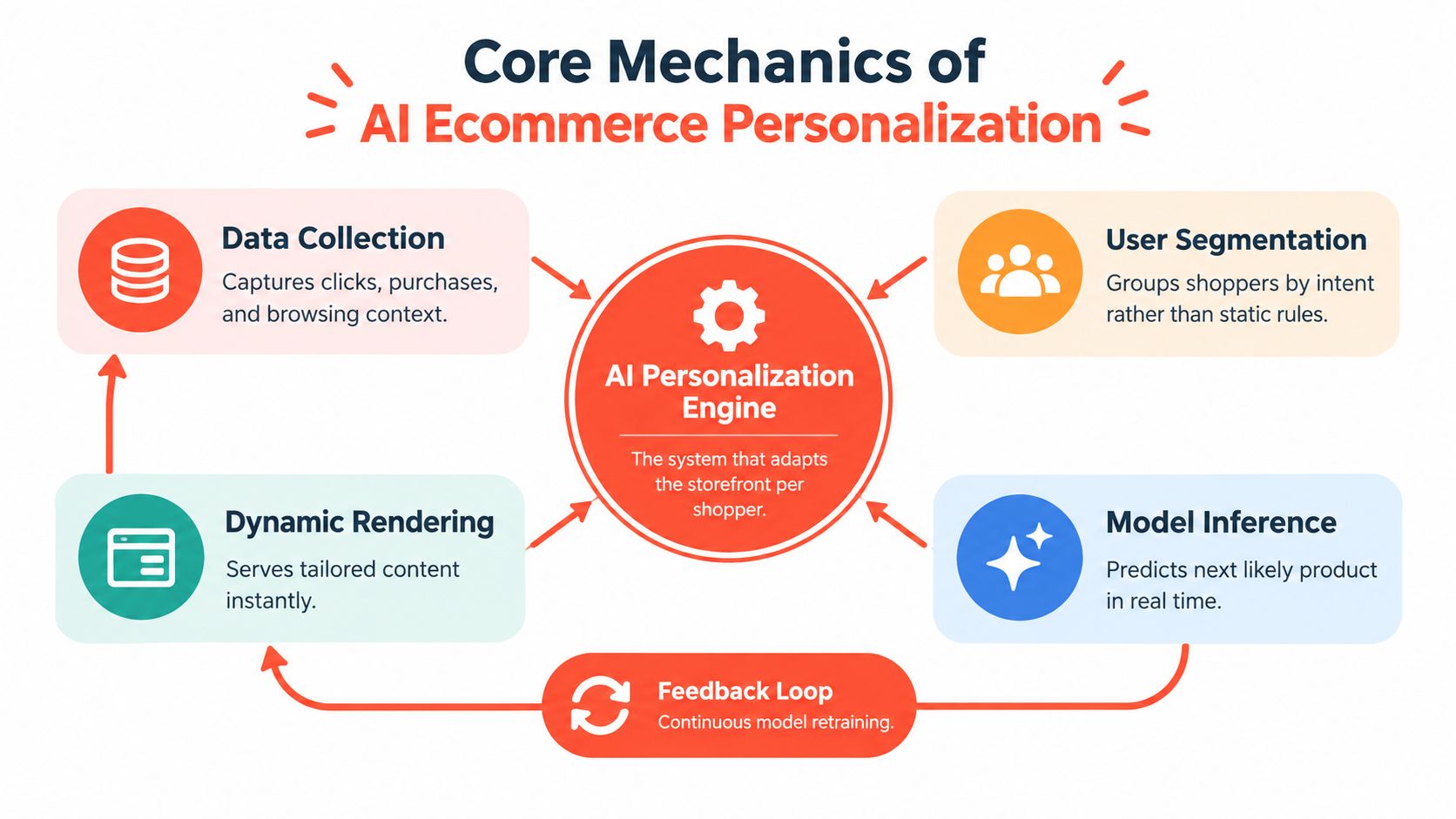
AI personalization begins with a data model, not an app catalogue. A basic Shopify store can use fixed rules such as “show products from the same collection” or “display bestsellers.” Those rules are transparent and often useful, but they don't adapt well to changing intent.
A machine-learning system evaluates signals and predicts which product, message, or merchandising treatment is most relevant in a particular context. The key inputs commonly include:
Behavioral signals: searches, clicks, viewed products, collection visits, filters, and cart activity.
Historical purchase data: products bought, order frequency, categories, variants, refunds, and replenishment patterns.
Real-time context: the current page, device context, session sequence, referral context, and inventory availability.
Catalog attributes: product type, use case, compatibility, material, price tier, color, and merchandising status.
Explicit preferences: information customers volunteer through quizzes, profile settings, or preference centres.
The quality of the output depends on how consistently Shopify captures and organizes those events. If a quiz records “sensitive skin” as unstructured text while the product catalogue uses inconsistent tags, the engine can't reliably connect the preference to eligible products. AI doesn't repair a weak taxonomy by magic. It often makes the consequences harder to see.
Retrieval isn't the same as decisioning
Two recommendation approaches appear frequently in vendor proposals.
Collaborative filtering finds relationships between shoppers and products. If customers who viewed one product often purchased another, the system can recommend the second product. This works well when a store has sufficient interaction history and when social proof is commercially meaningful.
Content-based recommendation matches product attributes to a shopper's known interests. A customer browsing fragrance-free skincare may receive other products tagged with related attributes. This approach can work for new catalogues or specialist stores where product metadata is strong but interaction volume is limited.
Many systems combine both methods. A rules layer then applies business constraints, such as excluding purchased products, suppressing out-of-stock variants, protecting margin, or prioritizing a launch range.
The important distinction is between retrieval and decisioning. Retrieval finds plausible products. Decisioning selects the most useful next action based on the shopper's stage, inventory, commercial objective, and consent state. A vendor that calls nearest-neighbour matching “advanced AI” may still provide a useful component, but Shopify directors should understand what the system optimizes.
A trustworthy implementation also needs a feedback loop. The system should record impressions, clicks, add-to-cart events, purchases, dismissals, and negative signals. Without impression data, you can't tell whether a recommendation failed because it was irrelevant or because shoppers never saw it.
Key Techniques for Shopify Merchants
Shopify merchants don't need to personalize every surface on the first release. Start with the places where relevance can reduce choice friction and where the underlying data already exists.
Dynamic recommendation engines
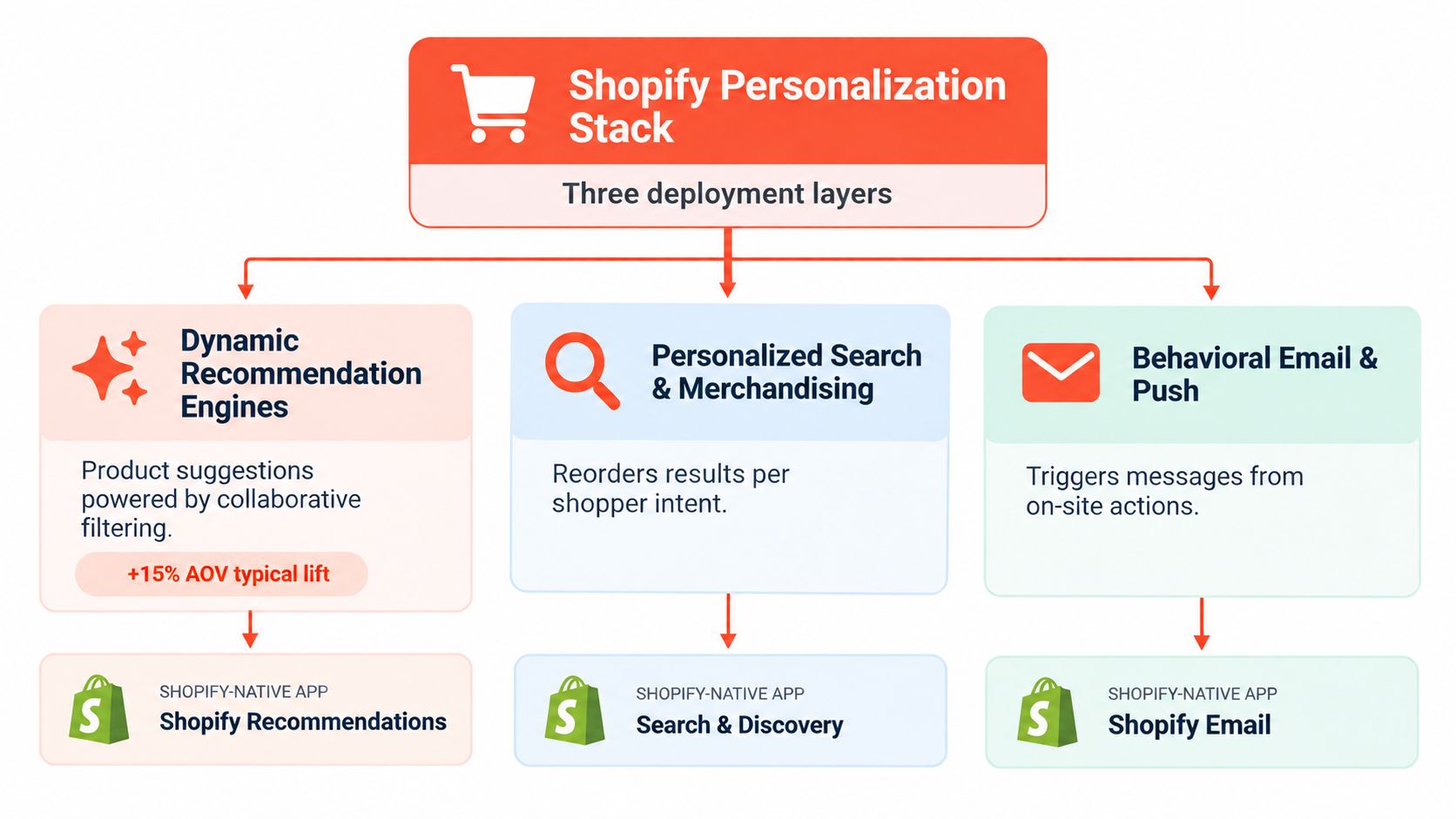
Recommendation modules can use the current product, collection, cart contents, and customer history to select products. On a product page, a “complete the routine” module should use compatibility and use-case rules before similarity. A skincare brand might recommend a cleanser that fits the shopper's stated routine, not just another product that other visitors viewed after the same item.
Keep the first version narrow. Implement one module on product pages and one in the cart, define exclusions, and log impressions. Don't add six “recommended for you” blocks that compete for attention and produce duplicated products.
The Shopify Search and Discovery guidance is useful when recommendation logic overlaps with collection filters, search relevance, and merchandising rules. These surfaces should share product attributes rather than maintain separate taxonomies.
Personalized search and merchandising
Search personalization should refine intent, not bury relevance beneath a customer profile. Query meaning remains the primary signal. Personalization can then influence ranking through known preferences, previous category engagement, or explicit quiz responses.
Merchants should create a clear override policy. A promoted product must remain eligible, in stock, and relevant to the query. A high-value customer shouldn't receive a completely different result set if that undermines price transparency or makes the store difficult to use.
AI-powered quizzes
Quizzes are valuable because they capture zero-party data, information a shopper chooses to provide directly. A well-designed flow asks only questions that change the recommendation, maps each answer to structured product attributes, and explains the result.
Quiz Kit is one Shopify option for AI-powered product recommendations and lead capture. It can help teams generate quiz results from plain-language prompts, but the merchant still needs to validate the mapping against the catalogue. An AI-generated quiz isn't a substitute for product information architecture.
Use the result page to explain the recommendation. “You selected a lightweight, fragrance-free routine, so we prioritized these products” gives the shopper a comprehensible reason to trust the output. Store the answer as a structured preference where consent permits, and make it possible to revise later.
The implementation should respect performance budgets. Load interactive components when they're needed, avoid duplicate analytics tags, and render recommendation content without blocking the core shopping path.
Funnel-Aware Recommendation Strategies
A recommendation that works on a collection page may be wrong for a cart drawer. The shopper's intent, uncertainty, and tolerance for exploration change as they move through the funnel, so the ranking objective should change too.
A field experiment found that generic recommendations improved conversion in the early purchase funnel. Retargeted recommendations later in the funnel didn't improve conversion rates, but they did increase impressions and total sales, as described in the research on generic and retargeted recommendations. Another experimental study reported a 5.9% increase over baseline conversion from recommenders, with stronger effects for hedonic products, according to the same research source.

Early funnel discovery
On the homepage and collection pages, shoppers often need orientation. Use broad but relevant discovery signals, such as category affinity, editorial selections, bestsellers, and products related to the current browse path. Avoid overfitting to a single click, especially for anonymous visitors.
The objective is to help shoppers find a promising route. A first-time visitor may benefit from a clear category recommendation or a proven bestseller more than a highly specific item based on limited behaviour.
Mid-funnel comparison
Product detail pages should support evaluation. Show complementary products, meaningful variants, alternatives at adjacent price points, and proof that helps the shopper choose. The model should understand product relationships, not merely co-occurrence.
For example, a coffee brand can distinguish between a grinder compatible with the selected brewer and a visually similar but incompatible accessory. Catalogue attributes and rules protect the experience when behavioural data is sparse.
Cart and checkout intent
The first recommendation interaction deserves disproportionate attention. A large product-recommendation analysis reported a 1.02% baseline conversion rate for sessions without recommendation engagement, with conversion increasing by 288% after one interaction. The analysis also reported average order value rising from a $44.41 baseline to 369% of that baseline after one recommendation interaction, with gains tapering after roughly five clicks, as documented in Barilliance's recommendation analysis.
Treat those figures as directional evidence, not a promise for your store. The practical lesson is stronger than the benchmark: optimize the first visible recommendation for relevance, placement, and clarity. In a cart drawer, prioritize useful complements, replenishment items, or threshold-supporting products. Don't turn a high-intent moment into an endless carousel.
Retention logic
Post-purchase recommendations should reflect ownership and timing. Exclude products already bought unless replenishment is appropriate, and use order history to suggest compatible additions rather than repeat the same catalogue view. Later-funnel retargeting can support recall and exposure, but it shouldn't rely on the same conversion logic used for discovery.
Measuring ROI and Business Impact
Personalization ROI is easy to overstate if the measurement plan tracks clicks from people who were already likely to buy. A recommendation may receive engagement because it appears beside a popular product, not because the algorithm created incremental demand.
Use a controlled test wherever the storefront allows it. Randomly assign eligible sessions to a static baseline or a personalized treatment, keep the merchandising rules stable, and record exposure before interpreting the result. For returning customers, preserve the assignment across sessions when possible so the test doesn't switch experiences mid-journey.
Track business outcomes in layers:
Module exposure: Did the shopper see the recommendation?
Interaction: Did the shopper click, dismiss, or ignore it?
Commercial action: Did the shopper add the product, convert, or increase basket value?
Customer value: Did the experience improve repeat purchase behaviour or retention?
Operational cost: What did the app, implementation, maintenance, and performance impact cost?
A useful test compares incremental revenue and contribution margin, not attributed revenue alone. Include app subscriptions, development time, support effort, and any measurable impact on page performance. The AI conversion optimization framework can help teams connect experimentation to broader CRO decisions.
Personalization ROI Metrics Framework
Metric | Definition | Target Impact |
|---|---|---|
Incremental revenue | Treatment revenue minus the controlled baseline | Demonstrates whether personalization created additional sales |
Average order value | Revenue divided by completed orders | Shows whether recommendations improve basket composition |
Conversion rate | Completed orders divided by eligible sessions | Indicates whether relevance reduces purchase friction |
Contribution margin | Gross profit after product and promotional costs | Prevents low-margin recommendations from appearing successful |
Repeat purchase rate | Customers returning to buy after the experience | Tests whether personalization supports sustainable value |
Trust signals | Consent choices, preference changes, complaints, and dismissals | Reveals whether commercial gains carry a customer-experience cost |
Total cost of ownership | Software, implementation, maintenance, and support | Tests whether the stack remains economically rational |
A lean stack usually produces better evidence because the data model is easier to inspect. If three apps each claim credit for the same order, your dashboard may look impressive while your decision-making gets worse.
Vendor Tradeoffs and Tech Stack Consolidation
Out-of-the-box SaaS tools are attractive for good reasons. They can shorten implementation, provide tested interfaces, and give a small team access to recommendation models without building infrastructure. The trade-off is that the merchant accepts the vendor's data model, rendering approach, release cycle, and measurement conventions.
Custom Shopify Functions solve a different problem. Functions can encode discounts, bundles, and order rules close to Shopify's commerce logic, which helps keep eligibility and transaction behaviour consistent. They aren't a complete recommendation engine, however. You still need event capture, model inference, catalog enrichment, storefront rendering, and experiment measurement.

Compare the operating models
Decision area | Stacked SaaS tools | Consolidated or custom approach |
|---|---|---|
Launch speed | Fast for standard use cases | Slower at the beginning |
Flexibility | Limited by vendor configuration | Adapted to the brand's data and UX |
Data ownership | Often divided across systems | Easier to govern through a shared model |
Performance | Each script adds potential overhead | Fewer moving parts can simplify optimization |
Maintenance | Vendor updates may conflict | Merchant controls the integration surface |
Commercial logic | May live in several dashboards | Can remain closer to Shopify's core rules |
App sprawl creates more than subscription cost. One tool may own quiz responses, another owns recommendation impressions, and a third owns email product blocks. If identity resolution fails, the shopper can receive contradictory messages. If consent states aren't synchronized, the brand may also lose confidence in whether a signal can be used.
Evaluate vendors through implementation details:
API efficiency: Can the system receive and return the required data without excessive client-side scripts?
Theme compatibility: Does it work with your Online Store 2.0 architecture and existing sections?
Fallback behaviour: What does a shopper see when the model has insufficient data or the service is unavailable?
Data portability: Can you export events, preferences, and product mappings?
Governance: Can marketing and engineering define exclusions, consent rules, and business priorities?
Ownership: Who debugs a conflict between the app, theme, analytics layer, and checkout?
Presidio is one example of a hybrid Shopify agency and software studio. Its work includes custom themes and apps, Shopify Functions, technical audits, performance tuning, and Quiz Kit for AI-powered recommendations and lead capture. The relevant model isn't “buy one more tool.” It's consolidating strategy, implementation, and ongoing support around a maintainable storefront, as discussed in this Shopify ecommerce personalization software guide.
Consolidation does require compromise. A single suite may offer fewer niche features than several specialist apps. For most DTC teams, that loss of granular control is acceptable when it removes duplicated tracking, reduces debugging paths, and gives the storefront a coherent source of truth.
Implementation Roadmap for DTC Brands
A safe rollout starts with the data you already have. Before choosing a model, audit product titles, variants, collections, tags, inventory states, customer identifiers, consent records, and event naming. If “sensitive skin,” “fragrance-free,” and “unscented” appear as unrelated values, recommendation quality will suffer regardless of the vendor.
Phase one, establish the foundation
Document the customer signals you're allowed to use and the reason each signal improves the shopping experience. Check theme compatibility, app scripts, analytics duplication, and fallback states. Agree on the baseline metrics before launch, including exposure, conversion, average order value, contribution margin, and trust indicators.
Start with a preference quiz or a tightly scoped product-page module. A quiz is often a practical first release because it creates an explicit value exchange. The shopper answers useful questions, receives an explainable result, and can revise the inputs.
Phase two, test one commercial decision
Choose one decision with a clear owner. For example, decide which complementary item appears in the cart drawer, or whether a product page shows related variants or a routine bundle. Keep the test focused enough that merchandising and engineering can inspect every outcome.
Use a static control. Define exclusions before launch, particularly for unavailable products, incompatible products, already purchased items, and products that violate the brand's pricing or compliance rules.
Phase three, expand only after validation
Once the first use case has a trustworthy measurement result, add another surface. Search, collection merchandising, email, and post-purchase recommendations should each have distinct objectives. Don't let a vendor automatically replicate the same ranking logic across every channel.
Review the system on a regular operating cadence. Remove modules that don't create incremental value, clean attributes that generate poor matches, and inspect customer complaints alongside revenue. A personalization program should become simpler as the team learns, not accumulate permanent experiments.
For a DTC brand migrating to Shopify, this roadmap is also a chance to avoid inherited technical debt. Move only the data, scripts, and integrations that support a defined customer or business outcome. Everything else should earn its place through a testable hypothesis.
Presidio helps Shopify and Shopify Plus brands design lean personalization systems, from AI-powered quizzes and product discovery to custom themes, Shopify Functions, performance work, and ongoing CRO. Visit Presidio to discuss an implementation that improves relevance without adding another unmanaged layer to your stack.

Jamie, Presidio’s Designer, leads the practice alongside Johnnie. With over 10 years of e-commerce experience, Jay is a Shopify expert, known for crafting innovative solutions that prevent tech debt.
Jaime
Senior Product Designer, 2020