Outrank AI

If your Shopify store is getting traffic but the homepage still shows the same banner to a first-time TikTok visitor and a loyal repeat buyer, you already know the problem. The site is doing merchandising, but it isn't doing personalization, so every session starts from the same generic baseline and leaves conversion on the table.
That gap is why ecommerce personalization software has moved from a nice add-on to core infrastructure. Market estimates place the category at about $263 million in 2023 with a projection to $2.4 billion by 2033, a 24.8% CAGR over the decade, while another industry view puts the market at $2,867.49 million in 2025 and $6,999.01 million by 2033 with an 11.8% CAGR from 2026 to 2033, which shows how fast the category is becoming a durable part of the stack rather than a passing feature trend (Contentful market summary). The numbers differ by methodology, but the direction is the same, brands are investing because storefront relevance now matters as much as paid traffic.
Table of Contents
Why Ecommerce Personalization Software Matters Now
A Shopify Plus team can spend weeks refining campaigns, then launch day shows the same story. The hero banner looks polished, traffic is up, but a first-time mobile visitor from social and a logged-in VIP still see the same page. At that point the store is merchandising, not responding to intent.
Ecommerce personalization software changes that operating model. It lets the storefront adjust recommendations, content blocks, and navigation from behavior and profile signals, so the experience can shift without hardcoding every variation. Consumer demand supports the shift. A 2025 compilation of ecommerce personalization statistics reported that 80% of consumers ages 18 to 64 were more likely to buy from companies that offer personalized shopping experiences, and 90% of consumers said personalization is appealing (Instapage personalization statistics).
Practical rule: if personalization only changes the email subject line, it is still a campaign layer, not infrastructure.
On Shopify, the stronger builds treat personalization as part of the buying path. Recommendation engines, dynamic merchandising, and contextual content help the site recognize the shopper without forcing every rule into manual segmentation. On Shopify Plus, that matters because a small lift in relevance is usually easier to sustain than a constant loop of paid acquisition spend and theme edits.
The business case is concrete. Personalized product recommendations have been reported to increase conversion rates by 320% in the same ecommerce personalization compilation, and personalization programs typically produce a 5 to 15% revenue lift when implemented well (Vovv ecommerce personalization statistics). Those are benchmarks, not guarantees, but they explain why merchandising teams keep asking for software that can move faster than a theme refresh and stay aligned across web, email, and SMS.
The hidden cost is app sprawl. A stack built from separate widgets, recommendation tools, and testing apps can create conflicting rules, duplicate scripts, and a heavier storefront. The better approach is a personalization layer that fits cleanly into the Shopify stack and respects what the theme, customer object, and event data can already do.
Privacy matters too. The strongest teams use first-party behavior, logged-in customer data, and contextual signals instead of depending on brittle third-party tracking. That keeps personalization usable after cookie loss and makes the system easier to maintain when the store is running across theme changes, app migrations, and custom builds.
Core Features That Define Personalization Platforms
A Shopify store that calls a widget a personalization platform usually ends up with thin results and a messier stack. Real platforms connect profiles, behavior, recommendations, and testing in one operating layer, so the merchant can change experiences without hardcoding every variant into the theme.
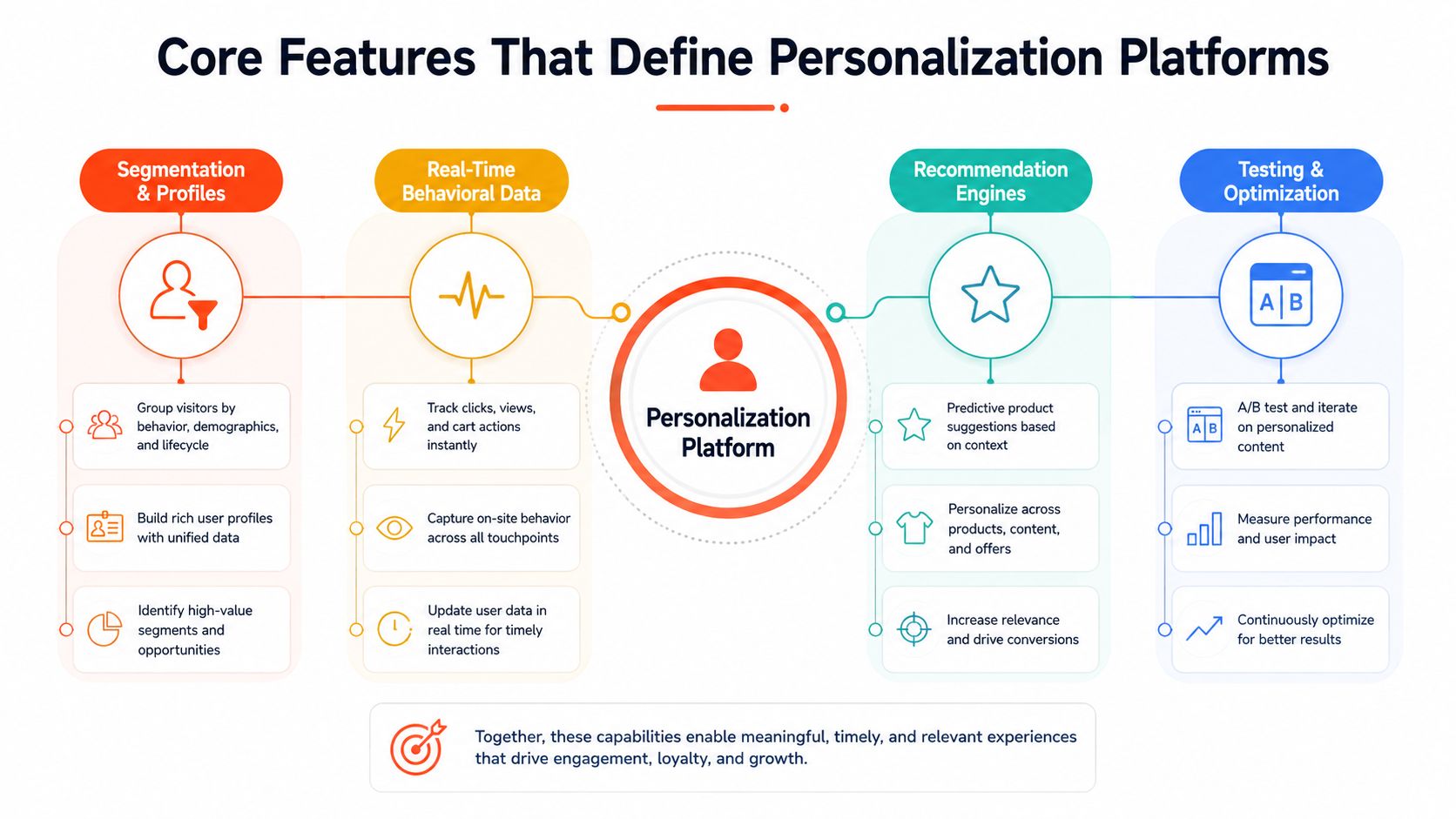
Segmentation and profiles
Useful segmentation goes past “VIP” and “new customer.” It changes as people browse, buy, return, and respond. On Shopify, that usually means tying customer tags, metafields, and lifecycle status together so a repeat buyer sees different calls to action than an anonymous session. If the platform cannot sync cleanly with customer objects, cohorts go stale and the handoff to email or SMS becomes unreliable.
Real-time behavioral data
The strongest personalization layers react while the session is still live. Clicks, cart additions, category views, and search terms should update the experience without waiting for an overnight batch job. On a theme-based store, that might mean reordering a collection or swapping a hero block after a clear signal. It only works if the data arrives fast enough to matter.
Recommendation engines
Recommendation logic is the part shoppers notice first. Static bestseller blocks are cheap, but they are blunt. A logged-in repeat buyer and a first-time visitor should not see the same “frequently bought together” pattern, because one already knows the catalog and the other needs a guided entry point. For Shopify stores, the better systems use cart context, purchase history, and product affinity, not just page-level popularity.
Testing and optimization
Personalization without testing is guesswork in a nicer wrapper. That matters on-site, where a wrong variant can hurt usability or slow the storefront. The data inputs should include more than clicks, too. Signals like site search behavior patterns often reveal intent faster than a shallow browse path, and they help teams decide whether a personalized module is doing real work or just adding noise.
A recommendation widget that looks smart but slows the page down is still a bad widget.
How to Evaluate Ecommerce Personalization Software
Start with data fit. If a platform cannot read Shopify products, customers, orders, and metafields without awkward middleware, you inherit brittle glue code that breaks the moment a theme or schema shifts. That usually happens when teams buy for a feature list instead of the data model they run.
Implementation depth matters just as much. App blocks and theme app extensions are fine for simple merchandising. For richer segmentation, multi-channel use cases, or anything that needs more stable timing, the better option is often custom logic, admin extensions, or server-side work.
Evaluation Criteria | What to Look For | Red Flags |
|---|---|---|
Shopify data model compatibility | Native sync with products, customers, orders, and metafields | Middleware that duplicates core store data |
Theme integration depth | App blocks, theme app extensions, and minimal Liquid overrides | Theme edits that fail on every update |
Performance impact | Light payloads, limited client-side scripts, and clear load sequencing | Heavy JavaScript bundles that compete with storefront rendering |
Maintenance burden | Configuration that a small team can sustain | Constant developer intervention for small changes |
Headless readiness | Storefront API support and flexible delivery patterns | Theme lock-in with no path to Hydrogen or composable builds |
Vendor control | Exportable data and clear ownership of learned segments | Black-box models and unclear exit options |
Cost is where many teams misread the trade-off. A low monthly fee can hide developer hours, QA time, debugging, and the cost of slower pages. If the platform also includes experimentation, evaluate it the way you would Shopify storefront experimentation, because the true cost is usually the operating overhead, not the license line item.
Data portability and product philosophy deserve the same scrutiny. If the system cannot export learned audiences or segmentation logic, you are renting intelligence you cannot move. That hurts most on Shopify Plus, where the stack may later shift from theme-based merchandising to headless or mixed architecture.
Compare the tool against the systems you already use. A platform that connects cleanly to CRM, analytics, and merchandising tools reduces manual stitching across teams. One that only adds another silo with nicer charts creates more work, even if the interface looks polished. For teams comparing vendor fit, a personalization vendor evaluation checklist can help separate real integration depth from surface-level claims.
Shopify Integration Patterns and Implementation Choices
The easiest path is usually theme-based, and that's fine when the use case is narrow. App blocks, theme app extensions, and Shopify's app-facing tooling can inject recommendations or content without rewriting Liquid templates, which is why many merchants start there. The trap is thinking that “easy to install” means “easy to run,” because every extra app bundle adds weight, and Shopify stores don't get a pass on performance just because the feature is useful.
For teams that already moved into composable storefronts, the integration model shifts. Hydrogen or other headless builds can consume personalization APIs directly and render targeted content closer to the server layer, which gives you more control over timing and state. The trade-off is obvious, custom control comes with more engineering ownership, more testing, and a higher bar for maintaining data consistency across services. If your architecture is already going that direction, the headless patterns in Shopify headless commerce builds are the relevant reference point.

Where app sprawl starts to hurt
The hidden cost shows up when teams stack three tools that all want to personalize the same page. One app loads recommendations, another controls popups, and a third injects targeting logic for email capture. Each one adds its own JavaScript bundle, each one competes for attention, and none of them knows the whole customer story. The end result is a store that feels more fragmented even though it has more “personalization” installed.
When custom middleware is worth it
Custom middleware built on Shopify's Storefront API and Admin API makes sense when segmentation logic needs to combine multiple systems, like CRM state, order history, and product rules. It also pays off when you need a single source of truth for customer traits that downstream tools can reuse. Presidio is one example of a Shopify partner that builds custom theme and app work, headless storefronts, and systems integrations for brands that need the stack to stay lean instead of app-heavy, which matters when maintenance is part of the decision.
The practical rule is simple. Use theme-level personalization for fast wins, use custom middleware when the rules cross systems, and don't add a second or third app until the first one has proven it won't slow the site or fragment the profile.
Privacy-Safe Personalization in a Post-Cookie World
Third-party tracking is a weaker base for personalization, and Shopify merchants feel that shift in the quality of the signals they can trust. The better route is to build on first-party and zero-party data, explicit preferences, purchase history, and consented behavioral signals that still work when browser-level identifiers do not.
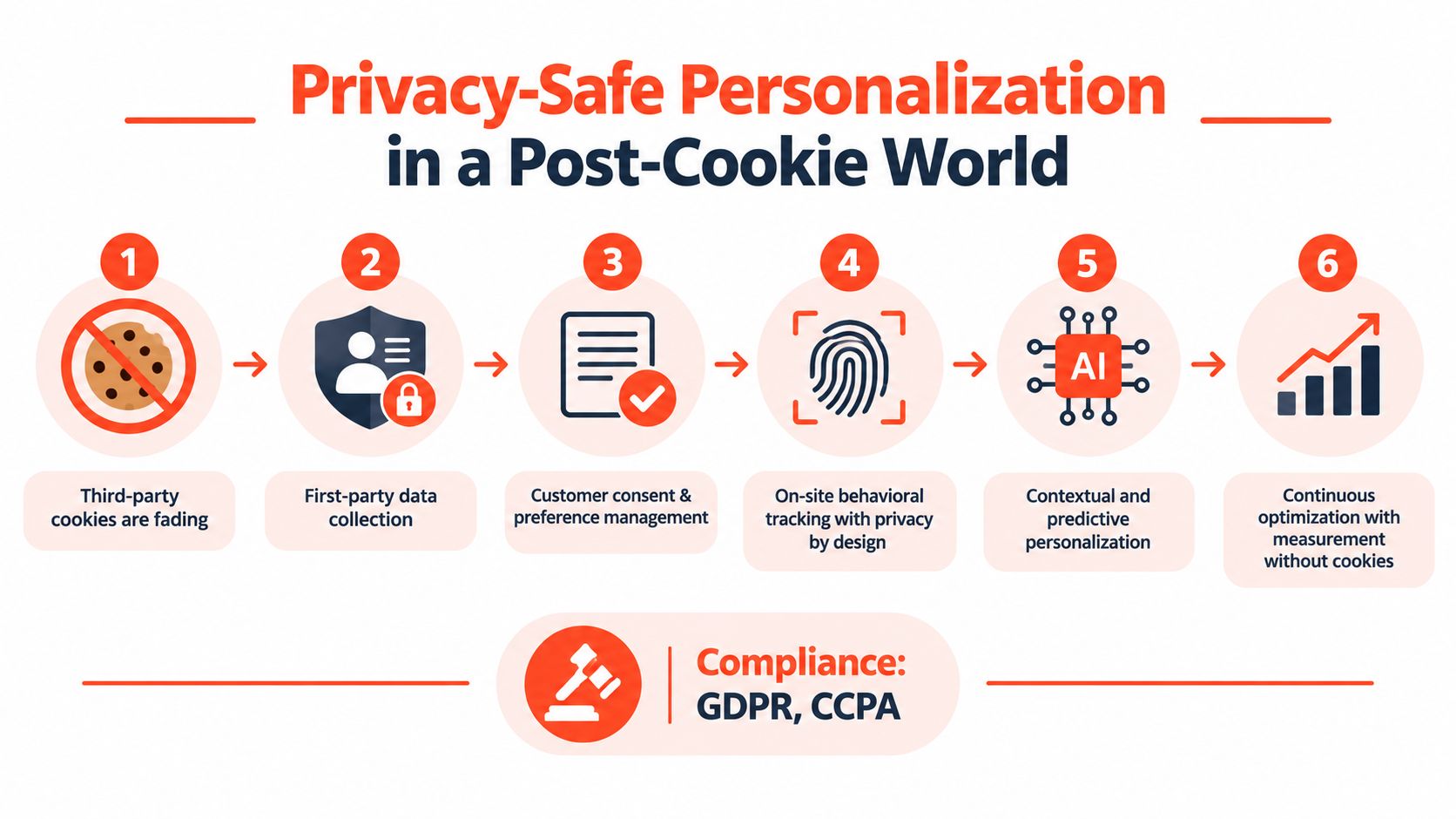
Collect the signal at the point of intent
Zero-party data does not need to be invasive to be useful. Post-purchase surveys, preference centers, and quizzes can ask shoppers what they want, then feed that data into customer metafields and segment definitions. That gives the personalization engine a deterministic starting point instead of trying to infer everything from browser behavior.
Keep tracking server side where it belongs
Shopify merchants should rely on customer events and server-side pixel patterns when consent allows it, because those flows are less brittle than client-side-only tracking. The goal is not to bypass consent. The goal is to keep measurement and personalization usable when browsers limit what can be observed in the page itself.
If a personalization vendor depends on fingerprinting to hold the model together, you are carrying technical debt and privacy risk at the same time.
Independent market coverage also points to privacy compliance, consent management, and data anonymization as growing design requirements, while omnichannel personalization across web, email, apps, and social keeps expanding as a business expectation (Data Insights Market summary). That matches what merchants are already seeing. The same source says consumers are using generative AI for online shopping more often, which suggests shoppers now expect contextual help, not invasive tracking.
The audit question I use is straightforward. Can each personalized experience be explained by a consented signal, or does it depend on opaque cross-site tracking to work? If the answer is unclear, the stack is carrying more legal and technical exposure than it should.
Realistic ROI and Growth Impact From Personalization
A Shopify store usually sees the clearest return from a few well-placed changes, not from switching on every feature in the app stack. Personalized recommendations are often the first place to start because they change what shoppers see while they are still deciding. Done well, they can improve conversion, order value, and repeat purchase behavior. Merchants that keep the implementation tight usually measure results faster than teams that add too many tools at once.
Personalization programs typically deliver a 5 to 15% revenue lift when implemented well, and high-growth companies can generate about 40% more revenue from personalization than slower-growing peers (Vovv ecommerce personalization statistics). Those figures do not guarantee the same result for every Shopify or Shopify Plus store, but they do show where the upside usually comes from, relevant recommendations, timely messaging, and merchandising that responds to intent instead of forcing a generic catalog flow. The same source also frames the gain as incremental gross profit from measurable behavior changes, not vanity clicks.
Personalization Tactic | Primary Metric | Typical Lift Range | Time to Measure |
|---|---|---|---|
Recommendation widgets on PDPs | Conversion rate | Qualitatively positive when tuned to context | After enough sessions to compare variants |
Cart-page cross-sells | Average order value | Qualitatively positive when offers match cart intent | After several campaign cycles |
Segmented email and SMS flows | Revenue per recipient | Better than batch sends when the message is timely | After a full lifecycle window |
Personalized post-purchase journeys | Repeat purchase rate | Stronger retention when follow-up matches prior behavior | After repeat-buy cadence plays out |
Dynamic homepage merchandising | Engagement and downstream conversion | Improves when the homepage stops being generic | After a stable traffic period |
Timing matters. A/B tests need enough traffic and enough exposure to separate real lift from seasonal noise, otherwise a short-lived bump gets read as a product win. The strongest results usually come in sequence, first prove the recommendation logic, then connect the same audience logic to email, SMS, and post-purchase flows.
Implementation trade-offs matter too. If the experience is personalized but the page slows down, the lift gets diluted quickly. I usually see merchants blame the recommendation model when the actual problem is the script bundle, app overlap, or theme work that adds weight to the storefront. That is why personalization ROI on Shopify is tied as much to stack discipline as to targeting quality.
Building a Sustainable Personalization Roadmap
A sustainable roadmap starts with what the team can maintain. If the stack takes three engineers to keep alive, it won't stay personalized for long, it'll just stay fragile. The better approach is to phase in what proves value quickly, then expand only when the data model and operating rhythm can support it.
Start with the simplest high-value placements, usually cart recommendations, post-purchase upsells, and a small number of on-site content blocks. Once those are stable, add lifecycle segmentation and homepage merchandising tied to real customer signals. Only after that should teams layer in predictive models that depend on richer history and tighter orchestration.
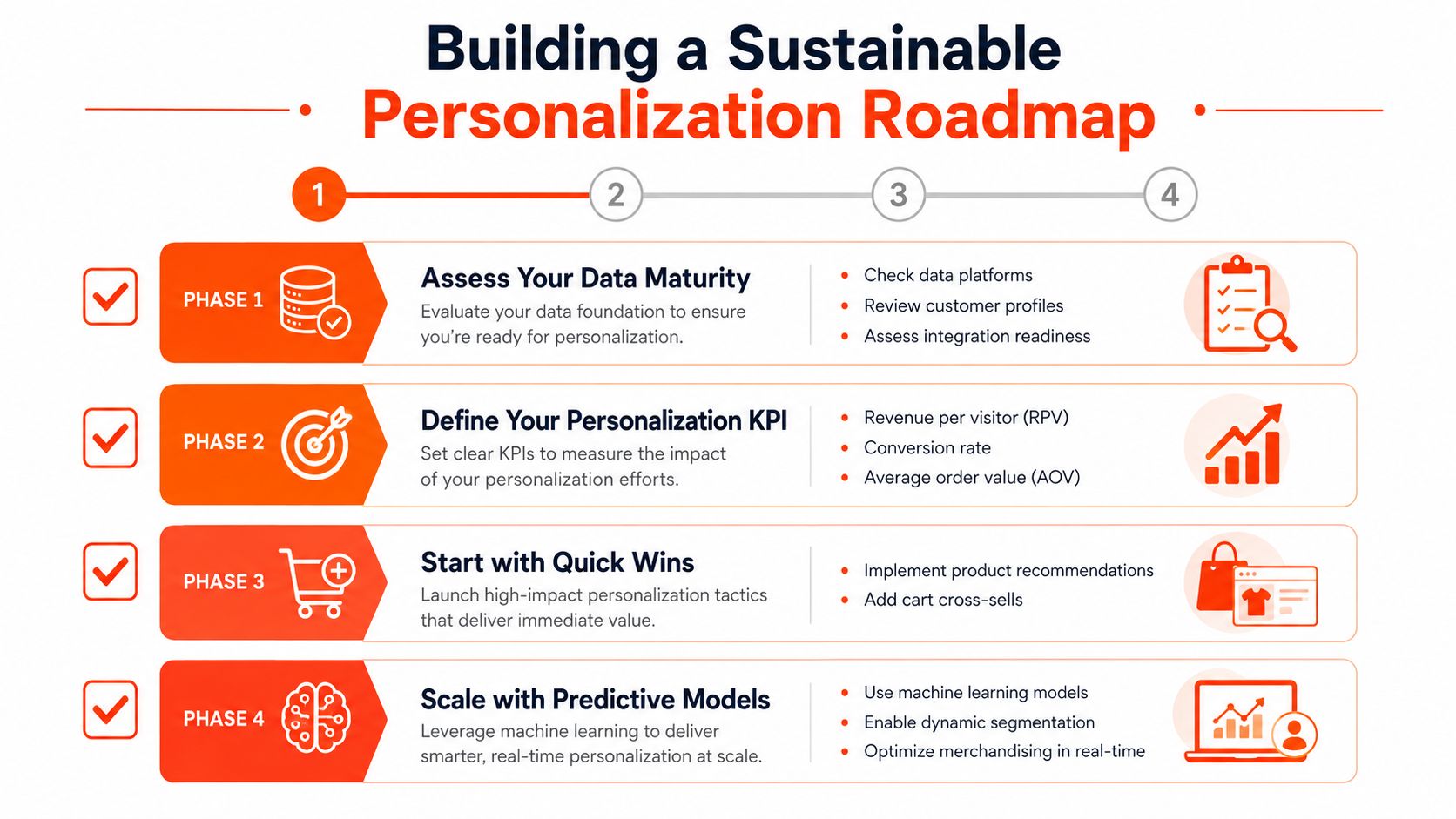
A useful scorecard for any vendor or internal build should include:
Data ownership: Who controls profiles, segments, and learned behavior?
Shopify compatibility: Does it work with theme app extensions, Storefront API, or both?
Engineering overhead: How often will a developer need to touch it?
Vendor lock-in risk: Can the logic and data move if the stack changes?
Performance impact: Does it stay light enough to protect the storefront?
The goal is not to maximize feature count. It's to create personalization software that behaves like infrastructure, something that keeps working as the catalog grows, the storefront changes, and the team stays lean. Merchants that audit their current tools, define a small set of success metrics, and review the stack every quarter usually end up with cleaner data, fewer scripts, and better long-term conversion discipline.
If you want a Shopify stack that keeps personalization practical instead of bloated, Presidio can help you audit the current setup, reduce app sprawl, and build the integrations that make relevance easier to sustain. Reach out if you want a maintainable plan for personalization on Shopify or Shopify Plus, from quick wins to a stack that can grow with your storefront.

Jamie, Presidio’s Designer, leads the practice alongside Johnnie. With over 10 years of e-commerce experience, Jay is a Shopify expert, known for crafting innovative solutions that prevent tech debt.
Jaime
Senior Product Designer, 2020