Presidio

A shopper lands on your Shopify store knowing roughly what they want. They type “black linen shirt,” receive a mixed list of products, can't find the right size quickly, and leave. Another shopper arrives with only a vague need, explores a collection, answers a short product quiz, and finds a suitable item without ever using the search box. Both journeys depend on the same thing: whether your store helps people move from intent to confidence.
That's why search and discovery is a revenue system, not a navigation detail. Search captures demand that shoppers can already express. Discovery helps shoppers clarify demand through collections, filters, recommendations, merchandising, and guided experiences. If either path breaks, your store loses product exposure, useful sessions, and potential orders.
Table of Contents
Why Search and Discovery Decides Revenue on Shopify
A shopper searches your store for a specific product and receives an empty results page. Another opens a collection, finds a useful recommendation, and adds an item without typing a query. These are different entry points, yet both affect the same commercial question: can the store turn a visitor's intent into a product decision?
Search deserves attention because its failure can end a session quickly. Google's retail research reports that 80% of global customers leave a site after an unsuccessful search. The original context is available in the Google retail search abandonment research. A failed query does more than frustrate someone. It blocks product discovery, comparison, and the route to cart.
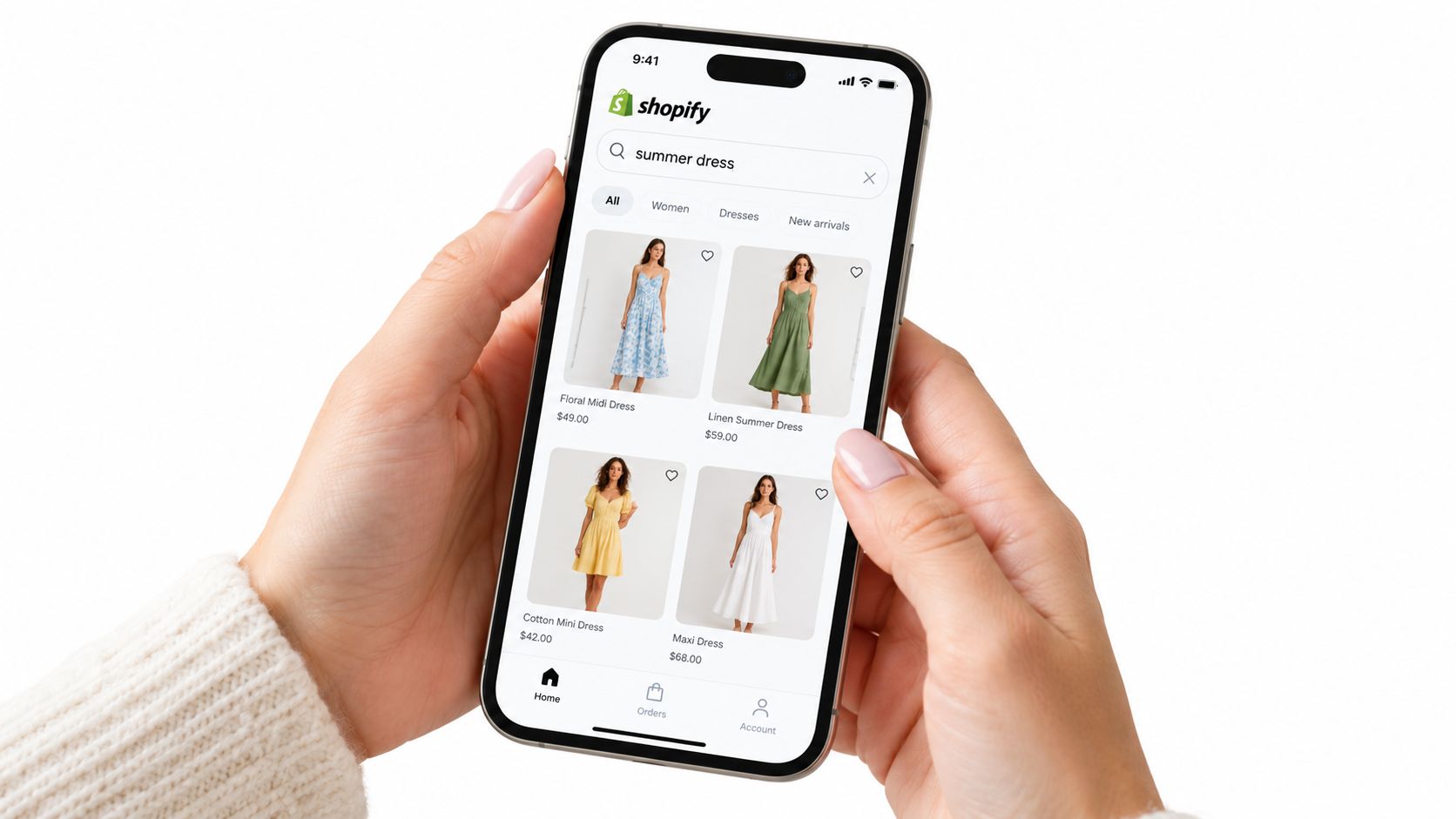
Two paths, one commercial outcome
Search and browsing follow different patterns, but each should help the right shopper see the right product at the right moment. Search responds to stated intent. Discovery helps shape intent through collections, filters, recommendations, and merchandising.
A customer entering “sensitive skin moisturizer” needs matching language, relevant product attributes, and filters that narrow the choice. A customer entering a skincare collection may need education, a routine builder, or recommendations based on skin type. One journey starts with a clear request. The other gives the shopper better questions and options as they explore.
Catalog size makes this harder. Product titles, tags, variants, collections, and inventory states create several points where shopper language can diverge from store structure. A wine retailer may need to connect grape variety with region, vintage, food pairing, and budget. A resource such as browse auction and retail prices can provide market context, while the Shopify store still needs a direct path from research to products the shopper can assess and purchase.
Commercial rule: Prioritize a discovery feature when it helps shoppers reach a relevant product, compare options with confidence, or choose a clear next action. Measure its commercial contribution before treating it as interface polish.
The implementation starts with the catalog. Titles and descriptions give search useful language. Metafields, collections, inventory data, and merchandising rules determine which products appear and in what order. Relevance brings suitable items forward. Merchandising applies business judgment. Recommendations keep the journey active when the shopper has not yet expressed a precise need. Together, these systems connect relevance, product presentation, AI-assisted suggestions, and measurement to revenue.
How Search and Discovery Work Together in Ecommerce
Think of a physical store with two forms of assistance. Search is the store associate who hears a direct request and retrieves suitable products. Discovery is the store layout that makes useful paths visible even when the customer hasn't asked a precise question.
A good associate understands that “sofa” and “couch” may describe the same need. A good store layout groups products by use, style, season, and price so customers can explore without knowing the retailer's internal vocabulary. Shopify stores need both behaviors because shoppers don't arrive with the same level of certainty.

Search captures intent
Search works best when the shopper has a problem or product in mind. The system should interpret the query, retrieve matching products, and offer filters that help narrow the set. Exact terms still matter for product codes, model names, sizes, and technical specifications, while broader language benefits from synonyms and semantic interpretation.
The search experience shouldn't end with a results grid. A useful result page may include category suggestions, filters, buying guides, complementary products, and a clear recovery path when the query is ambiguous. “Running shoes,” for example, could lead to filters for terrain, cushioning, width, and gender rather than a flat list with no direction.
Discovery expands intent
Discovery takes the lead when shoppers are researching, browsing, or unsure what they need. Collections, featured products, recommendations, quizzes, editorial modules, and related-product blocks all help convert uncertainty into a decision.
The underlying catalog foundation must support both systems. Product attributes need consistent names. Metafields should capture details that shoppers use. Collections should reflect meaningful shopping missions rather than internal departments. If search uses one vocabulary and merchandising uses another, the customer experiences two disconnected stores.
The broader search market shows why the word “discovery” matters beyond a Shopify storefront. In August 2026, Google held 91.1% of worldwide search engine market share, followed by Bing at 4.5%, Yahoo! at 1.23%, Yandex at 0.99%, DuckDuckGo at 0.7%, and Baidu at 0.62%, according to worldwide search engine market share data. Your storefront search is a smaller environment, but the principle is similar. A gateway that interprets language and controls what appears can shape the entire customer journey.
The shared journey
A shopper may start with a search, refine through filters, open a collection, view recommendations, and return to search with better language. The strongest implementations let those actions reinforce each other rather than forcing the shopper to restart.
Relevance Ranking and What Makes Results Feel Right
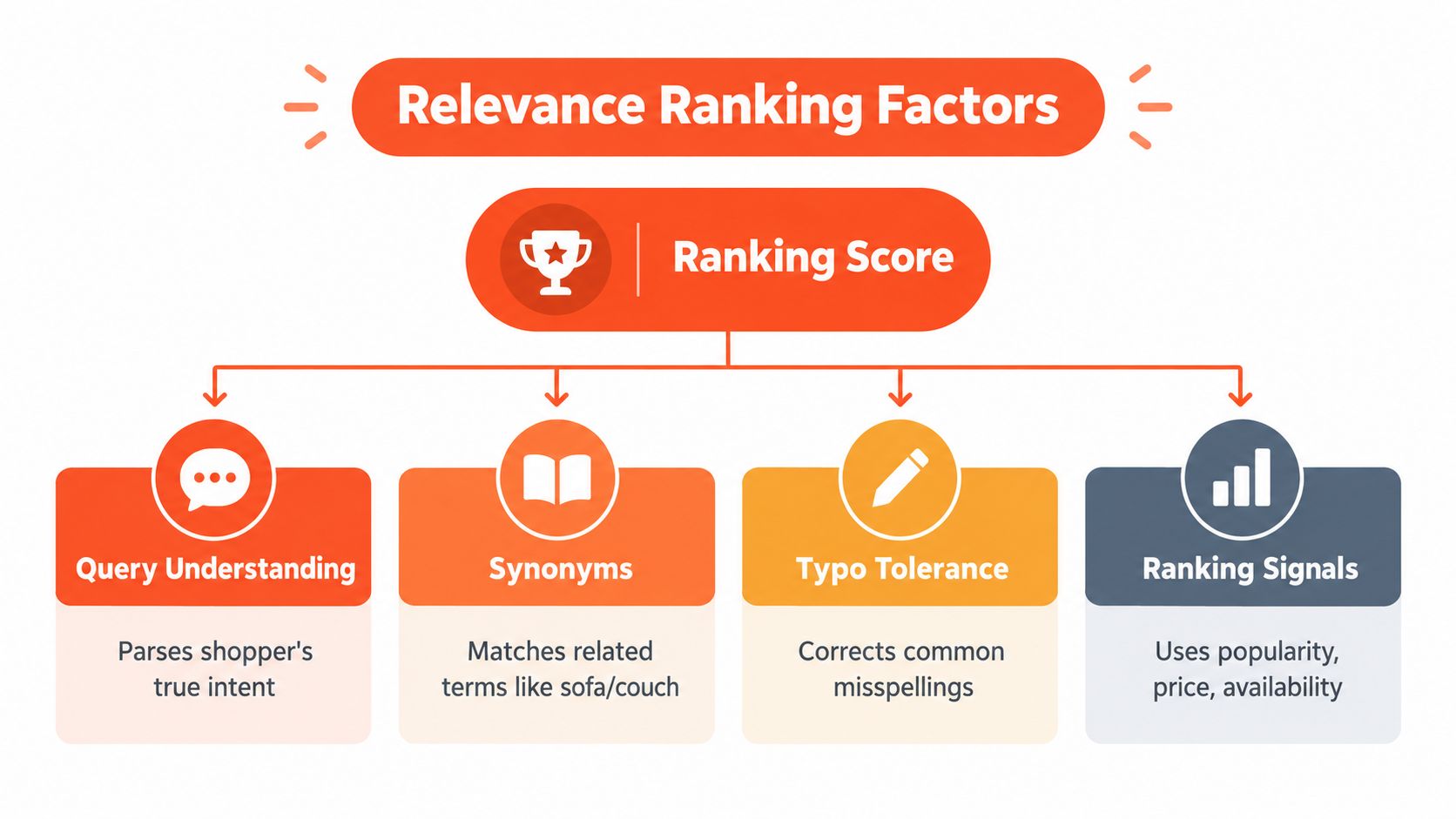
A search result feels right when it reflects what the shopper meant, not merely the characters they typed. That requires several layers working together. Query understanding identifies the likely product or category. Synonym handling connects different terms. Typo tolerance protects the experience from ordinary spelling mistakes. Ranking signals decide which suitable products appear first.
Start with the language shoppers use
Your product team may call an item a “hydrating facial emulsion.” Shoppers may search for “face moisturizer.” A furniture catalog may use “occasional chair” while customers type “accent chair.” Search logs reveal those gaps more reliably than internal meetings.
Build a vocabulary map from real queries. Include product names, category alternatives, common misspellings, material terms, use cases, and regional language. Don't create synonyms indiscriminately. If two terms describe different products, combining them can make results look broad while reducing trust.
A useful diagnostic sequence looks like this:
Zero-result queries: Group empty searches by theme. Repeated terms often expose missing synonyms, weak tagging, or catalog gaps.
Low-click queries: Review searches that return products but receive little engagement. The issue may be ranking, thumbnails, price visibility, or a mismatch between query and result intent.
Reformulated queries: Watch shoppers who search, change the wording, and search again. Their second query often reveals what the first result page failed to understand.
Slow queries: Separate relevance problems from performance problems. A correct result that arrives too late still creates friction.
Measure retrieval and commercial health
Search quality needs both technical and business measures. Research and benchmarks emphasize keeping zero-result queries below 2% to 5%, using NDCG above 0.80 and Mean Reciprocal Rank above 0.70 as relevance references, and keeping result latency under about 450 milliseconds at p95, as outlined in ecommerce search quality benchmarks.
These metrics answer different questions. Zero-result rate asks whether the store can retrieve anything useful. NDCG evaluates the quality of the ranking across results. Mean Reciprocal Rank focuses on how quickly the first relevant result appears. Latency measures whether the interface responds quickly enough for the shopper to continue.
Diagnostic insight: A merchant can't fix a relevance problem with a promotional badge if the first useful product is buried. Ranking, availability, and response speed need attention before visual polish.
For a deeper look at recommendation logic and implementation considerations, see AI product recommendations for ecommerce. The important distinction is that recommendations extend discovery, while relevance ranking determines whether the current query produces a credible starting point.
Personalization and Merchandising That Guide Shoppers
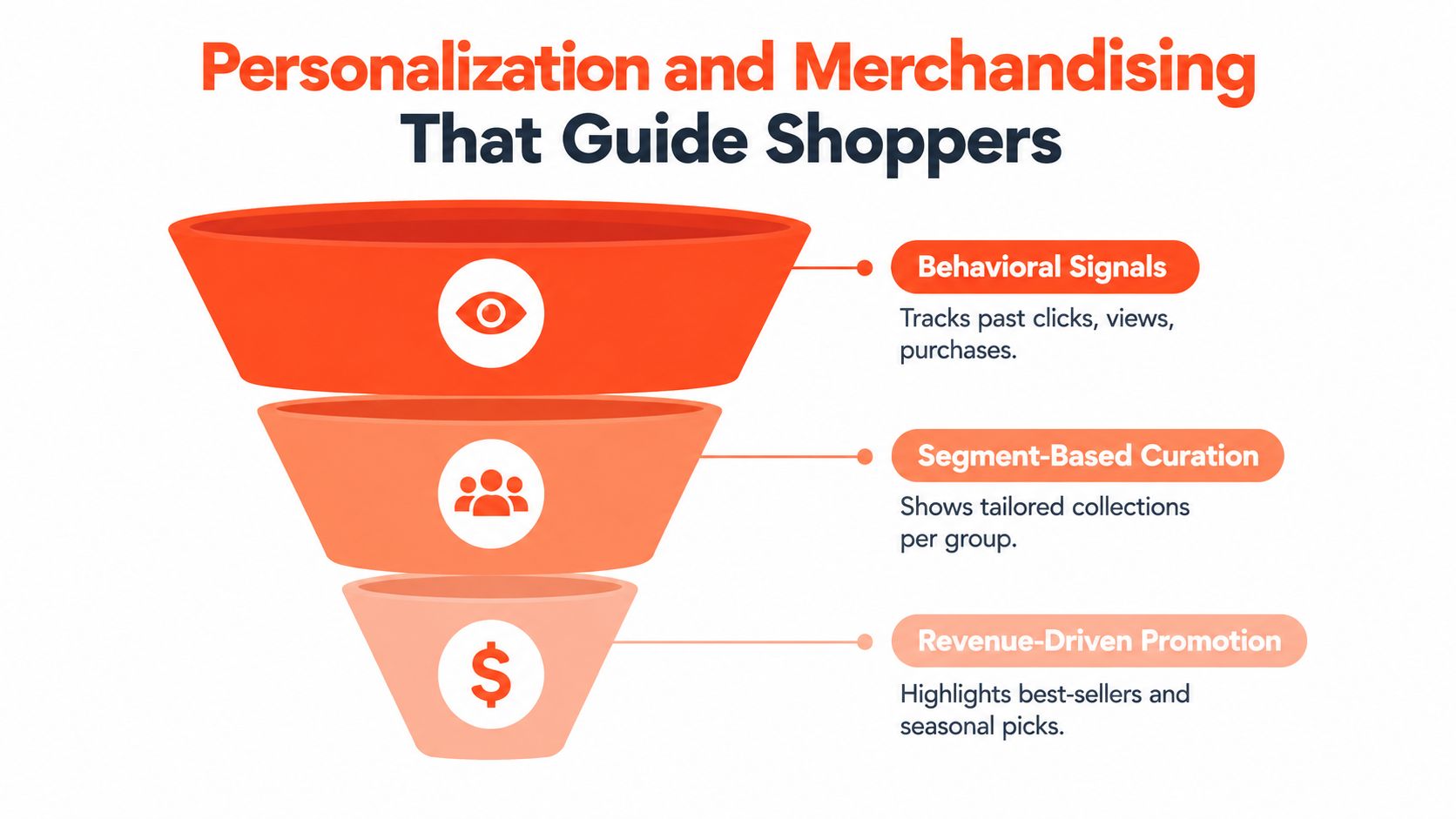
Relevance answers, “Which products match this request?” Merchandising answers, “Which suitable products should this shopper see first for this commercial context?” Personalization adds another question, “What might help this individual continue?”
Internal search users show strong intent. Industry summaries report that search users convert at about 2.0x to 3.0x the rate of non-searchers, and one benchmark records 4.63% conversion for search users versus 2.77% sitewide, as reported in ecommerce search and KPI benchmarks. Those figures don't mean every store should force shoppers into search. They show why a store should treat search sessions as valuable journeys and make the results page work hard.
Give automation a merchant boundary
Personalization can use viewed products, previous purchases, selected preferences, location, and on-site behavior. Those signals can influence recommendations, but they shouldn't override basic product suitability. A customer browsing winter coats still needs available sizes, accurate materials, and relevant fits before a model promotes a product because it was popular with another segment.
Merchandising rules provide control. A team can pin a seasonal collection, boost products with healthy inventory, bury discontinued items, or promote a private-label range within a relevant category. The rule should remain explainable. If no one can describe why a product appears first, troubleshooting becomes difficult and merchant trust falls.
Use guided discovery when the catalog is hard to understand
A quiz works well when shoppers know their desired outcome but don't know which attributes matter. A skincare quiz might ask about skin concerns and routine preferences before suggesting a small set of products. A supplement store might qualify goals and format preferences. The quiz isn't a replacement for search. It captures intent that a shopper can't express through a product keyword.
Recommendations should also connect adjacent decisions. A product page can suggest a compatible accessory, a replenishment item, or another product in the same routine. Keep those relationships tied to catalog data and business rules rather than adding disconnected recommendation widgets across the theme.
Learn how ecommerce personalization software can fit into this model without turning every interaction into an opaque algorithm. A lean build often uses native Shopify capabilities for foundational search, a focused quiz or recommendation tool for qualification, and theme-level merchandising for visible commercial rules.
Merchant control matters: Automation should widen useful choices, not hide the reason a product is being promoted.
Shopify Implementation Patterns for Search and Discovery
A shopper searches “waterproof daypack” and gets products with vague titles, missing attributes, or inconsistent tags. No ranking setting can fully repair that experience. Shopify implementation starts with catalog structure, then connects search, merchandising, recommendations, and measurement into one revenue system.
Shopify provides a practical foundation through storefront search, collection filters, product data, and the Search & Discovery app. A focused catalog with consistent titles, descriptions, product types, and metafields may work well with native tools. The trade-off is simplicity versus control. Native features reduce maintenance, while complex catalogs may require stronger query interpretation, ranking controls, or recommendation logic.
Compare the main implementation choices
Implementation Pattern | Best For | Trade Offs |
|---|---|---|
Native Shopify search and Search & Discovery | Stores with a focused catalog and consistent product data | Lower implementation overhead, with less control over advanced ranking behavior |
Native search plus custom theme enhancements | Brands needing better filters, result layouts, merchandising blocks, or guided paths | More design and development work, while keeping the core search foundation |
Dedicated search service integrated with Shopify | Large or complex catalogs requiring advanced relevance controls, analytics, and speed | Additional cost, integration ownership, and operational dependency |
Quiz and recommendation layer | Stores where shoppers need qualification or product education | Requires careful question design, product mapping, and ongoing content maintenance |
Headless or composable storefront | Teams needing a custom discovery interface across multiple systems | Greater flexibility, with more responsibility for performance, accessibility, and release management |
The catalog determines the right pattern. If ERP data updates titles, inventory, prices, or attributes, the integration must preserve the fields that search and merchandising use. An advanced search engine cannot correct inconsistent source data. Clean product information comes first.
Build for speed and access
Discovery features can become slower through accumulation. One app adds a filter, another adds recommendations, and a third inserts a quiz, each with separate scripts and styling. A custom theme section or consolidated app experience may keep the storefront faster and easier to maintain.
Shopify themes such as Broadcast, Palo Alto, and Modular can provide a structured foundation for custom storefront work. Quiz Kit can support AI-powered product recommendations and lead capture where guided discovery fits the buying journey. Presidio's ecommerce site search guidance presents search as part of product discovery, alongside storefront optimization, merchandising, and CRO.
Search and discovery should also be measurable at implementation level. Record queries with no results, filter use, recommendation clicks, add-to-cart activity, and purchases after search. Those signals show whether a ranking rule helps shoppers or merely changes the interface.
Poor search can lead shoppers to abandon a visit, so the architecture should support clearer product data, guided qualification, and flexible recommendation paths. AI-assisted shopping may influence how people find products, but that does not make a headless rebuild necessary for every Shopify store. Start with the smallest pattern that gives the team control, then expand when catalog complexity or measured gaps justify it.
Real World Examples of Discovery Done Well
A skincare store with a broad catalog often has a qualification problem. A shopper may know they have dryness or sensitivity, but not which ingredients, product types, or routines to choose. A quiz can ask focused questions, map answers to product attributes, and return a small set of suitable recommendations. The important implementation detail is the mapping behind the quiz. If answers aren't connected to reliable metafields, the result feels arbitrary.

A food brand may have the opposite issue. Its catalog is understandable, but shoppers type informal names and misspell products. Synonym handling can connect everyday language with catalog terminology, while typo tolerance helps recover obvious errors. The team should review the search log after launch and add only useful mappings. Over-broad corrections can create surprising results, especially when similar terms refer to different flavors or formats.
Seasonal merchandising in apparel
An apparel store may have relevant products in its catalog but present them in an order that ignores the current shopping mission. Merchandising can promote a seasonal collection, surface available sizes, and give priority to products that match the campaign. The rule should still operate within relevance. A seasonal item shouldn't appear for an unrelated query because it has a campaign tag.
The same logic applies to collection pages. A curated landing page can guide exploration with filters, outfit combinations, and editorial context. Recommendations then help the shopper continue after the first product view. These elements work best when they share the same attribute system, rather than relying on manually maintained lists that drift out of date.
Discovery is also becoming less linear. Recent coverage reports that over 60% of searches end without a click-through, and one 2026 market summary reports 9.5 billion monthly visits to generative AI sites on average, up 70% year over year, as discussed in search and discovery trend coverage. For a Shopify brand, that means product information should be clear enough to support comparison before the shopper reaches a product page, while the storefront should make the next action obvious when the shopper does arrive.
A useful review question is simple: can a first-time visitor move from a problem to a relevant product without knowing your internal category names? If not, improve the language, guidance, or recommendations before adding more visual features.
Measuring and Improving Search and Discovery Over Time
Treat discovery as an operating loop, not a launch task. Start by connecting search behavior to outcomes. Track search conversion rate, revenue per search session, zero-result rate, result clicks, product-page views, add-to-cart activity, and recommendation engagement. These measures help separate a retrieval issue from a persuasion issue. A query can have a low conversion rate because the results are wrong, because the products are unavailable, or because the product page fails to answer the shopper's questions.
Read the logs before changing the stack
Search logs are a practical source of product strategy. Group queries by intent and look for repeated patterns:
Vocabulary gaps: Add controlled synonyms or revise product language when shoppers use terms your catalog doesn't recognize.
Catalog gaps: Flag repeated requests for products, sizes, or attributes you don't carry.
Ranking problems: Review queries where shoppers click deeper results, reformulate the query, or return to browsing.
Merchandising opportunities: Identify high-intent searches that deserve curated landing pages, buying guides, or seasonal rules.
Run focused tests instead of rebuilding everything. Change one synonym group, ranking rule, collection order, or recommendation module, then compare the relevant business measure against a suitable baseline. Keep technical quality visible alongside revenue outcomes. The benchmark guidance cited earlier gives teams reference points for zero-result rate, ranking quality, and latency, but your own historical data should guide prioritization.
A practical audit rhythm
A useful audit asks four questions:
Can shoppers express intent? Review search terms, filters, synonyms, typo handling, and natural-language queries.
Do results earn trust? Inspect ranking, availability, price visibility, imagery, and product detail quality.
Can uncertain shoppers continue? Check collections, quizzes, recommendations, related products, and recovery paths.
Can the team improve the system? Confirm that logs, analytics, merchant rules, and product data are accessible to the people responsible for growth.
AI-assisted discovery makes this loop more important, not less. Traditional search still needs precision for exact product terms, while conversational systems can help shoppers explore broader needs. A durable Shopify implementation supports both, with structured catalog data beneath the experience and clear measurement above it.
Working principle: Improve the path that loses the most qualified shoppers first. A small fix to query language or product mapping can matter more than a large interface redesign.
Presidio builds Shopify and Shopify Plus storefronts, themes, apps, quizzes, recommendation experiences, and ongoing CRO programs that connect product discovery with measurable commerce outcomes. Visit Presidio to discuss a search and discovery audit, a lean implementation plan, or the next optimization your store needs.

Jamie, Presidio’s Designer, leads the practice alongside Johnnie. With over 10 years of e-commerce experience, Jay is a Shopify expert, known for crafting innovative solutions that prevent tech debt.
Jaime
Senior Product Designer, 2020