Presidio

A dropshipping store can look profitable while losing money on every order. The model has reached enormous scale, with one widely cited estimate placing the global market at USD 583.5 billion in 2026, up from USD 464.4 billion in 2025, yet established operators commonly report net margins of only 10% to 30%, with beginners often falling below 10% after advertising, fees, and returns. (Whop's dropshipping statistics overview) The surprising lesson is that dropshipping's low entry cost doesn't make it low risk. It shifts risk away from inventory and toward acquisition, fulfillment, refunds, supplier performance, and compliance.
The right question isn't just whether dropshipping has more pros than cons. It's whether the model gives your business enough control over contribution margin and customer experience to justify scaling on Shopify. For some brands, it's an efficient testing layer. For others, it becomes a costly intermediary between customer demand and a supply chain they don't control.
Table of Contents
Scale and Economics of Dropshipping
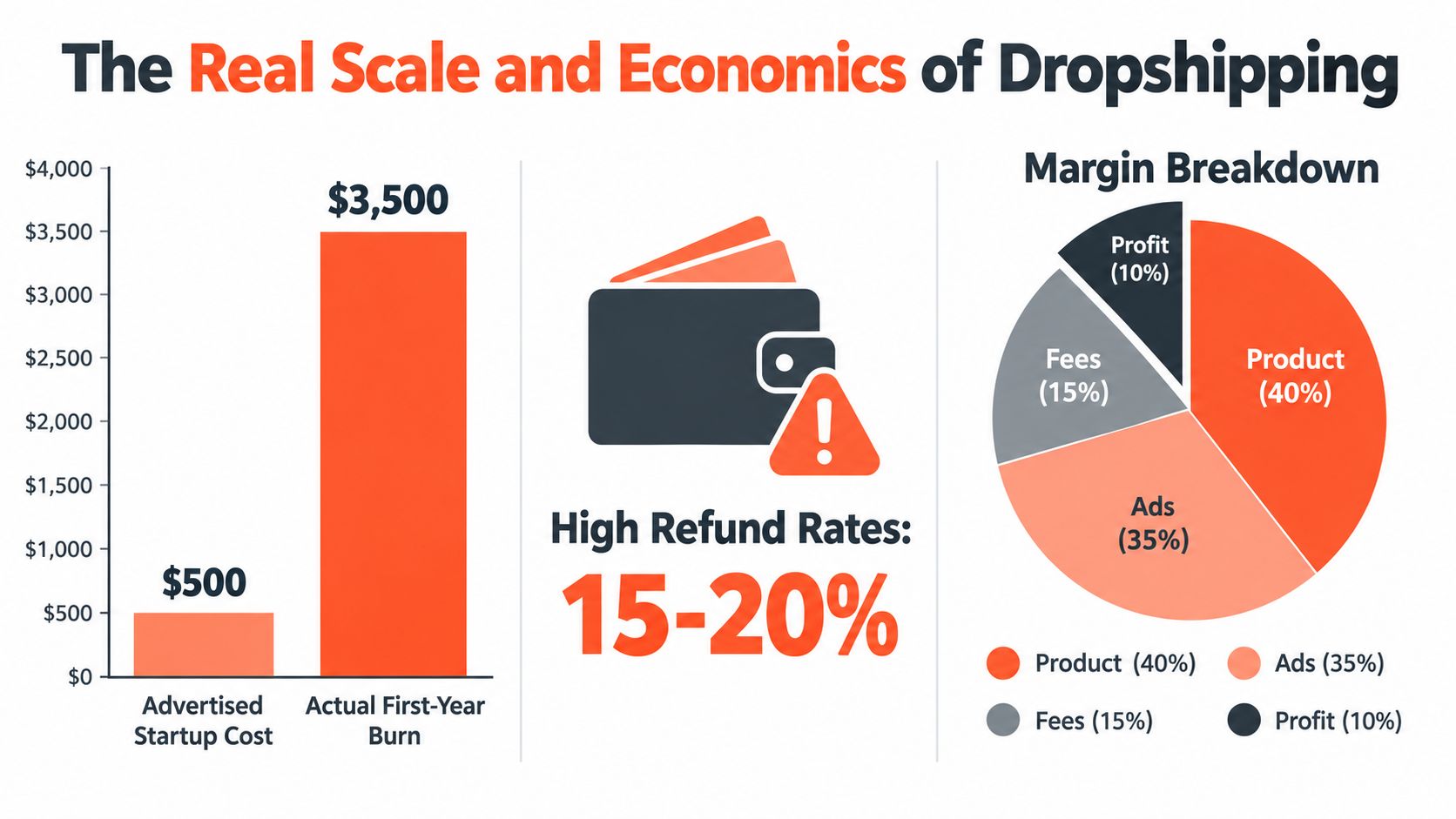
Dropshipping has become a large, competitive market rather than a small-store experiment. One market overview projects the industry could reach USD 2,180.8 billion by 2033, with a projected 20.7% compound annual growth rate. (Whop's market overview) That scale creates opportunity, but it also compresses differentiation. Merchants can launch broad catalogs quickly, while customers can compare similar products across many storefronts.
The clearest advantage is capital efficiency. A merchant can test demand without purchasing and storing a wide range of products in advance. The supplier holds the stock and fulfills the order after purchase. This allows a founder to test product-market fit, expand the catalog quickly, and preserve cash that would otherwise sit in inventory.
The economics tighten once each order passes through payment, advertising, support, and fulfillment workflows.
Contribution margin matters more than markup
A strong markup can hide a weak contribution margin. Shipping, platform fees, payment processing, advertising, refunds, and replacement shipments reduce the amount available for overhead and profit. One industry analysis places shipping and platform fees at 15% to 25% of revenue, while paid acquisition can add 20% to 35% of revenue in early stages. (Hostinger's dropshipping profitability analysis)
Calculate the economics at order level before raising ad spend:
Selling Price − Product Cost − Shipping − Payment Fees − Advertising Cost − Refund or Return Cost
This result is more useful than gross margin alone. If it is weak before salaries, software, tax, and customer support, additional traffic will not fix the model. It will increase the number of orders exposed to the same loss.
Supplier failure makes the calculation less predictable. Late dispatches, stock mismatches, damaged goods, and inconsistent tracking can trigger refunds, replacements, chargebacks, and support time. A supplier that appears inexpensive can therefore cost more once service recovery is included.
Product selection and search demand still influence the outcome. A focused category with specific customer intent gives a store more room to differentiate than a general catalog of interchangeable goods. For print-on-demand sellers, how to find profitable POD keywords can help connect product ideas with search behavior before listing pages are built.
The operational advantage has a limit
Catalog breadth is not commercial strength. The store still needs accurate inventory data, dependable delivery estimates, consistent product quality, and a support process that can respond when a supplier fails.
Dropshipping makes sense while it provides useful demand testing and the merchant can monitor these risks closely. A move to owned inventory or a more controlled fulfillment setup becomes justified when recurring sales expose supplier delays, refunds, margin erosion, or branding limits that the current model cannot correct. On Shopify, that threshold is operational, not cosmetic. Migrate when contribution margin depends on variables the merchant cannot control, or when customer experience requires direct control of stock, quality checks, packaging, and delivery promises.
Comparing Dropshipping Against Traditional Ecommerce Models
Dropshipping and inventory-based ecommerce solve different problems. Dropshipping reduces the merchant's exposure to unsold stock and warehouse operations. Holding inventory gives the merchant more control over purchasing, fulfillment, packaging, quality checks, and delivery promises.
Neither model wins every category. The right choice depends on whether the business values experimentation and breadth more than control and margin retention.
Criteria | Dropshipping | Inventory-Based Model |
|---|---|---|
Upfront capital | Lower, because the merchant doesn't purchase stock before an order | Higher, because the merchant buys and stores inventory |
Catalog expansion | Fast, subject to supplier catalogs and stock availability | Slower, because each product requires purchasing and planning |
Inventory risk | Lower exposure to unsold goods | Merchant carries the risk of overstock and obsolete products |
Gross margin potential | Usually tighter because the supplier handles part of the fulfillment chain | Often stronger when purchasing and fulfillment are managed efficiently |
Fulfillment control | Limited, with supplier performance affecting the customer experience | Greater control over picking, packing, quality checks, and shipping |
Branding | Dependent on supplier capabilities and packaging options | More control over packaging, inserts, bundling, and presentation |
Delivery consistency | Depends on warehouse location, stock accuracy, and supplier processes | Depends on the merchant's warehouse or fulfillment partner |
Product testing | Efficient for testing demand without a large inventory commitment | Requires more planning and capital before demand is proven |
Scaling constraint | Supplier capacity, stockouts, service quality, and contribution margin | Working capital, storage, operations, and replenishment accuracy |
Best strategic use | Validation, assortment expansion, regional coverage, and specialty products | Proven products, stronger brand control, and repeatable demand |
What the comparison means in practice
A new brand with limited cash may use dropshipping to validate a niche before committing to stock. An established brand may use it to add bulky, fragile, seasonal, or regionally difficult products without expanding its warehouse footprint. In both cases, the merchant should define what evidence would justify a change in fulfillment model.
Inventory-based ecommerce becomes more compelling when a product has repeatable demand and fulfillment quality affects conversion or retention. Owning stock can support faster dispatch, better packaging, more reliable bundles, and tighter inspection. It can also create new risks if demand changes or purchasing decisions are inaccurate.
A hybrid structure often makes commercial sense. The merchant can keep proven bestsellers in inventory while using dropshipping for experiments, long-tail products, or markets that need different fulfillment coverage. That approach turns dropshipping into a controlled operational tool rather than the permanent foundation of every product.
Practical rule: Use dropshipping to reduce uncertainty. Use owned inventory to increase control once demand justifies the commitment.
The same decision logic applies when comparing physical goods with digital products. Creators evaluating a digital product sales strategy for creators should consider not only production cost, but also fulfillment dependency, refund exposure, and the level of customer experience they need to own.
Why Startup Cost Is Not the Same as Viable Margin
Low startup cost does not prove that a store has viable margins. Avoiding an inventory purchase removes one upfront commitment, but it leaves substantial spending in place: creative production, customer acquisition, platform fees, refunds, payment processing, support, and replacement orders. The cash requirement shifts from stock ownership to daily operations.
Margin pressure appears after orders start. Advertising may be paid before sales revenue is settled. A customer can request a refund after the supplier has charged for fulfillment. A replacement shipment can add another product and shipping cost without creating another sale. None of these costs appears in the product's headline markup.

The order-level test
Evaluate every product by its full contribution margin, not by the gap between the selling price and supplier price. Record traffic costs, shipping subsidies, payment processing, refunds, returns, and customer service whenever those costs can be assigned reliably.
The cost of an ecommerce website is only one part of the launch budget. A lean storefront does not remove the variable costs attached to each transaction. A store can be inexpensive to build and still expensive to operate when acquisition costs rise or fulfillment performs poorly.
One industry roundup reports that around 90% of new dropshipping stores close within their first 120 days. (USA Drop's analysis of dropshipping viability) Treat that figure as a warning about model fragility, not as a forecast for every merchant. Stores often fail after launch because they cannot maintain acceptable economics while demand remains uncertain, rather than because they cannot publish products.
Delivery quality changes the calculation
Delivery affects conversion and margin before a support ticket is created. Customers weigh expected arrival times when deciding whether to buy. Late or inconsistent fulfillment can then increase support requests, refunds, negative reviews, and payment disputes.
Regional or US-based warehouse coverage can reduce refund pressure compared with shipping every order from overseas suppliers. Warehouse location therefore affects contribution margin, not only delivery speed. The benefit still depends on accurate inventory data, reliable tracking, and a supplier that can maintain service as order volume changes.
A supplier review should cover sample quality, inventory synchronization, tracking accuracy, packaging, response time, return handling, and capacity during demand spikes. If the supplier misses the promise displayed on Shopify, the merchant must manage the customer relationship and absorb the commercial consequences.
Set a migration threshold before scale makes the decision for you. Reconsider dropshipping when a product has repeatable demand, supplier failures are affecting refunds or reviews, or owned fulfillment would materially improve delivery and contribution margin. A brand can also outgrow the model when customer experience, bundles, inspection, or replenishment require control that the supplier cannot provide.
Dropshipping remains rational for a defined test, a differentiated offer, or a fulfillment problem that owned stock cannot yet justify. It becomes unsafe when the absence of inventory spend is treated as proof that each sale is profitable.
Compliance Risk and Platform Exposure
Dropshipping is often described as a logistics arrangement, but the merchant still faces legal and platform responsibilities. Cross-border sales can involve import duties, VAT, consumer protection rules, product requirements, supplier transparency, refund obligations, and tax documentation. Those responsibilities don't disappear because another company stores and ships the product.
The compliance problem grows when a merchant sells into several jurisdictions without mapping who is responsible for tax collection, delivery terms, returns, product documentation, and customer notices. A supplier may provide incomplete information, but the storefront still presents the offer to the buyer. That makes supplier due diligence part of the merchant's risk management.

Chargebacks turn supplier failures into account risk
A delayed package can produce more than a support ticket. If the merchant doesn't resolve the issue clearly and quickly, the customer may open a payment dispute. Repeated disputes can threaten payment account standing, restrict cash flow, and make the store harder to operate.
Recent industry coverage identifies stricter documentation and tax-declaration demands as a growing burden for cross-border dropshipping businesses. (Research Nester's dropshipping market analysis) The practical response is to document supplier agreements, product origin, shipping terms, customer notices, refund procedures, and records of dispute resolution.
A supplier can cause the failure, but the customer usually holds the storefront accountable.
Merchants should also avoid products that create unnecessary intellectual property or safety exposure. A cheap listing isn't worth the risk of counterfeit goods, unauthorized trademarks, inaccurate claims, or missing documentation. The supplier's catalog is not a compliance certificate.
This video provides additional context on the operational and tax issues merchants should consider before expanding a cross-border store:
The central question is whether the business can manage the claims process as carefully as it manages acquisition. At scale, dropshipping becomes an import, tax, customer service, and dispute-management operation, not just a product-listing shortcut.
When Dropshipping Makes Sense and When It Does Not
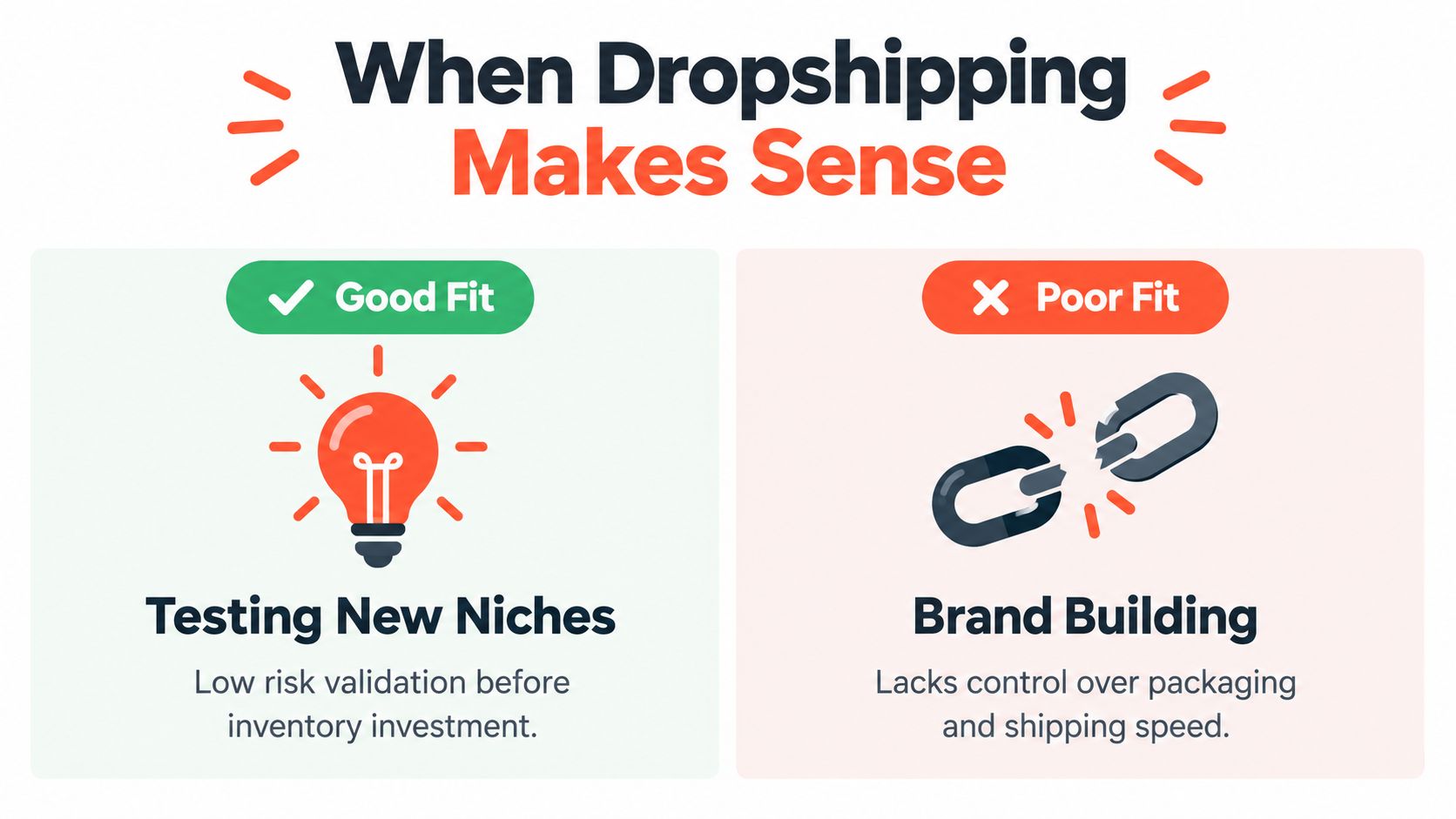
Dropshipping makes sense when the business needs information before it commits capital. It can be a practical way to test a product category, assess demand in a region, or extend an assortment without immediately purchasing every item. The model is especially useful when the product is difficult to store, expensive to handle, or uncertain enough that a warehouse commitment would be premature.
Good fits for the model
A founder testing a specialized home organization category can use dropshipping to learn which products attract qualified buyers before ordering stock. The founder should still sample the products, verify the delivery promise, and measure contribution margin. The purpose is not to build a permanent catalog immediately. It's to reduce uncertainty.
An existing retailer can use dropshipping for oversized products that would consume warehouse space or require specialized handling. A brand expanding into a distant market may also use a regional supplier to test local demand before establishing its own fulfillment arrangement.
Dropshipping can also support a hybrid catalog. Proven products can move into owned inventory, while experimental or long-tail items remain supplier fulfilled. That division gives the merchant better control where customer expectations are highest without eliminating assortment flexibility.
Poor fits for the model
The model is a weak fit when the brand promise depends on packaging, unboxing, product customization, or precise delivery control. It also struggles when products need inspection, complex bundling, strict compliance documentation, or consistent replenishment.
A premium skincare brand that promises a carefully managed customer experience may find generic supplier packaging and variable delivery unacceptable. A subscription business may face additional coordination problems because recurring orders depend on reliable inventory, predictable timing, and a consistent product experience. Merchants considering that route can review what a subscription model involves before combining recurring billing with supplier-dependent fulfillment.
Use three decision filters:
Margin tolerance: Can the product remain profitable after acquisition, shipping, fees, refunds, and support?
Experience control: Can the supplier consistently deliver the quality, packaging, and delivery promise the brand communicates?
Migration potential: If demand becomes repeatable, can the product move into regional or owned inventory without rebuilding the customer experience?
Dropshipping is a useful bridge when it produces better decisions. It becomes a ceiling when the merchant keeps using it after the business needs control the model can't provide.
Moving Beyond Dropshipping on Shopify
A migration away from dropshipping should begin with evidence, not frustration. The trigger is usually a pattern of repeatable demand combined with supplier-related costs, inconsistent delivery, weak packaging control, or contribution margin that no longer supports paid growth.
Set explicit migration thresholds around four questions:
Demand: Which products sell consistently enough to justify a purchasing commitment?
Margin: What does the order contribute after every variable cost, not just product and shipping?
Service: How often do delays, defects, stockouts, and refunds damage the customer experience?
Control: Which parts of the brand promise require owned inventory or a closer fulfillment relationship?
Move the operating system carefully
Start with clean Shopify data. Preserve product handles, variants, customer records, order history, discount logic, redirects, analytics events, and subscription relationships where applicable. A fulfillment change shouldn't create avoidable SEO losses or break the customer account experience.
Next, separate the catalog by fulfillment logic. Proven products may move to a warehouse or third-party logistics partner. Test products can remain dropshipped. Specialty products may need direct manufacturer fulfillment. Shopify should reflect those differences through inventory locations, shipping profiles, delivery promises, and customer-facing policies.
Reduce app sprawl during the transition. Every fulfillment, tracking, review, returns, and inventory app can add maintenance work and create conflicting data. Consolidate workflows where possible, then test order routing, cancellations, partial fulfillment, refunds, and stock updates before the new process handles live volume.
A headless build isn't automatically the answer, but brands with complex merchandising, regional experiences, or operational integrations may benefit from reviewing Shopify headless commerce as part of a broader architecture decision. The platform choice should follow the operating requirements, not the other way around.
The strongest migration plan runs both models with clear ownership during the transition. Document the supplier handoff, warehouse responsibilities, return addresses, customer support scripts, and escalation paths. Then monitor contribution margin, delivery performance, refund reasons, stock accuracy, and repeat purchase behavior after the change.
Presidio builds and supports Shopify storefronts, custom themes, apps, integrations, and migration programs for brands that need more control than a supplier-dependent model can provide. If dropshipping is limiting your margins or customer experience, visit Presidio to discuss a Shopify implementation and transition plan built around your operating requirements.

Jamie, Presidio’s Designer, leads the practice alongside Johnnie. With over 10 years of e-commerce experience, Jay is a Shopify expert, known for crafting innovative solutions that prevent tech debt.
Jaime
Senior Product Designer, 2020