Outrank AI

Product information is the most important factor in an online buying decision for 87% of shoppers, ranking ahead of price, shipping speed, and brand recognition, according to research on product description optimization. That makes a product description more than supporting copy. It's the salesperson who answers questions when your team is offline, the product specialist who explains compatibility, and the final reassurance a hesitant shopper reads before checkout.
The practical answer to how to write product description isn't “add more adjectives.” It's to identify the objection blocking the purchase, then make the product page resolve that objection with specific, scannable, credible information. On complex Shopify builds, that distinction matters. A premium jacket needs fit and care details, a supplement needs usage and compatibility guidance, and a subscription product needs clear expectations about what arrives and when.
Table of Contents
Why Product Descriptions Are Your Silent Salesperson
Product descriptions affect the sale before a shopper ever reaches the cart. If the copy explains what the product does, who it suits, how it feels, and what limitations apply, customers can make a confident decision without opening a chat window or searching another site.
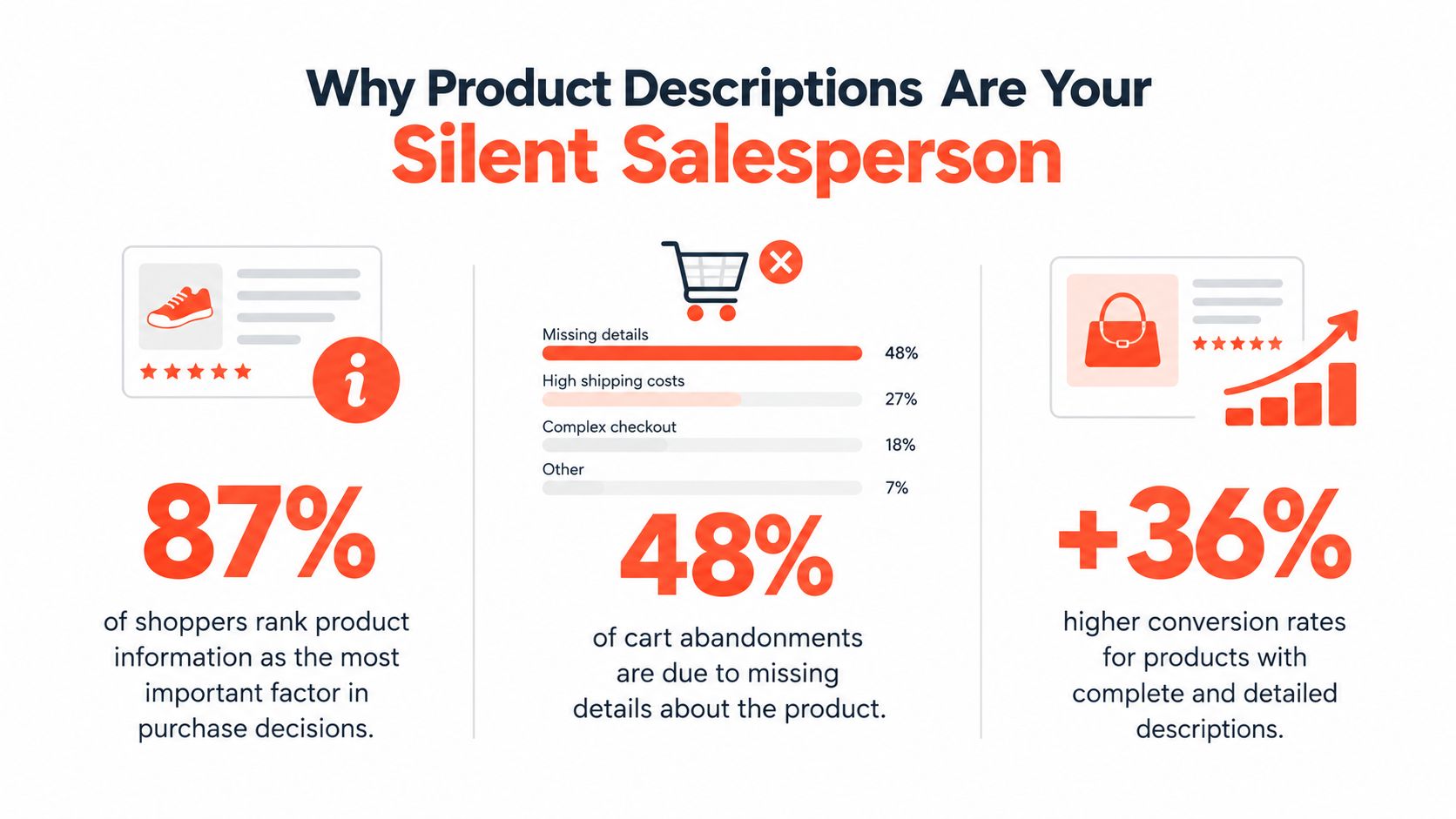
The operational cost of vague copy is just as important as the lost conversion. In the U.S., 24.5% of online purchases were returned in 2024, representing $890 billion, and inaccurate product information was associated with 23% of those returns, as reported in the same ecommerce product description statistics. A description that omits dimensions, materials, fit, or intended use can therefore create a sale that later becomes a return, with revenue and reverse-logistics costs attached.
Start with decision support, not decoration
A product page should answer the questions a store associate would handle in person:
Fit: How does it fit, and what measurements should the shopper compare?
Function: What does the product help the customer do?
Materials: What is it made from, and what does that mean in use?
Dimensions: Will it fit the customer's room, routine, device, or body?
Use case: Where, when, and for whom does it work best?
Those details don't make copy less persuasive. They give persuasive claims something concrete to rest on. “Premium quality” is difficult to evaluate. “Full-grain leather with a structured interior for daily card organization” gives the shopper a reason to believe the product fits a particular need.
Industry benchmark work also indicates that 90% of the largest ecommerce sites maintain a high level of quality and consistency in product descriptions, according to benchmark analysis from Envive. Detailed product content is now a category expectation, not a luxury reserved for flagship products.
Stores that replace manufacturer copy with unique, customer-focused descriptions have been reported to achieve conversion rates 2–3 times higher than stores relying on generic manufacturer content, as summarized in conversion-focused product description guidance. Treat that finding as a reason to test your own catalog, not as a guaranteed outcome. The right copy depends on product complexity, traffic quality, price, trust, and the objection standing between interest and checkout.
For a broader implementation view, merchants can pair content work with AI for ecommerce boost revenue, particularly when a large catalog needs consistent enrichment and review. The description still needs human validation, because no automation can safely invent missing specifications or infer compatibility.
Product content also belongs inside the wider conversion system. Page hierarchy, variant selection, merchandising, mobile behavior, and checkout friction can all change how effectively a description performs. A useful companion resource is this guide to Shopify conversion rate optimization, which places product-page copy within the full buying journey.
Understanding the Buyer Objection Before You Write
The first writing task isn't writing. It's finding the reason a qualified shopper hesitates.
A useful objection map starts with three questions:
What could go wrong after purchase?
What information would prevent that concern?
Where will the shopper look for the answer?
For a skincare product, the risk may be irritation or incompatibility with an existing routine. For apparel, it may be sizing, opacity, stretch, or how the garment looks on different body types. For outdoor equipment, durability and weather conditions may matter more than style. A subscription box introduces a different concern, namely whether the contents justify the commitment and how much control the customer has.
Build the map from customer language
Review support tickets, returns, product reviews, live-chat transcripts, search queries, and questions asked by sales staff. Don't summarize these inputs into vague themes such as “customers want quality.” Capture the actual uncertainty:
“Will this case fit a phone with a protective cover?”
“Can I wash this in a regular machine?”
“Is the shade suitable for cool undertones?”
“Does the replacement filter come with the device?”
“Will this work with my existing mount?”
Then separate functional objections from emotional objections. A functional objection asks whether the product will work. An emotional objection asks whether the purchase will feel worthwhile, flattering, safe, responsible, or aligned with the customer's identity.
The description should handle both, but not in the same sentence. Put the functional answer close to the relevant specification. Use the surrounding narrative, imagery, reviews, and use-case language to address the emotional side.
Practical rule: Every important feature should earn its place by answering a buyer question, reducing a perceived risk, or clarifying the product's best use.
Prioritize the objection with the highest cost
Not every question deserves equal prominence. Rank objections by how likely they are to stop checkout and how expensive the resulting mistake is. Fit and compatibility usually belong near the top because a wrong decision can lead to disappointment, support contacts, and returns. Care instructions may be decisive for a premium fabric. Delivery timing may matter more for a giftable product tied to an occasion.
Use a simple page brief before drafting:
Product detail | Likely objection | Copy response |
|---|---|---|
Dimensions | Will it fit my space? | State measurements and show what they mean in context |
Material | Will it feel or perform as expected? | Name the material and connect it to use |
Compatibility | Will it work with what I own? | List supported products and clear exclusions |
Care | Will maintenance be difficult? | Give specific cleaning or storage instructions |
Variants | Which option is right for me? | Explain differences, not just names |
For brands working on apparel discovery, apparel personalization strategies 2026 offers useful context on matching product presentation to shopper preferences. Personalization can improve relevance, but it shouldn't replace clear universal information. A recommendation engine may suggest the right product, yet the page still has to explain why the recommendation fits.
Transforming Features Into Customer-Centric Benefits
Feature-to-benefit writing works best when it stays close to the customer's situation. Start with the product's main job, then connect the attribute to the result the shopper wants.
A feature says, “Organic cotton fabric.” A benefit says, “Organic cotton fabric keeps the layer soft against your skin during long days.” The second version gives the material a role. It helps the reader decide whether the attribute matters.
Use the “so that” test
Write the feature, add “so that,” and finish the sentence in the customer's language.
Adjustable shoulder strap, so that the bag sits comfortably across different body types.
Removable filter, so that cleaning doesn't require replacing the entire unit.
Low-profile hinge, so that the cabinet door opens without colliding with the adjacent wall.
Stretch-woven fabric, so that the shorts move with you during training.
If the sentence produces a weak or redundant benefit, the feature may belong in the specifications rather than the opening copy. Technical details still matter, but shoppers shouldn't have to perform the interpretation themselves.

Lead with the decision
The first sentence should answer the product's primary question. For a wallet, that might be organization and durability. For a running shoe, it might be stability for a particular type of run. For a storage cabinet, it could be whether it fits a narrow hallway.
A useful opening has three parts:
Product identity, what it is.
Primary outcome, what it helps the buyer do.
Proof-bearing attribute, the feature that supports the outcome.
For example: “Keep daily essentials organized in a structured full-grain leather wallet designed to carry cards without losing its slim profile.” The sentence doesn't promise an abstract lifestyle transformation. It gives the shopper a clear product role and a tangible reason to continue reading.
Separate persuasion from verification
Use the opening paragraph to create relevance. Use bullets to make verification fast. Use a secondary section for edge cases, care, compatibility, and detailed usage.
A strong product block might look like this:
Hero sentence: One clear promise tied to the main objection.
Benefit paragraph: A short description of how the product fits into the customer's routine.
Specification bullets:
Material: State the actual material and relevant finish.
Fit: Explain measurements, cut, adjustability, or recommended sizing.
Use: Clarify the intended environment and activity.
Care: Give practical maintenance instructions.
Compatibility: Name supported systems and important exclusions.
Finish with a low-friction next step, such as checking the size guide, viewing the fit video, or selecting a compatible configuration. Research summarized in Square's product description guidance links concise, objective copywriting with 124% better usability, while unclear or incomplete product information was linked to 20% of unsuccessful online sales. The implication is practical: clarity isn't the opposite of conversion copy. It's part of it.
Structuring Copy for Scanning and Search Intent
Shoppers rarely read a product page from the first line to the last. They scan for the answer that matters to them, often moving through the page in an F-pattern. Search systems also need explicit language to understand what the product is, who it serves, and which questions it answers.
That calls for layered structure rather than one long paragraph.

Build the page in layers
Use this sequence as a flexible template:
Hero sentence: Identify the product and answer the primary objection.
Key features: Present the specifications shoppers need to verify.
Benefit blocks: Explain how the features affect use, comfort, performance, or care.
Search layer: Use natural product terms, meaningful subheadings, and descriptive copy.
Trust layer: Add reviews, demonstrations, guarantees, or other evidence available to the brand.
Bullets work especially well for measurements, included components, compatibility, and care. Paragraphs are better for explaining an experience or showing how a product fits into a routine. Don't force every detail into the same format.
Treat FAQs as product content
Question-and-answer blocks help shoppers who arrive with a specific concern. They also make the page's intent more explicit for question-based discovery. Recent ecommerce guidance recommends adding 3–10 FAQs based on real customer questions and page content, as discussed in product description guidance for conversions.
Write FAQs from actual evidence, not imaginary questions. Useful examples include:
Does this fit a standard under-seat travel space?
How should the fabric be washed?
Which devices are compatible with this accessory?
What comes in the box?
Can I use this product outdoors?
Is the finish likely to change with regular use?
Answer each question directly, then add the relevant limitation. “Yes” is not enough if compatibility depends on a model, version, measurement, or adapter.
Place the primary product phrase naturally in the title, hero copy, and an early supporting element when it fits the language customers use. Secondary terms should describe materials, use cases, sizes, and problems the product solves. Keyword repetition makes copy feel manufactured. Specificity creates relevance without stuffing.
For technical implementation and page-level search considerations, see this guide to SEO for product pages.
A short video can demonstrate what prose struggles to convey, particularly fit, movement, setup, or scale. The copy should tell shoppers what to watch for rather than merely embedding media.
Testing and Optimizing Your Product Descriptions
A polished description is a hypothesis about what information will help shoppers decide. Testing turns that hypothesis into evidence.
Baymard's desktop benchmark found that 90% of the top 60 ecommerce sites maintain a high, consistent level of product-description quality, while 10% fail to maintain that standard, according to Baymard's product description research. For a merchant, the message is straightforward. Thin, inconsistent copy stands out against the category norm.
Test by product complexity
Don't choose a universal word count for the catalog. A simple accessory may need concise copy and a strong specification list. A premium technical product may need deeper explanations, compatibility notes, and use-case guidance.
A practical testing range is:
Short: 100–150 words for simple, low-risk products.
Medium: 200–300 words for products with several meaningful objections.
Long: 400–500+ words for technical, premium, or high-consideration products.
These are test variants, not fixed rules. Baymard recommends comparing description lengths by product type, changing a subset of products for at least two weeks, and measuring conversion rate and revenue rather than relying on intuition, as detailed in its product description benchmark research. The test period should still account for traffic volume, promotions, seasonality, and other changes that could distort the result.
Keep the experiment clean
Change one meaningful variable at a time. If you replace the hero sentence, redesign the gallery, change the price presentation, and add reviews in the same release, you won't know what affected the outcome.
Track the metrics closest to the decision:
Add-to-cart rate: Indicates whether the page creates enough confidence to begin checkout.
Conversion rate: Shows whether the complete journey produces completed orders.
Revenue per session: Connects content performance to commercial value.
Return and support patterns: Reveal whether the copy set accurate expectations.
On Shopify, a test can use theme sections, controlled product groups, or a dedicated experimentation tool, provided the implementation preserves a clear control and variation. Document the original copy, change date, products included, and success metric. A useful overview of experimentation mechanics is this Shugert guide to CRO, while merchants can also review a practical framework for Shopify A/B testing.
Don't declare a winner because one variation looks better after a short burst of traffic. Check whether the result persists across devices, traffic sources, variants, and product types. A description that wins for a low-cost accessory may be the wrong pattern for a product with compatibility risk.
Your Product Description Writing Checklist
Use the checklist as a publishing gate, not as a prompt to add more copy. A description is ready when it makes the purchase decision easier, not when it reaches an arbitrary length.
Verify the decision logic
1. Research the objection.
Write down the main reason a qualified shopper might hesitate. Pull the wording from reviews, support tickets, returns, search queries, or conversations with customers.
2. Write a direct hero sentence.
The opening should identify the product and answer the most important question. Remove broad claims that don't help the reader decide.
3. Apply the “so that” test.
For each major feature, explain the customer result. If a feature has no meaningful consequence for the buyer, move it to a technical specification area.
4. Add the proof details.
Include materials, dimensions, care, fit, usage, included components, limitations, and compatibility where they affect confidence. Don't make shoppers search another page for information that determines whether the product will work.
Review the page experience
5. Format for scanning.
Use short paragraphs, descriptive micro-headings, and bullets for specifications. Make the first screen useful on mobile, where a shopper may only see the opening copy and a few key details before scrolling.
6. Add natural search language.
Use the product category, material, use case, and customer problem in language that sounds normal. Avoid repeating the same phrase where a precise synonym or clearer sentence would work better.
7. Answer real questions.
Add FAQ content when customers repeatedly ask about compatibility, care, sizing, setup, or use. Keep answers specific and disclose exclusions instead of hiding them.
8. Close with a friction-removing action.
A call to action can guide the next step without resorting to pressure. Invite the shopper to choose a size, compare variants, check compatibility, watch a demonstration, or add the product to the cart.
Before publishing, read the description beside the product images and variant selector. Ask whether the copy explains what the images cannot, whether the selected variant changes the answer, and whether a shopper could use the details to choose correctly without contacting support.
Finally, record the version. Note the objection addressed, the copy change, the affected products, and the metric you'll monitor. Product content should evolve when materials, packaging, variants, customer questions, and return reasons change. A description that was accurate at launch can become misleading after a product update.
The strongest product pages don't rely on clever phrasing alone. They connect customer uncertainty to product evidence, present that evidence in a scannable order, and improve through measured iteration. That's the practical standard for learning how to write product description copy that supports both discovery and checkout.
Presidio builds and supports Shopify and Shopify Plus storefronts, themes, apps, and conversion programs for brands that need product content to work within a maintainable commerce system. Visit Presidio to discuss product-page UX, CRO testing, personalization, or a Shopify implementation built for ongoing optimization.

Jamie, Presidio’s Designer, leads the practice alongside Johnnie. With over 10 years of e-commerce experience, Jay is a Shopify expert, known for crafting innovative solutions that prevent tech debt.
Jaime
Senior Product Designer, 2020