Presidio

An ecommerce website can cost anywhere from $0 for a basic DIY template launch to $250,000+ for a custom enterprise build. Most Shopify merchants should budget for recurring operating costs alongside the one-time build, because the launch invoice rarely represents the full first-year commitment.
That range isn't a contradiction. It reflects the difference between activating a template, configuring a straightforward catalog, and engineering a commerce system connected to ERP, fulfillment, subscriptions, analytics, and international operations.
The practical question isn't only, “What does it cost to build an ecommerce website?” It's “What will this store cost to launch, operate, maintain, and improve during its first year?” Platform subscriptions, apps, payment processing, support, content, shipping, and returns can change the economics quickly. A low upfront quote can become an expensive implementation when the store needs features the original scope excluded.
Table of Contents
What the Cost of an Ecommerce Website Looks Like in 2026
A 2026 industry guide places ecommerce website costs between $0 and $250,000+, depending on the platform, customization, and operational complexity (Shopify store development cost guide). Basic to mid-range builds sit around $0 to $5,000, small and medium business projects around $5,000 to $25,000, custom and mid-enterprise work around $25,000 to $80,000+, and complex enterprise implementations around $80,000 to $250,000+.
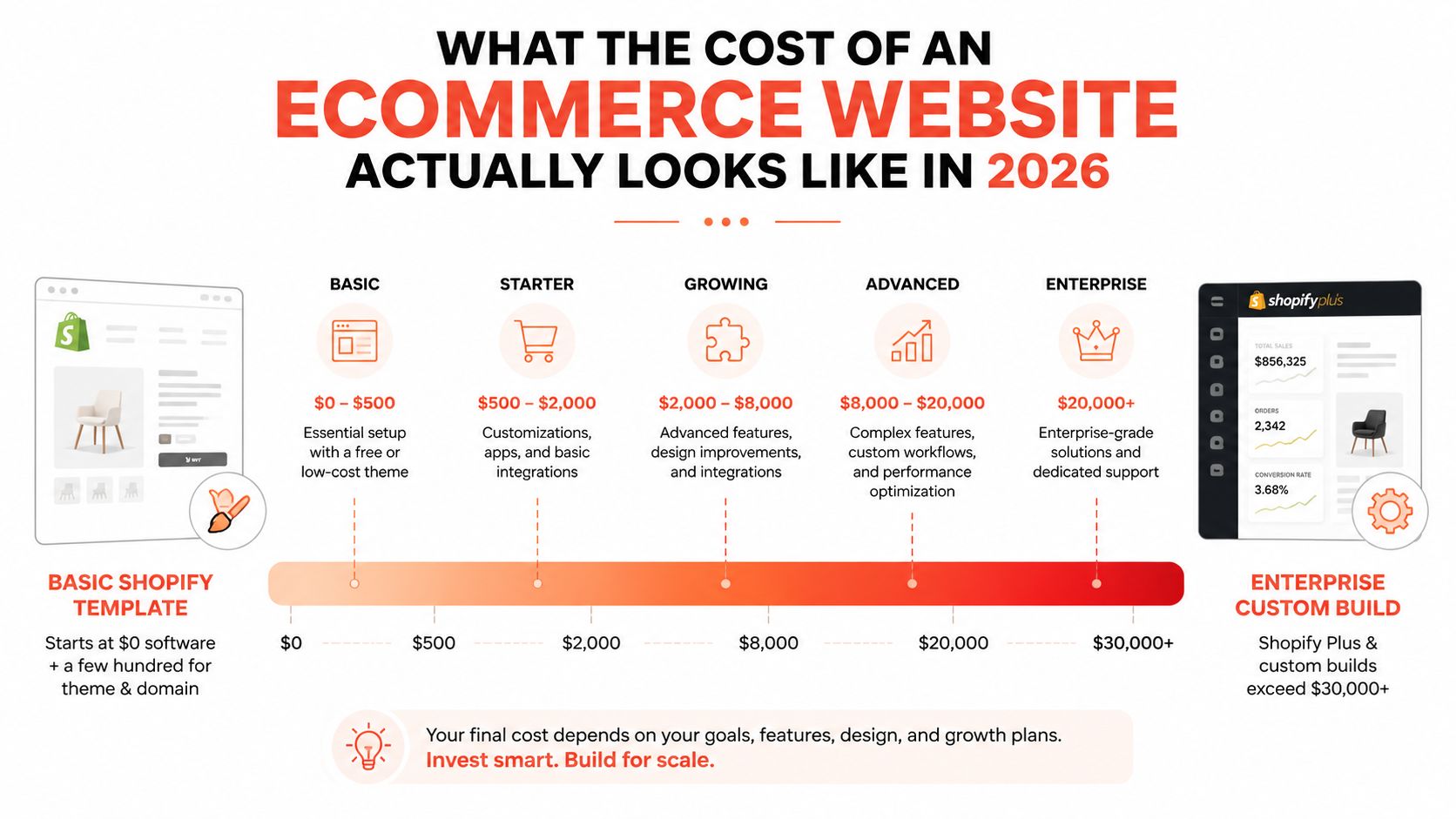
The build model sets the starting point. A store using a standard Shopify theme, a focused product catalog, and established apps has a very different cost profile from a Shopify Plus implementation with bespoke checkout requirements, multiple storefronts, migration work, ERP connectivity, and performance engineering.
The launch invoice is only one line
The first-year budget matters more than the build quote alone. BigCommerce cites professionally built Shopify stores at around $2,000 to $5,000 for development, with $1,200 to $3,600 in first-year recurring costs such as platform fees and apps (BigCommerce ecommerce cost analysis). Payment processing, shipping, returns, fulfillment, and ongoing support can add further operating spend.
Build the forecast in four layers:
One-time implementation: Design, theme setup, development, migration, integrations, and content preparation.
Recurring platform operations: Shopify, apps, email tools, search, analytics, and other software.
Transaction and logistics costs: Payment processing, shipping, returns, fraud tools, and fulfillment operations.
Post-launch investment: Maintenance, conversion work, merchandising, SEO, and new features.
A lean build is often the right choice when the catalog and workflows are straightforward. Approve the project only when the team can explain the store's first-year cost without relying on “we'll add that later.”
The Main Cost Drivers Behind Every Ecommerce Build
The largest ecommerce budgets usually come from scope, not from the Shopify subscription itself. A theme can provide the visual foundation, but teams still pay for the decisions and systems layered on top of it.
Design and UX range from light template customization to a fully defined design system and custom storefront. The price rises when the brand needs unusual merchandising, complex navigation, mobile-specific interactions, or extensive product storytelling. Theme licensing may be free or involve a one-time premium purchase, but the license doesn't include implementation, content entry, responsive QA, or conversion refinement.
Custom development becomes the next major variable. Checkout extensibility, subscription logic, B2B pricing, product configurators, bundle rules, and account experiences each require discovery, implementation, testing, and maintenance. Developer selection also affects the quote. Teams comparing nearshore and other delivery models can use Virtustant's 2026 nearshore rate report as a reference point when evaluating labor-market assumptions.
Integrations create work on both sides
An app installation is rarely the complete integration. The team must map data, define ownership, handle failure states, test webhooks, and confirm that staff can operate the resulting workflow.
Common integration categories include:
Customer and marketing systems: Email, SMS, reviews, loyalty, personalization, and analytics.
Operational systems: ERP, CRM, PIM, OMS, warehouse, and 3PL connections.
Merchandising features: Search, filtering, subscriptions, bundles, recommendations, and promotions.
Content and assets: Product photography, copy, video, translations, and structured metadata.
Platform costs also compound. Shopify bundles hosting into its plans, but the business still pays for the subscription, app licenses, payment processing, and operational services. Content is another frequent omission. A technically complete store can still miss its launch date if product images, descriptions, variant data, policies, and collection merchandising aren't ready.
The right proposal separates build cost, recurring cost, and excluded operational work. Without that separation, buyers compare a configuration quote with a custom engineering quote and assume the cheaper number represents the same deliverable.
Ecommerce Website Cost Tiers From DIY to Enterprise
The following tiers are useful for orientation, not as promises. The right tier depends on catalog complexity, customer journey, operational systems, and the amount of custom behavior the store must support.
Tier | Build Cost | Monthly Operating Cost | Timeline | Best For |
|---|---|---|---|---|
DIY | $0–$500 | Low, variable | Short | Hobby stores, experiments, and test concepts |
Template Launch | $1,500–$5,000 | Low to moderate | Short | Starter brands with straightforward catalogs |
Small Business Build | $8,000–$25,000 | Moderate | Several weeks | DTC brands needing a customized Online Store 2.0 theme |
Custom Mid-Market Build | $30,000–$80,000 | Moderate to high | Several weeks to several months | Brands requiring subscriptions, B2B logic, ERP, or CRM connections |
Enterprise or Plus Migration | $100,000–$250,000+ | High to substantial | Several months or more | Multi-store operations, complex migrations, and composable architectures |
The first tier works when the owner can configure the theme, prepare the catalog, install only essential apps, and accept limited differentiation. It doesn't work when the business needs custom account behavior, complex pricing, or coordinated operations from launch.
A template launch offers a sensible middle path. The brand buys speed and a proven storefront structure, then spends selectively on navigation, product templates, collection layouts, and content. This approach keeps risk contained while leaving room to learn which customer journeys deserve deeper investment.
The upper tiers justify themselves through operational complexity, not visual ambition alone. A custom front end connected to ERP, CRM, PIM, and fulfillment systems requires architecture, data mapping, testing, and ownership rules. Enterprise buyers should also budget for migration rehearsal, launch monitoring, rollback planning, and post-launch stabilization.
The cost spectrum shows why an agency quote without a clear scope is nearly meaningless. Ask what tier the proposal represents, which recurring services it assumes, and what happens when the catalog, markets, or integrations expand.
Design, Themes, and Custom Development
Design, theme choice, and development should be treated as one decision. Paying for a custom visual system while forcing it into a theme's constraints creates rework. Buying an expensive theme and then rebuilding its core templates produces a similar mismatch.
A free or paid Shopify theme is often enough for a focused catalog, straightforward product pages, standard promotions, and conventional checkout requirements. A premium theme can provide stronger merchandising sections, filtering patterns, promotional components, and responsive behavior without funding every element from scratch.
Where a theme stops being enough
Custom work starts to make sense when the storefront must express a distinctive buying journey or support rules that the theme doesn't handle cleanly. Signals include multilingual storefronts, B2B pricing tiers, subscription journeys, complex product configuration, unusual bundling, and custom checkout logic.
Before commissioning custom design, document the customer tasks that the theme must support. “Make it feel premium” is difficult to estimate. “Let shoppers compare compatible products, select a configuration, and preserve that selection through cart” gives a development team something testable.
Tier | Theme Cost | Custom Design | Custom Development |
|---|---|---|---|
Standard foundation | Free or low | Minimal brand application | Configuration and light edits |
Premium theme | One-time premium license | Theme sections and styling | Selective template enhancements |
Customized theme | Existing theme foundation | Wireframes, components, and custom sections | Feature-specific Liquid and app work |
Bespoke storefront | Custom architecture | Full design system and UX | Extensive theme, app, or headless engineering |
Developer pricing varies by capability, location, and delivery model. The quote should identify the work units, acceptance criteria, browser and device testing, and ownership of future changes. For a deeper look at the decision, review custom Shopify theme development.
The common mistake is customizing before validating the product and merchandising model. Start with the pages that influence purchase confidence, search, navigation, cart, and checkout. Add bespoke behavior only when it solves a defined customer or operational problem.
Shopify Plans, Hosting, Apps, and Integrations
Recurring software is the operating layer most build comparisons leave out. Shopify's own plan pricing lists Basic at $39 per month, Shopify at $105 per month, Advanced at $399 per month, and Shopify Plus starting around $2,300 per month (Shopify pricing information). These subscriptions cover the hosted commerce foundation, but they don't eliminate app, integration, payment, support, or operational decisions.
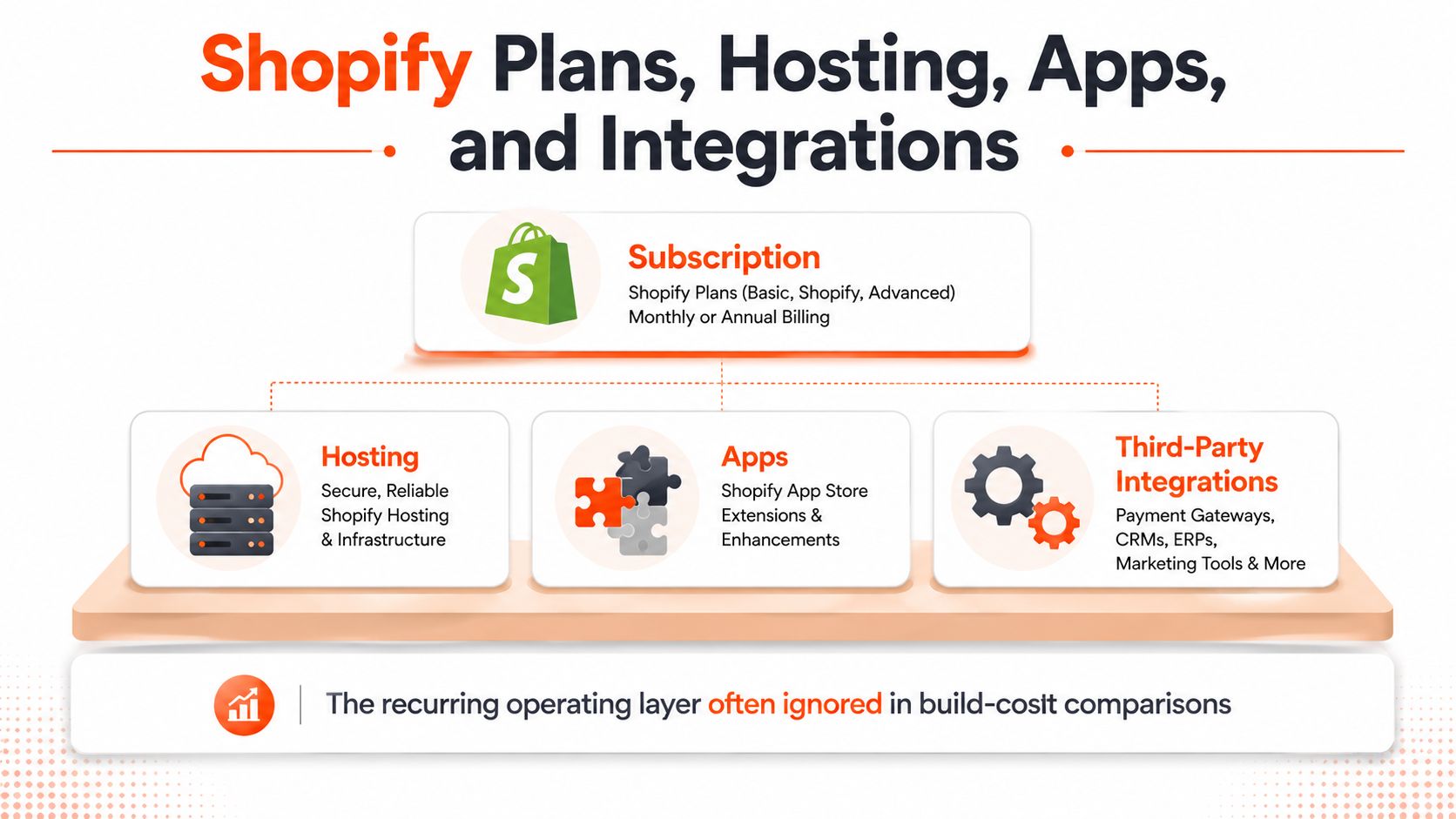
Hosting is bundled, which removes much of the server administration associated with self-hosted platforms. Businesses may still pay for supporting services such as image optimization, email delivery, analytics, domains, and other technical tooling. The key question is not whether an app is affordable in isolation. It's whether the app adds enough value to justify its subscription, performance impact, data permissions, and maintenance burden.
Audit the app stack before approving it
A mid-size DTC stack commonly contains tools for reviews, subscriptions, upsells, search, email or SMS, analytics, shipping, and fraud prevention. Recurring Shopify app costs for a mid-size DTC stack are benchmarked around $200 to $800 per month in one 2026 analysis, while platform fees can range from $39 to $399+ per month (First Pier Shopify development cost benchmark).
Use an integration register with five fields:
Purpose: Which customer or operational problem does the tool solve?
Owner: Who maintains settings, templates, and credentials?
Data: What enters the app, and where does the output go?
Failure mode: What happens if the app is unavailable?
Exit plan: Can the store replace it without rebuilding the storefront?
Brands using visual product content or AI-assisted merchandising can also evaluate tools such as AI model outfit ecommerce, provided the workflow fits their content standards and approval process. For operational connectivity, document the data contract before development begins. Shopify ERP integration planning is a useful reference for that exercise.
Ongoing Maintenance and Optimization Costs
Launch day creates a maintenance obligation. Shopify stores change whenever an app updates, a theme is edited, a product model expands, a promotion launches, or an integration changes its data behavior.
Technical maintenance includes theme and app compatibility checks, checkout audits, broken-link reviews, bug fixes, accessibility checks, and performance monitoring. Content and conversion work covers product detail page updates, landing pages, merchandising, experimentation, and seasonal changes. Growth optimization adds SEO hygiene, analytics review, and structured conversion research.
Maintenance Type | Low | High | Typical |
|---|---|---|---|
Technical maintenance | $200/month | $800/month | Scheduled audits and support |
Content and conversion | $500/month | $2,500/month | Ongoing merchandising and testing |
Combined annual upkeep | 10% of build cost | 20% of build cost | Useful planning reserve |
The 10% to 20% annual maintenance rule is a practical budgeting guideline cited in ecommerce cost planning, not a platform fee (Shopify ecommerce development cost guidance). A lean store may need less hands-on support in a quiet period, while a heavily integrated operation may need a standing development allocation.
A store doesn't stay finished. It either receives controlled improvements, or its owners eventually pay for accumulated neglect.
Skipping maintenance tends to create compound problems. Merchants discover broken templates during campaigns, staff work around unreliable integrations, and shoppers encounter slower or less coherent journeys. Reserve budget for both stability work and commercial improvement, because fixing defects and improving conversion require different skills and schedules.
For technical performance work, a dedicated Shopify speed optimization service can help separate measurement, diagnosis, and implementation rather than treating speed as a one-time launch checkbox.
A Simple Budgeting and Calculation Framework
Use a first-year model that makes every assumption visible:
Total Year-One Budget = One-Time Build Cost + (Monthly Platform, Apps, and Operating Costs × 12) + Maintenance Reserve + Growth Reserve
The framework has three practical inputs:
One-time build cost: Add design, theme work, development, migration, integrations, content production, and launch testing.
Recurring operating cost: Add the Shopify plan, app subscriptions, support retainers, and estimated transaction-related costs. Use actual app quotes where possible, rather than a generic allowance.
Reserves: Set aside maintenance and growth funds for technical fixes, conversion work, new landing pages, merchandising, and feature changes.
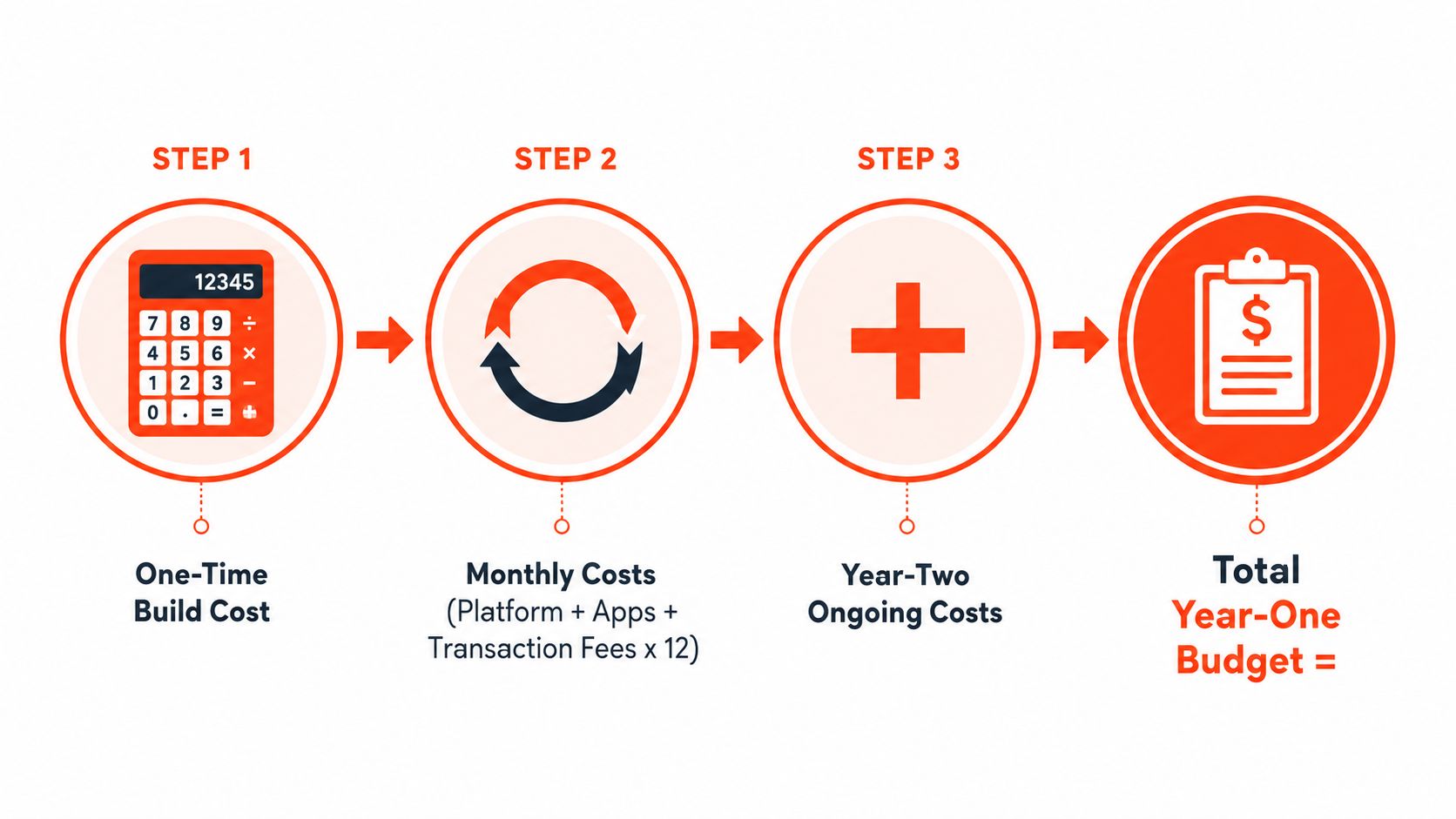
A worked planning example can use a $12,000 build, $450 per month in operating costs, an 18% maintenance reserve, and a 10% growth reserve. The arithmetic produces a first-year planning figure of roughly $24,000, before any unlisted marketing or logistics expense. The inputs are illustrative, so replace them with the figures in your proposals and app accounts.
Keep the model in one spreadsheet. Give each line an owner, billing frequency, start date, renewal date, and cancellation condition. Separate estimates from confirmed costs, then update the sheet during discovery.
This process exposes scope creep early. If a new integration adds development work and a recurring subscription, both effects belong in the model. A proposal that looks competitive at launch can become less attractive once its missing operating layers are included.
Hidden Operating Costs Most Buyers Underestimate
A build quote covers the storefront, not the cost of running each order. Payment processing can take a percentage of every sale plus a fixed fee, with the exact amount determined by the Shopify plan, payment provider, and market. Treat those charges as a first-year operating line, not a launch detail.
International selling adds more variable expense. Payment processing may be higher in some markets, while shipping and returns can consume a meaningful share of monthly turnover, according to the UpCounting Shopify startup cost analysis. These charges reduce margin even when they never appear on a development proposal.
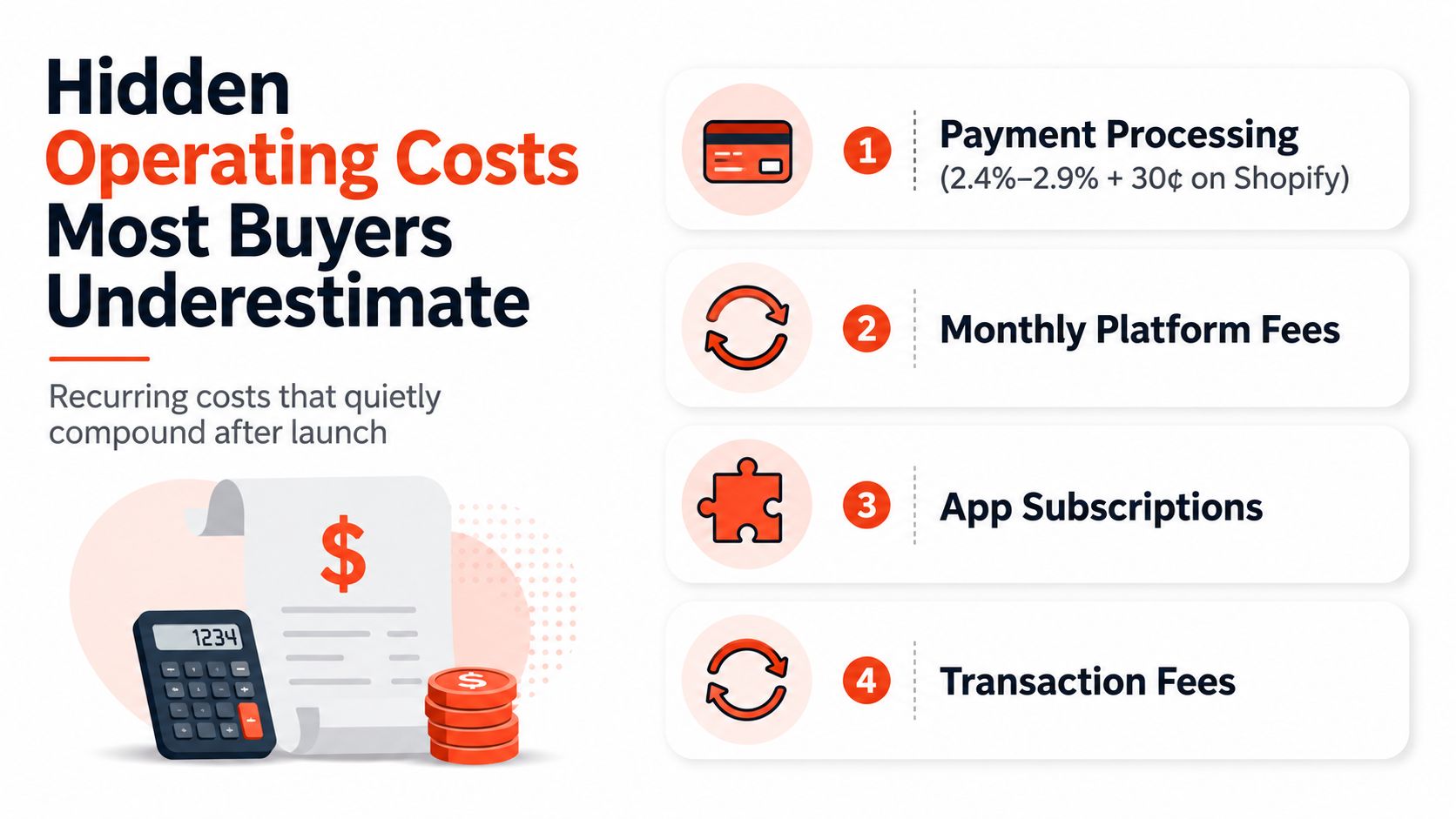
Before signing, ask the agency to identify:
Payment costs: Provider fees, plan-based transaction charges, currency conversion, and fraud tooling.
Fulfillment costs: Shipping labels, packaging, warehouse or 3PL charges, and delivery exceptions.
Returns: Reverse logistics, inspection, restocking, refunds, and customer service handling.
Software growth: Usage-based email, search, reviews, subscriptions, attribution, and personalization fees.
Compliance and operations: Tax, privacy, accessibility, regional content, and internal training.
Separate costs that scale with revenue from those that stay relatively fixed. Payment, fulfillment, returns, and usage-based software rise with order activity. Platform subscriptions and some apps may remain within a plan band until usage, features, or order volume changes. Model both categories across the first year, because a low build price can hide a much higher operating commitment.
Two Sample Budgets for Real Shopify Builds
A budget becomes easier to test when each line maps to a real delivery choice. The examples below are planning scenarios, not reported client results. They show how a lean launch and a migration can sit in very different first-year categories.
The lean DTC scenario uses a Shopify Basic setup, a premium theme priced at $180, theme customization and product setup at $2,500, launch apps at $1,200, and operating costs of roughly $250 per month. Its planning total is about $7,000 for the first year, before variable marketing, shipping, and returns costs.
The Plus migration assumes $40,000 for custom design and checkout extensibility, $15,000 for ERP and 3PL integrations, $5,000 for data migration, and $1,800 per month in operating costs. That model lands north of $85,000 in the first year, before costs that depend on order volume and market coverage.
Line Item | Lean DTC Launch | Shopify Plus Migration |
|---|---|---|
Platform foundation | Shopify Basic | Shopify Plus |
Theme or storefront | $180 premium theme | Custom storefront work |
Design and development | $2,500 | $40,000 |
Integrations | Included in limited setup | $15,000 ERP and 3PL work |
Data migration | Limited catalog preparation | $5,000 |
Launch apps | $1,200 | Included in broader operating stack |
Monthly operating costs | About $250 | About $1,800 |
Approximate first-year planning total | About $7,000 | More than $85,000 |
The lean scenario works because it limits custom behavior and keeps the app stack focused. The migration costs more because the team is buying continuity, integration depth, data accuracy, and a platform capable of supporting a more complex operating model.
Don't compare these budgets by storefront appearance. Compare them by risk, systems, data, and post-launch responsibility.
Quick Reference Checklist Before You Request Quotes
Give developers a written brief before requesting estimates. It reduces ambiguity and lets each vendor price the same work.
List the catalog size, variants, bundles, subscriptions, and product data quality.
Describe required markets, languages, currencies, domains, and regional storefront rules.
Collect reference stores and identify the interactions your team wants to preserve.
Separate must-have features from post-launch experiments.
Name every required system, including ERP, CRM, PIM, OMS, 3PL, email service provider, reviews, tax, and analytics.
Document inventory locations, fulfillment rules, shipping methods, and returns handling.
State payment methods, customer account requirements, B2B pricing, and checkout constraints.
Provide migration sources, data formats, redirects, customer records, order history, and product assets.
Set the launch date, internal approvers, content owners, and technical contacts.
Request separate pricing for build, recurring tools, support, change requests, and optimization.

The more precise the brief, the less room an agency has to pad an estimate for unknown scope. It also gives you a better basis for comparing delivery assumptions, exclusions, testing, and ownership.
Frequently Asked Questions About Ecommerce Website Cost
What is the minimum budget for a serious Shopify launch?
A serious launch includes accurate product content, a usable theme, payment setup, required apps, testing, and operating reserves. The platform subscription is only one line item. First-year planning should also include app fees, payment processing, fulfillment, and support.
How long does a typical build take?
A simple configuration can move quickly. Custom design, migration, integrations, subscriptions, B2B rules, and approval cycles extend the schedule. Request milestones for catalog readiness, design approval, development, testing, and launch support instead of relying on one broad date.
Is Shopify cheaper than custom WooCommerce at scale?
Neither platform is automatically cheaper. Shopify can reduce infrastructure administration, while WooCommerce offers more control over code and hosting. Compare development, security, maintenance, integrations, and internal technical ownership across the full lifecycle.
Should payment processing count as website cost?
Yes. It is usually a variable operating expense rather than a build fee, but every completed order can create a processing cost. Include it in the first-year model alongside shipping, fulfillment, and other order-related expenses.
Can AI tools eliminate launch costs?
AI can assist with product content, merchandising, and image workflows. It does not replace brand review, data quality checks, accessibility checks, user experience decisions, or integration testing. Use it to reduce manual work, not to remove launch controls.
What should happen after launch?
Set aside budget for stability, content updates, conversion work, and new functionality. Apps, campaigns, catalog changes, and customer expectations continue after launch, so an unattended store will gradually fall behind.
Presidio builds and supports Shopify and Shopify Plus storefronts, custom themes, apps, integrations, migrations, and ongoing optimization programs. If you are budgeting a new build or reviewing an existing store's first-year cost, visit Presidio with your catalog, systems, and growth requirements ready for a practical scope discussion.

Jamie, Presidio’s Designer, leads the practice alongside Johnnie. With over 10 years of e-commerce experience, Jay is a Shopify expert, known for crafting innovative solutions that prevent tech debt.
Jaime
Senior Product Designer, 2020