Outrank AI

A wholesale operator usually notices the problem before the buyer does. Sales representatives copy orders from email into an ERP, finance maintains a separate pricing spreadsheet, and the storefront shows the same catalog to every account. Buyers who should be reordering in minutes still ask for quotes, availability, and product specifications by email.
That's the point where an ecommerce agency B2B engagement becomes more than a website project. The right partner connects commercial rules, customer accounts, product data, sales workflows, and self-service purchasing into one system. The wrong one delivers a polished storefront that adds another layer of maintenance.
Table of Contents
Why B2B Brands Hire an Ecommerce Agency
A manufacturer or distributor rarely hires an agency because it needs attractive product pages. It hires one because the existing buying process has become expensive to operate. A sales rep checks a customer's contract price, confirms inventory in another system, creates a quote, waits for approval, and then rekeys the approved order. Meanwhile, the buyer sees incomplete information in the portal and calls support.
B2B commerce has reached a scale where these problems affect core operations, not just marketing. UNCTAD's 2024 ecommerce data reports nearly $28 trillion in business ecommerce sales across 46 developed and developing economies, representing roughly three-quarters of global GDP. The measure includes manufacturing, wholesale, services, and other business transactions, so it reflects a broad digital operating environment rather than only online retail.
The problem is usually organizational
An internal marketing team can manage campaigns and page content. It may not have the specialist capacity to model company hierarchies, reconcile ERP data, implement contract pricing, secure APIs, and design an approval workflow that sales will use. An agency brings those disciplines together, but only if its team understands wholesale operations rather than treating B2B as a consumer store with a login screen.
The first questions should be operational:
Who owns customer data? Decide which system is authoritative for accounts, contacts, tax details, and payment terms.
Where does pricing come from? Identify whether prices are stored by customer, segment, contract, quantity, region, or sales agreement.
Which orders should be self-service? Separate repeat purchases from configured, negotiated, or high-risk orders.
What must sales still control? Define the points where a representative approves, modifies, or takes over a transaction.
Practical rule: If the agency can't explain how an order moves from product selection to fulfillment, it probably understands storefronts better than B2B commerce.
Platform selection still matters, especially when comparing Shopify Plus, BigCommerce, Adobe Commerce, or a headless stack. For a broader view of platform trade-offs in a regional market, the NZ ecommerce platform showdown is a useful starting point. Equally, the implementation must support the buying model. The B2B ecommerce best practices guide is useful for pressure-testing requirements before vendors turn them into a feature list.
What a B2B Ecommerce Agency Delivers
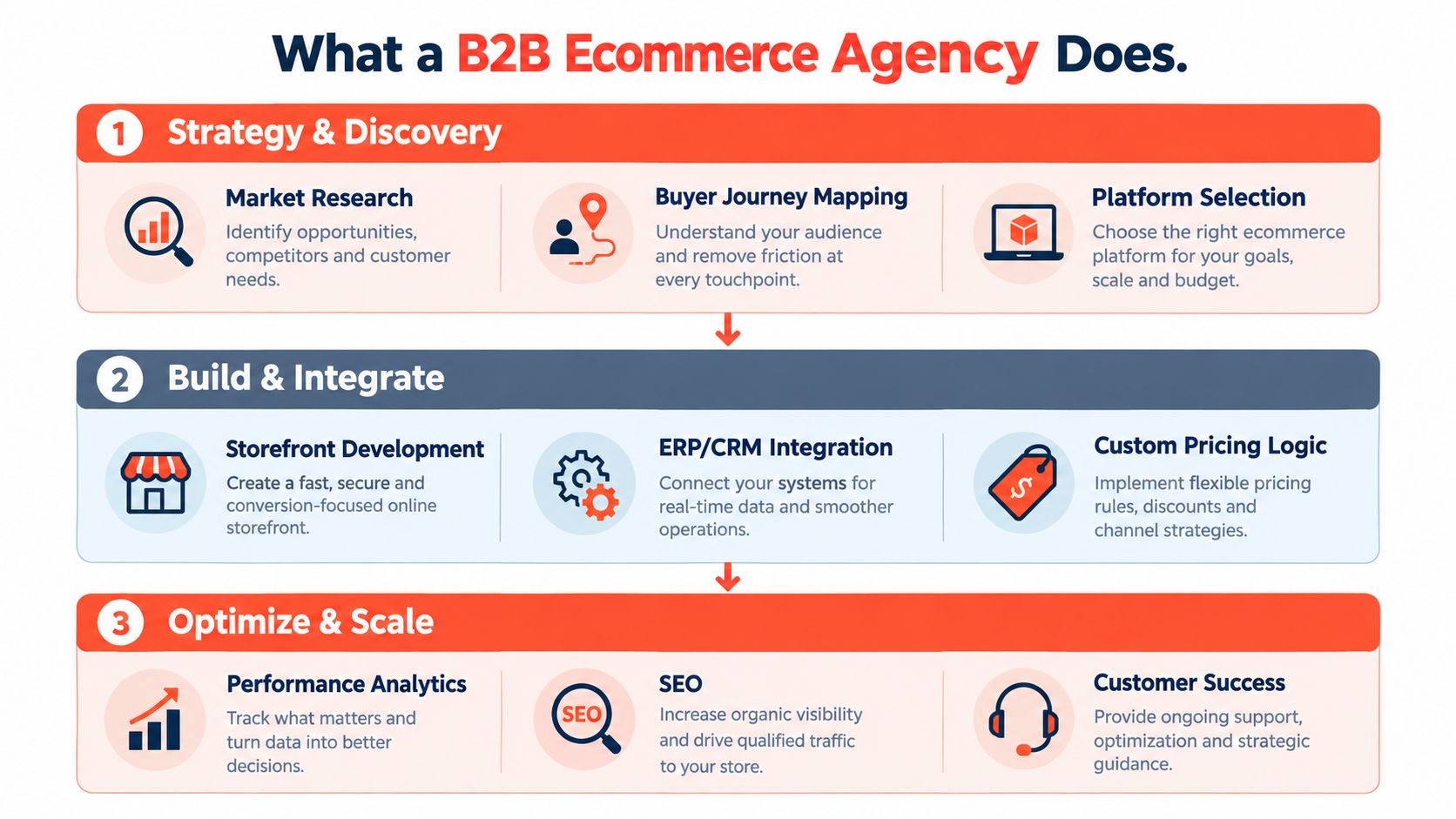
A credible B2B ecommerce agency designs and operates systems across the full lifecycle: strategy and discovery, build and integration, and optimization after launch. The storefront is only one part of the work. The larger responsibility is creating a self-service buying system that can support customers, sales teams, operations, and finance over its full five-year cost of ownership.
Strategy and discovery
The agency documents buyer journeys, commercial rules, data ownership, and operational constraints. Interviews should include sales, customer service, finance, operations, and the people responsible for the ERP. A workshop limited to marketing will miss the rules that determine whether customers can buy without representative assistance.
The discovery output should specify:
a canonical product and customer data model
account roles and permissions
pricing, quotes, approvals, and payment terms
integrations, data direction, and failure handling
native, custom, or headless functionality
ownership of maintenance and future changes
Platform selection belongs inside this work. Shopify Plus can suit a brand seeking managed infrastructure and a strong commerce foundation. A headless implementation can support unusual experience requirements, while creating more frontend and integration ownership. The agency should explain the five-year maintenance implications, including custom development, app subscriptions, hosting, monitoring, and internal support.
Build and integrate
Designers, Shopify developers, solution architects, and integration specialists turn the agreed rules into authenticated storefront experiences. Typical work includes company accounts, buyer permissions, customer-specific catalogs, contract pricing, quote-to-order flows, reorder tools, inventory visibility, and ERP or CRM synchronization.
The build should reduce routine dependence on sales representatives. Repeat orders and straightforward account purchases can move through self-service, while negotiated, configured, or higher-risk orders can retain human review. That division affects both the customer experience and the cost of operating the channel.
Clients still own commercial decisions. An agency can implement a pricing model, but leadership must approve discount rules. It can connect an ERP, but operations must define the response when inventory or order data fails to synchronize.
Optimize and scale
Launch begins the operating phase. A serious partner monitors search behavior, task completion, reorder friction, page performance, accessibility, support demand, and assisted versus unassisted purchasing. It should also document who maintains custom code, integrations, app subscriptions, and automation rules.
That ownership model belongs in the proposal. If it remains vague, the client may keep paying for repeated explanations whenever a product rule, integration, or customer workflow changes.
How B2B Ecommerce Differs From B2C
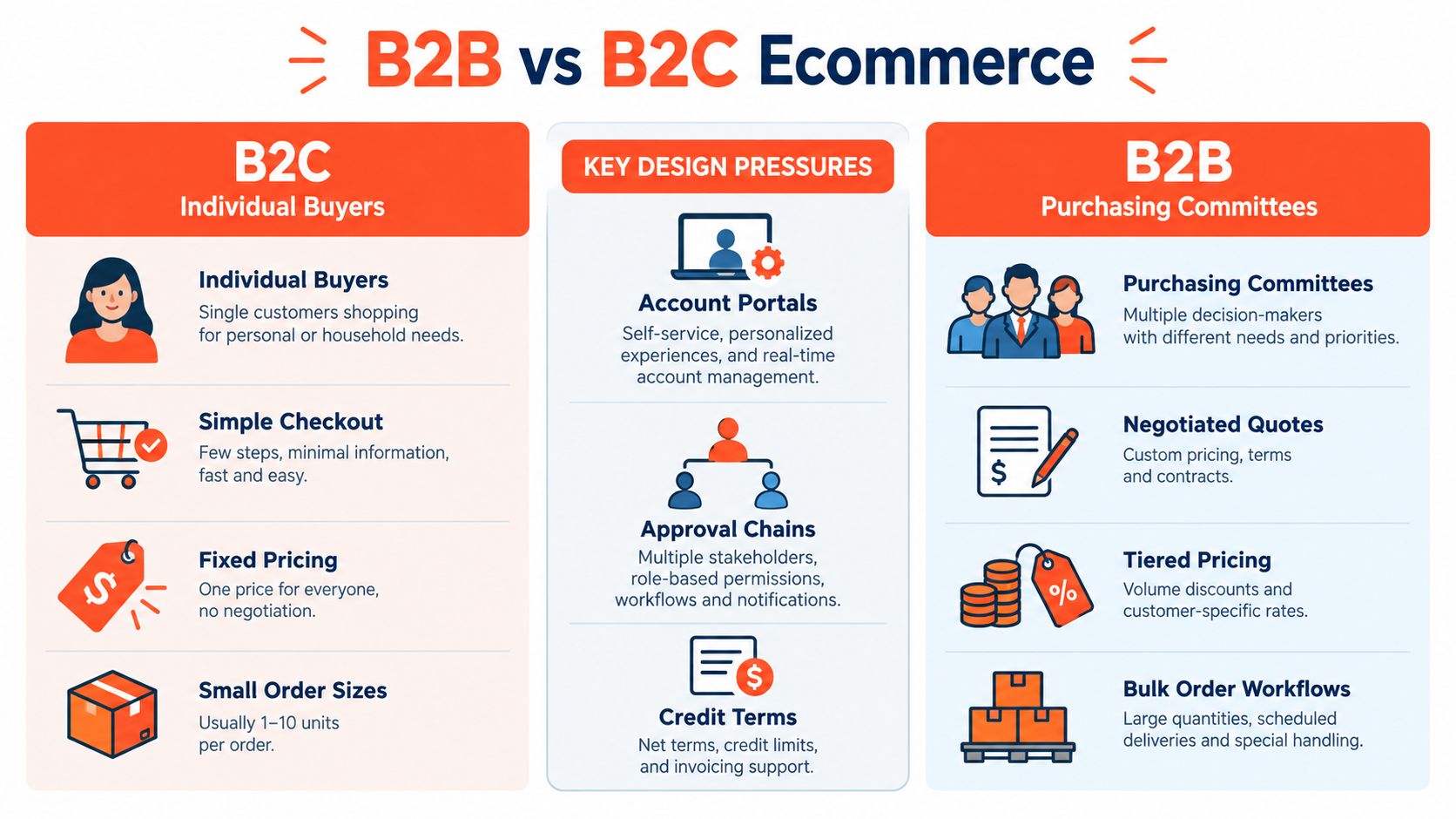
B2C commerce generally serves an individual who can browse, pay, and receive an order without involving another system of authority. B2B commerce serves a company, often through several people, under commercial rules that vary by account. The storefront therefore becomes an operating interface for procurement, sales, finance, and fulfillment.
The same catalog doesn't mean the same offer
A consumer catalog may show one price and one availability message. A B2B catalog may need to show different products, packaging units, minimum quantities, lead times, and prices depending on the account. A buyer might be allowed to reorder certain products but require approval for others.
That changes the data model. Customer identity can't stop at an email address. The system may need a company, locations, departments, buyers, approvers, purchasing limits, tax details, payment terms, and sales ownership. A simple customer login is not the same as an account portal.
Checkout is often a workflow
In B2C, checkout typically concludes the journey. In B2B, it may create a quote, trigger approval, reserve inventory, or submit an order on credit terms. A sales representative may need visibility without manually recreating the order.
The experience must support both self-service and assistance. McKinsey's 2024 B2B Pulse Survey covered 3,942 decision-makers across the United States and 12 other countries. It found that 71% of B2B organizations offer ecommerce, while ecommerce represents 34% of revenue for a typical organization. The same research describes revenue distributed across self-service, remote sales interactions, and in-person selling.
High-value buying requires confidence
The survey also found that 39% of B2B buyers were willing to spend more than $500,000 through self-service digital commerce or remote online interactions in 2024, compared with 28% two years earlier. 20% were willing to spend more than $1 million, compared with 15% two years earlier, as reported in this coverage of the findings.
Those buyers don't need a consumer-style animation. They need reliable specifications, account pricing, stock information, delivery commitments, permissions, and a clear path to a person when the purchase becomes complicated. That's why B2B isn't a harder B2C build. It's a different coordination problem.
Core Services a B2B Agency Should Provide
A proposal should describe decisions and ownership, not just list deliverables. The following categories are useful because each exposes a different implementation risk.
Platform and experience architecture
The agency should compare Shopify Plus, other packaged platforms, and headless options against the actual operating model. Native features can reduce custom maintenance, while headless architecture can provide more control over complex experiences. The trade-off is not “flexibility versus simplicity” in the abstract. It's whether the client can support the resulting code, integrations, testing, and release process.
Integrations and data movement
ERP, CRM, warehouse, payment, tax, search, and customer service systems need defined contracts. Ask which system owns each field, how often data moves, how failures are surfaced, and who resolves conflicts. An integration that works in a demo but drops an inventory update is not a successful integration.
The systems integration services resource offers useful context for evaluating this part of a proposal. Pressure-test whether the agency has included monitoring, retries, logging, permissions, and a process for API changes.
Custom commerce rules
Quote-to-order, subscriptions, bundles, quantity breaks, customer-specific discounts, and approval chains often need a mixture of platform configuration and custom development. The agency should show where each rule lives. If pricing logic is scattered across theme code, apps, and ERP scripts, future changes become slow and risky.
Accounts and onboarding
A good account experience lets a company invite users, assign roles, manage locations, view order history, save lists, reorder, and request help. New buyers need a clear registration and approval path. Existing buyers need confidence that their price list, payment terms, and eligible products are correct immediately after login.
Optimization after launch
CRO for B2B measures task completion as well as checkout conversion. Search success, product-specification discovery, quote completion, reorder success, support deflection, and authenticated performance reveal more than a public landing-page report. Accessibility and page speed also belong in the operating plan because procurement teams need usable tools across devices and working environments.
Service Area | Key Decisions | What to Pressure-Test |
|---|---|---|
Platform architecture | Native features, custom work, or headless | Who owns maintenance and releases? |
Data and integrations | System of record and synchronization rules | How are errors monitored and resolved? |
Pricing and ordering | Contracts, quotes, approvals, and discounts | Can commercial teams change rules safely? |
Accounts and permissions | Company structure, roles, and buyer access | Can the model support real purchasing authority? |
Optimization | UX, performance, SEO, accessibility, and testing | Which metrics guide post-launch decisions? |
How to Evaluate a B2B Ecommerce Agency
A beautiful portfolio proves that an agency can produce a beautiful portfolio. It doesn't prove that the team can reconcile an ERP, model account-specific pricing, or support sales-assisted ordering.
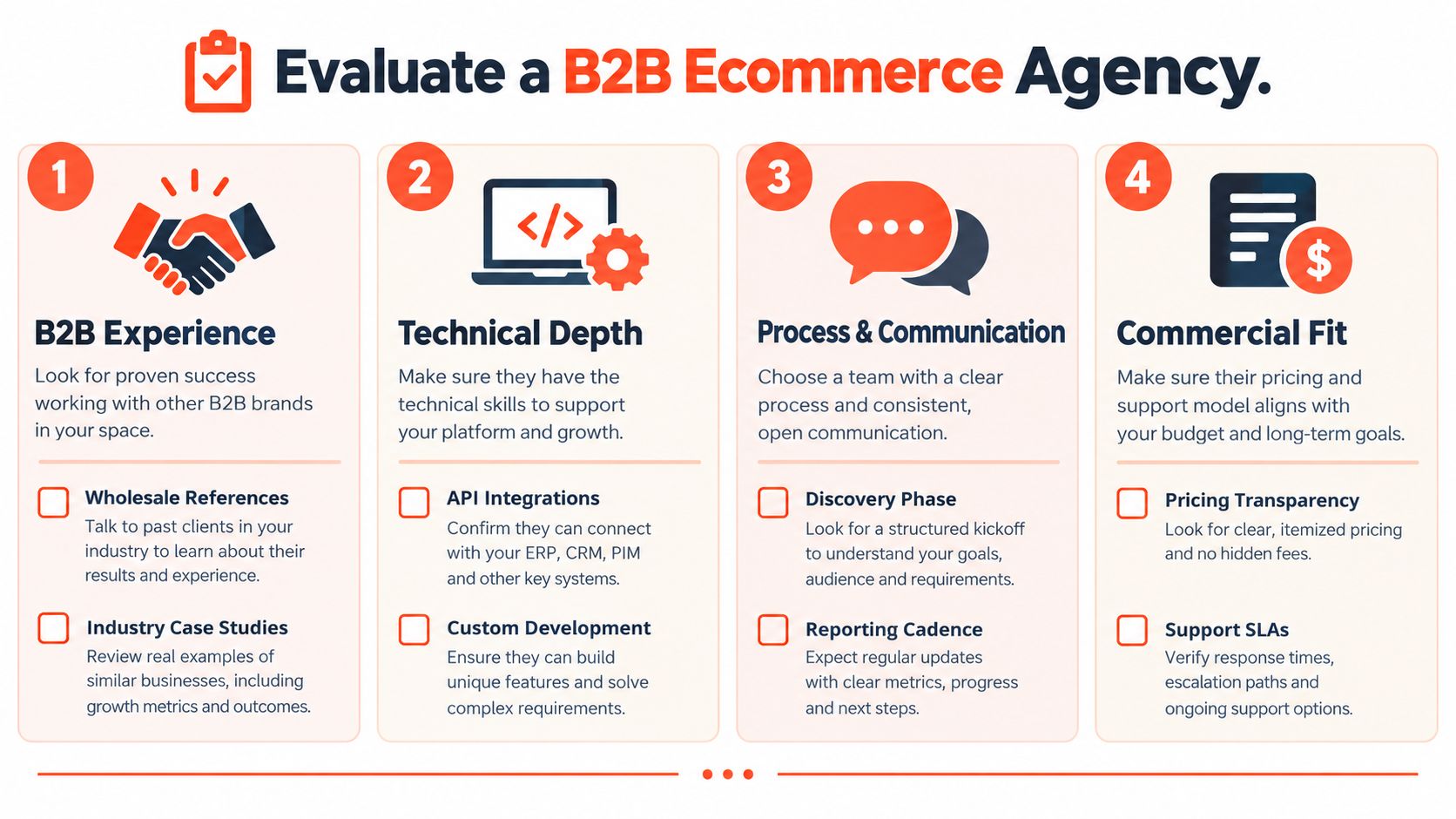
Start with references from businesses that resemble your operating model. Ask to speak with a wholesale client, a manufacturer, a distributor, or a brand with both direct and trade channels. Request examples of account pricing, company permissions, quote workflows, and post-launch support, not only screenshots.
Ask for evidence, not assurances
A useful shortlist process gives every agency the same operational scenario. Provide an example account hierarchy, a contract price, an approval requirement, an ERP order, and an inventory exception. Ask each team to explain the data flow and identify what belongs in Shopify Plus, an integration layer, the ERP, or a custom app.
Look for answers that acknowledge trade-offs. A specialist may recommend a leaner native implementation instead of forcing a headless build. It may also reject an app when the app creates duplicate customer or pricing logic.
B2B experience: Ask for named references and examples involving wholesale catalogs, trade accounts, or negotiated pricing.
Technical depth: Ask who will design APIs, integration monitoring, custom Shopify Functions, and release testing.
Communication: Confirm the discovery process, meeting cadence, decision log, documentation standard, and escalation path.
Commercial fit: Require a clear split between implementation fees, third-party subscriptions, support, and change requests.
Watch the operating model
A fixed fee with a vague integration scope creates tension later. So does a proposal that names senior strategists but not the developers who will build the system. Ask who remains after launch, what response times apply, and whether the agency will help diagnose issues that cross the storefront and ERP boundary.
Marketing performance also needs context. A complete guide to performance marketing can help separate acquisition strategy from commerce infrastructure. Your agency should still explain how campaigns connect to account eligibility, landing experiences, product data, attribution, and margin.
The best interview question is often simple: “Show us what you would deliberately leave out.” An agency that can protect the roadmap from unnecessary complexity understands total cost better than one that adds every requested feature.
Pricing Models and Engagement Structures
B2B ecommerce pricing becomes easier to assess when the engagement model is explicit.
A fixed-scope build works when discovery has already resolved the important unknowns. It can provide budget confidence for a well-defined migration or theme implementation. It breaks down when the client hasn't validated pricing rules, ERP behavior, account structures, or data quality. In those cases, the agency either absorbs risk, submits change orders, or cuts corners.
A time-and-materials engagement is more adaptable. It suits complex discovery, integration work, and phased delivery where the team expects to learn during implementation. The buyer gives up some budget certainty but gains a better chance of solving the underlying problem rather than defending an early estimate.
A monthly retainer fits continuous development, experimentation, technical support, and international expansion. It only works when the agency maintains a visible backlog, reports capacity, documents decisions, and ties work to business outcomes. Otherwise, the client pays for activity without building a durable roadmap.
The five-year cost is larger than the launch invoice
The launch proposal should separate one-time and recurring costs. Include app subscriptions, custom-code maintenance, integration monitoring, data cleanup, accessibility remediation, performance work, experimentation, API changes, and incident response. These costs may not appear in a design and development estimate, but they determine whether the storefront remains economical to operate.
A leaner build can outperform a feature-heavy one when it reduces app sprawl and keeps business rules understandable. It can also fail if the agency cuts foundational monitoring, documentation, or data governance. The useful distinction is between reversible experiments and systems that create lock-in.
For a broader example of how software pricing can be broken down, DataLunix pricing insights provides a useful reference point. For ecommerce-specific budgeting, the cost of an ecommerce website guide helps frame development as one part of the total ownership model.
Budgeting test: Ask the agency what the storefront will cost to change, monitor, and repair after the original team has moved on.
A hybrid structure often creates the best balance: paid discovery, a defined initial build, then a retained optimization and support layer. The contract should state what happens when priorities change and who owns the resulting code.
Case Studies and Success Metrics That Matter
Strong B2B agency engagements usually fit one of three patterns, each with a different effect on the storefront's five-year operating cost.
A migration replaces an aging portal or platform while protecting customers, orders, products, and search visibility. The difficult work sits behind the new theme: preserving account relationships, validating customer-specific prices, managing redirects, coordinating cutover, and training sales and support teams. A migration succeeds when buyers can continue working without exposing gaps between the storefront, ERP, CRM, and other systems.
A consolidation project reduces dependence on loosely connected apps. The agency moves durable business rules into a maintainable theme, custom app, Shopify Function, or integration layer, then removes tools that duplicate customer, pricing, or order logic. Fewer apps help only when ownership, monitoring, and data flows become clearer. The target is easier releases and fewer failure points, not merely fewer icons in the admin panel.
An optimization engagement starts with a live storefront. The team examines authenticated buyer behavior, search exits, reorder friction, support contacts, and performance, then improves the workflows that affect revenue and service effort. This approach often produces more useful gains than redesigning every page.

Measure the buying path
Conversion rate belongs in the report, but it does not describe the full economics of B2B. One large order may matter more than many low-value sessions, while a self-service order can reduce rekeying and support work even when the public conversion rate changes little.
Track measures such as:
Reorder rate: Whether existing customers can repeat a known purchase without support.
Quote completion: Whether buyers finish the quote journey and turn approved quotes into orders.
Assisted-to-unassisted migration: Whether routine purchases move from sales and support to reliable self-service.
Support deflection: Whether account, product, and order information resolves common questions without creating new service work.
Margin by buying path: Whether discounts, support effort, payment costs, and fulfillment behavior make each channel commercially viable.
A 2024 B2B commerce study reported that buyers value capabilities such as placing new or repeat orders, resolving issues through support, and finding products and technical specifications. Among organizations with ecommerce storefronts, ecommerce or portal orders generated an average of 50% of revenue, as detailed in the study coverage. That finding makes task completion, accurate pricing, and dependable product data more useful targets than visual novelty.
Report failures as business events. A quote that cannot become an order, a buyer who sees the wrong price, or an order that fails to reach the ERP needs an owner, a diagnosis, and a measured recovery path.
A practical review connects growth reporting to operating decisions:
Choosing the Right Agency and What Comes Next
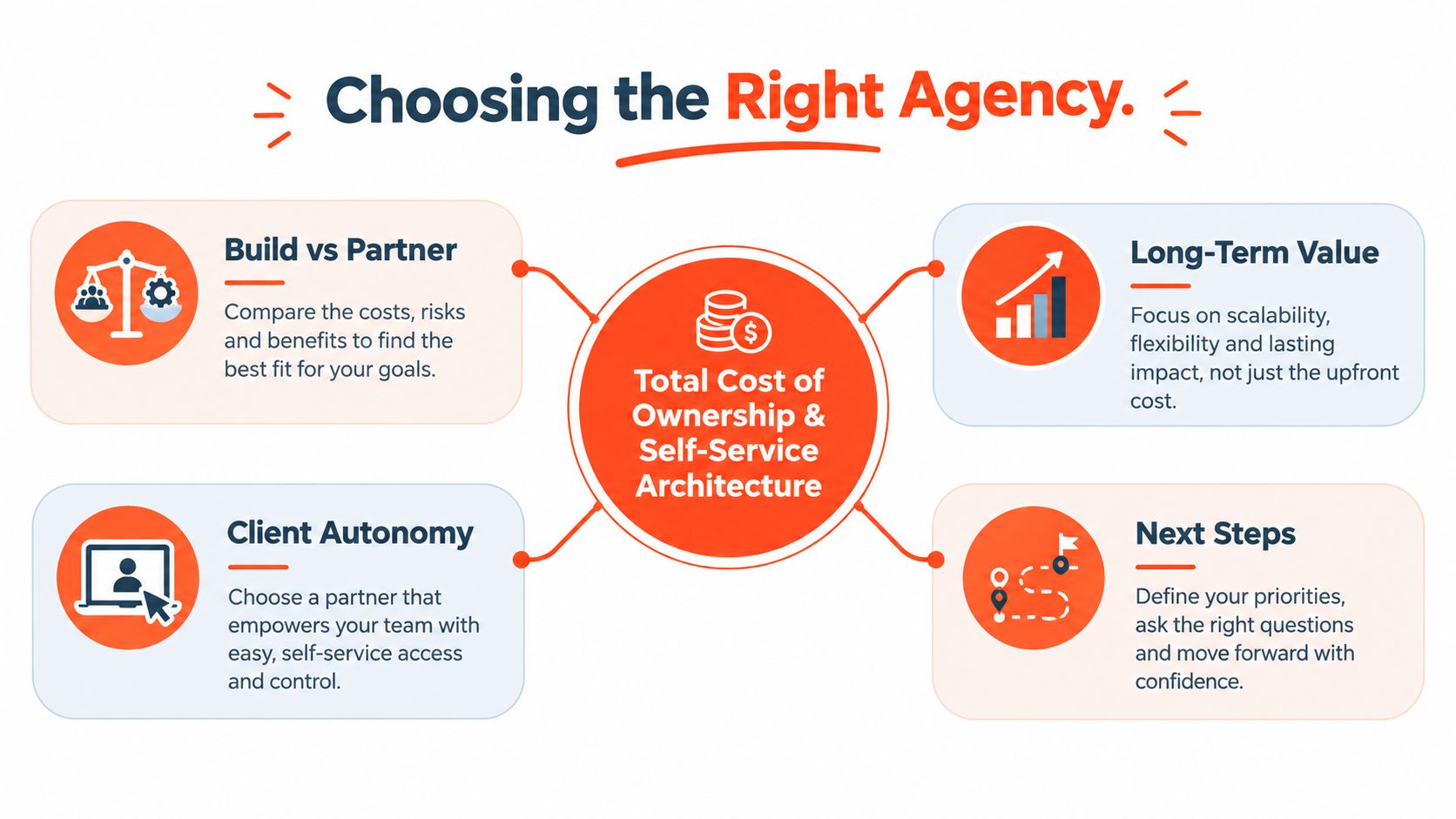
Choose the partner that can build a storefront your team can run for the next five years, not merely the partner that can launch it fastest. The decision should connect total cost of ownership with self-service architecture.
Before contacting agencies, write down four things:
Canonical data model: Identify the source of truth for products, customers, pricing, inventory, and orders.
Day-one integrations: List the systems that must exchange reliable data at launch.
Self-service boundaries: Decide which purchases should be automated and which require sales or support.
Success measures: Define reorder, quote, support, margin, and assisted-purchasing outcomes.
Presidio combines Shopify agency delivery with software-studio capabilities, including custom themes, apps, Shopify Plus implementations, integrations, headless storefronts, performance work, and ongoing optimization. If your B2B roadmap needs a maintainable Shopify foundation rather than another fragile layer of apps and manual workflows, visit Presidio to discuss the data model, buying journeys, and five-year operating plan before selecting a build approach.

Jamie, Presidio’s Designer, leads the practice alongside Johnnie. With over 10 years of e-commerce experience, Jay is a Shopify expert, known for crafting innovative solutions that prevent tech debt.
Jaime
Senior Product Designer, 2020