Presidio

A Shopify Plus apparel brand can discover an inventory problem only after a customer has paid. NetSuite shows 200 units of SKU X, the OMS shows 45, Shopify shows 12 available online, and the 3PL confirms zero on the warehouse floor. The order enters the system, payment succeeds, and the operations team has to explain why the promised product can't ship.
That isn't a connector problem in the narrow sense. It's an operating problem caused by systems that no longer agree about the same product, order, or stock position. Systems integration services give ecommerce teams the architecture, controls, monitoring, and ownership needed to keep Shopify connected to the ERP, OMS, PIM, shipping stack, and analytics layer after launch.
Table of Contents
Why Ecommerce Stacks Drift Out of Sync
The inventory scenario above can develop without one dramatic outage. NetSuite may receive a stock adjustment on one schedule, the OMS may reserve inventory on another, and Shopify may publish availability after its own synchronization delay. Meanwhile, the 3PL's physical count reflects receiving errors, damaged units, warehouse transfers, or an order that never completed the expected status transition.
Shopify's native capabilities are powerful, but they don't define every operational rule in a brand's back office. A connector may pass an order successfully while omitting the business context needed for routing, allocation, backorders, bundles, or partial fulfillment. The result looks healthy in a dashboard that measures message delivery, even though the customer-facing inventory is wrong.
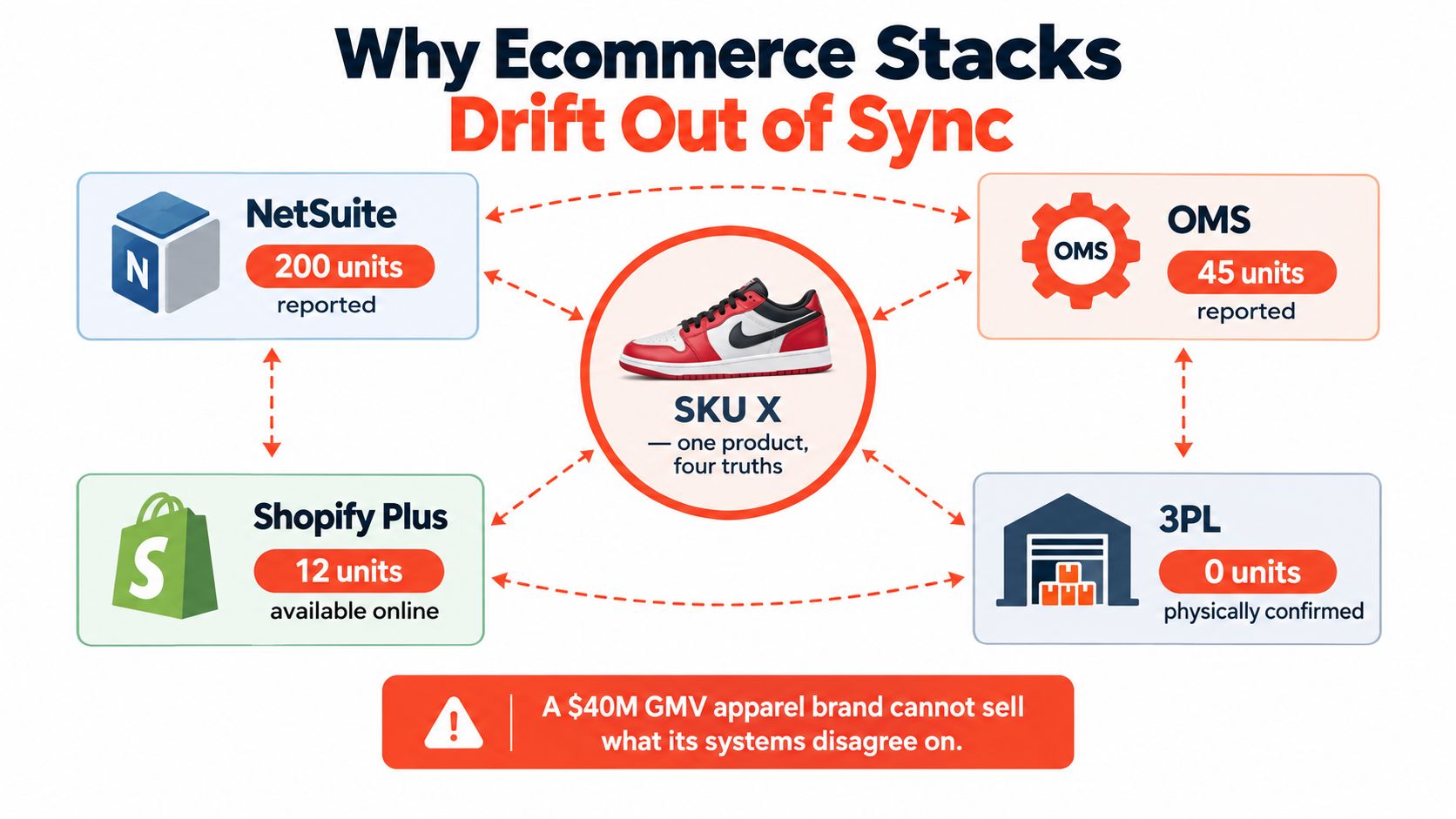
Four sources of operational drift
ERP and OMS cadence differences create competing versions of available-to-sell inventory. The ERP may be authoritative for valuation and purchasing, while the OMS owns reservations and fulfillment decisions. Neither system can overwrite the other without losing meaning.
Catalog forks appear when the PIM, Shopify, marketplaces, and warehouse system use different variant identifiers, titles, dimensions, or lifecycle states. A product can be active in one channel and incomplete in another.
Shipping logic splits across platforms. Carrier APIs calculate rates, the 3PL applies warehouse rules, and Shopify presents delivery choices at checkout. If those rules aren't governed together, a valid rate in one context can create an impossible fulfillment promise in another.
Practical rule: A successful API response proves that a message was accepted. It doesn't prove that the business state is correct.
Integration debt is an ownership question
The global system integration services market is projected by one independent estimate to grow from USD 553.33 billion in 2025 to USD 763.82 billion by 2030, representing a 6.7% CAGR, according to MarketsandMarkets' system integration services market coverage. The range of public forecasts differs, but the direction is consistent: organizations are still connecting more distributed applications, cloud services, and legacy platforms.
For a Shopify brand, the practical question isn't whether an integration can be built. It's who owns the integration when credentials expire, schemas change, queues stall, or a warehouse sends an unexpected status. Teams that monitor only go-live completion accumulate failure debt. Teams that treat integrations as maintained services define ownership, reconciliation, alerting, and recovery before the first production order moves.
What Systems Integration Services Actually Cover
Systems integration services connect Shopify to the operational systems behind the storefront and keep shared business data meaningful across those systems. The work includes interface design, field mapping, transformation rules, authentication, synchronization, error handling, reconciliation, monitoring, and support.
The key is to assign authority by domain. Shopify may own the customer-facing cart and checkout, but it shouldn't automatically become the source of truth for accounting, warehouse stock, or product governance. A durable design makes those boundaries explicit.
The five systems most brands need to map
ERP: NetSuite, SAP, and Microsoft Dynamics typically manage financial postings, purchase orders, inventory valuation, supplier records, and accounting dimensions. The integration must distinguish an order that Shopify accepted from an order that the ERP has successfully posted.
OMS: Manhattan, Fluent Commerce, and Brightpearl coordinate order routing, inventory reservations, split shipments, backorders, and fulfillment status. This layer often decides whether an order goes to a 3PL, retail location, or another fulfillment node.
PIM: Akeneo, Salsify, or an internal catalog service manages product attributes, variants, localization, taxonomy, and digital assets. The PIM should prevent every sales channel from inventing its own interpretation of a product.
Shipping: ShipStation, EasyPost, carrier APIs, and 3PL platforms handle shipping rates, labels, tracking events, package details, and manifested weight. Integration work must account for failed labels, carrier exceptions, and shipment updates that arrive out of order.
Analytics: GA4, Looker, Snowflake, and BigQuery consume commerce events for attribution, customer lifetime value, demand planning, and operational reporting. Analytics pipelines need stable event names and identifiers, not just a copy of whatever each application happens to emit.
System Category | Primary Responsibility | Common Platforms |
|---|---|---|
ERP | Financials, purchase orders, valuation, inventory records | NetSuite, SAP, Microsoft Dynamics |
OMS | Routing, reservations, split shipments, backorders | Manhattan, Fluent Commerce, Brightpearl |
PIM | Product data, variants, localization, assets | Akeneo, Salsify, in-house platforms |
Shipping | Rates, labels, tracking, carrier and 3PL events | ShipStation, EasyPost, carrier APIs, 3PLs |
Analytics | Events, attribution, LTV, demand planning | GA4, Looker, Snowflake, BigQuery |
The difficult work sits between those categories. ERP-linked order, inventory, and fulfillment flows often carry the highest risk because transactional records and reference data must remain consistent. When an ERP lacks a usable API, file-based or EDI integration may be necessary, but it needs stronger validation, replay, and reconciliation than a simple scheduled export.
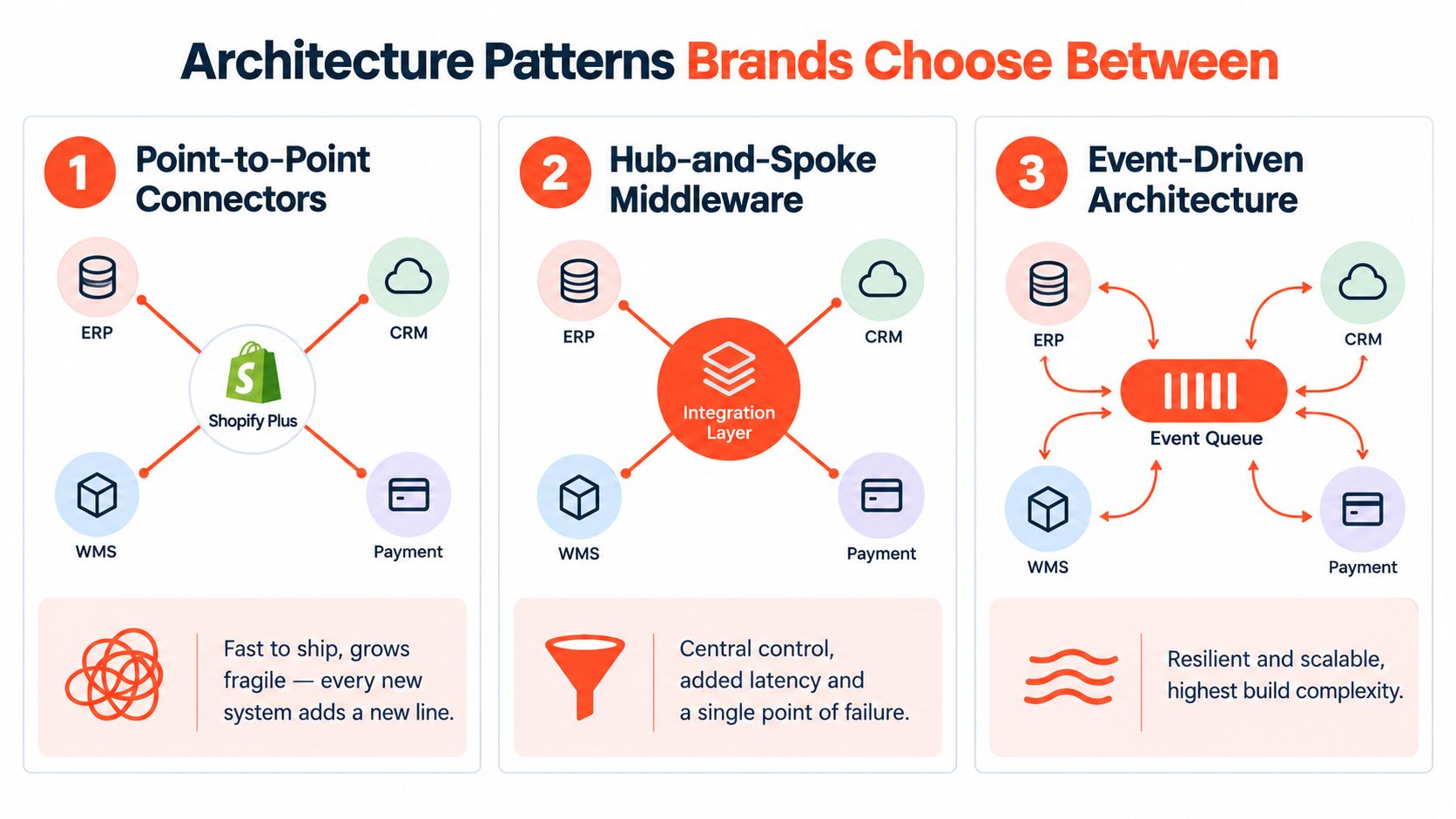
Architecture Patterns Brands Choose Between
Architecture determines how quickly a brand can launch and how expensive it becomes to diagnose the first serious failure. The right pattern depends on system count, operational risk, change frequency, and the team's ability to support distributed software.
Point-to-point connectors
Direct connections between Shopify and each operational platform are attractive because they have a short path from requirement to deployment. A small DTC brand might connect Shopify to an ERP, shipping tool, and analytics platform without needing a central integration layer.
The weakness appears when business rules spread across those connections. Each connector develops its own mappings, retries, credentials, and assumptions about product or order state. Adding another system means adding more paths and more places where the same rule can diverge.
Typical failure mode: drift. An order update may reach the OMS but not analytics, or a product change may update Shopify while the marketplace connector retains an older variant structure.
Hub-and-spoke middleware
An iPaaS or middleware layer such as Celigo, MuleSoft, Workato, or Boomi centralizes transformations and routing. That makes shared logic easier to locate, and prebuilt connectors can reduce custom work for common ERP, CRM, shipping, and data warehouse flows.
Centralization doesn't remove complexity. It creates a dependency on the platform's connector behavior, deployment model, queueing model, and pricing. Middleware can also become a change bottleneck when every team must wait for one integration layer to approve or release an update.
Typical failure mode: vendor lock-in. The brand may own its business rules conceptually while the implementation becomes difficult to move elsewhere.
Event-driven architecture
An event-driven design uses systems such as Kafka, AWS Kinesis, or GCP Pub/Sub alongside APIs and an API gateway. Shopify, the OMS, the ERP, and downstream consumers publish or receive meaningful state changes, while reconciliation services compare expected and observed outcomes.
This approach supports clearer replay and consumer isolation, but it requires disciplined event contracts, schema governance, queue monitoring, and operational expertise. Integration architecture also affects performance. Every middleware hop can add serialization, transformation, buffering, and protocol translation overhead, while message-based designs generally reduce delay compared with batch processing at the cost of more throughput management complexity, as discussed in technical research on integration performance and architecture.
Typical failure mode: dead-letter queues. An event that can't be processed must be retained, investigated, corrected, and replayed rather than discarded without notice.
Brands moving toward composable commerce architecture should treat the integration layer as a product boundary, not as plumbing hidden behind the storefront. A simpler architecture that the team can observe and recover often outperforms a complex one nobody can operate.
Integration Approaches on Shopify and Shopify Plus
Shopify and Shopify Plus support several integration paths, but they solve different problems. The choice should follow the brand's operational complexity rather than the novelty of the tool.
Native apps work well when the ERP, OMS, PIM, or shipping provider has a mature connector and the brand's workflows match the connector's assumptions. They're a sensible starting point for an early DTC operation with standard orders, straightforward fulfillment, and limited catalog variation. The risk is that app configuration can conceal important rules, making it difficult to test edge cases or inspect failed transformations.
Custom middleware built around Shopify's REST and GraphQL Admin APIs gives the brand control over mappings, orchestration, and recovery. It fits omnichannel companies with custom back-office systems, unusual allocation rules, or strict data ownership requirements. The trade-off is ongoing engineering responsibility. Custom code still needs credential rotation, API version management, monitoring, and incident response.
An iPaaS such as Workato, Celigo, or MuleSoft can provide shared orchestration and reusable connectors. It's useful when several systems need the same business rules and the internal team wants a managed integration environment. The brand should still inspect how the platform handles retries, rate limits, version changes, and exportability.
Webhook- and event-driven services using Shopify Flow, Pub/Sub, and Shopify Functions are effective for reactive workflows. They can trigger downstream actions without waiting for a large batch, but each event needs idempotency, ordering assumptions, and a recovery path.
Shopify Plus can be valuable when higher API capacity, more extensive Shopify Flow usage, and B2B requirements align with the operating model. Those capabilities don't replace architecture. They give a growing brand more room to implement a deliberate one.
Approach | Best Fit | Trade-offs |
|---|---|---|
Native apps | Early DTC brands with standard workflows | Fast setup, limited control over edge cases |
Custom middleware | Omnichannel brands with specialized back-office logic | Flexible, but requires long-term engineering ownership |
iPaaS | Teams coordinating several systems through shared flows | Centralized, but dependent on platform behavior and licensing |
Webhooks and events | Reactive workflows and state-change processing | Responsive, but requires replay and ordering controls |
Shopify Plus capabilities | Higher-volume, B2B, and more complex Shopify operations | More flexibility, not a substitute for integration governance |
A brand can use more than one approach. The practical question is whether the boundaries are clear and whether someone can explain what happens when a connector fails. Teams planning that decision can use Shopify integration services as a reference point for the engineering scope beyond installing an app.
How to Evaluate an Integration Partner
An integration partner should show how the service will operate after deployment, not only how quickly the first data exchange can be demonstrated. Ask for a reference architecture that identifies system ownership, message paths, retry behavior, reconciliation, and alert destinations.
Score the delivery model
Shopify capability: Verify Shopify certifications and meaningful Shopify Plus experience. Ask the team to explain API versioning, webhook behavior, Flow, Functions, and the operational differences between a standard store and a complex Plus implementation.
Back-office depth: Look for practical experience with the ERP, OMS, PIM, WMS, shipping, and analytics products in your stack. A partner that understands only Shopify may produce a polished storefront connection that fails at the warehouse or accounting boundary.
Operational ownership: Require a named owner for observability and on-call support. Monitoring must cover message failures, synchronization lag, rejected payloads, authentication problems, and reconciliation mismatches.
Documented patterns: Request examples of idempotency keys, schema validation, dead-letter queue handling, replay procedures, and secret management. You don't need proprietary code, but you do need evidence that these concerns were designed deliberately.
Post-launch support: Review the runbook, escalation path, support hours, and service-level terms before signing. A launch handoff without operational training leaves the merchant dependent on the original implementation team.
Red flags that predict maintenance trouble
Be cautious if a proposal has no error replay, no idempotency strategy, or no explanation of how schema changes will be detected. Hardcoded API keys in repositories, demo-only credentials, and a scope that ends at “go-live” are immediate concerns.
Ask for a sample incident postmortem. A capable partner should be able to describe how it distinguishes a bad payload from a downstream outage, how it prevents duplicate orders, and how it restores service without asking a merchant to edit production data manually.
Before you compare build estimates, compare recovery plans. The cheaper integration is often the one that documents how a failed order gets found and safely replayed.
Integrating for Reliability Instead of Just Connectivity
Connectivity is the starting condition, not the finished service. An integration that moves a valid order during a demonstration can still fail under rate limits, expired credentials, schema drift, duplicate webhook delivery, partial fulfillment, or a downstream outage.
Treat each flow as a small distributed service. That means structured logs with searchable order and event identifiers, retry policies that distinguish transient from permanent errors, dead-letter queues for messages requiring review, and schema checks that detect a changed field before it corrupts downstream data.
Put operational targets where merchants can see them
A reliability dashboard should expose the signals that affect customers and operators:
Sync lag: Show how long order, inventory, and fulfillment updates take to reach their intended consumers.
Order error rate: Separate rejected payloads from downstream outages and expose the affected order references.
Stockout alerts: Flag disagreements between available-to-sell inventory and warehouse or OMS state before customers encounter them.
Credential health: Track token and certificate expiry rather than waiting for an integration to stop. Production analysis from Osher's overview of system integration challenges identifies credential expiry and token or certificate rotation as recurring causes of sudden integration failures.
Replay status: Make unresolved dead-letter messages visible, assigned, and recoverable.
These targets belong in a dashboard that an ecommerce leader can review regularly, not only in a technical runbook. The exact thresholds should reflect the brand's customer promise and fulfillment model.

The first operating period after launch deserves particular attention because real orders expose edge cases that test data rarely contains. Assign an owner who can review failures, tune alerts, update mappings, and work with warehouse and finance teams. The goal isn't zero incidents. It's fast detection, safe recovery, and a shrinking class of repeat failures.
For brands connecting Shopify to an ERP, the order, inventory, and financial boundaries need special care. A practical ERP and ecommerce integration guide can help frame those boundaries, but the production design still has to reflect the brand's own order lifecycle and accounting rules.
How Presidio Delivers Systems Integration Services
A reliable engagement starts with discovery, not a preferred middleware product. Presidio can map the current state across Shopify, ERP, OMS, PIM, shipping, 3PL, and analytics systems before recommending an architecture. The discovery should identify data owners, authoritative fields, event timing, manual workarounds, failure history, and peak-period constraints.
The delivery model then breaks the work into timeboxed integration increments. Each increment has a defined business outcome, test data, acceptance criteria, and rollback path. A dedicated reliability engineer can work alongside the implementation team to define retries, dead-letter queue behavior, structured logs, alerts, and reconciliation checks rather than leaving those decisions until the end.
Observability should connect to the brand's existing tools, such as Datadog or New Relic, instead of creating another isolated dashboard. Runbooks should use the language of the in-house team. An operations manager needs to know which order states are safe to replay and when to involve the 3PL, while an engineer needs the payload, correlation identifier, downstream response, and deployment history.
Reduce cutover risk before the first live order
Migration is safer when the new path proves its behavior beside the old one. Shadow writes can send non-customer-facing records through the new service, while dual-run reconciliation compares totals, statuses, identifiers, and inventory outcomes across both paths.
Cutover windows should respect BFCM and promotional calendars rather than treating them as convenient dates. The team needs a rollback plan, a freeze policy for mappings, named decision-makers, and a clear process for orders created during the transition.
Two anonymized examples illustrate the difference between a connection and an operating service. A mid-market apparel brand unified NetSuite, Shopify Plus, and a 3PL with sub-minute order propagation, allowing the systems to share order state quickly while retaining explicit retry and reconciliation behavior. A home goods DTC brand replaced a brittle point-to-point middleware mesh with a queue-first architecture and cut integration-related support tickets by more than half.
Those outcomes depend on the implementation details, not on architecture labels alone. The queue-first design still needs consumer ownership, dead-letter handling, and operational alerts. The apparel integration still needs a defined source of truth for inventory, order state, and fulfillment confirmation.
Phase | Deliverable | Risk Control |
|---|---|---|
Discovery | Current-state map, ownership model, data-flow inventory | Finds hidden dependencies before architecture decisions |
Architecture | Interface contracts, system boundaries, failure model | Prevents duplicated business rules and unclear authority |
Incremental build | Tested Shopify, ERP, OMS, PIM, shipping, and analytics flows | Limits blast radius and exposes edge cases early |
Reliability engineering | Retries, idempotency, queues, logs, alerts, reconciliation | Makes failures visible and recoverable |
Migration and cutover | Shadow writes, dual-run comparison, rollback plan | Reduces transition risk around live orders |
Handoff and support | Runbooks, dashboards, training, escalation ownership | Keeps the brand capable after go-live |
A Presidio engagement is a fit when the brand needs more than a point-to-point app installation, has operational systems that must agree about orders and inventory, or wants a Shopify Plus implementation that can be maintained by an internal team. Presidio combines Shopify development, custom applications, ERP connectivity, and ongoing support, with the integration treated as part of the commerce operating model rather than a detached technical project.
Presidio helps Shopify and Shopify Plus brands map complex ERP, OMS, PIM, shipping, and analytics flows, then build integrations with monitoring, recovery paths, and maintainable handoff documentation. If your stack is already showing inventory drift, failed order synchronization, or growing integration support work, visit Presidio to discuss an architecture and delivery plan grounded in how your team operates.

Jamie, Presidio’s Designer, leads the practice alongside Johnnie. With over 10 years of e-commerce experience, Jay is a Shopify expert, known for crafting innovative solutions that prevent tech debt.
Jaime
Senior Product Designer, 2020