Presidio

Composable commerce had already been adopted by 72% of retailers in 2024, with 99% either using it or planning to use it, so this isn't a niche experiment anymore. It's the mainstream answer for brands that need a commerce stack that can change without tearing everything else apart.
Table of Contents
The Rise of Composable Commerce in Modern Retail
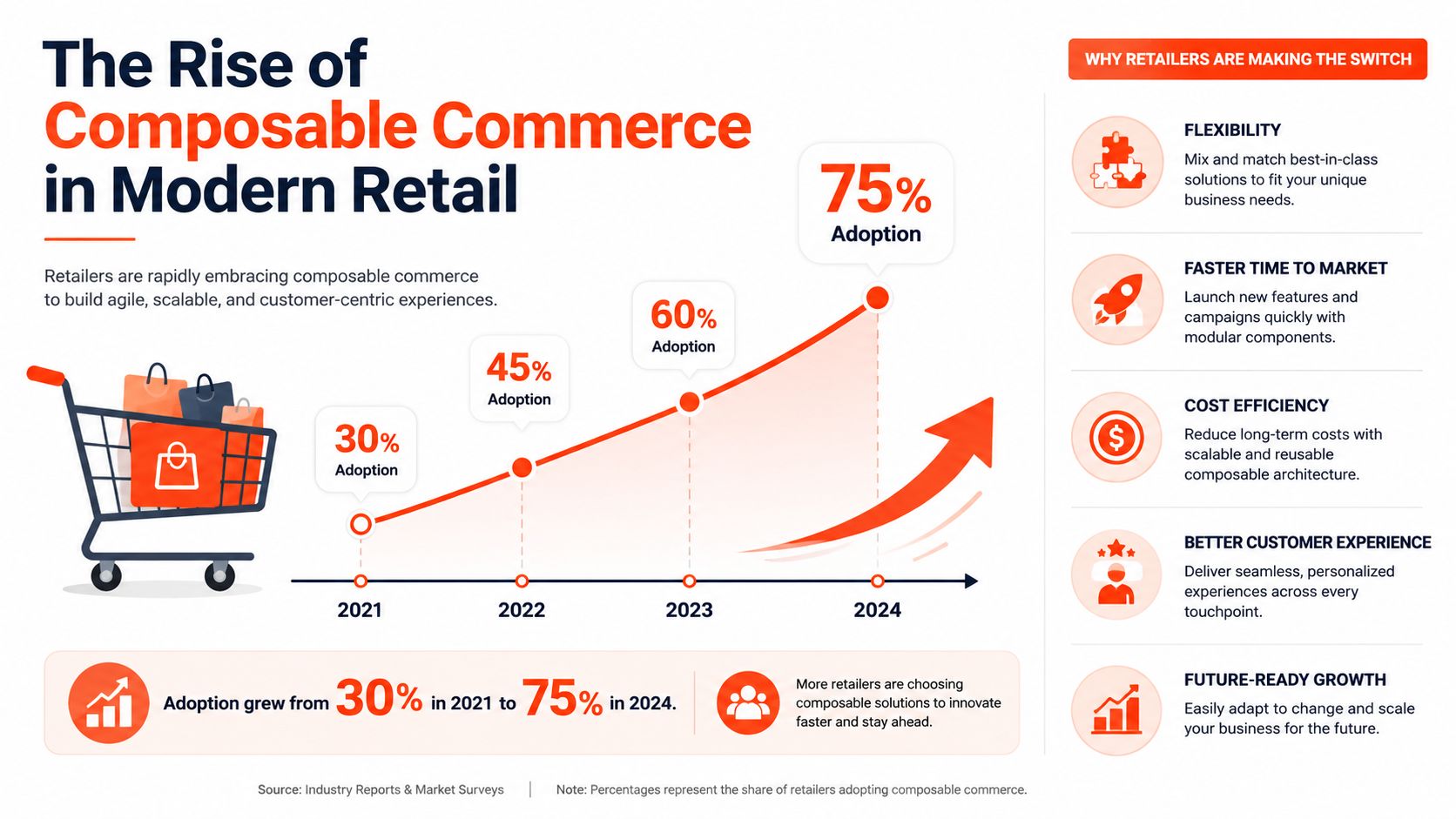
By 2024, composable commerce had moved well beyond pilot projects and early curiosity. In a retailer survey summarized that year, 72% had already adopted it, 27% were planning adoption, and only 2% said they were fully composable, while 99% were either using it or planning to use it (queue-it.com). That distribution is what you see when a pattern starts shaping real buying decisions, not just architecture debates.
The preference shift matters too. In the same dataset, 70% of retail decision makers preferred composable tooling, up from 44% two years earlier, while the all-in-one model fell from 56% to 30% over the same period. Retailers are choosing composable architecture when they want tighter control over how capabilities are assembled and how fast the stack can change.
Why the model spread so quickly
Composable commerce addresses the part of commerce that monoliths handle poorly, change. New channels, new merchandising rules, new personalization logic, and new operating requirements tend to arrive faster than many platform upgrade cycles can absorb. When every capability sits inside one large product, even a small adjustment can trigger broader coordination, shared release timing, and more risk around the rest of the stack.
Practical rule: if one change routinely forces coordination across the whole stack, the architecture is already slowing the team down.
That is why ecommerce directors tend to take it seriously. The appeal is not novelty, it is control. Teams can decide where a specialized capability adds value, where a standard Shopify foundation is enough, and where custom work would create more complexity than it solves.
A straightforward way to understand it is like retail operations assembled from modular services that connect through APIs. Search can be one service, checkout another, content another, payments another. The system stays coherent because the services are integrated through clear interfaces, not because every function has to live in one codebase.
For teams evaluating stack direction, the main point is that composable commerce is no longer a fringe preference. If you need a practical way to compare adjacent stack decisions, the Web Scraping API for RAG can help teams build internal research workflows around catalog, content, and commerce data.
Composable Commerce vs Monolithic Platforms
Composable and monolithic commerce both sell the same outcome, a working storefront that converts. The difference is in how much freedom you get when something needs to change, scale, or fail gracefully.
Attribute | Monolithic Platform | Composable Architecture |
|---|---|---|
Deployment changes | Often tied together, one update can affect several functions | Individual services can be updated separately |
Scaling | Usually broad, you scale the whole platform more than one bottleneck | More granular, you scale the service under pressure |
Vendor flexibility | Lower, features tend to be bundled | Higher, best-of-breed components can be swapped |
Failure impact | Problems can spread across the stack | Smaller service boundaries help isolate issues |
Release coordination | More cross-team dependency | More independent delivery paths |
Fit for change-heavy brands | Can feel rigid when requirements shift | Better when the business changes often |
The operational difference shows up fast. In a monolithic setup, teams often have to coordinate around shared releases, shared dependencies, and shared risk. In a composable setup, a search engine can change without forcing a checkout rewrite, and a CMS update doesn't have to wait on the rest of the commerce application.
What vendor lock-in looks like day to day
Vendor lock-in isn't always dramatic. Most of the time, it shows up as small compromises that accumulate. Maybe you accept a weaker checkout flow because changing it is too expensive, or you keep a mediocre search tool because replacing it means touching too many other parts of the stack.
That's why composable appeals to brands that care about selective modernization. They don't need to throw out every stable system they already have. They need a way to replace the pieces that are slowing them down without taking the whole store offline.
For Shopify teams comparing platform options and stack shape, a practical external reference is the Market Edge decision guide, which can help frame vendor trade-offs in broader platform conversations.
A monolithic platform can still be a smart choice when the business is simpler, the team is lean, or the roadmap doesn't justify integration overhead. Composable isn't automatically better. It's better when the business values independent evolution more than one-vendor convenience.
Core Architecture Components and How They Work
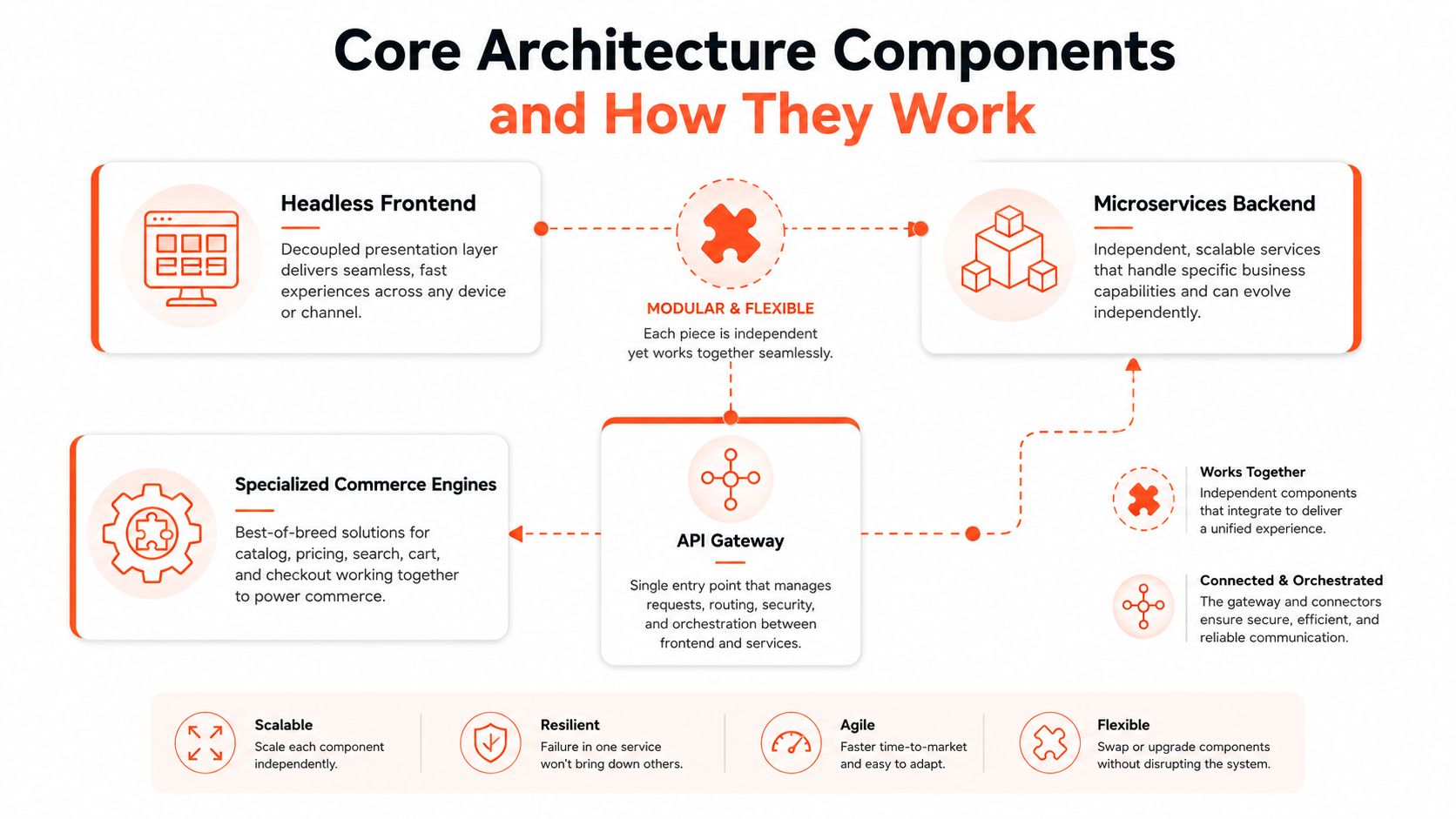
Composable commerce separates commerce capabilities into services that communicate through APIs. The cleanest way to describe it is as a stack of Packaged Business Capabilities, or PBCs, where each commerce domain is exposed as its own service with a defined contract (tagada.io). Search, cart, checkout, CMS, and payments can all live as distinct modules instead of being trapped inside one large application.
PBCs, APIs, and headless delivery
PBCs matter because they create boundaries that teams can operate. If search traffic spikes, the search service can scale on its own instead of pulling the entire commerce platform with it. If checkout needs a different provider, that service can be replaced without rewriting every neighboring function. That boundary is where composable systems earn their keep in production.
Headless delivery sits on top of that model. It decouples the storefront from the back-end commerce logic, so the same service layer can support web, mobile, kiosk, or other channels through APIs (shopify.com). For brands that need one commerce engine behind several experiences, that separation avoids duplicating core logic across every front end.
Practical rule: separate presentation first when front-end teams need faster iteration, but keep back-end service boundaries disciplined or you will recreate the same complexity in a new layer.
Composable systems are also framed through MACH principles, Microservices, API-first, Cloud-native, and Headless. That framing is useful because it keeps the architecture centered on modularity, independent scaling, and cloud deployment instead of one all-in-one product.
What this means for a Shopify stack
On Shopify, composable does not have to mean abandoning the platform. In many builds, Shopify stays as the stable commerce foundation, while specialized services handle the parts of the stack that need more control or change more often. A custom app can fill a gap, a headless storefront can improve channel flexibility, or a specialized search engine can sit alongside the core cart and checkout flow.
If your team needs custom functionality inside a Shopify-based architecture, custom Shopify app development is a practical reference point. The goal is not to add tools for their own sake. It is to keep the stable commerce core intact while isolating the capabilities that benefit from independent change.
The Business Case for Going Composable
Composable commerce is getting attention because it solves a practical problem for growing brands. As noted in a report from marketintelo.com, the category is attracting real market investment and continued growth expectations. That does not mean every Shopify brand needs to rebuild its stack, but it does show where budgets and platform planning are heading.
The ROI case comes from how teams work after a composable shift. Retail organizations using MACH architecture have reported positive returns, and some implementations have seen meaningful conversion gains after moving to headless or composable models, according to the same market analysis. The strongest business case appears when the current stack slows experimentation, delays launch cycles, or makes it hard to scale without adding more work to the core team.
What actually pays off
The payoff usually comes from removing bottlenecks between teams. Merchandising, growth, and engineering can ship smaller changes, test them faster, and avoid waiting on a full-stack release to adjust one customer-facing capability. That improves agility, but it also lowers the cost of a bad idea because the team can reverse course without unwinding the entire system.
The trade-off is straightforward. More services create more integration work, more vendor management, more monitoring, and more governance. Composable systems reward teams that define ownership clearly, keep API contracts stable, and plan for versioning early. They punish teams that assume tools will fit together without real operational discipline.
For brands evaluating whether the added complexity is worth it, Shopify performance optimization is a useful reference point. Faster pages and cleaner implementation habits matter even more once a stack includes several connected services.
The practical takeaway is simple. Composable makes the most sense when a business needs faster experimentation, more scalable operations, and less dependence on a monolithic system. If those pressures are not present, the extra coordination can cost more than it returns.
When Shopify Brands Should Consider Composable Architecture

For Shopify brands, the right question isn't whether composable is “better.” It's which parts of the stack deserve to stay stable and which parts are starting to constrain growth. A good Shopify foundation already covers a lot, so the goal is selective modernization, not reflexive replacement.
Keep the stable core, decouple the bottleneck
Use Shopify as the stable core when your catalog, checkout, and operational workflows are working well enough and the team can move without friction. Decouple only the capabilities that are slowing conversion, personalization, or experimentation. That might mean replacing a weak search layer, adding a custom subscription experience, or building a storefront that needs more front-end freedom than a theme can comfortably provide.
The cleanest composable decisions usually appear when one part of the business keeps asking for exceptions. A merchandising team wants a search experience that behaves differently by collection. The growth team wants a custom landing-page system that doesn't fit the theme schema. Operations wants a workflow that doesn't align with the native app pattern. That's a sign the capability, not the whole platform, needs attention.
Practical rule: don't make checkout composable just because you can. Make it composable when the current constraint is clearly tied to revenue, conversion, or operational efficiency.
Signals that the stack may be outgrowing the theme
More complex merchandising: If the catalog requires distinct experiences across many product groups, a lightly customized theme may stop being enough.
Specialized operational logic: If subscriptions, bundles, or discount logic keep bending native patterns, a targeted service may be cleaner.
Unique UX requirements: If the brand needs interfaces that can't be expressed well inside theme constraints, headless or hybrid patterns become more attractive.
If you're already solving these problems with custom work, it may be worth looking at the architecture beneath the fixes. Presidio's custom theme, app, and storefront work fits into that kind of selective approach, where the goal is to keep Shopify as the foundation and extend only what needs extension.
The useful decision is rarely full composable versus none. It's usually stable Shopify core plus a few carefully chosen services, or a full rebuild that's probably more architecture than the business needs.
Real-World Implementation Patterns and Migration Paths
Most successful composable programs don't start with a total rewrite. They start where the business feels pain first, then replace one layer at a time. That reduces risk, keeps the store live, and gives the team a chance to prove value before they commit to more change.
One common pattern is front-end decoupling with the commerce engine left intact. The brand keeps Shopify, or another established commerce system, as the transactional core and builds a separate storefront layer where the user experience needs more control. That lets the team move faster on design, content, and testing without rewriting everything behind the scenes.
How teams usually sequence the work
Start with the highest-friction capability: Search, merchandising, or content often show pain before checkout does.
Preserve rollback paths: Keep a way to revert a service if the new one causes instability.
Replace adjacent systems only when needed: Don't swap four services because one is annoying.
Measure operational fit, not just launch speed: Fewer release blockers matter as much as visible UX improvements.
Another pattern is phased capability replacement. A brand may keep Shopify for the core storefront and gradually introduce services for personalization, subscriptions, or content. That works best when each replacement has a clear owner and a clean contract with the rest of the stack.
For teams planning a move to Shopify or Shopify Plus, the migration discipline matters as much as the target architecture. A useful reference is Shopify migration support, especially when you're trying to avoid a big-bang cutover that creates avoidable business risk.
What not to do
Big-bang rewrites usually fail because they try to solve architecture, design, and process problems at once. They also make it hard for the business to see progress early. A composable roadmap should deliver something tangible before the stack is fully transformed, otherwise the team ends up paying integration costs without visible upside.
The best migration paths keep the current revenue engine stable while carving out the parts where modern architecture delivers the most value. That's the difference between a controlled transition and an expensive rebuild.
Common Misconceptions and When to Stay Simple
Composable commerce gets oversold when people treat it like a universal upgrade. It isn't. Headless isn't the same thing as composable, and more services don't automatically mean more flexibility. Sometimes they just mean more integration work and more things to monitor.
The biggest mistake is assuming complexity is always justified. If a Shopify brand has a stable catalog, a clean theme, manageable app usage, and a roadmap that doesn't demand heavy customization, a simpler setup may be the smarter choice. A lean store often performs better operationally than a fragmented one.
A simple stack with disciplined execution usually beats a clever stack that no one wants to maintain.
Stay simple when the team is small, the business model is straightforward, and the main problems are around creative execution or basic conversion hygiene rather than platform limits. Composable becomes more compelling when the business repeatedly hits the same ceiling and the ceiling is clearly architectural, not organizational.
The right answer is rarely “compose everything.” It's “compose the pieces that are holding the business back, and leave the rest alone.”
If you're deciding whether Shopify should stay as your stable foundation or become part of a more modular stack, Presidio can help you map the trade-offs, build the right pieces, and avoid over-engineering. Visit Presidio to talk through a Shopify architecture that fits your growth stage, not just the latest trend.

Jamie, Presidio’s Designer, leads the practice alongside Johnnie. With over 10 years of e-commerce experience, Jay is a Shopify expert, known for crafting innovative solutions that prevent tech debt.
Jaime
Senior Product Designer, 2020