Presidio

You're probably staring at a store that still works, but only just. The catalog keeps growing, the integrations keep multiplying, and every change feels like a small gamble because the current platform was never built for where the business is now. That's usually the moment Shopify migration services stop being a convenience and start looking like risk management.
The trap is assuming migration is a clean export and import job. In practice, the hard part is protecting revenue, preserving SEO equity, and reshaping messy legacy data so it fits Shopify's opinionated model without breaking checkout, fulfillment, or reporting. A structured migration engagement is what turns a platform switch into an operational reset instead of a fire drill.
Table of Contents
Why Shopify Migration Services Matter in 2026
A common pattern looks like this. A DTC brand starts on a platform that was easy to launch, then the catalog expands, the app stack gets tangled, and every new requirement needs another workaround. At that point, moving to Shopify isn't just about a nicer admin, it's about getting onto a platform that can absorb growth without turning every release into a maintenance event.
That's why professional Shopify migration services matter now more than ever. Shopify remains a major destination in replatforming, with a 2026 crawl showing 31,946 stores migrating to Shopify from seven major competitors, versus 10,271 stores leaving, a 3.1:1 inbound ratio, and a net gain of 21,675 stores. The same dataset also recorded 20,671 moves into Shopify and 10,758 moves out over a recent 90-day period, which reinforces the direction of travel in the market. Shopify migration momentum data
The real reason teams get stuck
Not every team fails because they can't move products. They fail because they underestimate the number of places where commerce data, customer identity, and integrations touch the business. Product feeds, email automation, subscriptions, ERP syncs, analytics, and support workflows all have to survive the switch with enough continuity that the customer never feels the handoff.
That's where a structured migration partner changes the equation. Instead of treating the project like a one-time data transfer, they plan for audit, mapping, staging, cutover, and validation as one controlled sequence. Shopify's own enterprise guidance says Shopify Plus migrations generally average three to four months from kickoff to go-live, while professional migration guides often place full projects at 6 to 12 weeks depending on complexity. Shopify enterprise migration guidance
A practical migration also protects the less glamorous parts of the stack, like customer communication. If your replatforming touches lifecycle email, it helps to sanity-check support tools and onboarding flows alongside the store move. A useful external reference for that is Mailwarm's best email warmup tools, because deliverability problems tend to show up right when the team is already distracted by launch work.
For teams comparing partners, the important distinction is simple. A naive export/import gets data into a new database. A real migration service makes sure the new store is usable, searchable, supportable, and maintainable on day one. If you want a deeper framing of the broader service model, Presidio's overview of ecommerce migration services is worth comparing against any proposal you receive.
What Shopify Migration Services Include
A lot of proposals sound thorough until you read the assumptions. They mention products and pages, maybe redirects, then leave out data cleanup, integration mapping, theme rebuilds, QA, or launch support. That gap matters, because a migration package that only moves records usually creates a new store that looks live but still behaves like a draft.
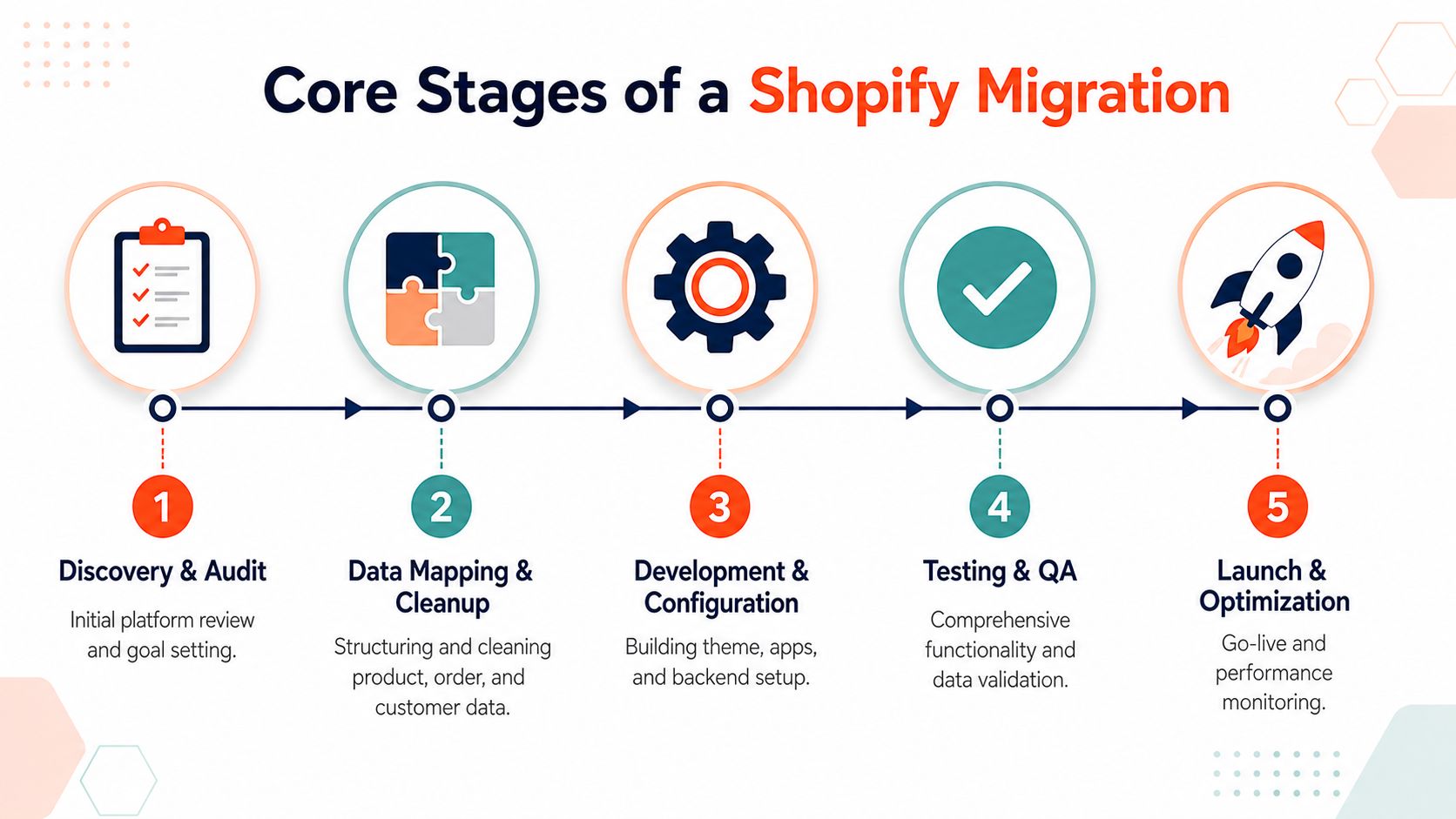
A serious engagement usually includes five workstreams that overlap in practice. First comes a platform audit, where the team inventories content, product structure, customer fields, orders, URLs, apps, and data dependencies. Then comes data mapping and cleanup, because legacy schemas rarely fit Shopify cleanly without reshaping.
The work hidden behind “migration”
The middle of the project is where the engineering happens. Theme work, storefront rebuilds, and app configuration have to line up with the new data model, not the old one. That includes navigation, collection logic, checkout-related behavior, tracking, and anything that depends on product structure or customer attributes.
QA deserves its own budget and its own discipline. Broken search, missing tags, miscategorized products, and incorrect discount logic are the kinds of bugs that often survive a shallow migration checklist. Post-launch validation then catches the last layer of issues, from redirect gaps to analytics mismatches.
Practical rule: if a vendor can't explain how they test variants, redirects, customer records, and key integrations together, they're selling an import, not a migration.
Strong migration partners also fold in adjacent services. UX cleanup, CRO-minded layout decisions, and performance tuning often belong in the same project because changing platforms is the cleanest moment to fix friction that's been tolerated for years. If you're comparing how different teams position that broader scope, The AI CMO's guide to marketing automation in 2026 is useful context for judging whether a proposed stack supports the rest of the funnel.
The YouTube walkthrough below is useful if you want a visual sense of how the process is usually framed in practice.
The short version is that the service should reduce ambiguity, surface hidden data work early, and leave the store in a state your team can operate after launch. The best Shopify migration services do that by treating scope, testing, and launch support as one operational package.
The Core Stages of a Shopify Migration
A migration breaks when teams treat every task as isolated. The sequence matters more than the individual steps, because data shape influences design decisions, and both affect QA. A disciplined process keeps each stage honest before the next one starts.
Start with audit and mapping
The first stage is discovery. The team identifies what exists, what matters, and what needs to change before anything touches Shopify. The output should be a practical inventory, not a vanity document, because the migration plan lives or dies on whether the source data can be mapped cleanly.
Once that's done, the team cleans and reshapes the data. Catalog issues, duplicate records, and malformed fields usually surface here. A strong migration partner does not just export and hope, they decide what gets transformed, what gets retired, and what needs manual handling.
Build, test, and prepare the cutover
Development and configuration come next. Theme templates, integrations, custom logic, navigation, and store settings get built against the staged data model rather than the legacy one. That sequencing matters because it keeps the storefront from being designed around assumptions the new platform cannot support.
Testing needs to happen in layers. Product pages, cart behavior, search, customer accounts, fulfillment flows, and analytics should all be validated before launch, then validated again after the cutover. A controlled launch plan also needs a rollback mindset, because once traffic lands on the new store, the team needs a path to recover if something critical breaks.
The most expensive mistake is launching before the team knows which systems are still talking to each other.
Post-launch monitoring closes the loop. The store should be checked for crawl issues, broken links, missing data, and operational friction while the migration is still fresh in everyone's mind. URL continuity is often one of the first places migrations fall apart, which is why redirect planning deserves its own review, and 301 redirect Shopify guide is a useful companion reference.
A disciplined sequence keeps the project boring in the best possible way. The business gets a known handoff, the team gets fewer surprises, and the new storefront starts from a stable foundation instead of a pile of assumptions.
Hidden Risks That Derail Ecommerce Migrations
The worst migration failures rarely look dramatic on launch day. They show up later as broken merchandising logic, missing customer history, strange inventory behavior, or data that imported cleanly but no longer behaves the way the business expects. Those problems come from the gap between how the old platform stored information and how Shopify expects that information to be structured.
Shopify's data model is opinionated
Many teams underestimate the platform shift. Shopify standard products allow three options and 100 variants, inventory is tracked at the variant-by-location level, and metafields enforce strict types and size limits. Bundles, global stock models, and free-form JSON structures often need reshaping instead of direct import. Shopify migration data-model constraints
That sounds technical, but the business impact is straightforward. A product setup that worked fine in a legacy catalog can become awkward or impossible if the structure does not fit Shopify's assumptions. If your current stack uses custom product grouping, nested attributes, or unconventional inventory rules, the migration has to normalize that data before launch.
The failure modes that keep repeating
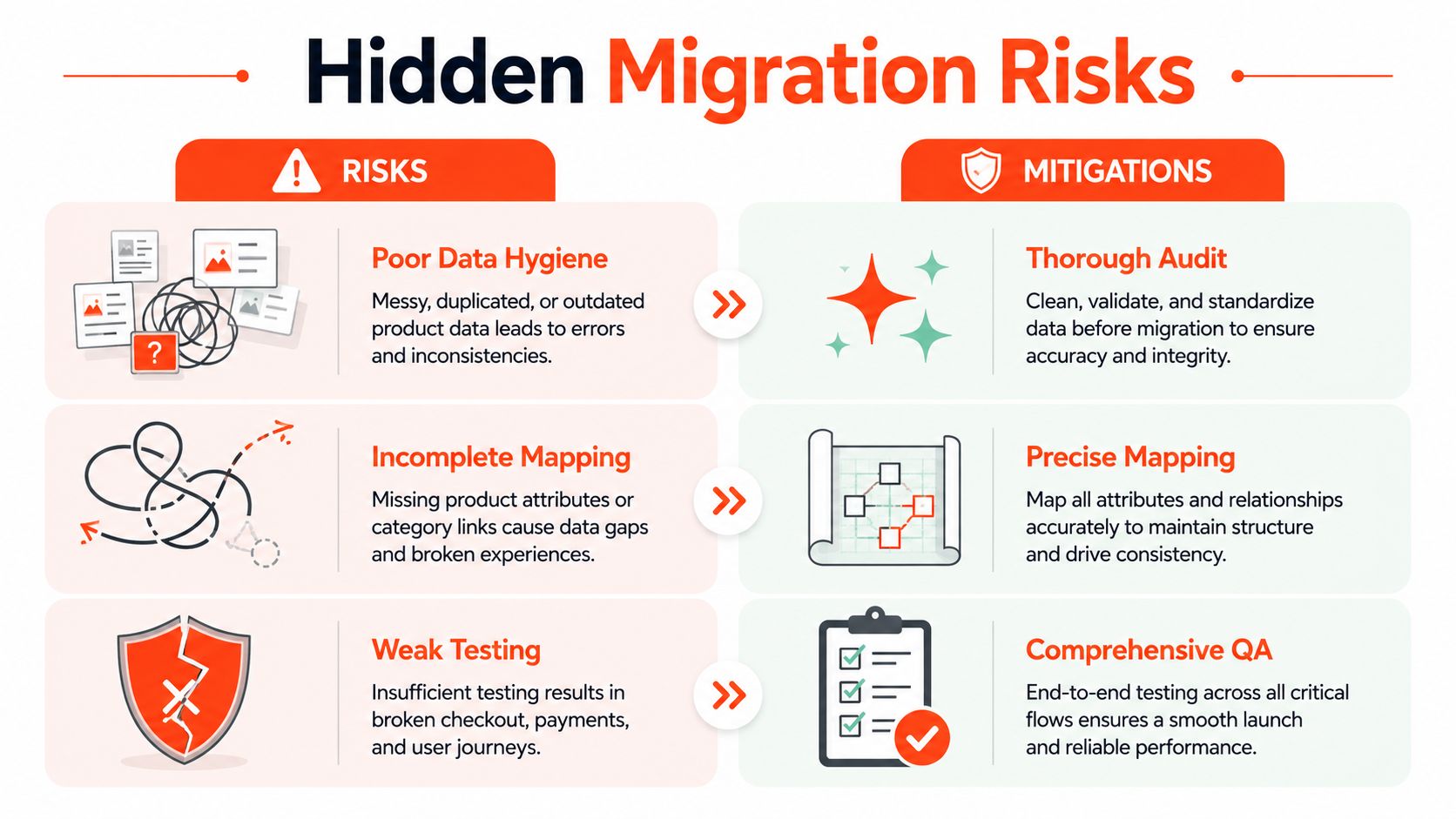
Poor data hygiene is the first one. Duplicated SKUs, inconsistent naming, and incomplete customer records create downstream problems that show up in reports, support tickets, and merchandising workflows. Incomplete mapping is the second, especially when teams forget how categories, tags, attributes, and content blocks interact across systems.
Weak testing is the third. A checkout that works in one scenario but fails when a customer uses a discount, a subscription, or a different shipping profile can still look fine in a basic smoke test. Structured QA matters more than a quick visual review.
The last common problem is assuming the launch is the finish line. It is not. Search engines, analytics, and support teams all need a verified handoff after go-live, because migration issues often appear when real traffic hits the new store. If redirects are part of your risk surface, keep URL continuity in the scoping conversation from the start, and use this redirect resource as a reference point.
A good migration framework exists to force these mismatches into the open early, because complex catalogs and enterprise integrations rarely survive a naive lift-and-shift intact.
How to Evaluate Shopify Migration Pricing and Scope
Pricing varies because scope varies, and the people writing the cheapest quote are often making the broadest assumptions. The right comparison is not “who's lowest,” it's “who has priced the work I need.” If two proposals can't be compared line by line, they're not comparable.
Compare the models, not just the totals
Fixed-scope migrations work best when the catalog is clean, the integrations are limited, and the design changes are modest. They're easy to budget, but they can become brittle if hidden complexity appears late. Phased engagements handle larger or messier stores better because they separate discovery, build, and launch into distinct commitments.
Retainer-style support makes sense when the migration is part of a broader transformation, especially if the brand expects post-launch optimization, iterative merchandising changes, or ongoing technical improvements. That model is less about a single go-live and more about keeping the store moving after the migration is done.
Typical Shopify Migration Scope Drivers | Low Complexity | High Complexity |
|---|---|---|
Catalog shape | Clean products and simple variants | Custom bundles, irregular attributes, or legacy product logic |
Integrations | Few core tools | Multiple ERP, CRM, fulfillment, and marketing connections |
Design work | Theme adaptation | Custom storefront rebuild or headless work |
Content volume | Limited pages and blog content | Heavy editorial content and SEO-sensitive archives |
Operational risk | Simple cutover | Complex launch windows, support coordination, and rollback needs |
The table above is the fastest way to spot a quote that's been flattened too hard. If a proposal ignores any of those rows, the missing work usually turns into a change order later.
Ask what's actually included
A real scope should answer how products, customers, orders, pages, redirects, and metadata will be handled, and what gets verified before launch. It should also be explicit about who owns QA, who signs off on content, and who monitors the store after cutover. For a second opinion on how a partner should frame a broader Shopify engagement, compare the proposal against this Shopify Plus agency guide.
Budget for uncertainty, not optimism. The stores that launch cleanly are usually the ones where complexity was named early instead of discovered in week eight.
Cheapest is rarely cheapest once the hidden work appears. The better question is whether the quote covers the shape of your business, or just the easiest parts to promise.
How Presidio Approaches Shopify Migrations
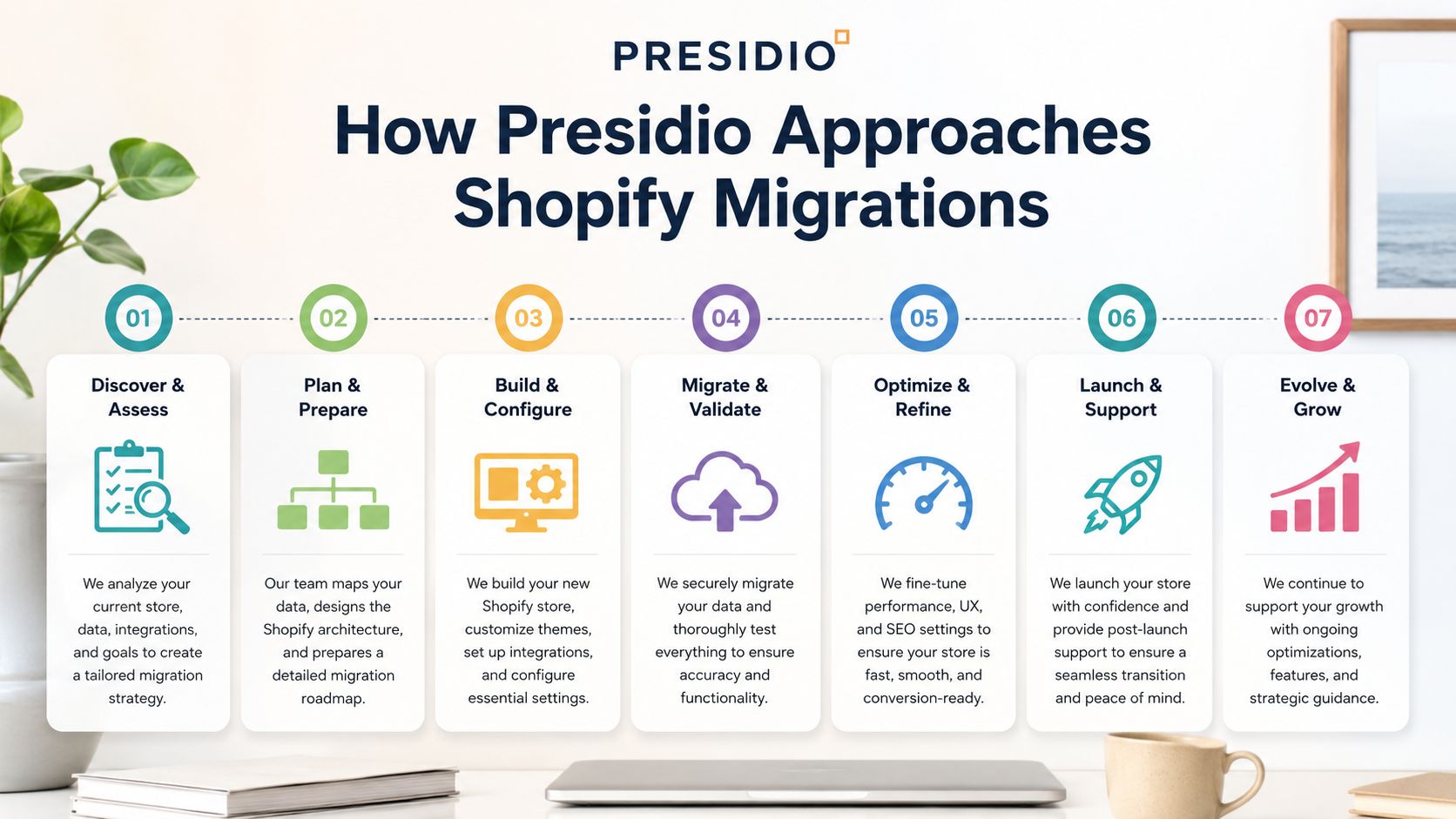
Presidio's migration approach makes sense if you've been burned by tool-heavy implementations before. It combines agency delivery with a product studio mindset, so the team can reduce reliance on patchwork tooling and build a store that's easier to maintain after launch. That matters because the value of a migration is what happens after the old platform is gone.
Why the model matters
A hybrid agency and product studio can keep the migration grounded in reusable components, custom apps, and maintainable storefront patterns. Presidio's toolkit includes premium themes, custom development, and apps for things like quizzes and discount logic, which helps avoid overbuilding with scattered third-party dependencies. That matters on complex projects, where the wrong shortcut creates maintenance debt almost immediately.
The practical benefit is cleaner handoff. If the migration leaves you with a storefront that depends on fewer brittle fixes, your team can move faster later without reopening the architecture every time a new initiative comes up. That's especially useful for brands that need subscriptions, advanced merchandising, or headless flexibility without turning the stack into a zoo of one-off plugins.
Presidio also brings a track record across brands that operate at serious scale, including OUAI, Bobbie, OLIPOP, Momofuku, NOBULL, KHY, Acure, Vintner's Daughter, FlavCity, and Good Good Golf. That portfolio matters less as a badge and more as a signal that the team has had to solve for different catalog shapes, operational constraints, and growth models.
For migration buyers, the key question is whether the partner can leave you with a store that's both functional and maintainable. Presidio's approach is built around that standard, which is the right lens for any migration service, not just their own.
Planning Your Next Replatforming Move
The cleanest way to choose a partner is to start with the stack you already have. Inventory the systems that touch commerce, decide what has to survive launch unchanged, and separate the nice-to-have redesign work from the migration work that protects revenue. Then ask every vendor to show how they handle data mapping, QA, redirects, and post-launch support in writing.
Stakeholder alignment matters just as much. Marketing needs to know how content and campaigns will be handled, operations needs visibility into inventory and fulfillment, and engineering needs a realistic cutover plan. If support or help desk workflows are part of the move, it's smart to review a broader systems guide like Halo AI's help desk automation migration guide so service continuity doesn't get overlooked.
The strongest migration conversations are the ones that ask for evidence, not promises. Ask to see sample mapping logic, staging checkpoints, launch validation steps, and the exact assumptions behind the quote. If the answers are vague, the project probably is too.
Presidio plans and delivers Shopify migrations for brands that need the move to hold up operationally, not just look good on launch day. If you're weighing a replatform, visit Presidio to see how their migration, theme, and custom development work fits the kind of store you're trying to run.

Jamie, Presidio’s Designer, leads the practice alongside Johnnie. With over 10 years of e-commerce experience, Jay is a Shopify expert, known for crafting innovative solutions that prevent tech debt.
Jaime
Senior Product Designer, 2020