Presidio

You've inherited a Shopify store that technically works, but every change feels dangerous. Marketing wants new landing pages, merchandising wants better collection logic, finance wants cleaner ERP data, and your developer is warning that another app may slow the storefront or interfere with checkout. Meanwhile, three Shopify partners have sent proposals that all promise a “high-converting, scalable experience.”
The deliverables look similar because the proposals describe the storefront. They rarely describe the operating model behind it. Shopify website development services are not a one-time website purchase. They're a decision about who will maintain your codebase, govern your apps, protect accessibility, and help your team make better changes for years after launch.
Table of Contents
What a Shopify Service Engagement Looks Like in Practice
An ecommerce director reviewing partners after a failed replatform usually starts with a spreadsheet. One proposal lists strategy, design, development, migration, and launch. Another lists almost the same deliverables. A third adds CRO and post-launch support. On paper, all three look interchangeable.
They aren't. The important differences sit underneath the scope. One partner may hand over a theme and disappear. Another may keep selling change requests without taking ownership of the roadmap. A stronger engagement gives your team a durable technical foundation and a repeatable way to improve it.
A serious Shopify engagement has four operating layers:
Discovery that challenges the brief: The team audits the existing store, catalog, integrations, customer journeys, content model, and commercial constraints before committing to a solution. Discovery should expose whether a requirement belongs in the theme, a Shopify Function, an app, an ERP, or a process change.
A build measured by validation gates: Progress should be demonstrated through working vertical slices, not a reassuring calendar. A collection experience, product page, cart, checkout extension, and operational integration should be validated as connected capabilities.
A controlled launch window: The partner needs a cutover plan, data checks, redirect validation, monitoring, and a rollback path. “We'll fix it after launch” isn't a launch strategy.
An operating layer after release: The contract should define theme maintenance, app reviews, CRO work, accessibility remediation, performance monitoring, and feature delivery after the initial excitement fades.
What to look for in the proposal
Ask for named team members, not only role descriptions. You should know who owns architecture, who writes the theme code, who handles integrations, and who approves releases.
Request concrete handoff artifacts, including the repository structure, environment documentation, data mappings, app inventory, design system, QA records, and unresolved-risk register. A partner that can't describe the handoff usually hasn't designed it.
Practical rule: If the proposal explains what will ship but not how the store will be operated afterward, you're buying a launch event, not a development partnership.
Finally, ask how the roadmap continues through the first year. The right cadence might include monthly prioritization, quarterly technical reviews, and a backlog tied to commercial goals. The exact schedule matters less than whether the partner remains accountable when the store becomes part of everyday merchandising and marketing work.
Core Scopes of Shopify Website Development Services
Shopify development services aren't one standardized package. The right scope depends on how much control your brand needs, how complex your operations are, and how much integration overhead your team can support.
Custom theme development
For most DTC brands, a custom Online Store 2.0 theme is the sensible default. It gives designers control over brand expression and gives developers a structured foundation for reusable sections, templates, metafields, and editorial flexibility. It can also reduce the need for overlapping front-end apps when the requirement belongs in the theme.
Shopify describes the theme as the core control layer for a store's organization, features, and visual presentation. Its theme architecture documentation also explains how theme app extensions allow developers to add app blocks, embed blocks, assets, and snippets without directly modifying theme code. That separation supports cleaner upgrades and reduces theme drift.
Headless commerce
Headless development separates Shopify's commerce engine from the customer-facing front end. A Hydrogen storefront with a custom CMS can make sense when the brand has unusually complex merchandising, editorial publishing, international experiences, or a performance strategy that justifies additional integration work.
The trade-off is operational. Your team now owns more systems, deployment paths, caching decisions, preview workflows, and front-end dependencies. Headless isn't automatically faster or more flexible in business terms. Choose it when the customer experience requires that architecture, not because it sounds more advanced.
Migration and replatforming
A migration from Magento, WooCommerce, BigCommerce, or a custom monolith is a data and search project as much as a design project. The scope should cover product and customer mapping, order history decisions, URL redirects, collection logic, metadata, analytics, tax behavior, subscriptions, and operational integrations.
A visually improved storefront can't compensate for lost rankings, broken customer records, or an order flow that finance can't reconcile. Treat migration planning as risk reduction, not administrative preparation.
Integrations and custom apps
Integrations connect Shopify to the systems your business already depends on, including ERP, PIM, subscriptions, loyalty, fulfillment, and customer service. Custom apps and Shopify Functions are appropriate when native features don't express the business rule cleanly.
Scope | Best fit | Complexity | Typical risk |
|---|---|---|---|
Custom theme | DTC brands needing control, speed, and maintainable merchandising | Moderate | Over-customization or unnecessary app dependency |
Headless storefront | Complex content, international, or composable experiences | High | Integration overhead and fragmented ownership |
Migration | Brands moving from another commerce platform | High | Data loss, SEO disruption, and operational downtime |
Integrations and apps | Businesses with specialized workflows or rules | Moderate to high | Sync failures, checkout conflicts, and unclear ownership |
The partner should explain why each capability belongs in a particular layer. A good recommendation isn't “Shopify can do it.” It's “this is the lowest-maintenance place to put it.”
How Shopify Development Projects Are Priced
The cheapest proposal is often the most expensive one to operate. A low initial fee may exclude content migration, integration edge cases, QA depth, accessibility work, or the post-launch support needed to keep the store stable.
Three commercial structures appear regularly.
Fixed fee works when the theme scope, templates, content responsibilities, integrations, and acceptance criteria are clearly defined. It gives you budget certainty, but it makes change expensive. If the contract doesn't define assumptions and change control, both sides end up negotiating every new requirement.
Retainer fits a brand with a living backlog. The team may work across CRO, landing pages, feature development, technical maintenance, and experimentation each month. Retainers create continuity, but only if the partner commits to a clear capacity model, prioritization process, response expectations, and delivery reporting.
Time and materials suits discovery-heavy work or integrations where the final shape can't be known upfront. It offers flexibility, but your team carries more budget risk. Use it with a capped discovery phase, transparent estimates, and regular demonstrations.
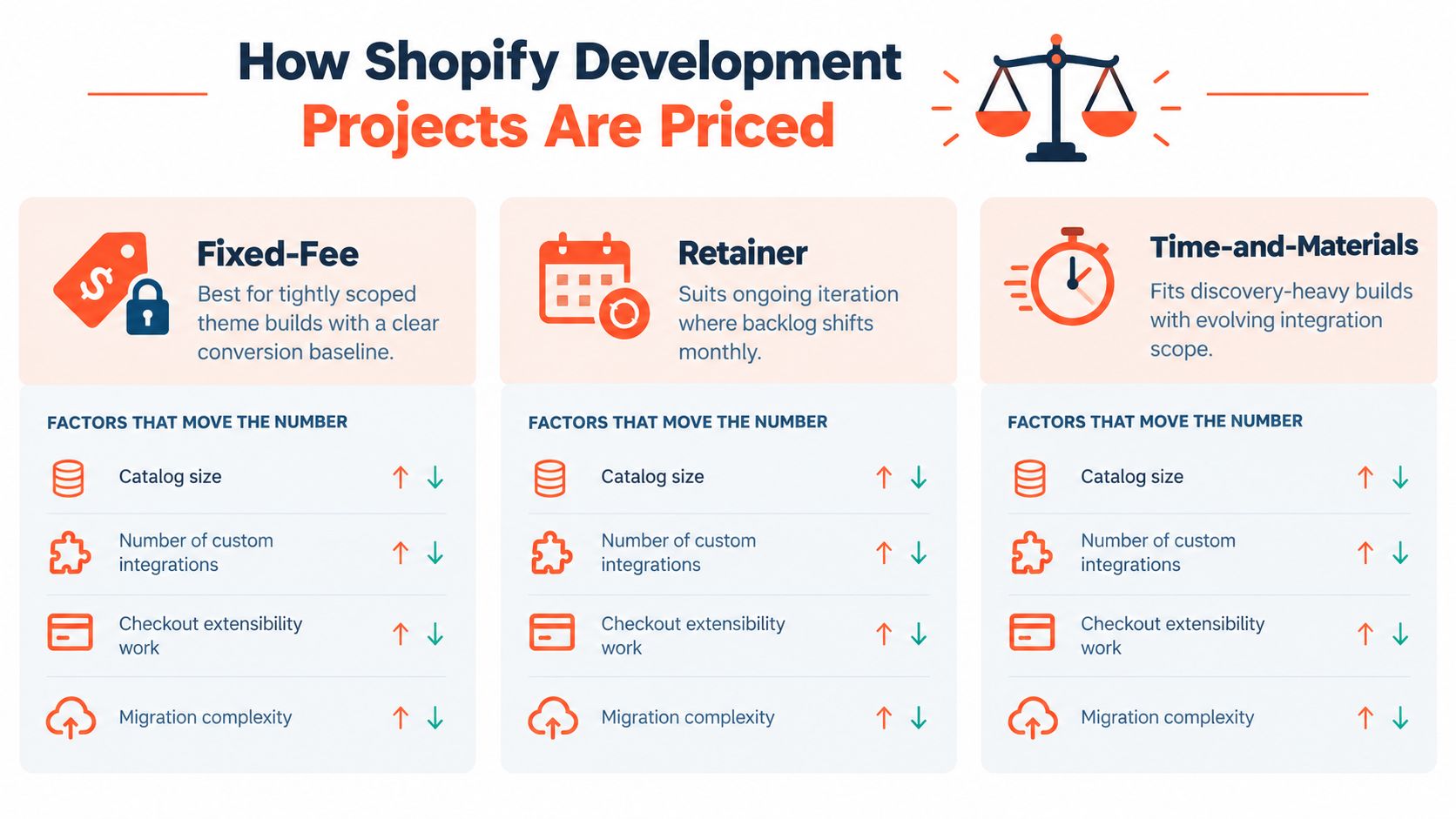
The inputs that change the commercial picture
The number of templates matters more than the number of pages. A product detail template with complex personalization, subscription logic, reviews, bundles, and merchandising rules carries more risk than several simple editorial pages.
Other cost drivers include:
Integration count and depth: A read-only catalog connection is different from bi-directional inventory, pricing, customer, and order synchronization.
Custom app development: A reusable internal tool may cost more initially but replace recurring app fees and reduce conflicts later.
Checkout extensibility: Requirements that affect checkout, discounts, payment behavior, or validation need specialized planning and testing.
Migration complexity: Data quality, redirect mapping, historical orders, subscriptions, and international structures can expand the work quickly.
Design depth: A mature design system and validated components reduce rework. Bespoke interaction patterns require more design, development, and QA effort.
For a useful commercial comparison, separate the build fee from the first operating cycle. This guide to ecommerce website cost is useful as a budgeting reference, but your own scope should determine the estimate. Demand a line-item view of assumptions, exclusions, dependencies, and post-launch coverage rather than accepting a single attractive total.
A Realistic Build Lifecycle From Discovery to Launch
A Shopify Plus build should move through validation gates, not just dates on a project plan. Calendar milestones can create the illusion of progress while unresolved decisions accumulate in the background.
Gate one, discovery
The team establishes the commercial and technical baseline. That includes business constraints, catalog structure, customer journeys, integrations, markets, content ownership, analytics, and success measures. It should also identify what will remain native, what requires customization, and what should be removed from the current stack.
Discovery ends with decisions, not a mood board. You need an approved scope, known risks, an initial data model, and a list of assumptions that someone owns.
Gate two, architecture
Solution design turns those decisions into a sitemap, component model, data structure, and reference architecture. The team chooses between Liquid and a headless approach, defines app boundaries, maps integrations, and identifies checkout extension points.
Here an experienced custom Shopify theme development team should explain trade-offs in language your engineering and commercial teams can both understand. If the architecture can't be connected to operating cost and delivery risk, it isn't finished.
Gate three, vertical-slice build
Build customer-facing capabilities end to end. A product-page slice might include the design system component, Liquid implementation, product data, reviews, subscription behavior, analytics events, accessibility states, and mobile QA. This approach exposes integration and content problems earlier than a design-first handoff followed by a long coding phase.
Gate four, quality assurance
QA must cover more than browser screenshots. Test device and browser combinations, real payment and tax providers, discounts, subscriptions, account flows, inventory behavior, analytics, and failure states. Accessibility deserves its own acceptance criteria. Shopify states that WCAG 2.2 is its guiding principle, with daily automated testing, checks on code changes and merges, and annual manual testing against its accessibility checklist through its accessibility practices.

Gate five, launch and hypercare
Use a staged cutover where possible. Monitor storefront errors, checkout behavior, redirects, search visibility, and key customer paths. Keep a rollback plan and define who can make launch decisions.
The project isn't complete when DNS changes or the new theme is published. A defined hypercare period should resolve defects, confirm integrations, review real orders, and transfer operational knowledge to the merchant team.
Comparing Boutique, Full Service, and Product Studio Models
Partner structure affects delivery more than most procurement documents admit. The question isn't which model sounds most complete. It's which model gives your brand the right mix of speed, technical depth, continuity, and commercial accountability.
A boutique studio can be excellent for a focused theme build or a contained redesign. You usually get direct access to senior people and fewer layers between brief and implementation. The risk is capacity. A small team may struggle with a complex migration, multiple systems, or sustained support after launch.
A full-service agency can combine brand strategy, creative, media, UX, and development. That simplifies vendor management when the work genuinely spans those disciplines. It can also add account layers, handoffs, and retainer pressure when your immediate need is a technically disciplined Shopify build.
A product studio typically combines an engineering pod with reusable components, tools, apps, and longer-term roadmap ownership. It can offer more depth than a small boutique while staying closer to the code than a large agency structure. The critical question is whether the studio maintains the products and foundations it uses, or merely repackages agency work.
Criterion | Boutique studio | Full-service agency | Product studio |
|---|---|---|---|
Speed of build | Fast for focused scopes | Variable, depending on team layers | Fast when the foundation fits |
Roadmap ownership | Often limited after launch | Usually tied to account and retainer teams | Designed for continued product iteration |
Tooling | Project-specific | Broad creative and marketing stack | Reusable modules, apps, and engineering practices |
Support | Depends heavily on founders or core team | Formal, but potentially layered | Dedicated technical continuity |
Best fit | Clear redesign or contained theme work | Multi-channel transformation | Growth brands needing build plus ongoing evolution |
The questions that reveal the difference
Ask who owns the repository after handoff. Ask whether the people selling the work will remain involved. Ask how the partner handles an app that becomes redundant after a native feature release. Ask for an example of a decision that reduced scope or recurring complexity rather than increased the invoice.
The strongest model for a growth-stage DTC brand is often hybrid. You get agency-level execution for the launch and product-studio discipline for the codebase, tooling, and roadmap that follow.
Long Term Outcomes That Matter After Launch
The launch is a single event. The store's real quality becomes visible in the months that follow, when marketers publish changes, Shopify releases updates, apps modify storefront behavior, and customers encounter edge cases nobody saw in a staging environment.
Performance is the first operational signal. Teams should set a performance budget, monitor mobile experience, and investigate regression causes instead of treating speed as a launch-only task. The exact target depends on the storefront, content, and customer journey, but the discipline is consistent: measure, assign ownership, and prevent new features from consuming the budget.
Maintainability is the second signal. Shopify reports $378 billion in gross merchandise volume and $11.56 billion in revenue for fiscal 2025, while its latest investor materials show the infrastructure operating at substantial commerce scale. Your implementation doesn't need to copy that scale, but it does need an architecture that can support increasingly important transactions without becoming fragile.
App governance is a commercial discipline
The app question is not just how many apps you have. It's whether each app earns its place in the storefront and operating model. Recent Shopify performance guidance describes stores commonly running 15 to 20 apps, and warns that more than about eight front-end apps often correlates with mobile LCP above three seconds. Those figures come from the industry analysis of third-party app performance, so treat them as directional rather than as a universal threshold.
Review every app for purpose, rendered assets, checkout interaction, data ownership, subscription cost, fallback behavior, and replacement options. Native Shopify features or custom functions may be preferable when the requirement is central to merchandising or checkout and will remain important for the foreseeable future.
Accessibility must survive real content
A theme that passes a review can still fail when apps, product content, account areas, and custom checkout changes are added. One 2026 benchmark reported only 5 to 11% of audited Shopify stores reaching WCAG 2.2 AA conformance under a strict checkout standard, while 30 to 40% appeared compliant at theme level but failed after apps, content, and customizations were included, according to the benchmark's Shopify accessibility coverage.

That makes accessibility a code and QA discipline, not a checkbox. The same principle applies to CRO. Experimentation needs reliable analytics, clear ownership, and a front end that marketers can modify without destabilizing core purchase paths.
A good partner doesn't only help you ship the next feature. They help you keep shipping without making the store harder to understand.
How to Evaluate and Shortlist a Shopify Partner
Run partner selection like a technical and commercial diligence process. A polished case-study deck proves very little if the team can't explain its architecture, acceptance criteria, or post-launch operating model.
Start with proof of capability
Ask for live examples that resemble your catalog complexity, average order economics, subscription model, international footprint, and integration scope. Request a code walkthrough from a Liquid theme or Hydrogen storefront. You don't need every line explained. You do need to see whether the developer can discuss data boundaries, performance, accessibility states, and upgrade safety.
Confirm the partner's Shopify experience and, if relevant, Shopify Plus capabilities. Ask which parts of the proposed build are native, theme-based, app-based, custom, or headless. A partner that recommends the same architecture for every merchant isn't doing discovery.
Test the process before signing
Require a written statement of work with acceptance criteria. It should define content responsibilities, data migration assumptions, integration behavior, QA coverage, launch support, change-request pricing, and repository ownership.
Ask these questions directly:
Replatforming: What was the last migration that slipped, and what caused it?
Change control: How are new requests estimated, approved, and prioritized?
Technical ownership: Who writes the code, and who owns the repository after handover?
Monthly support: What does a typical retainer include, and what falls outside it?
App governance: How do you decide whether to retain, replace, or custom-build a capability?
Accessibility: How are product pages, account areas, apps, and checkout changes tested?
Request two references, not one. Speak with a client in growth mode and another in maintenance mode. The first can tell you whether the team ships. The second can tell you whether the team remains useful after the launch budget is spent.
Watch for operational red flags
Walk away from estimates produced without discovery, unnamed developers, vague “best practice” language, and proposals that promise speed without describing QA. Treat an inability to explain Liquid versus headless trade-offs as a serious warning.
A partner should also be able to describe what happens when an app conflicts with checkout, when a release changes theme behavior, or when a content editor introduces an inaccessible component. Those answers reveal whether you're hiring a delivery team or a sales process.
For a focused comparison of capabilities and engagement fit, use this Shopify Plus agency evaluation resource alongside your own interviews and reference checks.
Treating Development as a Long Term Operating Decision
A Shopify store is a codebase with a checkout attached. The code ages, dependencies change, apps accumulate, and the platform evolves. Shopify says its merchant base spans millions of businesses in more than 175 countries, and its Spring ’26 Edition documents continued changes to merchant-facing capabilities and checkout. A build that only works under today's assumptions will create friction as the business expands.
That's why the engagement should include version-controlled themes, documented release procedures, app ownership, accessibility checks, and a recurring performance review. The partner should maintain a roadmap tied to customer friction, revenue opportunities, operational efficiency, and platform changes, not a list of hours that needs to be consumed.
Make the first 90 days diagnostic
The first operating cycle should establish evidence before major recommendations are made:
Baseline storefront performance: Record the current mobile experience, key templates, checkout path, and major third-party scripts.
Run an accessibility audit: Include theme components, product content, navigation, account flows, app output, and checkout-related changes.
Inventory the app stack: Document each app's purpose, owner, subscription cost, rendered assets, data dependencies, and replacement options.
Review the data layer: Confirm that analytics events, consent behavior, merchandising signals, and purchase events are reliable.
Prioritize two CRO hypotheses: Choose specific customer or merchandising problems, define the evidence required, and agree on how the team will evaluate the result.
This work changes the relationship. Instead of re-pitching the same strategy at every renewal, your team and partner build on a shared technical and commercial record. The hybrid agency-and-product-studio model is valuable when it combines hands-on delivery with reusable foundations, maintained tools, and genuine roadmap ownership.
Choose Shopify website development services with the next release in mind, not only the next launch. If you need a partner for custom themes, Shopify apps, migrations, integrations, performance work, accessibility, and ongoing optimization, Presidio can help assess the current store and define a maintainable Shopify or Shopify Plus roadmap. Start with a technical and commercial review, then ask for a first-90-days plan tied to the problems your ecommerce team needs to solve.

Jamie, Presidio’s Designer, leads the practice alongside Johnnie. With over 10 years of e-commerce experience, Jay is a Shopify expert, known for crafting innovative solutions that prevent tech debt.
Jaime
Senior Product Designer, 2020