Presidio

You're probably not choosing a language in isolation. You're choosing a way to ship a Shopify app that must authenticate merchants, survive webhook traffic, fit Shopify's extension model, run on a host your team can operate, and remain understandable after the original developer moves on. A public App Store listing, a private integration for one retailer, and a checkout customization can all justify different answers to the same search query, “best language for creating apps.”
For Shopify teams, the practical choice usually comes down to TypeScript, JavaScript, Python, Ruby, Go, Liquid, or Rust in a tightly constrained runtime. The right option depends less on language rankings and more on the extension point, merchant audience, existing team skills, deployment model, and long-term maintenance burden.
Table of Contents
Why There Is No Single Best Language for Creating Apps
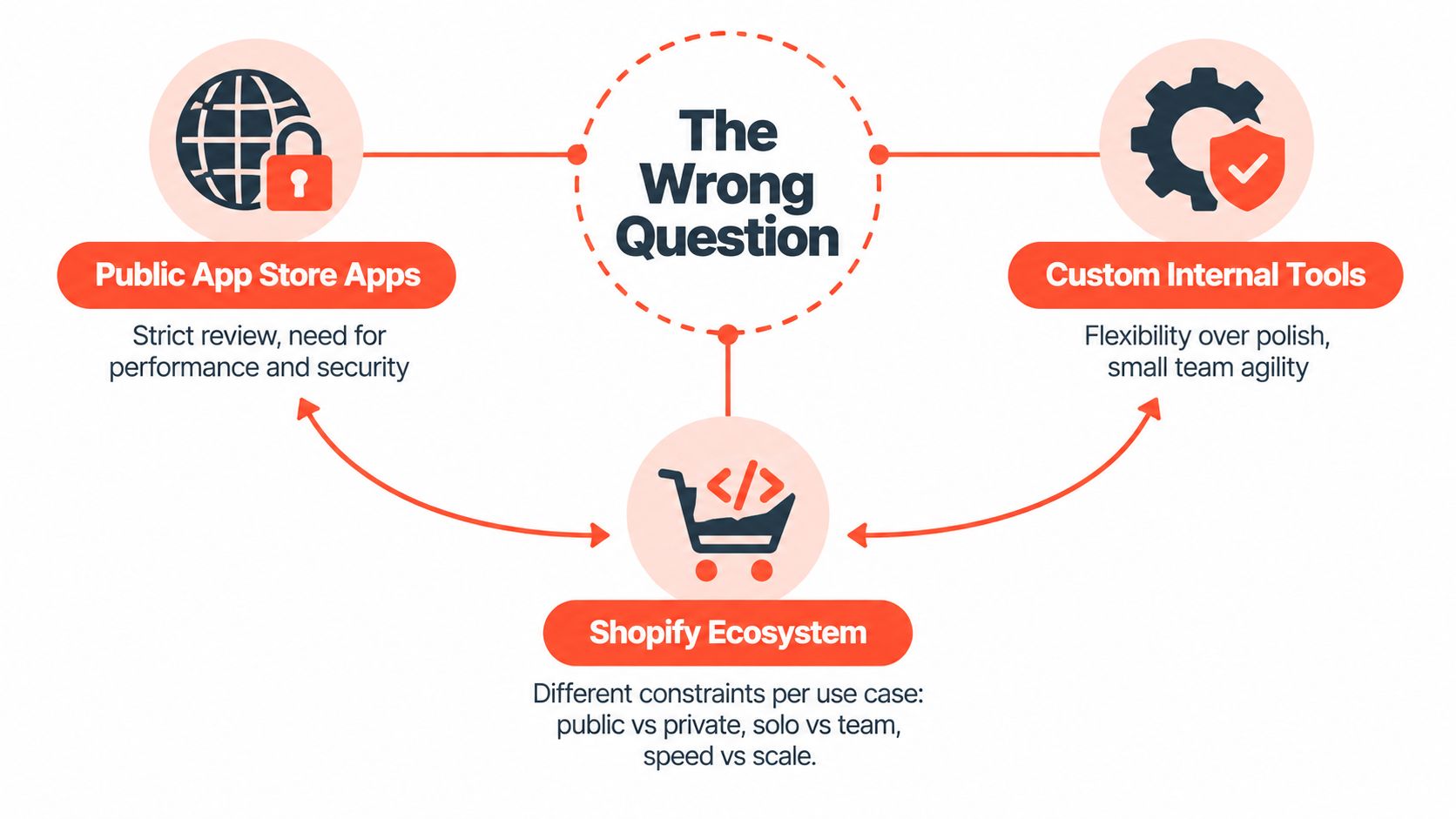
A universal winner doesn't exist because Shopify isn't one runtime. A public embedded app may use Remix, React, Polaris, App Bridge, OAuth, webhooks, and Shopify's Admin GraphQL API. A custom storefront may rely on Liquid or Hydrogen. Shopify Functions and checkout extensions introduce their own execution constraints, while an operations integration may spend most of its life processing webhooks and synchronizing data in a back-end service.
Those environments reward different decisions. A language that feels productive for an admin dashboard may be awkward for a Function. A fast back-end may still create unnecessary work if the team lacks front-end experience with Polaris. A familiar PHP or Rails application can be the sensible choice for a single-merchant tool, even when a new public app would align more naturally with Shopify's current JavaScript ecosystem.
Start with the extension point
Shopify's extension surface should be the first filter:
Public App Store apps need reliable installation, OAuth, webhook handling, billing, embedded navigation, and a maintainable merchant-facing UI.
Admin extensions benefit from Shopify's React-oriented tooling and Polaris conventions.
Checkout extensions and Functions operate within Shopify-defined capabilities and runtime boundaries. The available APIs matter more than a general-purpose language preference.
Custom storefronts may be Liquid-first, Hydrogen-based, or a hybrid, depending on the buyer experience and rendering strategy.
Internal tools can favor the team's existing framework because App Store distribution and broad merchant support aren't part of the problem.
Practical rule: Decide where the code must run before deciding what language should write it.
The wider mobile market reinforces this context-first view. Swift and Kotlin are the dominant native choices, with one industry dataset reporting 79% of iOS apps written in Swift and 77% of Android apps using Kotlin (CodeBridge's mobile language analysis). That doesn't make either language the universal best language for creating apps. It shows that platform constraints shape sensible choices.
For Shopify, the equivalent question is not “Which language is most popular?” It's “Which language gives this team the shortest path to a reliable implementation at the Shopify extension point we need?”
The Shopify App Ecosystem and Where Each Language Fits
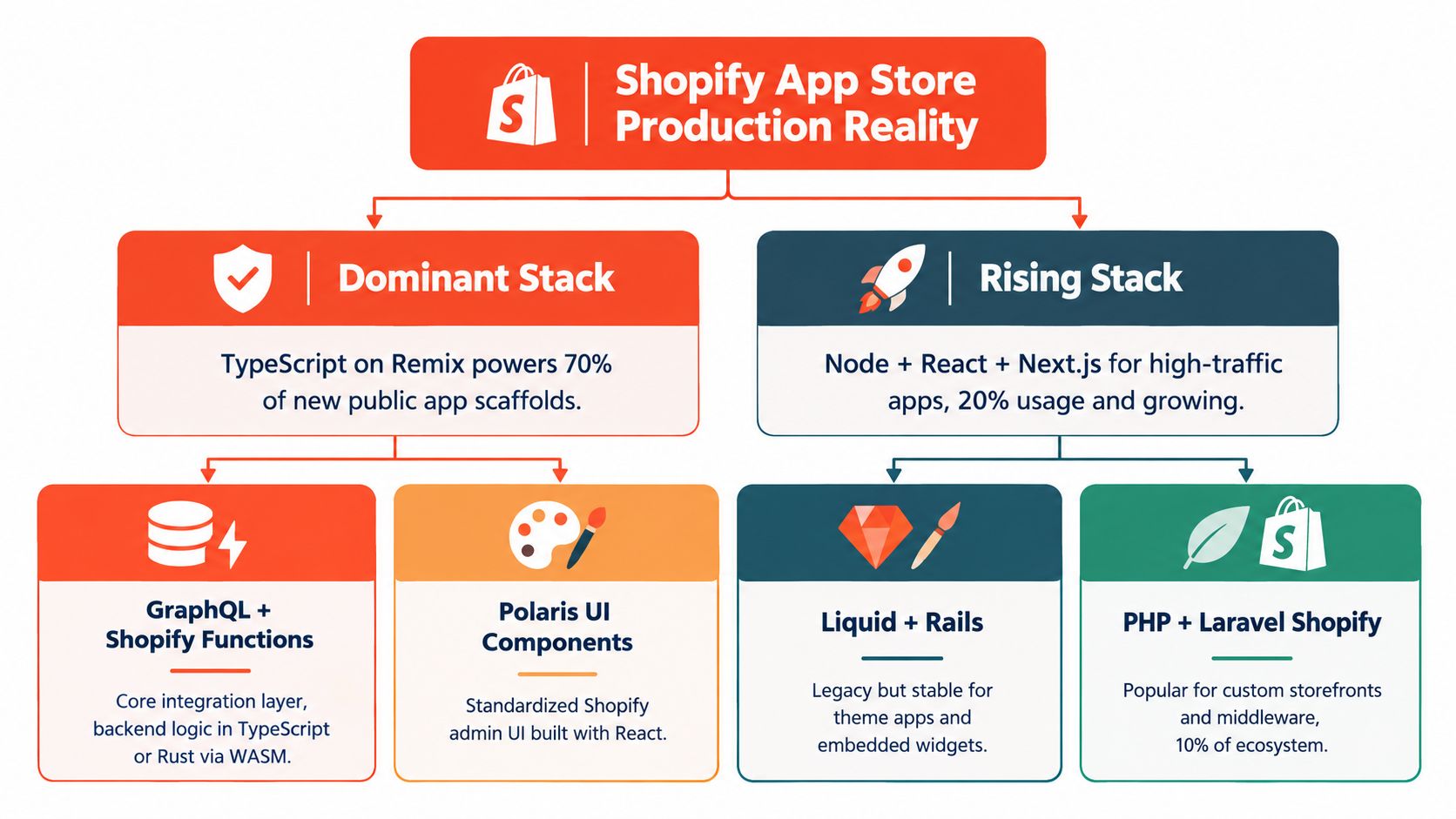
Shopify's current production gravity points toward JavaScript and TypeScript, especially for public apps with embedded admin interfaces. Shopify CLI, React-based UI patterns, App Bridge, Polaris, and the Remix app template create a connected workflow that reduces the amount of framework glue a team must assemble itself.
That advantage is practical rather than ideological. TypeScript can keep front-end components, loaders, actions, API clients, and webhook handlers in one familiar environment. Generated types and established Shopify examples also make it easier for a new developer to understand the expected integration shape.
Where the main stacks appear
TypeScript on Remix is a strong default for a public embedded app. Remix's request-oriented model maps naturally to authenticated routes, server-side data loading, form actions, and webhook endpoints. React and Polaris cover the admin interface, while Shopify CLI helps teams create and test app projects and extensions.
JavaScript on Node.js remains useful when a team already operates Express, Koa, or another Node service. It can handle API orchestration, webhook receivers, queues, and integrations effectively, although a JavaScript-only codebase gives up some of TypeScript's compile-time guidance.
Ruby on Rails still fits teams with established Rails conventions, mature internal tooling, and a preference for convention over configuration. It can be productive for merchant portals and back-office workflows, but developers may need to assemble more of the current Shopify UI and extension experience themselves.
Python suits data-heavy applications, catalog processing, analytics, recommendation pipelines, and integrations where Django or FastAPI experience already exists. The trade-off is that Shopify's most visible application examples and typings tend to be stronger in the JavaScript and TypeScript path.
Go can be valuable for high-concurrency services, webhook processing, and focused integration APIs. It usually isn't the easiest choice for a team that also needs to build a polished embedded admin UI, because the front end still lives in a separate JavaScript or TypeScript world.
Liquid remains the right answer for theme-level work that doesn't need a standalone app server. It isn't a replacement for a public embedded application, but it can be the cleanest implementation for a storefront presentation problem.
Shopify's extension model is also central to architecture. Teams working on checkout behavior should understand the boundaries described in this guide to Shopify checkout extensibility, rather than assuming a conventional server route can control every checkout interaction.
The ecosystem therefore favors TypeScript, but it doesn't eliminate alternatives. The best language for creating apps in Shopify is usually the one that matches both the required extension and the team's ability to support it.
Comparing the Top Languages for Shopify App Development
Generic language benchmarks aren't enough for a Shopify project. The useful comparison includes Shopify CLI support, Polaris and App Bridge integration, GraphQL ergonomics, webhook behavior, deployment options, and how much custom infrastructure the team must maintain.
Language | Shopify CLI Support | Framework Strength | Runtime Performance | DX & Typings | Best Fit |
|---|---|---|---|---|---|
TypeScript | Strongest path through current app templates and extension workflows | Remix and React provide a cohesive public-app stack | Strong for API and webhook workloads when hosted correctly | Strong Shopify examples, generated types, and editor support | Public App Store apps and embedded admin tools |
JavaScript | Strong through Node-based tooling and libraries | Express, Koa, and React are flexible and widely understood | Effective for event-driven services and webhook receivers | Fast to start, but fewer compile-time checks than TypeScript | Existing Node teams and integration services |
Python | Usable, though less aligned with the main front-end path | Django and FastAPI are mature choices | Well suited to data processing, with deployment design affecting responsiveness | Good general tooling, but Shopify typings and examples can require more manual work | Analytics, data pipelines, and established Python back ends |
Ruby | Viable through Rails conventions and community packages | Rails remains productive for structured business applications | Capable, though embedded app response behavior needs careful hosting | Excellent Rails ergonomics, with more Shopify-specific assembly | Teams already invested in Rails |
Go | Best treated as a focused service choice | Lightweight frameworks keep services simple | Strong for concurrent webhook and integration workloads | Clear and efficient, but onboarding is less forgiving for teams unfamiliar with Go | High-throughput services and infrastructure-minded teams |
TypeScript and JavaScript
TypeScript on Remix usually wins when the product is a multi-tenant public app with a substantial admin experience. The team can share language knowledge between UI code, server routes, API clients, and background integration logic. That shared context matters more than a theoretical performance advantage.
Plain JavaScript remains a reasonable choice for a small service or an existing Node codebase. The cost appears later, when a growing app has many Shopify resources, asynchronous flows, and extension contracts. Without static checks, developers must rely more heavily on tests and runtime validation.
Teams evaluating React beyond Shopify can also use the ecosystem knowledge from building mobile apps with React Native, particularly around shared JavaScript skills and component thinking. The mobile context differs, but the staffing and reuse considerations are familiar.
Python, Ruby, and Go
Python is attractive when the app's differentiator is data work rather than admin UI. Django offers a complete application structure, while FastAPI can provide a focused API layer. The friction comes from manually bridging Shopify's JavaScript-first examples, typings, and embedded interface patterns.
Rails is often the most efficient option for a team that already knows Rails. It becomes less attractive when a developer must reproduce current Shopify embedded-app conventions without existing internal patterns. Go offers excellent service characteristics, but its terser style and smaller Shopify-specific UI footprint can slow onboarding for a product team building both the interface and the integration.
Framework Support and Developer Experience Across Stacks
Language choice becomes visible to the team through framework friction. Shopify's TypeScript path benefits from a close relationship between the app scaffold, React, Remix, Polaris, App Bridge, GraphQL clients, and Shopify CLI. A developer can move from a generated project to an authenticated route, then into an admin screen, without switching architectural idioms at every step.
That convenience doesn't remove the hard parts. Session token handling, OAuth edge cases, webhook verification, API version changes, and extension configuration still require deliberate testing. Generated scaffolding gives a starting shape, not a finished production architecture.
Language | Primary Framework | Official CLI | Hot Reload | GraphQL Typing | DX Pain Points |
|---|---|---|---|---|---|
TypeScript | Remix with React | Strongest fit | Smooth for the main app workflow | Strongest when generated or maintained consistently | Framework upgrades, dependency churn, and server/client boundaries |
JavaScript | Express or Koa with React | Good through Node workflows | Strong in common React setups | Available, but less protective without TypeScript | Runtime errors and weaker contracts across layers |
Python | Django or FastAPI | Usually supplementary rather than central | Good within framework tooling | Often requires more manual schema discipline | More integration work around Shopify's front-end conventions |
Ruby | Rails | Community and project-specific workflows | Mature Rails experience | Usable, though less central to the default Shopify path | Recreating current embedded-app patterns and managing response behavior |
Go | Lightweight HTTP frameworks | More manual project setup | Tooling is dependable but less Shopify-specific | Requires deliberate client and schema choices | Separate front-end stack and a steeper team learning curve |
The TypeScript path
Remix's loaders and actions make request boundaries explicit, which helps with Shopify session access and form-driven admin workflows. React and Polaris provide familiar components for embedded interfaces, while App Bridge handles host-aware behavior that shouldn't be rebuilt from scratch.
GraphQL typing is especially valuable when an app touches products, orders, metafields, discounts, and fulfillment data. The type system won't catch a flawed business rule, but it can expose mismatched fields and response assumptions before a merchant encounters them.
Where other frameworks still work
Rails shines when the team values established conventions, background jobs, migrations, and a cohesive business-application structure. Laravel can serve a similar role for PHP teams, particularly where merchants already have hosting and operational expertise around PHP. Developers improving a familiar utility-first workflow may also find Tailwind CSS for developers useful when the project's design system calls for custom styling beyond Polaris.
Python's strongest experience appears when the application needs data transformation, scheduled processing, or machine-learning integration. Go is compelling for a small, well-defined service that must process concurrent requests without bringing a large framework into the deployment.
Local development adds another layer. Shopify CLI, hot reload, and an ngrok tunnel can make the first request easy to test, but developers still need to inspect browser behavior, webhook retries, session expiry, and production-like API responses. The implementation guidance in how to build Shopify apps is useful as a practical reference, but no scaffold substitutes for an explicit testing and observability plan.
Hosting, Performance, and Long-Term Maintainability
A Shopify app can be technically correct and still be operationally painful. Hosting affects cold starts, background work, logs, secrets, scaling behavior, and how quickly a replacement developer can diagnose a merchant issue.
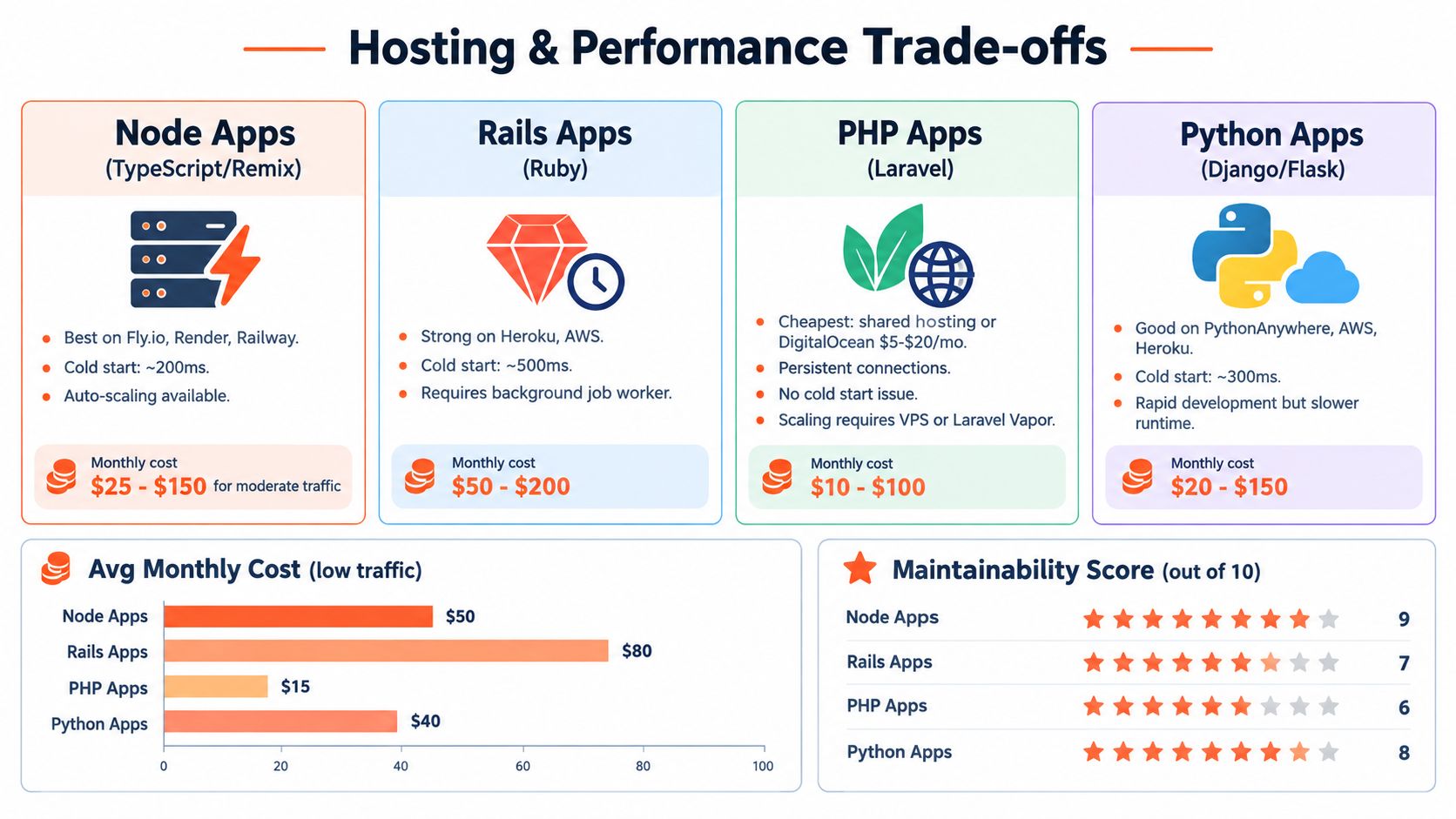
Node and TypeScript apps can run on Fly.io, Render, Railway, Vercel, or AWS. The right choice depends on whether the app needs a persistent process, scheduled workers, queues, or a serverless request model. Vercel can be convenient for request-oriented deployments, while Fly.io, Render, and Railway can feel more natural when the application has a long-running service or worker. AWS offers broader control, but that control creates more infrastructure responsibility.
Match the host to the workload
Rails applications can work well on Heroku-style platforms or Hatchbox-managed servers when the team understands workers, asset builds, database operations, and deployment rollback. PHP and Laravel may fit cPanel or shared hosting environments already operated by a merchant, although scaling a legacy deployment can become difficult once background jobs and concurrent integrations grow.
Python services can run on platforms such as AWS, Heroku, or Python-focused hosting providers. Go usually works well in container-based environments because teams can keep the service small and explicit.
Performance must be measured against real app behavior, not language reputation. For Flutter mobile projects, official guidance recommends measuring on a physical Android or iOS device in profile mode, rather than debug mode or an emulator, and its tooling tracks jank, download size, battery efficiency, and startup time (Flutter performance guidance). The same discipline applies here: test webhook throughput, API latency, queue delays, and startup behavior on the host you plan to use.
Operational test: Deploy a thin but real slice of the app before committing to the stack. Test authentication, one API query, one webhook, one background task, and one extension path.
Maintainability deserves equal weight. JavaScript dependencies can move quickly, especially across major Remix and React changes. Ruby's gem ecosystem may feel steadier, but a team that lacks Rails knowledge will pay for that familiarity gap. The most maintainable Shopify app is the one with documented deployment steps, predictable logs, tested webhook behavior, clear ownership, and few hidden platform assumptions.
The data layer can also outweigh the language decision. A 2025 Flutter and Dart benchmark recorded 32.61 ms for Isar, 33.11 ms for Sqlite3, 64.17 ms for Drift, 140.49 ms for Floor, and 1032.38 ms for Sembast across its full workload (the published ORM benchmark). The Shopify lesson is direct: database design, indexing, queues, and storage libraries can matter more than the language label on the repository.
Choosing the Right Language by Shopify App Use Case
The same team can make different language choices for different Shopify products. A theme enhancement, an embedded public app, and a checkout customization don't share the same runtime or distribution requirements.
Shopify App Use Case | Recommended Language | Supporting Framework | Why It Fits |
|---|---|---|---|
Public embedded App Store app | TypeScript | Remix, React, Polaris, App Bridge | Aligns the admin UI, authentication flow, API access, and Shopify-oriented tooling |
Custom internal merchant tool | The team's established language | Rails, Laravel, Django, FastAPI, or Node | Reduces training and can favor delivery speed over broad ecosystem alignment |
Shopify Functions | TypeScript or Rust where supported by the target Function workflow | Shopify Functions APIs and Wasm-compatible tooling | The runtime and API boundary determine the implementation more than preference |
Checkout extensibility | TypeScript-oriented extension workflow or the supported extension language | Checkout UI extensions and Shopify extension tooling | Shopify controls the extension surface, so the implementation must fit its contract |
Hydrogen custom storefront | JavaScript or TypeScript | Hydrogen and React | Matches the React storefront model and composable commerce approach |
Data-heavy integration | Python | Django, FastAPI, or task-specific data tooling | Useful for catalog transformation, analytics, and processing pipelines |
Theme-only feature | Liquid | Shopify theme architecture | Avoids introducing a separate app service when the feature belongs in the theme |
Public apps need ecosystem alignment
A multi-tenant public app typically benefits from TypeScript on Remix because the team must support many merchant configurations while maintaining a consistent embedded experience. OAuth, webhooks, billing, API versioning, and admin UI all create integration surfaces where shared types and familiar Shopify examples reduce avoidable errors.
A single-tenant integration behind a company firewall may favor Rails, Laravel, or Python. If the merchant's internal team already operates that stack, introducing TypeScript solely because it's fashionable can increase support risk rather than reduce it.
Extensions change the answer
Checkout and Function work is less flexible than ordinary back-end development. The supported runtime, API, and sandbox behavior should drive the decision. A team can keep its main service in Python or Go while isolating the Shopify-specific extension code in the language and build path Shopify requires.
Hydrogen introduces a separate storefront concern. If the buyer experience is React-based and the team already works comfortably in that ecosystem, JavaScript or TypeScript is the natural fit. Teams comparing broader cross-platform product decisions can also review AppLighter's discussion of mobile development framework choices, while keeping the Shopify storefront and mobile app constraints separate.
For a merchant-specific implementation, custom Shopify app development can help define whether the requirement belongs in a theme, an admin app, a Function, or an external integration. That architectural placement should happen before the team selects a language.
Situational Recommendations and Next Steps for Shopify Teams
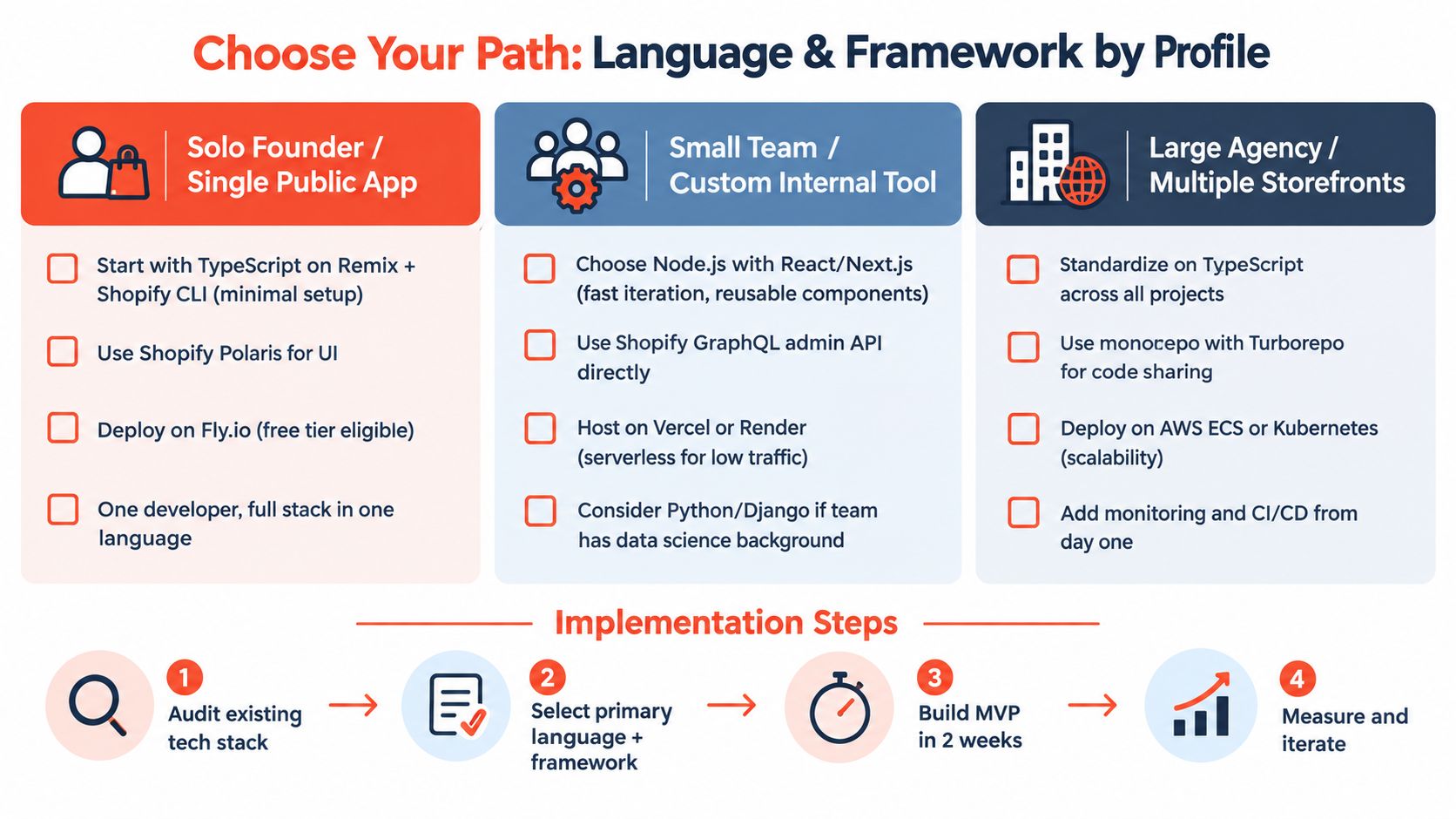
A solo founder building one public App Store app should usually start with TypeScript on Remix, using Shopify CLI and Polaris. One language across the embedded UI, server routes, webhook handlers, and API client reduces context switching and makes the first production architecture easier to explain.
An in-house ecommerce team extending checkout behavior or Functions should keep its core integration close to Shopify's supported extension workflow. TypeScript is a sensible connective layer for admin extensions and webhooks, while a separate Python service can handle specialized data processing if the team already owns that capability.
Agencies supporting several merchants need stronger conventions than a one-off internal tool. Standardizing the public-app layer on TypeScript can simplify shared components, review practices, and onboarding. A Python or Go service may still be appropriate behind that layer when data workloads or integration volume justify the additional boundary.
Validate the choice before expanding it
Use a focused validation cycle:
Scaffold the app. Create the Remix project through Shopify CLI, connect a development store, and confirm the authentication path.
Build one merchant-facing slice. Add a Polaris admin screen that reads and updates a real Shopify resource.
Exercise the extension boundary. Implement one relevant Function, admin extension, checkout extension, or theme integration.
Test operations. Deploy to the intended host and inspect startup behavior, logs, webhook retries, queue processing, and rollback steps.
Write the handover. Document environment variables, deployment commands, API scopes, data ownership, and upgrade responsibilities.
Industry adoption also shows why “best” keeps changing. Swift was introduced by Apple in 2014, Kotlin was announced by JetBrains in 2011, and Google endorsed Kotlin as its preferred Android language in 2019. A 2025 industry summary reported 2.5 million Kotlin developers worldwide, while JavaScript remained the most widely used general-purpose language at 66% of developers in the 2025 Stack Overflow survey (the mobile development statistics summary). Official platform support can reshape an ecosystem quickly, so teams should choose a stack they can upgrade and staff, not merely one that looks popular today.
Presidio offers Shopify theme and app development, including custom storefronts, headless builds, integrations, and ongoing technical support. If your team needs to turn this language decision into a maintainable Shopify implementation, visit Presidio to discuss the app surface, extension requirements, and delivery path before development begins.

Jamie, Presidio’s Designer, leads the practice alongside Johnnie. With over 10 years of e-commerce experience, Jay is a Shopify expert, known for crafting innovative solutions that prevent tech debt.
Jaime
Senior Product Designer, 2020