Presidio

A growing Shopify brand rarely decides to explore headless commerce because the team wants a more fashionable technology stack. The pressure usually starts elsewhere. Liquid customizations have spread across snippets and templates, third-party apps add scripts to every page, marketing requests wait in a development queue, and performance work keeps producing smaller gains.
The store still sells, but every change feels risky. Developers avoid touching legacy code, marketers can't launch a campaign without help, and the storefront becomes harder to adapt as the catalog, channels, and customer expectations expand. Headless ecommerce development services can address those constraints, but they aren't an automatic upgrade. They replace theme-level limitations with a more flexible architecture and a larger operating responsibility.
Table of Contents
When Your Shopify Store Outgrows Its Theme
A DTC brand might begin with a polished Shopify theme and a manageable collection of apps. Over time, the theme becomes the place where every exception lives. A product quiz needs custom logic, a subscription app modifies the product template, merchandising adds conditional sections, and a new campaign requires another set of Liquid snippets.
The visible symptoms are familiar. Landing pages take longer to produce, old code becomes difficult to trace, and app scripts compete for browser attention. Core Web Vitals can deteriorate even after the team compresses images and removes obvious code waste. The problem isn't necessarily Shopify itself. It's the accumulated coupling between presentation, business rules, theme files, and vendor scripts.
Practical rule: If a routine marketing request requires a developer to understand several unrelated theme dependencies, the architecture is already creating an operating cost.
The decision usually comes down to two paths. The first is continued theme optimization, app consolidation, and selective custom development. That path often works well when the catalog and customer journey are straightforward. The second is to separate the storefront from Shopify's commerce services, giving the frontend its own framework, deployment process, and performance strategy.
Headless is valuable when the brand needs control that a theme can't provide efficiently. A custom product configurator, highly editorial landing page system, multi-market experience, or web-and-app content model may justify the investment. A standard DTC store with modest customization may get better results from a leaner theme and fewer apps.
The right question isn't, “Can Shopify support headless?” It can. The question is whether the additional engineering, testing, documentation, and maintenance will produce enough commercial and operational value to outweigh the simplicity of a well-built theme.
Understanding Headless and Composable Commerce Architecture
Traditional Shopify commerce keeps the storefront and commerce platform closely connected. Liquid templates render the customer experience while Shopify manages products, inventory, orders, payments, and checkout within the same broader system. That structure reduces the number of systems a team must coordinate, but it also places boundaries around how the frontend is built.
Headless commerce separates the storefront, commerce engine, and presentation layer into independently deployable services, typically connected through REST or GraphQL APIs, as described in this headless ecommerce architecture guide. A custom frontend requests product, collection, cart, and customer data from Shopify, then renders the experience using its own components and delivery model.
The restaurant model
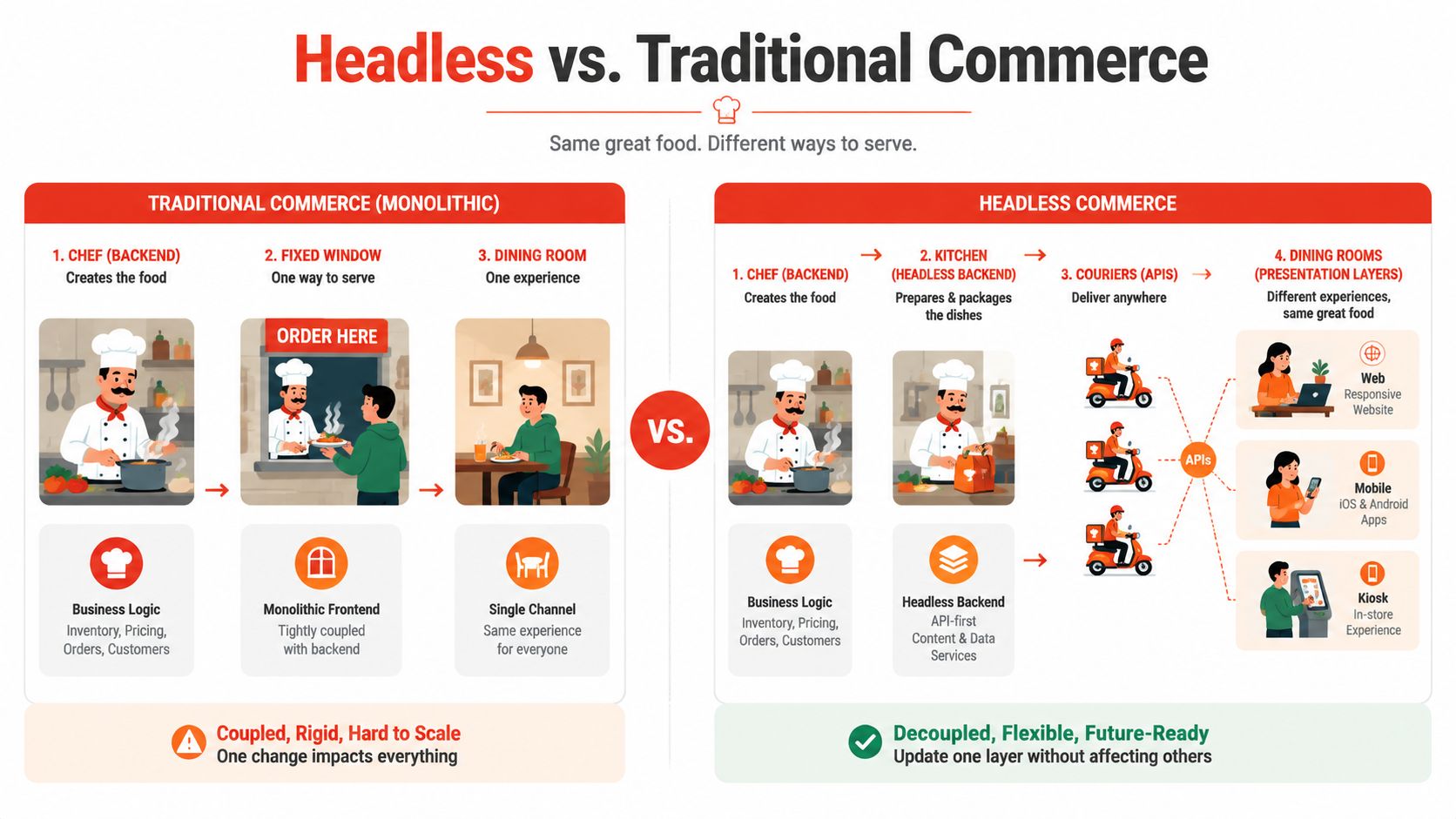
Think of a monolithic store as a restaurant where the kitchen and dining room share one fixed service window. The kitchen prepares the food, the window controls how customers receive it, and changing the service format can affect the whole operation.
In a headless setup, Shopify remains the kitchen. It continues to handle inventory, orders, product data, payments, and checkout. The frontend becomes the dining room, designed and deployed separately. APIs act like couriers, carrying commerce data to a website, mobile application, kiosk, or another presentation layer.
That separation doesn't mean abandoning the Shopify admin. Merchants can continue managing products, orders, collections, and operational workflows in Shopify. Headless also doesn't mean replacing native checkout security with a custom payment system. The implementation determines how customers move from the storefront into Shopify's checkout flow and how the team handles cart, customer, and analytics behavior around it.
Where composable commerce fits
Composable commerce takes the separation further. Instead of relying on one platform for every customer-facing capability, the brand assembles services for content, search, reviews, personalization, analytics, and other functions. A headless Shopify storefront might use Hydrogen or the Storefront API for commerce, Next.js or Remix for the frontend, Sanity or Contentful for structured content, and middleware or edge functions to coordinate requests.
That flexibility comes with more ownership. Every added service introduces authentication, monitoring, failure handling, version management, and data governance. Brands evaluating the model can also review this practical explanation of what composable commerce means before treating composability as a requirement rather than an option.
Performance and Flexibility Benefits of Going Headless
Headless architecture creates performance opportunities, but it doesn't create performance automatically. The frontend team must choose an appropriate rendering strategy, control JavaScript bundles, optimize images, cache predictable responses, and test the site under realistic conditions.
Field and industry measurements report median Largest Contentful Paint values of roughly 1.4 to 1.8 seconds for headless storefronts, compared with about 2.4 seconds for traditional platforms, while some production comparisons report a homepage LCP change from 3.2 seconds to 1.4 seconds after a move from a monolithic implementation to headless React. These figures come from Core Web Vitals measurements for headless commerce, and they should be treated as benchmarks, not promises.
Server-side rendering, static generation, and edge rendering can deliver meaningful gains when the page architecture supports them. A team can pre-render editorial content, stream product data selectively, and avoid loading every integration on the initial route. A poorly designed headless build can still ship oversized bundles, block rendering, or make too many API calls.
What changes for the engineering team
Frontend work becomes more familiar to modern product engineers. Component libraries, design tokens, pull requests, automated deployments, preview environments, and framework-level testing replace much of the theme-file workflow. Multiple developers can work on separate components without repeatedly editing the same Liquid files.
The brand also gains more freedom for experiences that don't fit a standard template. Product configurators, guided buying journeys, interactive merchandising, and content-rich campaign pages can use frontend patterns chosen for the experience rather than forced into theme conventions. Third-party services can connect through APIs, although each integration still needs a deliberate fallback and monitoring plan.
Metric | Traditional Shopify Theme | Headless Shopify Build |
|---|---|---|
Rendering control | Constrained by theme structure and Liquid templates | Controlled through the chosen frontend framework |
Release coupling | Theme and commerce changes often share one workflow | Frontend releases can be deployed independently |
Content operations | Usually tied to theme sections and platform tools | Can combine Shopify content with a dedicated CMS |
Performance ceiling | Depends heavily on theme and app behavior | Can use SSR, SSG, and edge delivery with disciplined engineering |
Maintenance profile | Simpler system, but theme and app interactions can accumulate | More flexibility, with more APIs, deployments, and monitoring |
The trade-off is clear. Headless can improve developer velocity and frontend control, but marketing teams may lose some visual editing convenience unless the CMS and component system are designed well. The same discipline that makes the storefront fast must continue after launch. A practical Shopify performance optimization process still matters, whether the team chooses a theme or a decoupled frontend.
Deciding If Headless Is Right for Your Brand
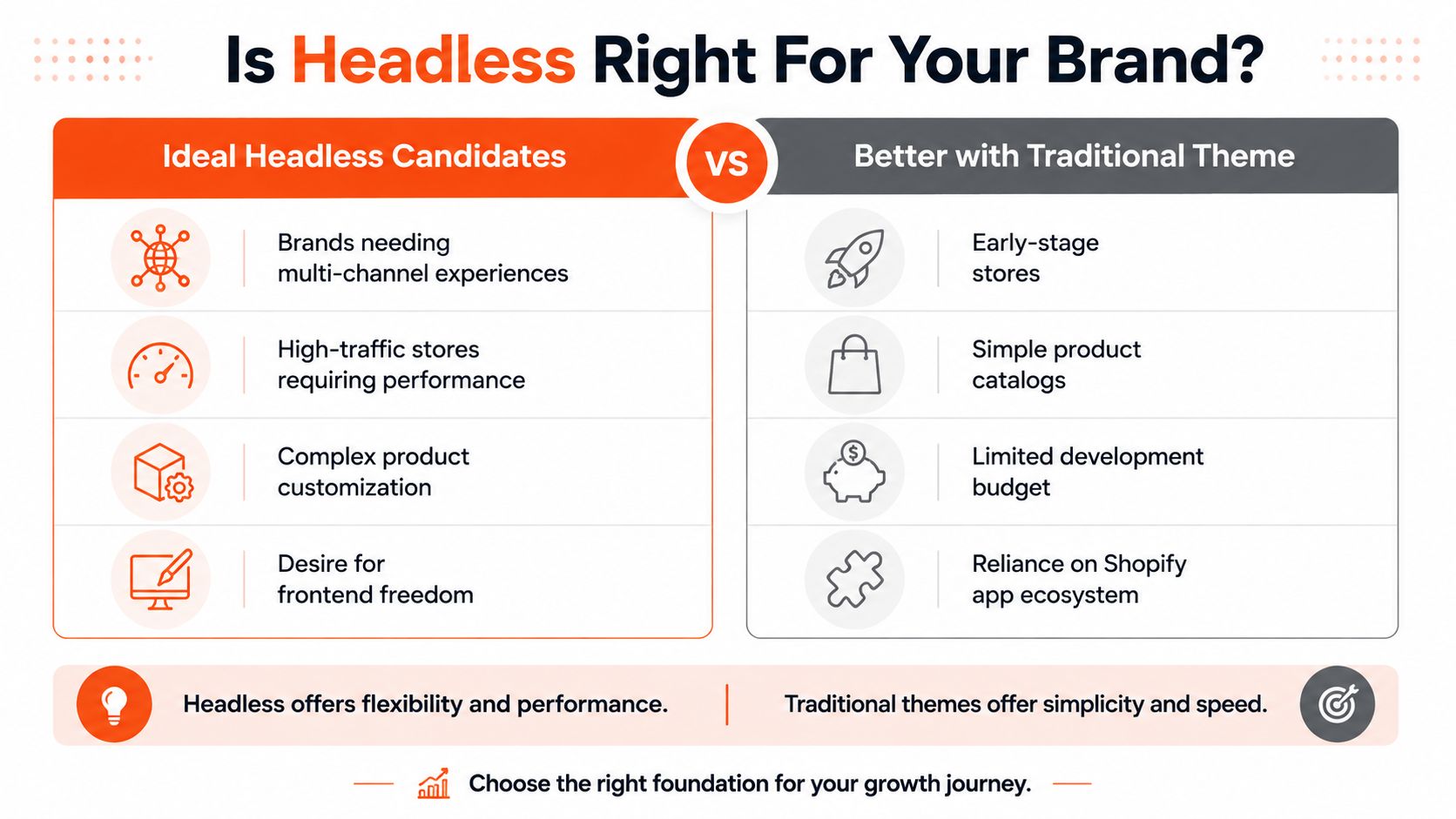
Headless makes the most sense when the business problem is architectural, not merely aesthetic. A redesign alone rarely justifies a separate frontend. The stronger case appears when the brand needs multiple presentation layers, unusual shopping interactions, international complexity, or integrations that repeatedly strain the current theme.
A useful assessment starts with the customer experience. Does the brand need a product configurator with complex state? Does it publish campaign pages frequently across more than one channel? Does it need frontend behavior that theme conventions make expensive to maintain? These conditions point toward headless because they create recurring value from frontend independence.
Strong candidates and poor candidates
Headless candidates often have:
Complex experiences: Configurators, guided selling, interactive discovery, or highly customized merchandising.
Multiple channels: A shared commerce foundation supporting web, mobile, kiosk, or other presentation layers.
Integration pressure: Search, content, personalization, reviews, and operational systems that need coordinated API delivery.
Technical ownership: Internal engineers or a dependable partner able to maintain the frontend after launch.
A clear business case: Specific performance, release velocity, international, or conversion objectives that can be measured.
A theme may be the better choice when:
The catalog is straightforward: The existing Shopify data model already supports the buying journey.
The team relies on apps: Important functionality depends on apps that assume a theme-based storefront.
Content changes are frequent and nontechnical: The team needs simple visual editing and doesn't have a CMS operating model.
Engineering capacity is limited: No one owns deployments, API failures, accessibility, or frontend security.
The problem is fixable: App consolidation, theme refactoring, image optimization, and selective custom development can address the bottleneck.
A commonly repeated revenue threshold is not a reliable decision rule. Headless ROI depends on margin, technical debt, launch frequency, market complexity, internal capability, and the cost of current limitations. A smaller brand with an unusually complex experience may benefit, while a larger brand with a simple catalog may not.
The adoption case is substantial. One 2025 industry summary reports that 73% of businesses use headless architecture, while 98% of non-users plan to evaluate it within 12 months. The same summary reports an average 42% conversion rate increase associated with headless implementations and says 79% of users rate scalability as strong. Those figures are reported in headless commerce statistics from Swell, but they shouldn't replace a store-specific business case.
For a deeper Shopify-specific view of the architecture decision, review this guide to Shopify headless commerce. The practical test is simple: document what the current theme prevents, estimate the recurring cost of those constraints, and compare it with the total cost of owning a custom frontend.
Core Services and Deliverables in a Headless Build
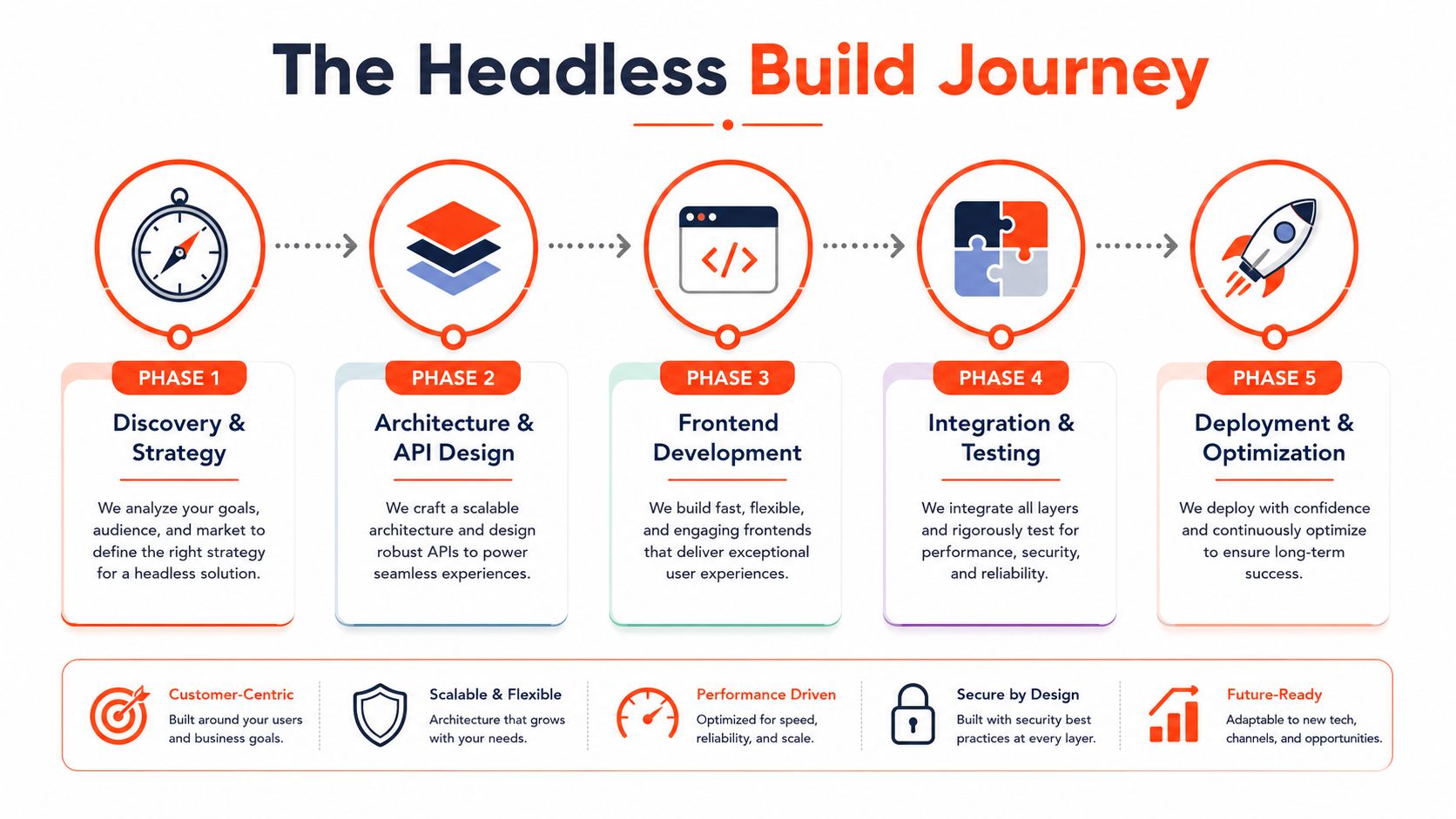
A serious headless engagement begins before frontend development. Discovery should document the current Shopify setup, catalog behavior, app dependencies, content workflow, analytics requirements, customer accounts, checkout path, and operational integrations. The output should be an architecture decision with explicit trade-offs, not just a framework recommendation.
Discovery and architecture
The partner should map the data flow between Shopify, the frontend, CMS, search, reviews, analytics, fulfillment, and other services. The team decides whether Shopify's native content tools are enough or whether Sanity, Contentful, or another CMS will justify its own operating workflow.
Architecture work should cover:
Frontend selection: Next.js, Remix, or Hydrogen based on team skills, rendering needs, deployment model, and Shopify alignment.
API design: Storefront API queries, mutations, caching rules, error handling, and rate-limit strategies.
Content modeling: Reusable content types, page composition, product storytelling, localization, and publishing permissions.
Integration boundaries: Which system owns pricing, inventory, search, customer identity, promotions, and analytics events.
Migration planning: URL structures, redirects, metadata, content, customer data, and staged rollout responsibilities.
Frontend, middleware, and operations
The frontend deliverable should include a component library and documented design system, not only page templates. That foundation helps marketing and product teams add experiences without rebuilding common elements each time. It also gives QA a stable set of components to test across devices and states.
The middleware layer deserves special attention. It may coordinate cart operations, checkout redirects, customer authentication, preview modes, webhooks, personalization decisions, and fallback behavior when an external service fails. Sales proposals often focus on visible screens and understate this invisible layer, even though it determines production stability.
A complete handoff should include API documentation, environment documentation, CI/CD configuration, staging and preview workflows, test coverage, accessibility checks, monitoring, and incident procedures. Post-launch support should cover performance observation, experimentation infrastructure, bug resolution, and incremental feature development. Without those deliverables, the brand may receive a custom storefront but not a maintainable commerce system.
Realistic Timelines and Costs for Headless Projects
Headless project estimates become unreliable when they describe only the frontend. The actual work includes discovery, data modeling, integration behavior, content migration, analytics validation, QA across browsers and devices, launch planning, and post-launch stabilization.
The brief for this decision doesn't provide verified numeric timeline or cost data, so exact figures would be misleading. A focused build is generally less demanding than a multi-market implementation with custom shopping logic, but the scope must define what “launch” includes. A proposal that excludes content migration, redirect mapping, app replacement, or operational testing isn't cheaper in practice. It has just moved those costs outside the headline estimate.
What drives the investment
Frontend complexity matters, but integration depth often creates the largest surprises. A brand may need to replace theme-dependent apps, recreate merchandising behavior, coordinate customer accounts, preserve analytics events, and reconcile data between Shopify and external systems. Every integration adds failure states that need tests and monitoring.
Other cost drivers include:
Content migration: Rebuilding page structures and editorial workflows in a new CMS.
Quality assurance: Testing carts, discounts, inventory states, localization, accessibility, and responsive layouts.
Performance engineering: Auditing server rendering, caching, images, scripts, and third-party requests under real conditions.
Operational readiness: Training teams, documenting ownership, and defining incident response.
Scope control: Managing requests that would otherwise turn a storefront migration into a full product rebuild.
Project Type | Timeline | Development Cost | Monthly Maintenance |
|---|---|---|---|
Focused storefront migration | Depends on confirmed scope | Depends on integrations and migration depth | Depends on support coverage |
Multi-market implementation | Longer discovery and rollout | Higher because of localization and systems coordination | Higher when more storefronts and services require monitoring |
Enterprise composable build | Phased delivery is usually more practical | Driven by custom workflows, integrations, and governance | Requires ongoing engineering, observability, and service ownership |
A credible agency should separate one-time build work from recurring ownership. Hosting, observability, CMS licenses, support retainers, framework upgrades, accessibility remediation, and experimentation all belong in the total cost of ownership discussion. Neutral industry coverage highlights the trade-off: headless increases frontend control while also expanding integration complexity, QA scope, and maintenance. A 2026 market report cited in that coverage estimates 39% of mid-sized retailers experienced migration delays tied to fragmented backend architecture and reports integration costs rising about 24% in multi-vendor setups. See the analysis of headless commerce trade-offs and operating costs.
How to Evaluate a Headless Development Partner
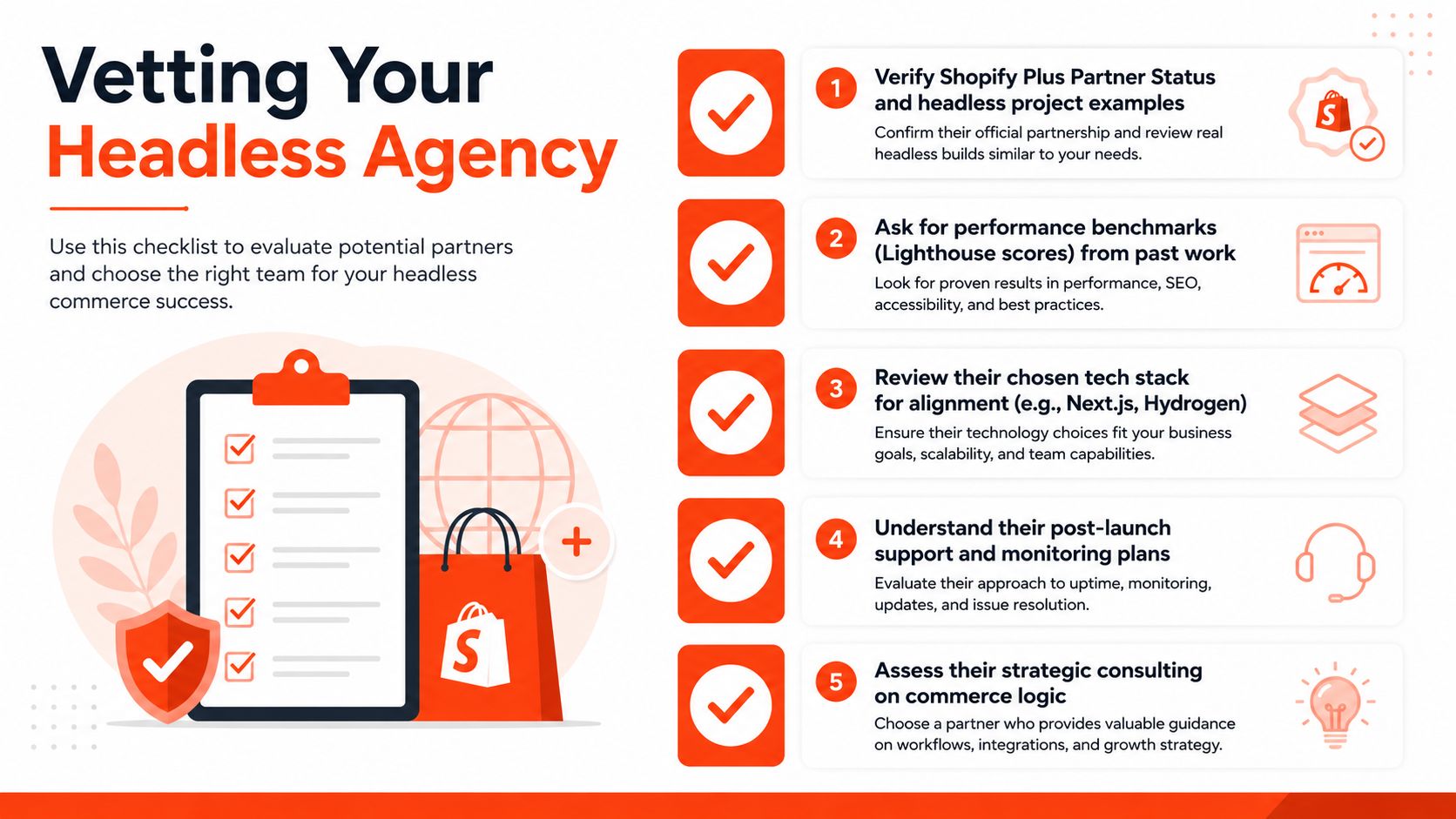
A portfolio can show visual quality without proving production competence. Ask how the agency handled cart state, checkout transitions, app compatibility, content publishing, API failures, analytics, accessibility, and post-launch changes. Those details reveal whether the partner has built a commerce system or only assembled a convincing demo.
Shopify-specific experience matters. React or Next.js expertise alone doesn't demonstrate knowledge of the Storefront API, Shopify data models, checkout behavior, customer accounts, discounts, webhooks, or the practical limits of a headless app ecosystem. Hydrogen experience can help, but the framework should follow the requirements rather than drive the strategy.
Questions that expose delivery quality
Request evidence of:
Performance ownership: Ask for before-and-after Core Web Vitals data, test conditions, and the techniques used to achieve the result.
Integration judgment: Ask how the team handles apps that depend on Liquid, theme events, or script injection.
CMS governance: Find out who models content, manages previews, handles localization, and supports marketing workflows.
Delivery discipline: Confirm that the partner uses source control, pull requests, staging environments, automated deployment, and rollback procedures.
Testing depth: Ask how they test discount combinations, inventory changes, customer states, mobile behavior, accessibility, and third-party failures.
Post-launch support: Require a written explanation of monitoring, response times, framework updates, and feature maintenance.
A credible partner will challenge unnecessary complexity. If every brand gets the same stack and migration plan, the agency is selling a pattern rather than solving your operating problem.
Headless also changes internal staffing. Product managers, marketers, developers, and support teams need clear ownership of content, releases, integrations, and incidents. If you need flexible operational support while your internal team focuses on commerce decisions, a resource such as Latin American virtual assistants can help with appropriate administrative and content workflows, but that support doesn't replace engineering ownership.
Presidio is one example of a hybrid Shopify agency and software studio that works across themes, apps, integrations, performance work, and headless storefronts. Treat any agency, including Presidio, as a candidate to evaluate against your requirements, delivery evidence, and support model rather than selecting on positioning alone.
Planning Your Next Steps Toward Headless Commerce
Start with an audit, not a framework. Inventory every theme customization, app, integration, content type, analytics event, checkout dependency, and operational workflow in the current Shopify store. Mark each item as something to migrate, replace, simplify, or retire.
Then define success in operational terms. Choose the performance, conversion, release velocity, content independence, and channel objectives that matter to the business. Your partner should be able to connect architecture decisions to those objectives and explain how the team will measure them after launch.

Shortlist partners that can explain both the upside and the maintenance burden. Ask for discovery workshops before approving a full build, and consider a contained proof of concept when the business case remains uncertain. A phased storefront or market can test the architecture without forcing the entire organization through one irreversible cutover.
Budget for the full operating cycle, including discovery, development, migration, QA, launch, monitoring, and ongoing engineering. The best headless project is not the one with the most services. It's the one whose added complexity remains justified after the launch team has to operate it.
Presidio helps Shopify and Shopify Plus brands assess headless architecture, build custom storefronts, connect commerce systems, and continue improving performance and conversion after launch. Visit Presidio to discuss whether a decoupled build, a leaner theme, or a phased approach fits your store.

Jamie, Presidio’s Designer, leads the practice alongside Johnnie. With over 10 years of e-commerce experience, Jay is a Shopify expert, known for crafting innovative solutions that prevent tech debt.
Jaime
Senior Product Designer, 2020