Outrank AI

Most advice about a headless Shopify agency starts with the wrong premise: headless isn't automatically an upgrade. It's a separate operating model, and it turns your storefront into a software product that someone must maintain after launch.
The architecture can deliver a higher performance ceiling, deeper frontend control, and better integration options. But it also adds engineering dependency, governance work, release management, and ongoing cost. Shopify's own guidance warns that headless can extend build and update timelines while increasing reliance on engineering resources and maintenance responsibility in its enterprise headless commerce guide.
The right question isn't, “Can we build headless?” Any capable team can. Ask three harder questions instead: What will the agency own, how will your team publish after launch, and what business problem justifies the extra operating expense?
Table of Contents
What a Headless Shopify Agency Actually Does
A headless Shopify agency shouldn't be treated as a vendor that delivers a striking React frontend and disappears. It should operate as a long-term technical partner responsible for the storefront, the integration layer, and the systems that let your commercial team keep moving.
In a conventional Liquid engagement, the agency usually works inside a Shopify theme. It creates templates, sections, snippets, app connections, and merchandising controls, then hands the store back to your internal team. That model can work well because Shopify owns much of the runtime and marketers can make many changes through the admin.
Headless changes the ownership boundary. The agency may own a Hydrogen storefront, the deployment pipeline, caching behavior, API contracts, error handling, and the connection between Shopify and services such as a CMS, PIM, search platform, ERP, reviews provider, or personalization engine. Shopify describes Hydrogen as a React-based framework for routing, data fetching, server-side rendering, and UI reactivity, while Oxygen provides hosting, caching, and environment management in its headless build options documentation.
The work continues after launch
A serious partner builds more than page templates. It establishes:
A maintainable codebase, with documented environments, reviews, testing, and deployment controls.
An integration contract, defining which system owns products, editorial content, pricing, inventory, customer data, and orders.
A publishing workflow, so marketers can update campaigns without waiting for a developer.
Operational monitoring, covering frontend errors, API failures, slow responses, broken checkout journeys, and failed deployments.
A release model, including previews, approvals, rollback procedures, and dependency updates.
The agency also needs to understand merchandising. A campaign can be technically correct and commercially useless if your team can't assemble a landing page, schedule a promotion, change collection presentation, or update product storytelling without opening a development ticket.
Practical rule: If the proposal describes launch in detail but says little about publishing, monitoring, rollback, and ownership, it's incomplete.
Headless Shopify adoption has moved beyond isolated experimentation. One 2025 industry summary reports that 60% of retailers are adopting or planning headless implementations, including 20% in production, 25% actively migrating, and 15% with approved plans for the next 24 months in its headless adoption research. That makes partner quality more important, not less. Your shortlist should distinguish agencies that can run a storefront from agencies that can keep one healthy.
How Headless Shopify Works Under the Hood
Think of Shopify as the warehouse and operating system for commerce. It holds products, variants, inventory, customers, carts, checkout, orders, payments, and fulfillment. The headless storefront is a separately engineered shop window that asks the warehouse for information through APIs and decides how to present it.
In Shopify's recommended stack, the storefront commonly uses Hydrogen, Shopify's React framework, and Oxygen, Shopify's managed edge hosting environment. The storefront requests commerce data through the Storefront API. Administrative operations and back-office workflows use the Admin API. An external CMS, search service, PIM, or personalization layer sits beside Shopify and contributes its own data through separate connections.
A product page illustrates the sequence. Hydrogen receives the request, queries Shopify for product and merchandising data, requests editorial content from the CMS when needed, composes the page on the server, and returns the rendered result to the customer. The browser then hydrates the interface and handles interactions such as variant selection, cart updates, recommendations, and navigation.
Liquid and headless make different trade-offs
A Liquid store keeps data, logic, and presentation inside Shopify's theme architecture. That gives merchants a straightforward editing model and reduces the number of systems a team must operate. A headless build separates those concerns, which gives developers more control but creates more contracts to maintain.
The separation can help teams tune rendering and caching independently from commerce logic. It can also improve time to first byte and Core Web Vitals when the application is engineered carefully. The architecture itself doesn't guarantee that result. Poor data fetching, excessive JavaScript, unoptimized media, or uncontrolled third-party scripts can erase the advantage.
For a deeper explanation of the architecture and its strategic implications, see Presidio's guide to Shopify headless commerce.
The useful distinction is simple:
Shopify remains the commerce system of record.
The headless frontend becomes a custom application.
The API layer becomes the contract between them.
The agency becomes responsible for keeping that contract reliable.
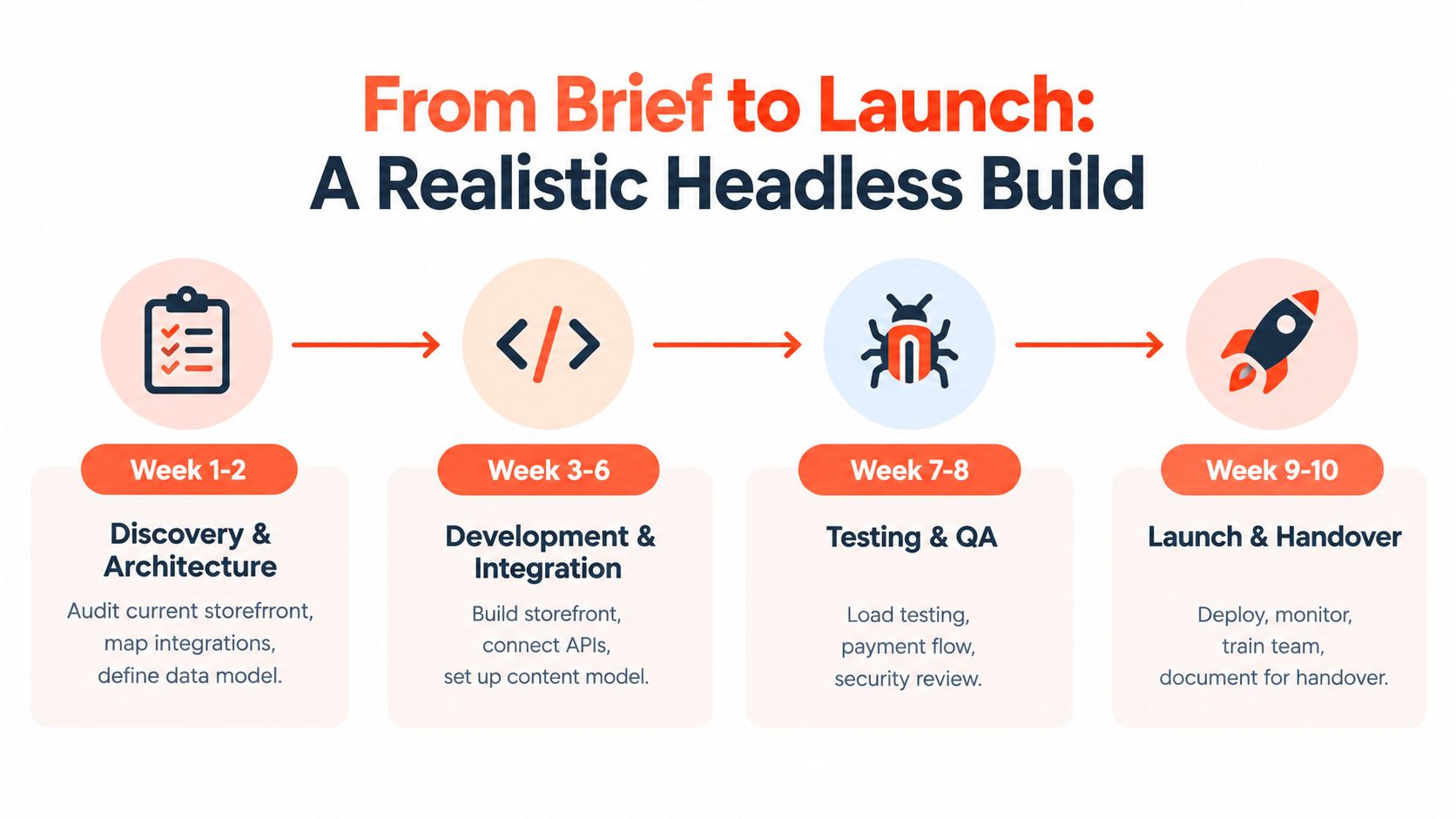
A Realistic Headless Build From Brief to Launch
A headless project feels less like a theme redesign and more like a product launch. The brand has to make architecture, content, integration, and operating decisions before the visual polish is complete.
Discovery decides whether headless survives
The first phase audits the existing storefront, catalog structure, analytics, app inventory, CMS needs, search behavior, international setup, and operational workflows. The agency should compare Hydrogen and Oxygen with alternatives such as Next.js or Remix on another supported host, then document why one runtime fits the business.
This is also where the team identifies scope traps. Subscription logic, product configuration, market-specific content, customer accounts, search indexing, and ERP synchronization can all change the architecture. If the agency skips this work, those decisions surface during frontend development, when they cost more to change.
Prototyping exposes workflow problems
The design and prototype phase should produce a clickable storefront for critical journeys, not a collection of disconnected screens. Product detail, search, collection browsing, cart, account behavior, campaign landing pages, and editorial components need to work as a connected experience.
Your marketing team should participate here. Ask them to create a campaign, revise product content, change navigation, and approve a page. If they can't perform those actions in the prototype's content model, the problem is already visible.
Integration and soft launch reveal reality
The build then connects Shopify with the CMS, search, reviews, subscriptions, email or customer data platforms, analytics, and any operational systems. The agency should test failure states, not only successful API responses. A timeout, stale product record, missing image, unavailable variant, or rejected cart update needs a defined user experience.
A soft launch on selected products or markets gives the team a controlled way to find edge cases. It's where brands often discover that editorial ownership is unclear, search results don't reflect merchandising rules, or a third-party script damages performance.
The supplied roadmap presents a 10-week delivery model, moving from discovery and architecture through development, testing, and handover. Treat that as a project shape, not a universal promise. The actual calendar depends on integration depth, content migration, design scope, market complexity, and how quickly your team resolves decisions.
The final phase is post-launch iteration. It includes merchandising support, incident response, content model adjustments, performance tuning, and backlog management. Most plans underweight this phase, even though it determines whether headless improves editorial velocity or creates permanent developer dependency.
Headless vs a Highly Optimized Liquid Store
A well-built Liquid storefront deserves a serious comparison. Shopify's infrastructure and modern themes can provide strong performance without making your team operate a custom frontend. Shopify's enterprise materials state that its infrastructure renders 1.8x faster on average than stores on other platforms, and that 93% of Shopify brands achieve fast storefront performance in its enterprise performance guidance.
Independent 2026 reporting gives headless Shopify a higher reported performance ceiling. Its medians for Hydrogen on Oxygen are 1.4 seconds LCP, 110 milliseconds INP, 95 milliseconds TTFB, and a 78% Core Web Vitals pass rate, compared with 2.0 seconds LCP, 185 milliseconds INP, 280 milliseconds TTFB, and a 58% pass rate for traditional Shopify storefronts in its comparative performance report. Those figures describe reported medians, not a guarantee for your build.
Dimension | Headless Hydrogen + Oxygen | Optimized Liquid Plus, Dawn-derived |
|---|---|---|
Frontend control | Broad control over rendering, interaction, routing, and integrations | Strong control within Shopify's theme architecture |
Performance ceiling | Higher when caching, rendering, and JavaScript are engineered well | Often sufficient when the theme and app stack are disciplined |
Build complexity | Separate application, APIs, deployment, testing, and monitoring | Shopify theme, sections, extensions, and supported apps |
Content operations | Requires deliberate CMS and component governance | Usually more accessible through Shopify admin tools |
Team requirements | React and API engineering capability, internally or through a partner | Theme development and Shopify operations expertise |
Ongoing ownership | The brand owns more of the frontend stack | Shopify manages more of the storefront runtime |
The budget decision matters more than the architecture debate
Headless wins when frontend independence solves a real constraint. It doesn't win because a React storefront sounds more advanced. Your finance and ecommerce teams should model the recurring work, including release management, dependency upgrades, integration monitoring, content governance, and developer availability.
A Liquid store may be the better investment when the brand has one market, straightforward merchandising, and a capable team using the theme editor daily. A headless store may be justified when the brand needs multiple frontends, complex product experiences, editorial workflows, or integrations that are difficult to support in Liquid.
Choose the system your team can operate, not the one that looks most advanced in a technical diagram.
Services and Deliverables You Should Expect
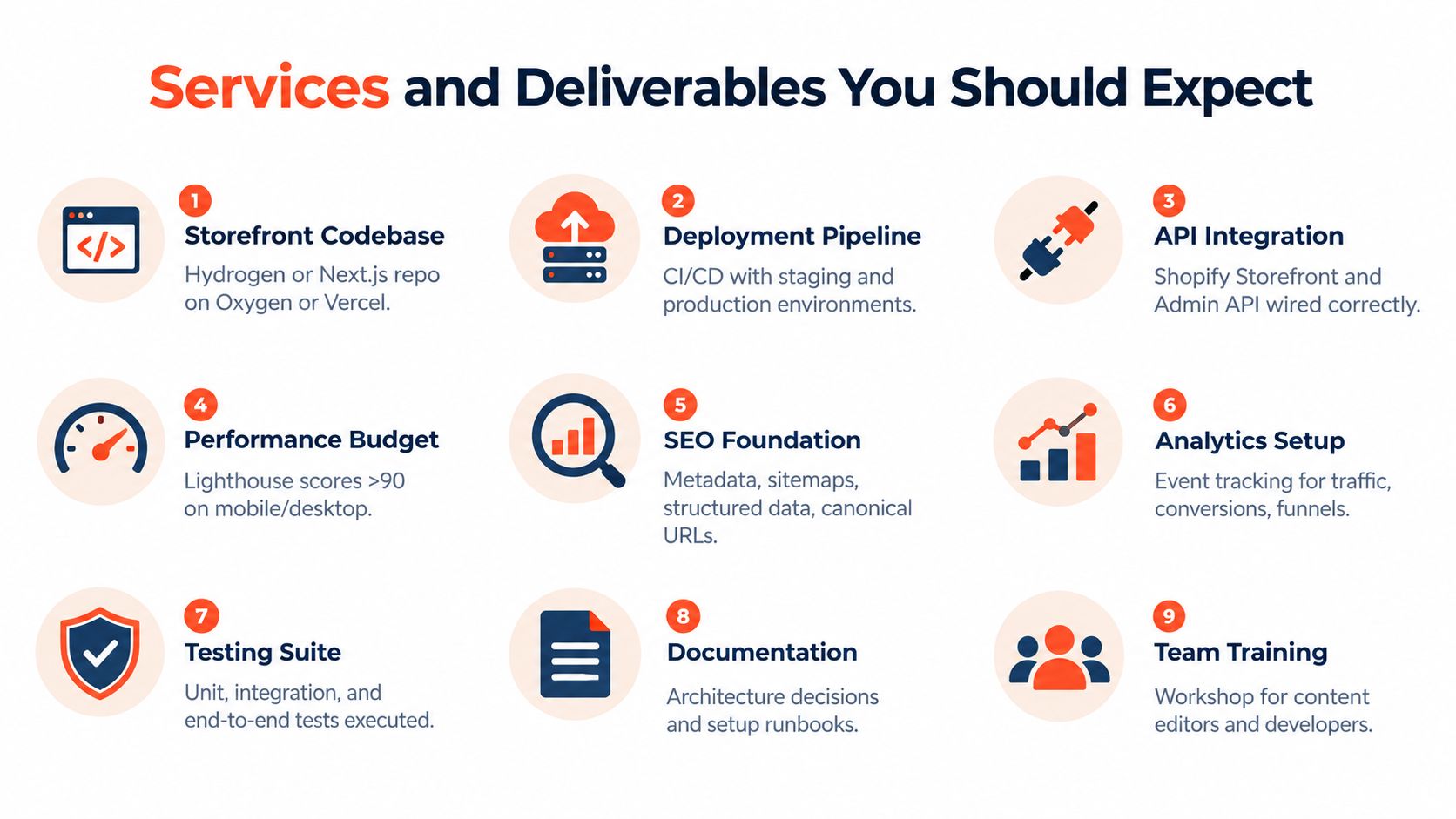
A headless proposal should name deliverables, owners, acceptance criteria, and post-launch responsibilities. “Custom storefront development” isn't enough. You're buying an application and an operating model.
Core engineering deliverables
Expect a repository for Hydrogen, Next.js, or another agreed framework, deployed to Oxygen or a supported host. The agency should document local, preview, staging, and production environments, with CI/CD, code review, automated testing, logs, and runtime observability in place before launch.
The design system should exist as code, not only in a design file. Ask for reusable components, design tokens, responsive behavior, accessibility decisions, and a component workbench such as Storybook or an equivalent system. Accessibility should be treated as a measurable baseline aligned with WCAG AA, not as a final visual check.
The integration layer deserves its own scope. It may include:
Product and content systems, such as a PIM and Sanity or Contentful.
Search and discovery, using tools such as Algolia, Searchspring, or Coveo.
Customer engagement, including Klaviyo, Customer.io, reviews, loyalty, and personalization.
Subscriptions and operations, covering subscription services, ERP connections, fulfillment, and inventory.
Analytics and consent, with event definitions that survive the move away from Liquid app embeds.
Third-party scripts shouldn't be copied into the new frontend without review. Each script needs an owner, loading strategy, consent behavior, and performance impact assessment.
The deliverables that protect year two
The agency should also provide an SEO migration plan with redirect mapping, canonical behavior, metadata, sitemaps, and structured data parity. It should document how the team will prevent traffic loss when URLs, rendering, navigation, or product taxonomy change.
Content governance is equally important. Define who can create components, who approves content, how regional variations work, how campaigns are scheduled, and which changes require engineering review. Without those rules, a flexible CMS becomes another source of inconsistency.
A 90-day post-launch support plan should name owners, response expectations, monitoring coverage, and escalation routes. The runbook should explain deploys, rollback, incident response, API version management, dependency upgrades, and routine maintenance.
For a broader view of the work involved, review Presidio's headless ecommerce development services. Presidio is one example of a Shopify agency that combines custom storefront development with performance work and ongoing development support. Compare that service model with other partners, and make sure the practical obligations appear in the contract rather than as optional extras.
How to Evaluate and Interview Agencies
The strongest headless Shopify agency can explain failure modes without turning every answer into a sales pitch. Start with evidence, then test how the team thinks.
Ask for live production URLs and inspect them with browser developer tools. Look at rendering, caching, network requests, image behavior, JavaScript execution, accessibility, structured data, and error handling. A polished demo proves that an agency can make a presentation. It doesn't prove that the storefront survives production complexity.
Demand proof of relevant delivery
Prioritize Shopify Plus experience and production Hydrogen launches over prototype work. Ask whether the agency will provide client references, what the agency owned after launch, and which parts of the system the client retained internally.
Request a repository sample under NDA if the agency can't share public code. You're not looking for proprietary business logic. You're evaluating naming, component boundaries, testing, documentation, deployment discipline, and how a developer would safely change the application.
The technical interview should include pointed questions:
Cart attribution: How do you preserve campaign and analytics attribution when browser privacy controls or ad blockers interfere?
Preview environments: How does each branch receive a reviewable environment, and who can approve a release?
Script governance: How do you measure and control third-party scripts?
Catalog growth: How do caching, search indexing, and data fetching behave as the catalog expands?
API resilience: What happens when Shopify or an external service returns an error, timeout, stale response, or unexpected schema?
SEO ownership: Who validates redirects, rendered HTML, metadata, canonical URLs, and structured data before launch?
Interview the operating model
Ask who will staff the project day to day. You want the actual senior architect, frontend lead, delivery owner, and post-launch contacts identified in writing. Clarify how scope changes are priced, how decisions are recorded, and what support tiers include response expectations.
Red flags include unrealistic pricing, no production references, refusal to show any code structure, and a white-label delivery model that hides the people doing the work. Don't accept a proposal that describes “ongoing support” without naming the systems, hours, responsibilities, and escalation process.
“Walk me through the last headless project that slipped, and what changed in your process because of it.”
That question reveals more than another portfolio review. A serious partner can describe where estimation failed, which assumption broke, how the client was informed, and what process changed afterward. Generalists usually offer a polished explanation that contains no operational lesson.
When Headless Is and Is Not Worth It
Headless is a cost and operating-model decision, not a badge of technical maturity. Choose it when the storefront has a constraint that Liquid cannot solve cleanly, such as a complex configurator, bespoke buying journey, multiple regional experiences, specialized CMS workflow, or integration architecture requiring independent frontend control.
A modern stack alone is not a business case. Budget for engineering availability, release coordination, content governance, incident response, and ongoing maintenance. Headless usually brings longer delivery timelines, more frontend engineering, additional maintenance, and greater architectural complexity. Those costs continue after launch, so compare the full investment with this practical ecommerce website cost framework, not with the initial build quote.
Use the operating model as the filter
A single-market brand with straightforward products and a merchandising team comfortable in Shopify admin will usually get better value from a carefully optimized Liquid store. A business with complex content roles, multiple storefront experiences, or a roadmap built around custom frontend behavior may justify headless.
Post-launch publishing is the decisive test. If marketers need developers for routine campaign changes, headless has created a bottleneck unless the CMS and component governance support editorial independence. If the brand has no internal React capability and will not fund an ongoing partner relationship, the architecture will create a permanent operating cost.
Scenario | Liquid Store | Headless Store |
|---|---|---|
Standard catalog and campaign pages | Usually the practical choice | Adds complexity without a clear need |
Heavy configurator or custom product builder | May require difficult workarounds | Stronger fit for frontend control |
Daily theme-editor merchandising | Direct and accessible | Requires a carefully designed CMS workflow |
Multiple regional storefront experiences | Can work within Shopify's capabilities | Useful when experiences need deeper separation |
Small technical team | Lower operational burden | Risky without a retained engineering partner |
Integration-heavy commerce stack | Possible, depending on requirements | Better suited when APIs must coordinate several systems |
Evaluate content velocity as well as page performance. Count how many publishing steps a campaign requires, who approves components, how quickly teams can correct an error, and whether developers are pulled into routine merchandising. A faster storefront does not justify a slower content operation.
There is no universal revenue threshold that makes headless correct. Approve it when the operating gains, custom experience, or integration needs outweigh the added engineering and governance burden. If the case depends only on a hoped-for speed improvement, choose a disciplined Liquid build and revisit the architecture when the business constraint is clear.
A Practical Next-Step Framework
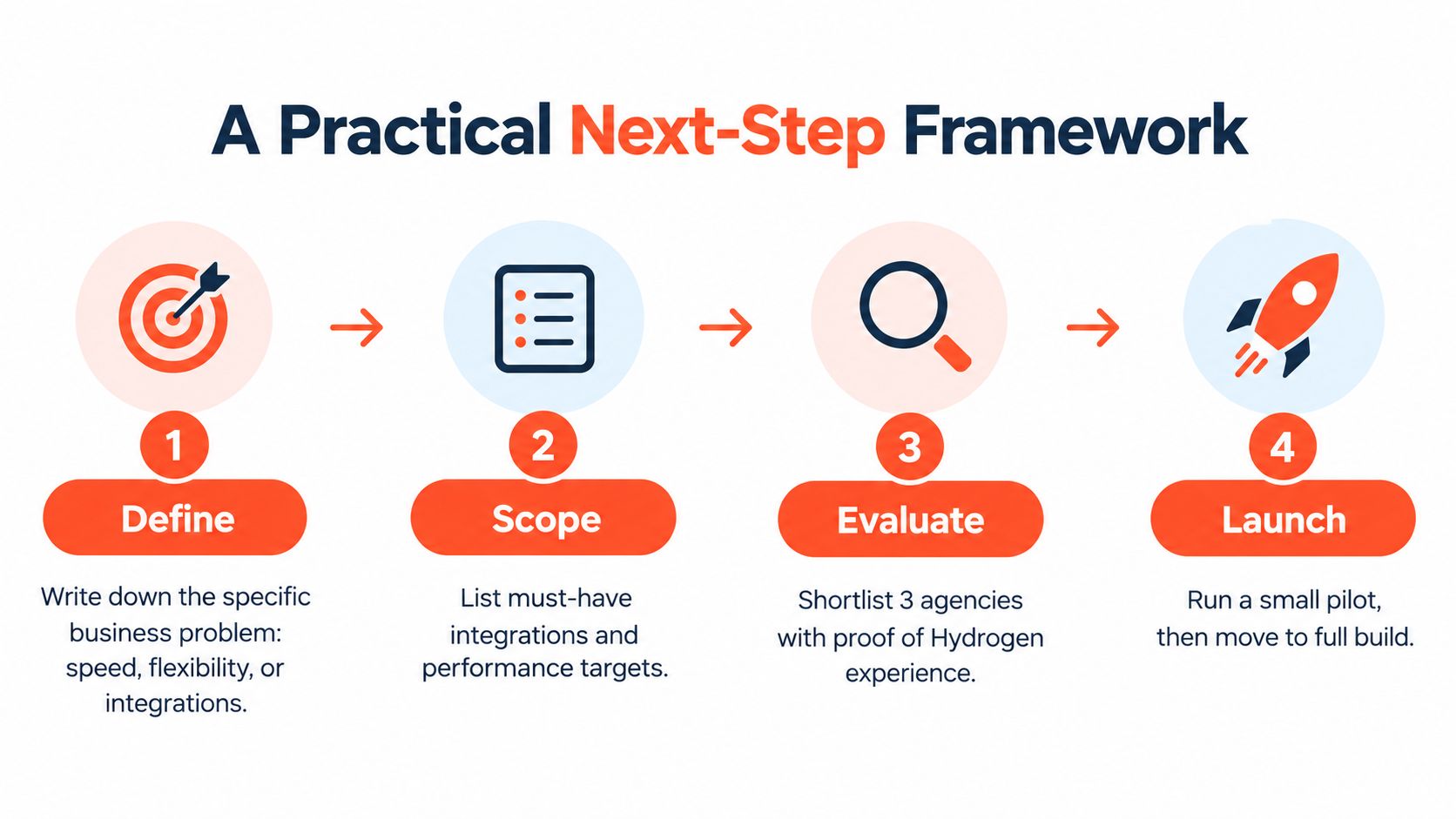
Run the decision as a short investigation, not a platform referendum.
Define the trigger. Write down the business problem, whether it's speed, flexibility, content workflow, or integrations. Confirm that the problem can't be solved inside a well-built Liquid storefront.
Set the baseline. Ask two agencies to audit or prototype the current Liquid experience, with Lighthouse and real-user performance evidence where available. You need a credible baseline before comparing architectures.
Scope discovery first. Shortlist three partners with verifiable production experience and commission a fixed-scope architecture sprint. Don't approve a full build before the agency maps data ownership, integrations, content governance, SEO, and support.
Contract for operations. Include a 90-day post-launch retainer with named owners, publishing support, incident response, monitoring, and a backlog process.
If your team can't name three concrete workflows headless will enable, choose a disciplined Liquid build and revisit the decision when the operating case becomes clear.
Presidio helps Shopify and Shopify Plus brands evaluate headless architecture, build maintainable custom storefronts, improve performance, and support ongoing ecommerce development. Visit Presidio to discuss your storefront constraints and determine whether headless is the right operating model for your team.

Jamie, Presidio’s Designer, leads the practice alongside Johnnie. With over 10 years of e-commerce experience, Jay is a Shopify expert, known for crafting innovative solutions that prevent tech debt.
Jaime
Senior Product Designer, 2020