Outrank AI

Most advice about conversion rate optimization starts in the wrong place. It obsesses over button color, headline length, and tiny form tweaks, then treats the rest of the storefront like a black box. That's too narrow for Shopify brands, where CRO lives at the intersection of messaging, behavior, performance, and checkout architecture.
For an ecommerce director, the question isn't whether a CTA should be orange or black. It's which touchpoint is suppressing profitable conversions, which friction belongs to design, which belongs to engineering, and which belongs to the offer itself. On Shopify and Shopify Plus, that distinction matters because the same traffic can perform very differently depending on theme structure, app sprawl, and checkout complexity.
Table of Contents
Rethinking Conversion Rate Optimization Beyond Button Colors
Understanding the Gap Between Average and Elite Conversion Rates
Rethinking Conversion Rate Optimization Beyond Button Colors
CRO gets marketed like a creative polish exercise, but the discipline is broader than that. A button color test might help, yet it won't rescue a storefront whose product pages load slowly, whose navigation buries the best sellers, or whose checkout asks buyers to fight through avoidable friction. Conversion rate optimization is really about removing the obstacles that stop a visitor from taking the next profitable action.
That's why the best teams don't treat CRO as a copywriting department tucked inside marketing. They treat it as a shared operating system for growth, design, development, and operations. A growth lead can spot a drop-off. A developer can determine whether the issue is theme logic, app overhead, or rendering delay. A merchandiser can decide whether the offer, assortment, or placement is off.
Shopify brands often need that cross-functional model because storefront performance and user experience are tightly coupled. If branding feels inconsistent, a resource like best branding agencies can help frame the visual system, but CRO still has to verify whether that system supports buying behavior. The storefront has to do both jobs, look right and convert.
Practical rule: if a test doesn't change the path to purchase, it's probably not a CRO priority.
A common error teams make is treating every page as equally important. They run experiments where the traffic is easy to reach, not where the business impact is highest. That creates busy work, not real strategic advantage. A mature CRO program starts with the revenue journey, then works backward to the touchpoints that deserve attention.
Understanding the Gap Between Average and Elite Conversion Rates
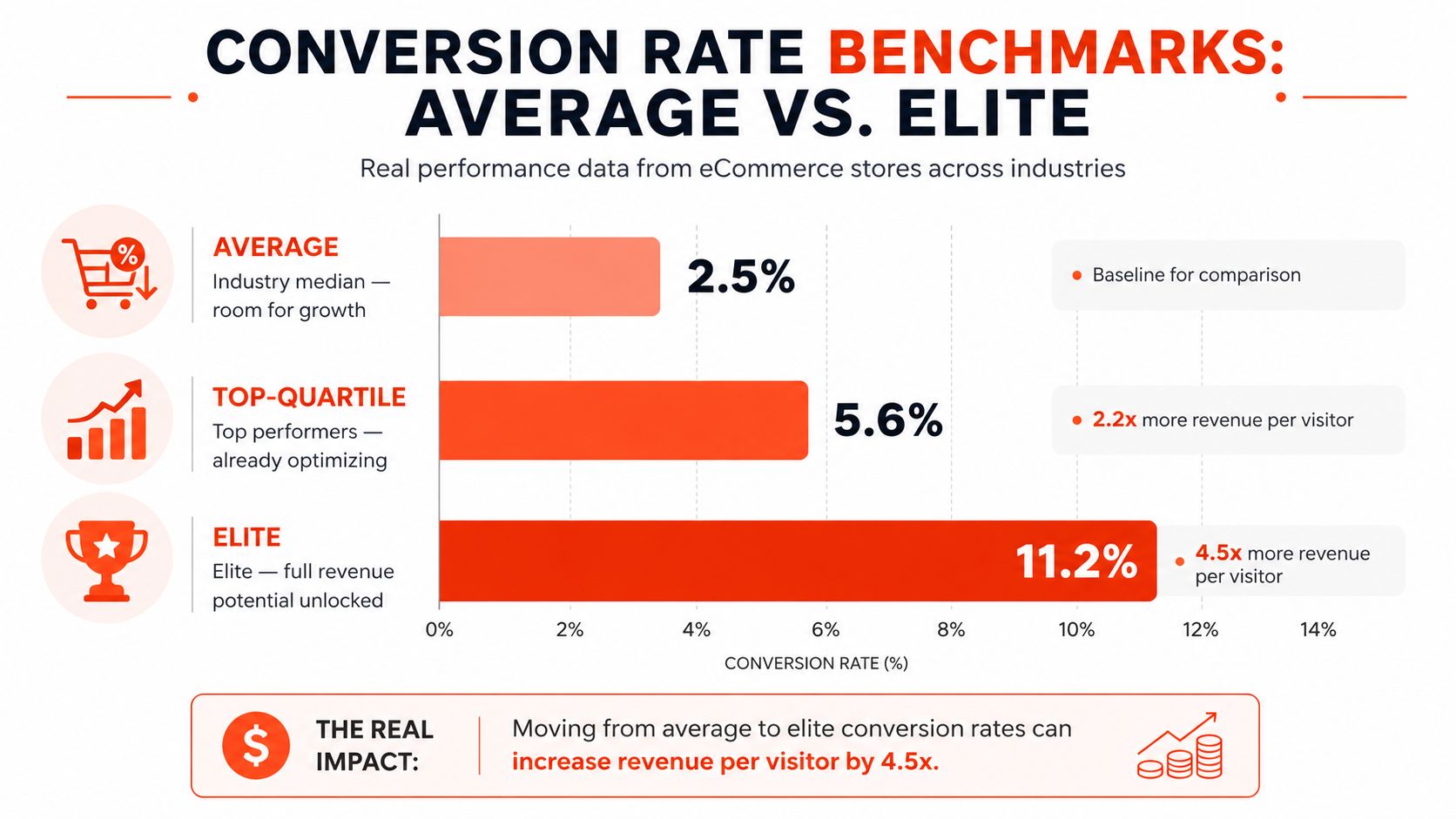
The benchmark gap is why CRO isn't optional. Across all industries, the average website conversion rate is 2.35%, while the top 25% of companies advertising with Google Ads reach 5.31% or higher and the top 10% reach 11.45% or more, according to Unbounce benchmark data cited by DesignRush and based on 41,000 landing pages, 464 million pageviews, and 57 million conversions (Invesp CRO statistics). That spread isn't a rounding error. It separates a store that captures traffic from one that consistently turns traffic into revenue.
For a Shopify brand, the implication is straightforward. If your store sits near the overall average, you are leaving meaningful revenue on the table compared with elite operators converting at roughly 4.8x that level at 11.45% (Invesp CRO statistics). You do not need a dramatic redesign to close that gap. You need a disciplined sequence of changes that reduce friction, strengthen the buying experience, and fix the parts of the storefront that slow shoppers down.
Why the benchmark gap matters for ecommerce directors
Benchmarks are not for ego. They support budgeting and prioritization. When leadership asks why the team should invest in CRO instead of more acquisition spend, the answer is that existing traffic already has a cost attached to it. Improving conversion efficiency makes every visitor more valuable.
The other value is interpretation. A better product page, a cleaner cart flow, or a clearer offer can look small when you view it in isolation. Across a meaningful traffic base, those changes add up. Mature teams care less about isolated wins and more about a repeatable system that raises performance across the full storefront.
A benchmark only matters when it changes budget decisions, roadmap priorities, and the definition of success.
The lesson is discipline. Elite performance at scale is not luck or brand aura. It comes from clearer touchpoints, lower friction, and better execution across the buying path. That is where a structured CRO program earns its keep.
Identifying the Touchpoints That Drive Revenue
Much CRO work fails because it optimizes the wrong slice of the journey. Teams get excited about a bump in email capture, form completion, or add-to-cart activity, then find that downstream revenue did not move in a meaningful way. The fix is to evaluate the storefront as a chain of revenue-influencing touchpoints, not as a pile of pages.
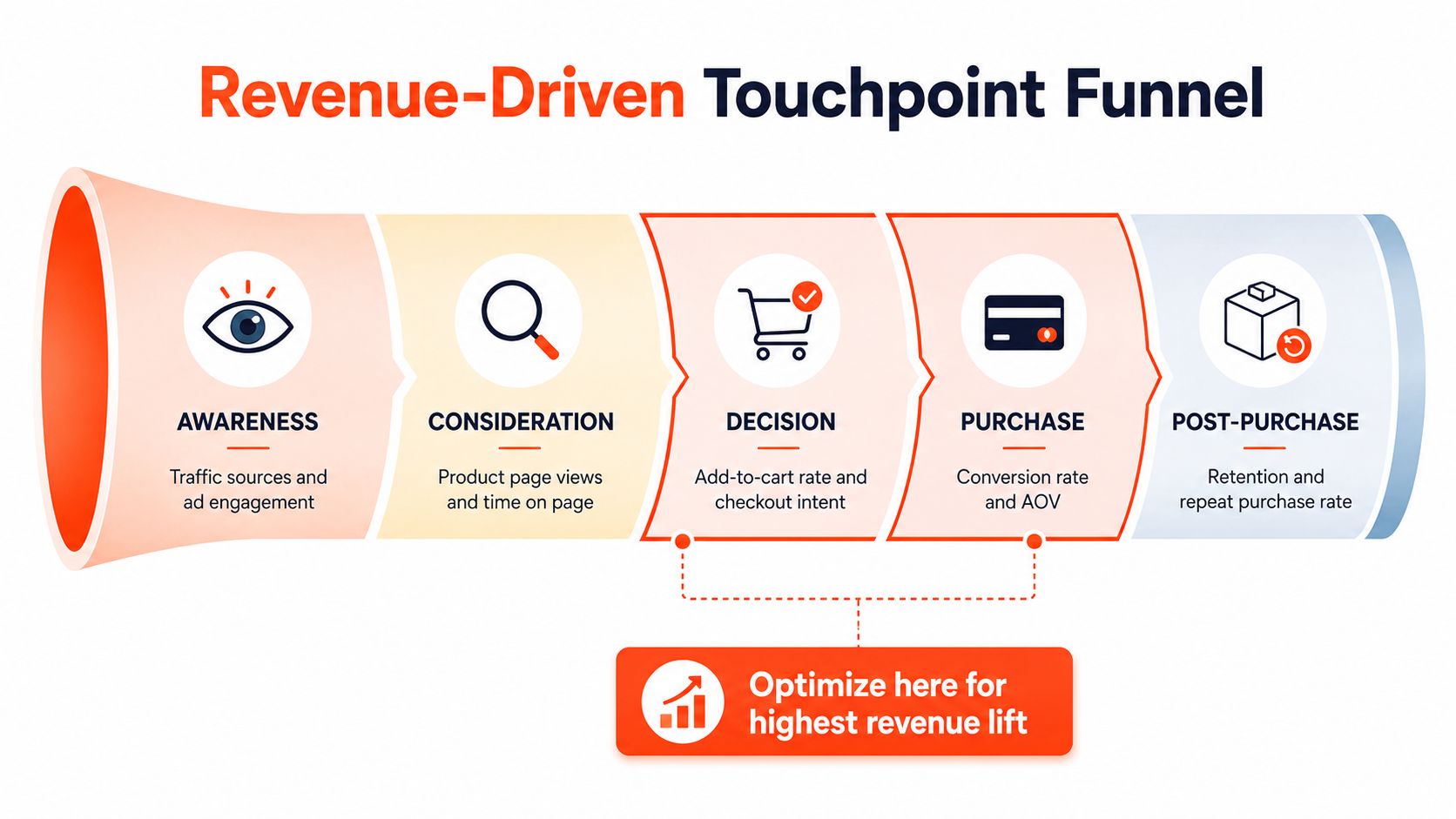
Where Shopify stores usually leak value
On Shopify, the highest-value touchpoints usually cluster around product discovery, product detail pages, cart progression, and checkout. That is where buyers move from curiosity to commitment. If those steps are weak, no amount of homepage polish can fully compensate.
The peer-reviewed retail framework in the brief makes the point well, CRO starts by identifying the touchpoints that influence sales most, then matching optimization actions to them (PMC article). That framing is more useful than generic advice to “test everything.” It forces prioritization. A product page that shapes purchase intent deserves more attention than a low-impact page with high engagement but weak commercial value.
For Shopify Plus teams, checkout deserves special scrutiny because even small amounts of friction can overwhelm otherwise strong intent. Presidio's piece on Shopify checkout extensibility matters here because checkout changes are not only about appearance, they are about what the platform allows, what it blocks, and what can be simplified without breaking the buying flow.
How to separate vanity metrics from revenue signals
Not every signal deserves the same weight. A high time-on-page number can mean interest, confusion, or comparison shopping. Add-to-cart activity is more meaningful, but it still does not guarantee a profitable order.
Use a simple filter:
Direct revenue signals include purchase completion and checkout progression.
Intent signals include product views, add-to-cart behavior, and cart starts.
Noise signals include metrics that feel good but do not clearly predict order value or margin.
That hierarchy keeps the team honest. It also protects you from celebrating a test that helps a narrow step while hurting the outcome you care about. If you optimize for the wrong touchpoint, you can win the test and lose the quarter.
The practical takeaway is to map CRO work to the places where buying decisions harden. That is where effort returns the most value, and where experiments tell you something important about how customers really behave.
Core CRO Tactics and Testing Methodologies for Shopify
The strongest Shopify CRO programs don't rely on one tactic. They combine testing, merchandising, personalization, and iteration in a sequence that matches the store's actual problems. A/B tests are useful, but only when the hypothesis comes from observed friction, not a designer's preference.

Start with evidence, not assumptions
A good hypothesis starts with behavior. Heatmaps, recordings, funnel reports, and customer support tickets usually reveal where people hesitate or bail. Then the test should isolate the thing most likely causing that friction.
That can mean a headline test on a product page, but it can also mean restructuring navigation, changing recommendation logic, reducing form friction, or simplifying the checkout path. Multivariate testing has a place when several components interact, yet many organizations find greater value in clear A/B tests with one primary change at a time.
Use the right tools for the right layer
The testing stack should support the decision, not complicate it. Analytics tools show what happened. Behavioral tools show why. Experimentation platforms validate the fix. For teams comparing platform options, a resource like best apps for shopify is useful when you're deciding which apps support measurement, merchandising, and on-site conversion work.
If you're building a more mature workflow, Presidio's internal guidance on conversion rate optimization tips with AI is worth reviewing because AI can shorten the path from observation to hypothesis when you're handling a lot of session data.
A practical testing roadmap usually moves in this order:
Product page friction, because persuasion happens there.
Navigation and discovery, because bad information architecture hides demand.
Cart and checkout cleanup, because intent gets lost there.
Mobile usability, because small-screen friction is often underdiagnosed.
Read results like a merchant, not just a tester
A test isn't successful just because one variant wins. It's successful when the result makes the business easier to run. Did the change improve the path to checkout? Did it reduce uncertainty? Did it support higher-quality orders?
Winning experiments should make the storefront simpler to operate, not just prettier to look at.
That's the standard. CRO is a learning system, and every test should sharpen the next decision, not decorate a slide deck.
When Technical Performance Is the Real CRO Blocker
Many Shopify teams try to solve a technical problem with a UX tweak. That works until it doesn't. If the storefront is carrying too much theme baggage, too many apps, or too much script overhead, the conversion issue isn't primarily about copy. It's about performance debt.
Recent CRO guidance puts site speed, mobile optimization, browser caching, CDN use, unused JavaScript and CSS removal, and server response time at the center of optimization. One guide calls out TTFB over 600 ms as a practical threshold worth investigating (Articos CRO best practices). That's a useful reminder for Shopify teams, because slow rendering can undermine every other improvement you make.
Why theme architecture matters more than people expect
On Shopify, theme structure can become a hidden constraint. A store can look polished in design reviews and still perform poorly because the theme is overloaded with custom sections, third-party widgets, and duplicated logic. App sprawl often adds more friction than teams realize, especially when each app injects scripts and styles that compete for browser attention.
Conversion work starts to resemble engineering. If the issue is rendering delay or layout instability, you need to refactor the theme, remove unnecessary dependencies, or rebuild part of the experience before running a long test program. Presidio's Shopify site speed optimization is relevant because speed work and CRO are the same conversation when load time becomes the bottleneck.
Technical fixes that often unblock conversion
A few problems show up repeatedly in Shopify audits:
Heavy JavaScript bundles that delay interactivity.
Unused CSS that bloats page weight and slows rendering.
Font inefficiency, where too many typefaces or font variants create avoidable overhead.
Checkout complexity, where too many moving parts create hesitation at the final step.
If typography is part of the issue, a guide on how to optimize web fonts with subsetting can help teams think about reducing unnecessary font payload. That kind of fix won't win a headline test, but it can remove enough friction to make every page feel sharper.
The point is sequencing. If your storefront is structurally slow or unstable, copy changes are decoration. Fix the performance debt first, then test the experience on a foundation that can hold the result.
Choosing Between Quick Wins and Deep Technical Fixes
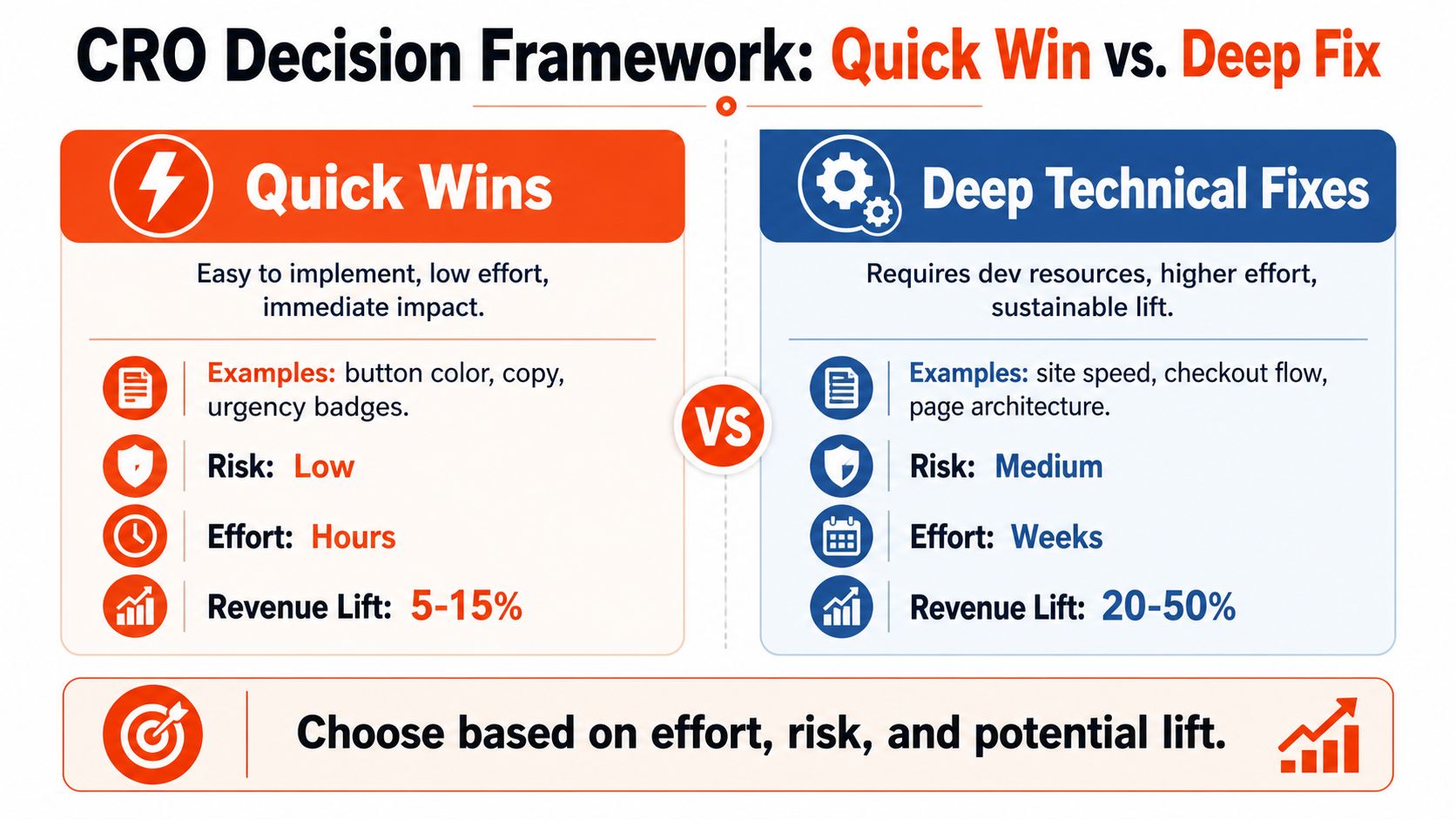
Not every CRO problem needs a rebuild, and not every issue can be solved with a button label. The right move depends on whether the friction is behavioral, structural, or technical. Teams that confuse those categories waste time on the wrong kind of work.
Quick wins help when the path is already sound
Quick wins are useful when the store already loads cleanly, the checkout works, and the main issue is clarity. That could mean tightening the hero message, moving the CTA closer to the value proposition, reducing distraction on a landing page, or clarifying shipping and returns language on a product page.
These changes are attractive because they're fast and low risk. They're also fragile if the underlying system is weak. A nice CTA won't fix a store that confuses buyers or slows them down.
Deep fixes matter when the structure is the problem
Deep technical fixes are the right choice when the problem lives in infrastructure, not persuasion. If app overhead is bloating the page, if the theme is hard to maintain, or if checkout logic is doing too much work, the team needs engineering time. Those projects take longer, but they create a cleaner base for every later test.
A practical way to decide is to ask where the friction shows up first. If users are seeing the page and not understanding it, start with UX. If they're waiting on the page, fighting layout shifts, or hitting app-related clutter, start with performance and architecture.
A simple decision rule for Shopify teams
Use this filter:
Choose quick wins when the issue is message clarity, visual hierarchy, or offer framing.
Choose deep fixes when the issue is speed, stability, checkout complexity, or technical debt.
Choose both when the storefront is usable but held back by avoidable friction and a weak implementation foundation.
That balance matters. Quick wins can create momentum, but deep fixes create durability. A mature roadmap uses both, in the right order, so the team isn't forced to keep re-solving the same bottleneck every quarter.
Building a Sustainable CRO Program for Long-Term Growth
The stores that keep improving don't treat CRO like a one-off audit. They build it into the operating rhythm of the business. That means a stable theme foundation, fewer unnecessary apps, a clear testing process, and enough technical discipline to keep experiments from fighting the platform.
I've seen this work best when teams define ownership early. Growth owns the hypothesis. Development owns implementation quality. Merchandising owns product framing. Leadership owns the trade-off between short-term lift and long-term maintainability. When those roles are clear, CRO becomes a compounding habit instead of a scramble before every campaign.
Presidio fits into that model as one option for teams that want a Shopify partner handling storefront builds, performance tuning, and ongoing optimization together. That matters because the same group that ships the theme should understand how to support the testing roadmap after launch.
What sustainable programs have in common
They don't add complexity unless the business needs it. They keep the stack lean, the analytics trustworthy, and the roadmap tied to revenue touchpoints. They also revisit decisions that were once “finished,” because storefronts drift as apps, campaigns, and merchandising strategies change.
The best programs are built to answer a simple question repeatedly: what's the next highest-value friction point, and what's the least messy way to remove it? That's the discipline behind CRO. It's not a stunt, and it's not a cosmetic exercise. It's the ongoing work of making a Shopify store easier to buy from, easier to run, and easier to improve.
If you want a Shopify storefront that converts better without piling on more technical debt, visit Presidio and start a conversation about CRO audits, performance tuning, and a testing roadmap built for your store's actual bottlenecks.

Jamie, Presidio’s Designer, leads the practice alongside Johnnie. With over 10 years of e-commerce experience, Jay is a Shopify expert, known for crafting innovative solutions that prevent tech debt.
Jaime
Senior Product Designer, 2020