Outrank AI

Your flagship promotion is ready, but the storefront team is still waiting for a safe deployment window. A loyalty widget needs a theme change, the merchandising team wants a new landing page, and the international team needs a different product journey. In a tightly connected Shopify Plus storefront, those requests can share the same theme code, release process, and set of dependencies.
That's the situation in which ecommerce directors usually start asking, what is headless commerce, and whether separating the storefront from Shopify's commerce engine will solve the problem. Headless can create more freedom, but it also changes how your team builds, integrates, monitors, and maintains the store. The decision isn't whether a custom frontend looks better. It's whether the business can justify a more demanding operating model.
Table of Contents
When a Monolithic Storefront Stops Scaling
A monolithic storefront can serve a brand well for years. The theme, content, checkout experience, apps, and commerce functions work together in one platform, which gives a lean team a familiar workflow. Problems emerge when every new experience must pass through that same shared structure.
A sale campaign may require promotional templates, merchandising rules, analytics tags, and a loyalty component. If all of those depend on one theme, a small change can affect unrelated pages. Developers have to coordinate releases, marketers wait for implementation, and product teams lose the ability to experiment on their own schedules.
The warning signs inside the release process
The architecture is usually under pressure before customers notice a dramatic failure. Look for operational symptoms such as:
Shared deployment windows: A checkout-adjacent change gets held back because another team is preparing a campaign.
Rigid templating: Designers can't create the experience they need without working around theme constraints.
App dependency buildup: Each new capability adds scripts, settings, and compatibility concerns to the storefront.
Framework limitations: The team can't use the frontend tools or rendering patterns that best fit the experience.
Channel duplication: A mobile app, kiosk, or other customer touchpoint needs separate presentation logic instead of reusing commerce data.
An international expansion can expose the same limits. Regional teams may need different navigation, content structures, merchandising logic, or buying journeys, while the existing theme assumes one universal storefront. The backend may already handle products, inventory, customers, and orders effectively, but the presentation layer becomes the bottleneck.
Practical rule: If the business problem is mainly slow pages, start with performance and theme optimization. If the problem is that teams can't independently create and operate several customer experiences, architecture deserves closer attention.
Headless commerce addresses that separation. It lets a custom frontend evolve independently while the commerce backend continues managing transactional responsibilities. The next question is what exactly gets separated, and what remains connected.
The Core Idea Behind Headless Commerce
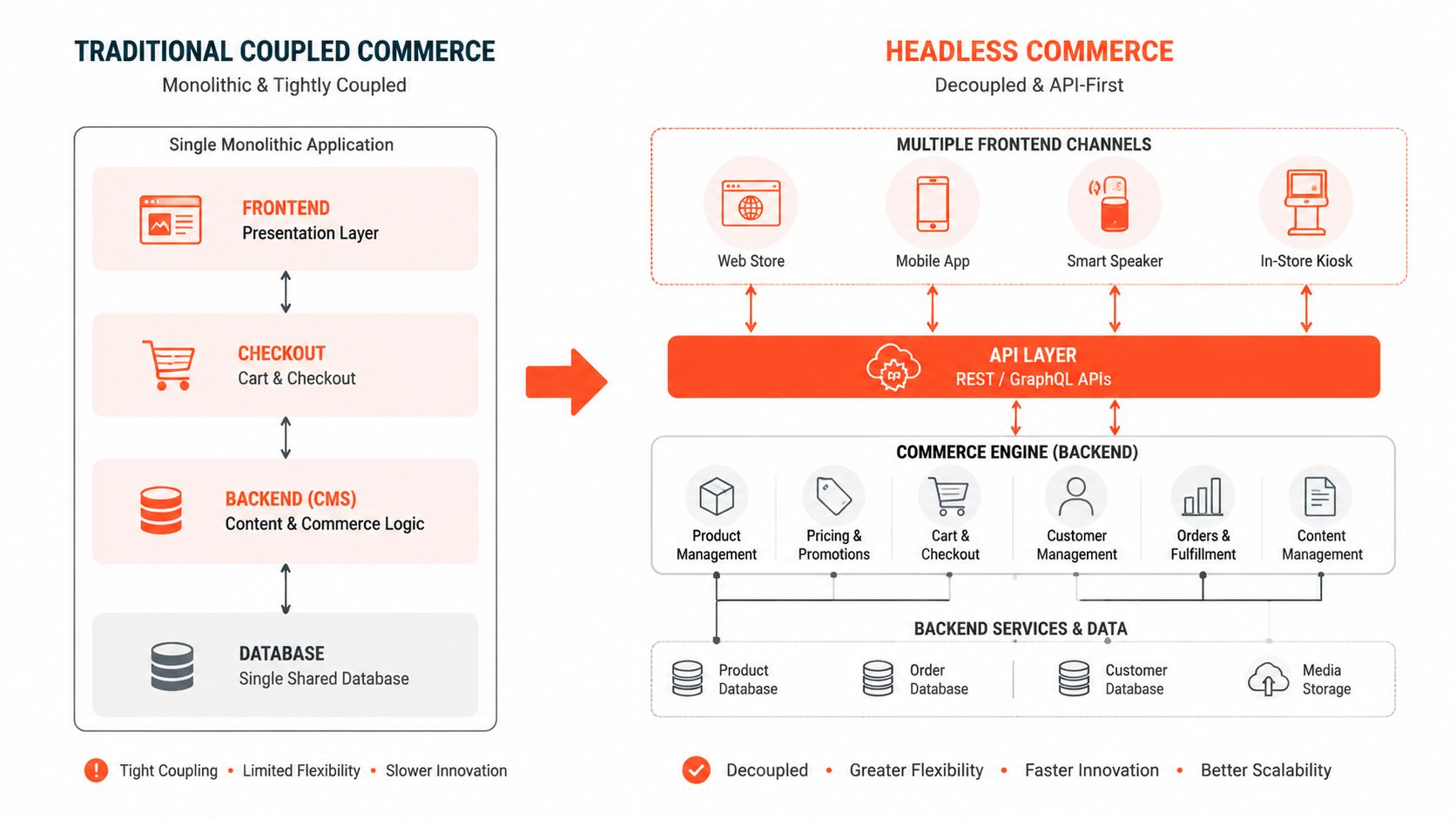
Start with the traditional model. A coupled commerce platform usually combines the storefront templates, content presentation, commerce logic, and backend data within one coordinated system. The platform renders the customer-facing pages while also managing products, carts, orders, inventory, and related business rules.
That arrangement reduces the number of boundaries your team has to manage. It can also make the frontend dependent on the platform's templates, theme conventions, and release process. A change to the customer experience may require changes inside the same system that handles critical commerce operations.
Headless commerce separates the presentation layer from the commerce backend. The frontend is the part shoppers see and interact with. The backend remains responsible for products, pricing, carts, checkout processes, customers, orders, and inventory. APIs carry the requests and responses between them.
A simple restaurant analogy
Think of the storefront as a restaurant menu and the commerce backend as the kitchen. The menu determines how dishes are presented, grouped, and described. The kitchen handles preparation, ingredients, orders, and fulfillment.
The API acts like the waiter. The menu sends a request for a product or cart action, the API takes that request to the kitchen, and the kitchen returns structured information. The frontend then decides how to display the result.
That separation means the same commerce backend can support different presentation layers, including:
A web storefront built with Next.js, Nuxt, or another modern framework.
A native mobile application.
An in-store kiosk.
A voice or connected-device experience.
A specialized landing page with its own interaction model.
The backend doesn't need to know whether a customer is viewing a product on a browser or through an application. It responds to authorized API requests, while each frontend delivers an experience designed for its channel.
Headless isn't the same as composable commerce. Headless describes the separation between frontend and backend. Composable commerce is a broader approach that assembles multiple specialized services, such as search, content, personalization, payments, and fulfillment. A store can be headless without replacing every service, and it can use composable components without adopting a fully custom frontend.
The API layer is therefore more important than the visual rebuild. If the contracts between systems are reliable, the architecture can support independent experiences. If they're poorly designed, headless distributes the same problems across more services.
How the API Layer Connects Everything
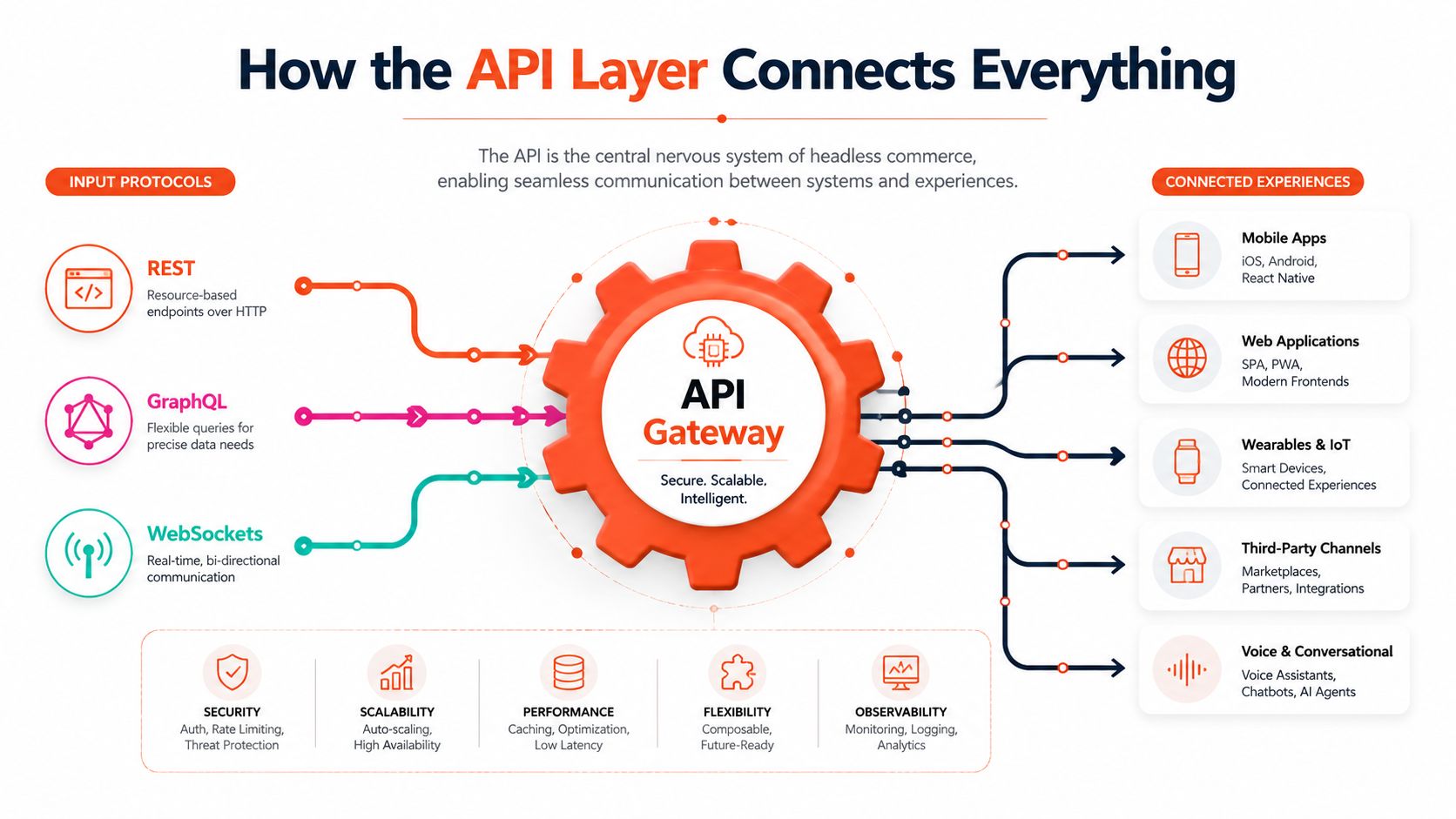
The API layer is the working surface of a headless system. The frontend doesn't reach directly into the commerce database. It sends an authorized request, receives structured data, and turns that response into a page or interaction.
A typical product page might request product details, pricing, availability, recommendations, and content. The commerce engine returns the data, often as JSON, and the frontend renders it using the chosen framework. A cart request follows a similar path, but it also needs session handling, validation, error states, and a secure route to checkout.
The protocols your team will manage
REST exposes resources and operations through predictable endpoints. It works well for straightforward requests, such as retrieving products or updating a cart.
GraphQL lets the frontend request the fields it needs. That can help a product page avoid receiving unnecessary data, although the team still has to design, secure, cache, and monitor the queries.
Webhooks support event-driven updates. An order status change, inventory event, or fulfillment update can notify another system without requiring that system to repeatedly ask whether anything changed.
The API layer also connects the commerce engine to services beyond the storefront. A headless stack may include a CMS, search platform, payment provider, tax service, ERP, order management system, customer data platform, and analytics tools. Each connection creates a contract that someone must own.
Architecture principle: The frontend can change independently only when the API contract remains deliberate, documented, versioned, and observable.
For example, an ERP integration may need to synchronize products, inventory, orders, and customer records. The business rules and failure paths deserve the same attention as the storefront itself. This Shopify and ERP integration guide covers the operational connection that commerce teams often underestimate.
A useful visual explanation of this request flow appears below.
API versioning matters because a backend change can affect several channels at once. Error handling matters because an unavailable recommendation service shouldn't necessarily prevent a shopper from buying. Webhook reliability matters because delayed inventory or order updates can create operational confusion.
Headless gives you architectural freedom, but the API layer determines whether that freedom remains dependable.
Headless vs Monolithic vs Hybrid Commerce
These architectures sit on a spectrum. Headless isn't automatically an upgrade, and a monolithic storefront isn't automatically outdated. The right choice depends on the customer experience you need and the operating capacity your team can sustain.
Factor | Monolithic | Headless | Hybrid |
|---|---|---|---|
Storefront flexibility | Uses the platform's theme and templating model | Uses an independently built frontend | Keeps the standard theme while customising selected journeys |
Release speed | Coordinated releases can slow independent work | Frontend teams can release separately, subject to API and governance controls | Speeds up targeted initiatives without changing the whole store |
Initial cost | Usually lower when requirements fit the platform | Higher because the team builds and operates another presentation layer | Sits between the two, depending on the custom surface |
Ongoing ownership | Fewer architectural boundaries | Requires frontend, API, infrastructure, and integration ownership | Limits custom ownership to selected experiences |
Integration burden | Integrations often live inside the platform or theme ecosystem | APIs create clear connections but more contracts to manage | Adds complexity only around the decoupled components |
Required skills | Theme development and platform knowledge may be enough | Requires broader frontend, backend, architecture, performance, and security skills | Needs specialist skills for the custom areas |
When the simpler model wins
A monolithic storefront can remain efficient for a stable catalog, a small number of customer touchpoints, and a team that values predictable maintenance. If the theme can support the brand experience and performance requirements, separating the frontend may add cost without solving a meaningful constraint.
Where headless earns its place
Headless fits brands that need multiple frontends to use one commerce backend, or that require an experience the standard theme structure can't support cleanly. It can also suit teams that release frontend experiences frequently and have the engineering capability to maintain API contracts and operational controls.
The middle path
Hybrid commerce keeps the standard theme for most of the store and introduces custom technology where the business case is strongest. A brand might retain a conventional collection experience while using a custom product configurator, editorial landing page, or application for a specific journey.
That approach reduces migration risk. It also gives the team a way to validate whether the custom experience creates enough value before committing to a complete storefront separation.
Documented Performance and Conversion Gains
Headless can improve performance when the team uses the separation to build a leaner frontend. Server-side rendering and static-site generation can deliver HTML efficiently, while caching, code splitting, modern image handling, and carefully designed APIs can reduce the work a browser must perform.
An industry source reports that headless storefronts often load 20% to 50% faster than the monoliths they replace, and associates a roughly 2% conversion lift with each 1-second load-time improvement. Those figures come from Elastic Path's headless commerce overview, so treat them as directional evidence rather than a guaranteed outcome for your store.
Other benchmark summaries report that Shopify Liquid to Hydrogen migrations delivered 40% to 60% faster LCP, 60% to 75% smaller JavaScript bundles, and 6% to 14% conversion-rate lifts. The figures appear in this headless commerce architecture analysis, and they shouldn't be presented as proof that architecture alone caused every improvement.
Match the architecture to the workload
The strongest opportunities usually appear where the storefront carries heavy frontend work. Mobile-first browsing, image-rich product pages, complex interactive merchandising, and markets with inconsistent connectivity can expose delays that a carefully designed frontend may reduce.
Area | Likely improvement | Measurement to track |
|---|---|---|
Initial rendering | Faster delivery through SSR, SSG, and caching | LCP, time to first byte, field performance |
Browser workload | Less client-side JavaScript and fewer blocking tasks | JavaScript bundle size, interaction timing, TTI |
Product discovery | More controlled page composition and search integration | Search engagement, product-page progression |
Checkout journey | Fewer frontend delays around cart and checkout handoff | Checkout completion and error rates |
Engineering delivery | Independent frontend experimentation | Lead time, release frequency, rollback incidents |
Performance isn't automatic. Third-party scripts, oversized media, slow APIs, excessive personalization, and poor cache invalidation can erase the advantage. A faster framework can't compensate for a storefront that requests too much data or waits on too many services.
Before migration, record mobile and desktop field data, Core Web Vitals, checkout completion, revenue per session, and development lead time. Afterward, compare the same segments and separate architecture effects from image compression, CDN changes, theme cleanup, or a redesigned purchase flow. The Shopify performance optimization guide provides a practical reference for improving the existing storefront before you decide that a full rebuild is necessary.
The Hidden Operating Costs Most Comparisons Skip
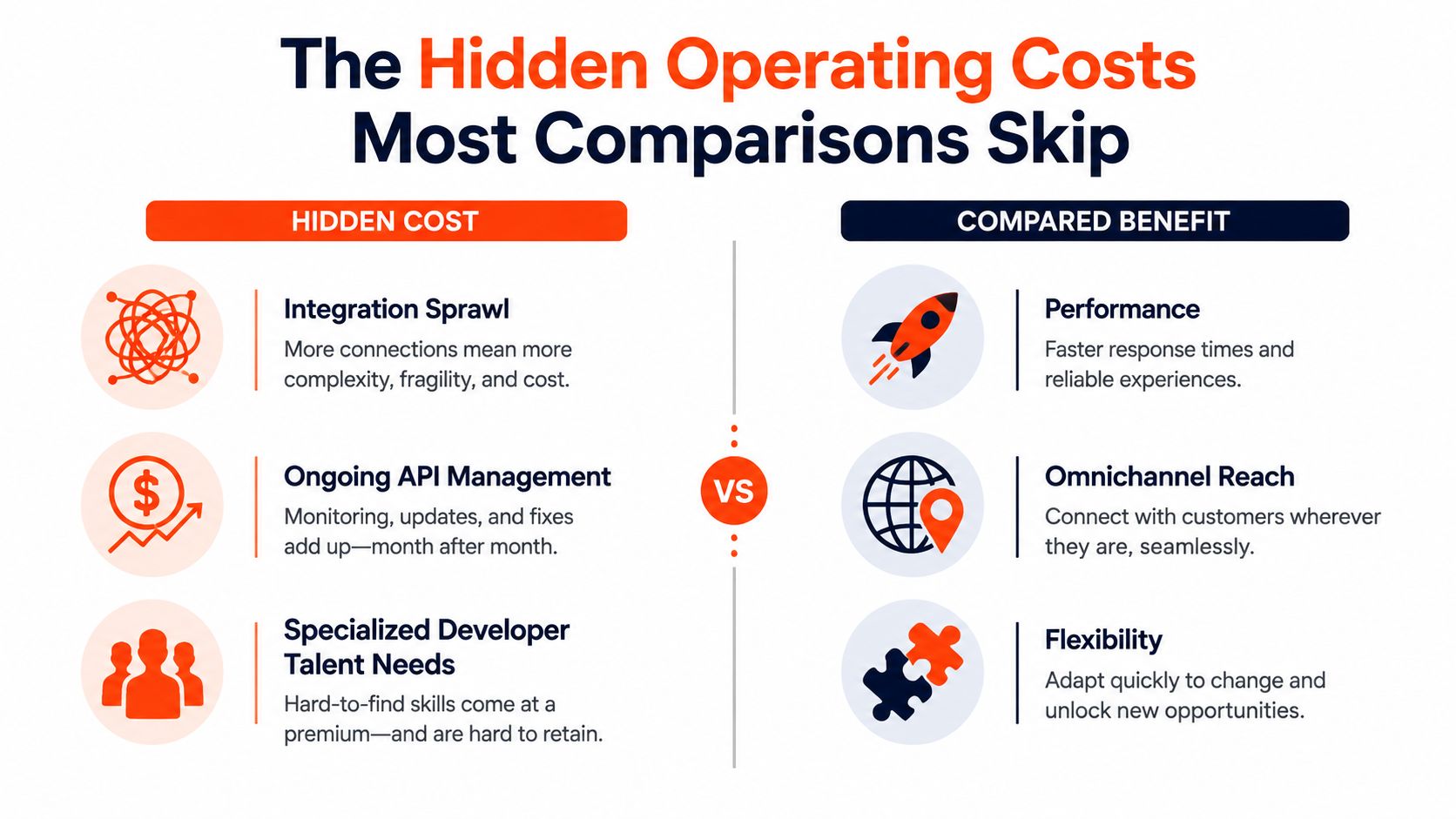
The hidden cost of headless isn't limited to the first frontend build. It's the permanent responsibility for the boundaries between systems.
Integration sprawl appears quickly. A brand may connect a CMS, search provider, personalization tool, analytics package, payment service, ERP, and order management platform. Each integration needs authentication, monitoring, version management, retry behavior, documentation, and a clear response when the connected service fails.
More boundaries mean more ownership
APIs reduce direct coupling, but they don't remove dependencies. They replace some platform constraints with contracts your team must design and protect.
Common responsibilities include:
Integration governance: Define which system owns each product, customer, inventory, and order field.
Failure handling: Decide what the shopper sees when search, recommendations, content, or a downstream service is unavailable.
Observability: Monitor API latency, error rates, webhook delivery, cache behavior, and frontend experience.
Security review: Protect credentials, customer data, payment flows, and privileged operations across every connection.
Regression coverage: Test storefront journeys whenever the frontend, API, platform, or integration changes.
Specialized talent is another factor. A theme-focused team may need support from frontend engineers, backend or platform engineers, solution architects, performance specialists, and security reviewers. Hiring or retaining those skills becomes part of the operating model, not a one-time project line.
Maintenance continues after launch. Framework upgrades, API changes, accessibility work, webhook reliability, cache invalidation, incident response, and browser testing all require recurring capacity. Vendor tooling can reduce assembly work, but it won't eliminate the need to understand how data moves through the stack.
Operating test: Before approving headless, name the owner, fallback, monitoring signal, and support process for every critical integration.
Build a total-cost model that includes licensing, implementation, staffing, hosting, observability, experimentation, support, and future channel work. Headless pays when faster experimentation, richer experiences, or additional channels produce more business value than that continuing operational premium.
When Going Headless Actually Makes Sense
Headless makes sense when storefront flexibility solves a defined commercial problem. “We want a modern architecture” isn't enough. The business should be able to identify the experience, channel, or release constraint that justifies the added ownership.
Four signals deserve serious consideration:
Major design replatforming: The brand needs a substantially different experience, international storefront structure, or product journey that the current theme and app model can't support cleanly.
Multichannel expansion: One commerce engine must serve a web store, mobile application, marketplace, in-store kiosk, or another interface without duplicating commerce data.
Extreme performance requirements: The business has field evidence that frontend delivery limits the customer journey, and it can measure whether a new architecture improves that constraint.
Engineering ownership: The organisation has internal developers or a dependable technical partner who can maintain APIs, integrations, infrastructure, testing, accessibility, and security.

Use a focused decision checklist
Ask whether the current architecture blocks a high-value initiative. Confirm that executive sponsors understand the ongoing cost, not just the launch budget. Establish who owns the frontend and API layer after launch, and define the metrics that will determine whether the investment worked.
A staged approach often reduces risk. Start with a new market, a high-value product page, an editorial commerce experience, or another bounded journey. Keep the existing storefront operating where it remains effective, then expand only when the new operating model proves manageable.
If the answer is “the theme feels limiting,” test theme extensions, app consolidation, performance work, or selective custom development first. Headless is valuable when it removes a material constraint, not when it adds technical novelty.
Headless as One Option in a Composable Stack
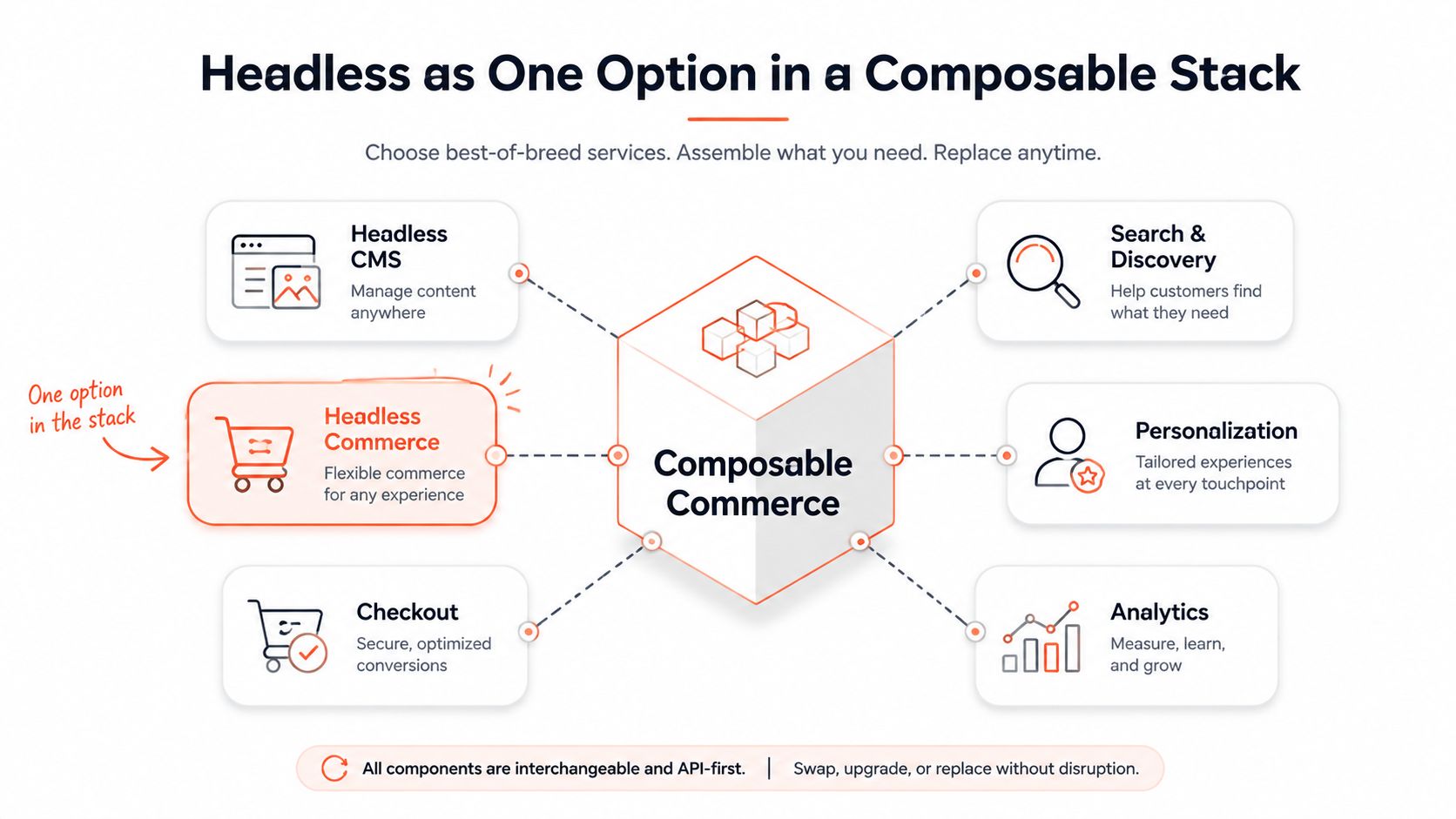
Headless commerce is one component of a broader composable strategy. A composable stack may combine a commerce engine with a headless CMS, search and discovery, personalization, checkout, payments, fulfillment, identity, and analytics services. APIs connect those capabilities, but the business doesn't have to replace every service at once.
A Shopify or Shopify Plus store can remain the system of record while the brand decouples only the presentation layer or introduces a specialised service where it adds value. Another brand may need a custom content system, regional storefronts, and advanced search. A growing merchant may need only a faster theme, better images, or a small number of targeted integrations.
The practical spectrum includes:
A coupled storefront with a standard theme.
A hybrid experience with selected custom surfaces.
A headless storefront using a shared commerce backend.
A broader composable stack with several independently operated services.
The right choice follows the constraint. Consider theme extensions, Shopify Functions, selective integrations, and app consolidation alongside a full headless rebuild. The guide to composable commerce can help place headless within that wider architectural model.
Headless commerce has moved beyond a specialist architecture. A survey reported that 92% of respondents had implemented a composable solution, while 96% said they were very or extremely familiar with composable commerce, as reported by Retail Dive and Elastic Path. Independent estimates place the global headless commerce market at about US$2.13 billion in 2026, with a projection of US$7.24 billion by 2033 at a 22.6% CAGR, according to the same verified market context.
That momentum doesn't make headless mandatory. It makes the decision more consequential. Choose the architecture your team can operate reliably, and require a clear business case before separating the storefront.
Presidio builds and supports Shopify and Shopify Plus themes, apps, integrations, and headless storefronts, with services spanning performance tuning, UX and CRO audits, ERP connectivity, accessibility improvements, and ongoing development. If you're evaluating headless commerce or a staged hybrid path, visit Presidio to discuss the customer experience, technical ownership, and operating model your brand needs.

Jamie, Presidio’s Designer, leads the practice alongside Johnnie. With over 10 years of e-commerce experience, Jay is a Shopify expert, known for crafting innovative solutions that prevent tech debt.
Jaime
Senior Product Designer, 2020