Outrank AI

64% of consumers prefer companies that tailor experiences to their wants and needs, while 53% are highly concerned about personal-data privacy. Personalization in marketing means tailoring messages, offers, and product discovery to what an individual customer has clearly shown they want, in exchange for using data responsibly and explaining the value clearly.
You've probably seen the problem in your own store. A customer buys from you, returns later, and gets the same homepage, the same product grid, and the same welcome message shown to someone who has never heard of your brand. The store has information that could make the next visit more useful, but it treats every shopper as a stranger.
Good personalization changes that interaction. It helps a returning visitor find a relevant product faster, receive a useful reminder instead of another generic promotion, or see recommendations shaped by preferences they willingly shared. Poor personalization feels like surveillance, especially when a brand uses sensitive or unexpected information without making the exchange clear.
Table of Contents
The Moment a Store Finally Noticed You
A shopper returns to a DTC store after buying from it twice. She knows the brand, likes the product, and has a reason to come back. Yet the homepage greets her with the same broad campaign she saw during her first visit, followed by products unrelated to her previous orders.
She has to search again. She has to dismiss products she already bought. She has to remember which size, formula, flavor, or bundle worked last time. Nothing is technically broken, but the store makes a loyal customer do unnecessary work.
Now change one part of the experience. The shopper's earlier quiz answers inform the collection she sees. Her previous order helps the store surface compatible products. A replenishment message appears at a sensible moment, without exposing private details or pretending the brand knows more than it does.
That second experience is personalization. The brand isn't just adding her name to an email. It's using relevant signals to make product discovery, content, timing, or offers more useful.
The practical distinction: Relevance feels like attention when the customer can understand it. It feels like surveillance when the brand's knowledge seems unexplained, excessive, or inaccurate.
Personalization, then, isn't a feature you switch on once. It's an experience design choice. Every recommendation, banner, email, and promotion answers the same question: should this customer see the same thing as everyone else, or is there a customer-approved reason to adapt it?
A Working Definition Without the Jargon
Personalization in marketing is the practice of using customer data to tailor communications, product recommendations, offers, and digital experiences to an individual or defined segment. Useful signals can include browsing behavior, purchase history, stated preferences, location, or demographic information.
A simple operating model has four parts:
Collect signals. Notice what a shopper has purchased, browsed, selected in a quiz, or explicitly told you.
Match the experience. Adjust product recommendations, merchandising, content, offers, or messaging.
Time the interaction. Deliver the message when it fits the shopper's situation, rather than sending every customer the same campaign.
Respect the boundary. Use information for a clear purpose and give customers meaningful control.
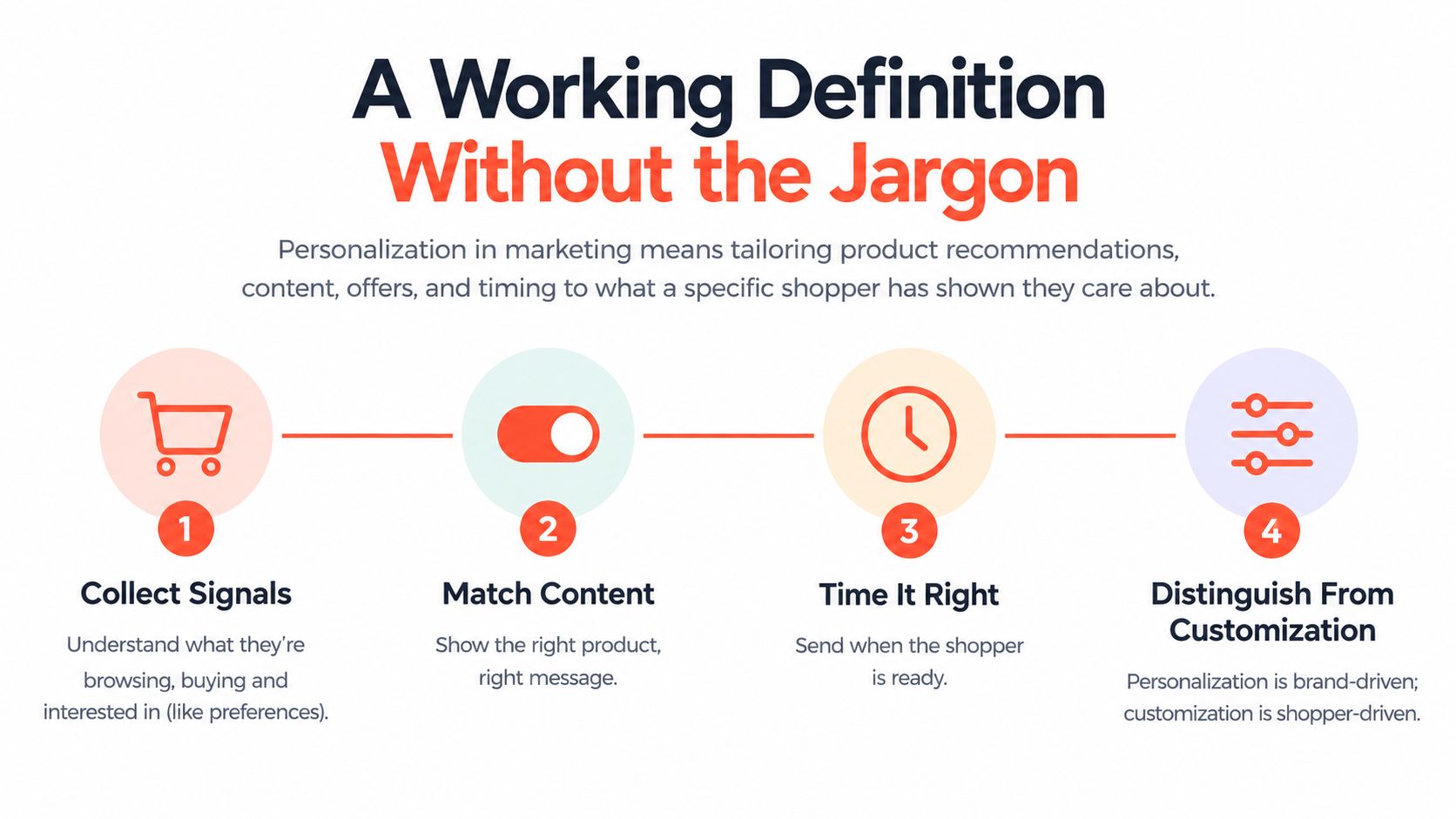
Personalization differs from customization. With customization, the shopper changes the experience herself, such as choosing a preferred currency, selecting a favorite color, or arranging a dashboard. With personalization, the brand adapts the experience based on information it has collected or the customer has shared.
It also differs from segmentation. Segmentation groups customers with common traits, such as location, lifecycle stage, or purchase behavior. Personalization can use those groups, but it aims to make the interaction more relevant to the individual or to a narrowly defined audience.
The method existed long before artificial intelligence. In 1961, marketer Lester Wunderman coined the term “direct marketing” and advanced individualized offers and loyalty programs. During the 1980s and early 1990s, database marketing expanded the use of customer records, response histories, and recency-frequency-monetary models to identify valuable customers and target outreach. The same logic later moved into CRM platforms, automation, real-time analytics, and on-site recommendation systems. (History of marketing and direct marketing)
For practical ideas about adapting website content and journeys, this resource on practical website personalization tips is a useful companion. The underlying principle remains simple: collect a relevant signal, make a useful change, and explain the value through the experience.
The Three Main Types and When to Use Each
A Shopify merchant doesn't need to begin with an elaborate one-to-one system. The right starting point depends on the signals already available, the complexity of the catalog, and the team's ability to maintain the experience.
Demographic personalization
This approach adapts the storefront based on who the shopper is or where they're located. A brand might show region-specific shipping information, local availability, or a banner for products suited to a particular climate.
The data can come from location, customer records, stated profile details, or account information. It's useful when geography materially changes the buying decision, but it can become crude when demographic assumptions replace actual preferences.
Behavioral personalization
Behavioral personalization responds to what someone has done. A visitor who viewed running shoes may see related products. A shopper who added a skincare product to the cart may receive a reminder or a complementary recommendation. An email subscriber who repeatedly clicks a category can enter a more relevant content flow.
This is often the most practical starting point for Shopify brands because the signals connect directly to shopping intent. The risk is repetition. Showing the same abandoned product too aggressively can make a helpful reminder feel like an ambush.
One-to-one personalization
One-to-one personalization combines identity, stated preferences, past orders, and current behavior. A returning subscriber might see a restock message for a specific product, alongside accessories that fit their previous purchase and content suited to their selected routine.
This path can create the most relevant experience, but it also demands stronger data quality, connected systems, clear consent, and disciplined measurement. It's a destination for mature teams, not a requirement for every store.
Type | Typical data sources | Example on Shopify | Best fit for |
|---|---|---|---|
Demographic | Location, account details, stated profile information | A regional shipping or product availability banner | Brands with meaningful geographic or audience differences |
Behavioral | Product views, cart activity, email clicks, purchase history | Recommendations based on recently viewed products | Most growing stores seeking a practical first use case |
One-to-one | Unified profile, quiz answers, orders, browsing, lifecycle status | A tailored product grid and replenishment journey for a returning customer | Brands with complex catalogs, repeat purchases, or mature data operations |
The useful question isn't “How advanced can we make this?” It's “Which signal gives this shopper a clearer next step without asking the team to maintain a system it can't trust?”
Why Ecommerce Teams Treat It as Foundational
Personalization matters because shoppers increasingly expect brands to recognize context. McKinsey found that 71% of consumers expected companies to provide personalized interactions, and 76% said they became frustrated when brands failed to do so. (McKinsey research on getting personalization right)
For a Shopify store, those expectations translate into ordinary merchandising decisions. A first-time visitor may need help understanding the range. A returning customer may need a faster route to replenishment, a compatible product, or a new category related to a known preference.

McKinsey also reported that 76% of consumers considered personalized communications important when initially choosing brands, while 78% said personalized content made them more likely to repurchase. Those findings point to two different commercial jobs:
Reduce choice friction: Use quizzes, category preferences, and behavioral recommendations to help shoppers find a suitable product.
Support retention: Use order history and lifecycle context to make replenishment, education, and cross-sell messages more relevant.
Improve merchandising: Put products with a stronger contextual fit in front of shoppers instead of relying on one universal product hierarchy.
Make loyalty useful: A points or rewards program can turn purchase history into a more relevant relationship. A guide to digital stamp and points cards can help clarify the mechanics before you design the experience.
McKinsey found that companies excelling at personalization generated 40% more revenue from personalization activities than average performers. The finding doesn't mean adding a recommendation block automatically creates that result. It suggests that strong execution connects customer understanding to product discovery, communications, offers, and measurement.
A store's search and merchandising experience matters here too. Product relevance starts before the email or homepage banner, so teams should examine search and discovery as part of the broader customer journey.
The business case is therefore more concrete than “customers like being understood.” Personalization can shorten discovery, give returning shoppers a reason to come back, and connect the right product to the right moment. It only earns those outcomes when the brand's assumptions are accurate and the customer accepts the data exchange.
Four Implementation Paths From Simple to Sophisticated
Personalization works best as a maturity ladder. Start with the smallest useful adaptation, then add complexity when the existing layer is reliable.
Rule-based segmentation
Begin with rules your team can explain. Show different content to new and returning visitors, adapt a banner by geography, or create an email path for customers who bought a particular category.
This needs basic customer and behavioral data. Maintenance is relatively light because a merchandiser can inspect each rule and understand why it fired.
Behavioral targeting
Next, respond to actions such as product views, cart additions, purchases, and email engagement. Shopify merchants can use triggered emails, related-product modules, and cart recovery journeys to make the next interaction more timely.
The maintenance burden grows because teams must manage frequency, exclusions, product availability, and message fatigue. A recommendation that ignores an out-of-stock product or continues after purchase quickly loses credibility.
Predictive product discovery
Quizzes offer a strong bridge between simple rules and predictive systems because they collect explicit signals. A shopper answers questions about goals, preferences, or constraints, and the store returns a more focused product set.
Tools such as Presidio's Quiz Kit can use quiz responses as zero-party data for personalized product recommendations and customer tagging. The team still needs to decide which questions earn their place, how answers map to products, and how to explain the recommendation.
For adjacent production needs, a resource on best video production companies can help teams evaluate creative support when personalized journeys require more product education.
One-to-one orchestration
At the advanced end, a store combines unified profiles, live intent, product data, and lifecycle context to change the experience in real time. Product grids may be re-ranked, email timing may adapt, and channels may suppress messages after a purchase or opt-out.
This approach needs stronger data governance, integration work, testing discipline, and ongoing optimization. Before investing in complex systems, review the available ecommerce personalization software and map each option to a specific customer problem.
A sensible roadmap looks like this:
Entry stage: Use clear rules and one or two high-value moments.
Growth stage: Add behavioral triggers and explicit preference capture.
Scale stage: Introduce predictive ranking only after data quality and measurement are dependable.
The technology should follow the quality of the decision. A simple rule that improves discovery is more valuable than an advanced model nobody can audit.
Where Relevance Crosses Into Creep
More data doesn't automatically create better personalization. It can create a more accurate experience, but it can also make shoppers wonder how much the brand knows and why it knows it.
A 2025 global study found that 64% of consumers prefer companies that tailor experiences to their wants and needs, yet 53% are highly concerned about personal-data privacy, and only 33% trust companies to use their information responsibly. (Qualtrics research on privacy and personalization)
Comfort varies by data type. Consumers are most comfortable with purchase history at 45% and website visits at 42%, but comfort falls to 12% for financial information, with social-media posts also viewed far less comfortably. The same research found the lowest average comfort in France and the highest in India, so a global brand shouldn't treat “the consumer” as one uniform audience.
A practical permission framework starts with signals customers understand:
Ask for purpose-specific information: A quiz can request preferences because the shopper receives better recommendations in return.
Prefer first-party signals: Use purchase history, website behavior, and stated choices before reaching for sensitive data.
Minimize collection: Don't ask for information merely because a platform makes it available.
Show control: Make preference settings, opt-outs, and communication choices easy to find.
Test the explanation: If the shopper wouldn't understand why you're asking, redesign the question or remove it.
The trust test: Would the shopper understand why you're asking for this information, and what they'll receive in return?
Personalization is a negotiated exchange. The customer grants access to a signal, and the brand owes a visible improvement in relevance without turning that permission into permanent observation.
Measuring Lift Without Fooling Yourself
A personalized experience can receive clicks because it targets shoppers who were already close to buying. That's why attributed revenue or click-through rate alone can't prove that personalization created incremental value.
Use a control wherever the experience allows it. Keep a holdout group on the standard product module while another group receives personalized recommendations. For a campaign, use a randomized A/B test so the difference between groups reflects the treatment rather than a pre-existing audience difference. Shopify teams can use Shopify A/B testing to structure experiments around a specific storefront or merchandising change.
Track a measurement stack rather than one attractive metric:
Incremental conversion: Compare the personalized group with the non-personalized control.
Profit and order value: Check margin and average order value, not just attributed sales.
Repeat purchase: See whether relevance supports another purchase over the customer lifecycle.
Negative signals: Monitor returns, unsubscribes, suppressions, opt-outs, and signs of message fatigue.
Permission outcomes: Record whether customers accept, adjust, or withdraw the data choices that power the experience.
The available evidence makes the caution important. An IAB study found that 79% of consumers in the United States felt more positive toward brands that customized advertising to their preferences, and more than 70% said they were willing to share data to support advertising. Yet a 2025 YouGov study found that only one in four Americans agreed personalized advertising helps them discover products they may want. (IAB consumer value exchange research)
The YouGov findings also reported that 52% named opt-out controls and 35% named minimal data collection as leading ways to increase comfort. A campaign can therefore perform well on a surface metric while weakening trust. Measure commercial lift and permission health together.
A Personalization Plan You Can Start This Week
Start with five decisions:
Which signals do you already collect? Audit orders, browsing, quiz answers, lifecycle status, and consent records.
Where is the biggest relevance gap? Pick one moment, such as product discovery, replenishment, or cart recovery.
What is the lightest useful intervention? Begin with a rule, segment, or explicit preference rather than a complex model.
How will you prove incremental value? Set up a holdout or randomized test before launch.
Would the experience feel fair if explained aloud? Review the data request, benefit, controls, and opt-out path.
Personalization isn't a launch-and-forget feature. It's a long-running negotiation between relevance and trust, and every iteration should make that exchange clearer.
Presidio helps Shopify and Shopify Plus brands improve product discovery through maintainable storefronts, custom ecommerce development, CRO, and tools such as Quiz Kit for personalized recommendations. Visit Presidio to discuss a personalization roadmap grounded in shopper signals, testing, and responsible data use.

Jamie, Presidio’s Designer, leads the practice alongside Johnnie. With over 10 years of e-commerce experience, Jay is a Shopify expert, known for crafting innovative solutions that prevent tech debt.
Jaime
Senior Product Designer, 2020